
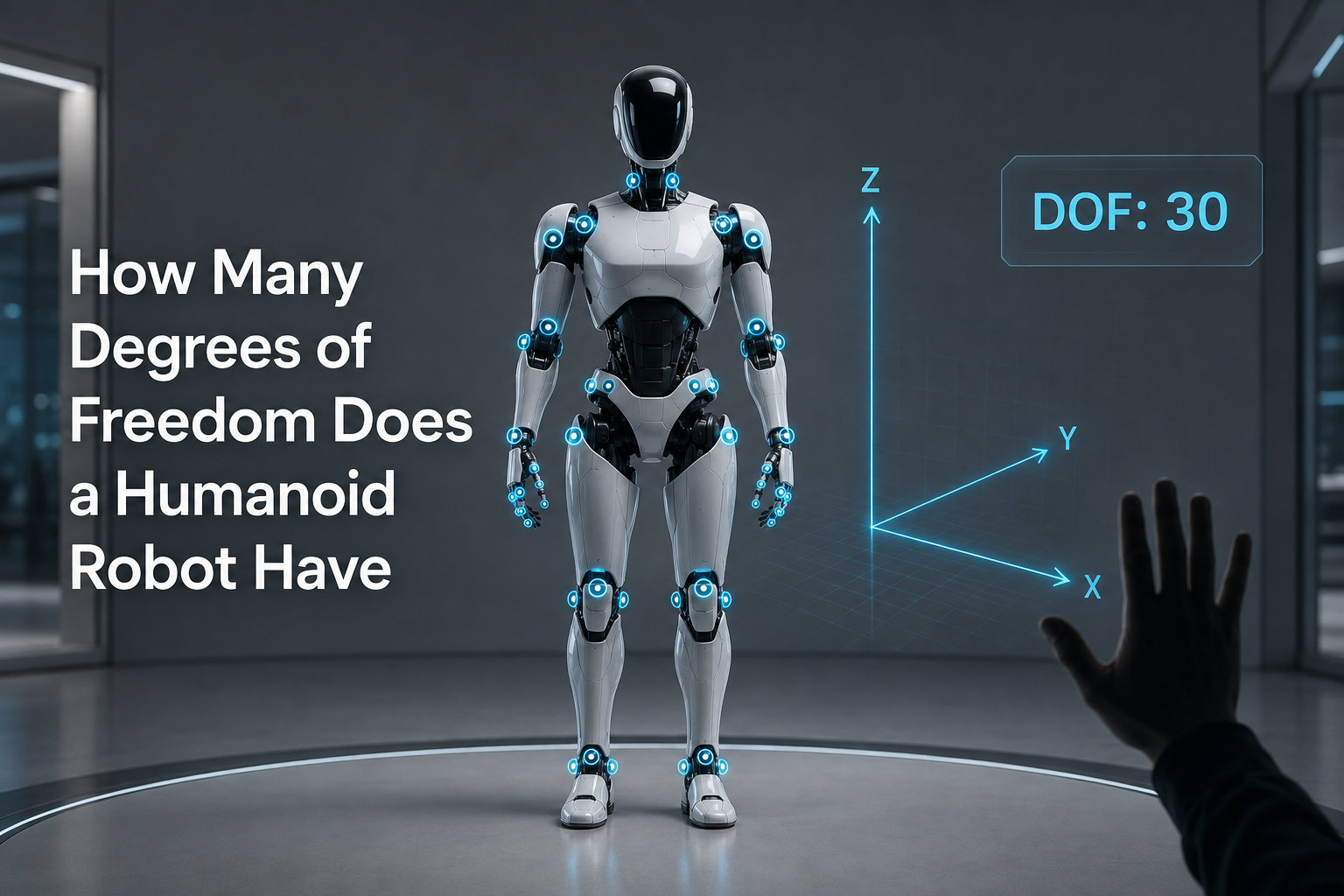
Most modern humanoid robots have between 28 and 56 degrees of freedom (DoF), with research platforms like Kengoro reaching as high as 174 DoF. The exact count depends on the design, but a typical full-body humanoid uses 6 DoF per leg, 7 DoF per arm, plus additional joints in the torso, neck, and hands to support walking, balance, and manipulation.
I have been tracking humanoid robot specs for years on Smashing Robotics, and the DoF question comes up more than almost any other technical detail. So I pulled together the latest data from Atlas, Optimus, Unitree G1, 1X NEO, Figure 02, ASIMO, and Kengoro to give you a complete answer.
Table of Contents
What Are Degrees of Freedom in Robotics
Degrees of freedom (DoF) in robotics is the number of independent movements a robot can make. Each movable joint or axis contributes one degree of freedom, so a robot with six joints can position and orient its end-effector in six independent ways.
In free space, any rigid body has a maximum of 6 DoF: three translational (movement along the X, Y, and Z axes) and three rotational (roll, pitch, and yaw). This is the foundation of degrees of freedom in robotics and explains why a basic industrial robot arm has exactly six axes.
DoF are created by joints, which come in two main types:
- Revolute joints rotate around an axis (like a knee or elbow).
- Prismatic joints slide linearly along an axis (like a telescoping rail).
Some humanoids also use spherical or continuous joints for human-like rotation. When a robot has more joints than the minimum needed for a task, those extra joints are called redundant DoF, and they help the robot reach around obstacles or find more natural postures.
How Many Degrees of Freedom Does a Humanoid Robot Have
A humanoid robot typically has between 28 and 56 degrees of freedom, with the most common full-body designs landing in the 30 to 40 DoF range. Commercial humanoids from Tesla, Figure, and 1X cluster around 28 to 35 DoF, while research platforms like Honda ASIMO and Boston Dynamics Atlas push past 50 DoF.
To put it in context, here is the standard breakdown used across the industry:
- Each leg: 6 DoF (hip pitch/roll/yaw, knee pitch, ankle pitch/roll)
- Each arm: 7 DoF (shoulder pitch/roll/yaw, elbow pitch, forearm roll, wrist pitch/yaw)
- Two legs + two arms: 26 DoF
- Torso and neck: 2 to 6 DoF
- Hands (optional, varies widely): 0 to 50 DoF
That baseline of 26 to 32 DoF covers most of the bodies in current production. Hands are where the count can climb fast. A 1X NEO hand alone adds 25 DoF, and Kengoro’s tendon-driven musculoskeletal design adds dozens more.
The total you will see in spec sheets is simply the sum of every actuated joint in the robot. If you want to understand how those joints work together to produce movement, the article on forward and inverse kinematics is the next logical read.
Degrees of Freedom Breakdown by Body Part
A humanoid’s DoF count is not random. Every joint serves a specific purpose, from walking on uneven ground to picking up a coffee cup. Here is how the DoF distribute across the body in a typical full-body humanoid.
| Body Part | Typical DoF | Function |
|---|---|---|
| Each leg (hip, knee, ankle) | 6 | Bipedal walking, balance, ground adaptation |
| Each arm (shoulder, elbow, wrist) | 7 | Reaching, lifting, manipulation |
| Torso/waist | 1 to 3 | Trunk rotation, reach extension |
| Neck | 2 to 3 | Head pan, tilt, sometimes roll |
| Each hand | 11 to 25 | Grasping, dexterous manipulation |
| Total (no hands) | 28 to 32 | Locomotion + basic manipulation |
| Total (with full hands) | 50 to 80+ | Human-like dexterity |
The 6 DoF per leg configuration is the most stable baseline for bipedal walking. The 7 DoF per arm configuration mirrors the human arm, which has 7 DoF from shoulder to wrist. Adding 1 to 3 DoF in the waist gives the robot a larger reach envelope without moving its feet.
Hands are where designs diverge most. A basic gripper adds 1 DoF (open/close), while a five-fingered anthropomorphic hand can add 20+ DoF per hand. We will dig into specific hand DoF in the comparison section below.
Specific Humanoid Robots and Their DoF Count
Here is a consolidated comparison of the major humanoid robots on the market or in research as of 2026, including their publicly stated DoF counts.
| Robot | Manufacturer | DoF | Notes |
|---|---|---|---|
| Atlas | Boston Dynamics | 56 | Hydraulic research platform, 28 in hands |
| Optimus (Gen 2) | Tesla | 28 | 22 DoF in each hand alone (44 total hands) |
| Unitree G1 | Unitree | 42 to 43 | Affordable research platform with optional 3-finger hands |
| 1X NEO | 1X Technologies | ~30 to 55 | 25 DoF per tendon-driven hand |
| Figure 02 | Figure AI | ~30 | Disclosed count is approximate |
| ASIMO | Honda | 57 | Retired research platform, benchmark for decades |
| Kengoro | University of Tokyo | 174 | Musculoskeletal, highest DoF humanoid ever built |
| T-HR3 | Toyota | 32 | Remote-controlled humanoid with torque-servo modules |
| HRP-4 | AIST | 34 | Slender research humanoid from Japan |
| Robonaut 2 | NASA | 42 | Upper-body only, designed for space tasks |
You can see the spread clearly. Tesla Optimus and Figure 02 aim for the lower end to keep mass and cost down, while Boston Dynamics Atlas and Honda ASIMO push the upper end for maximum dexterity. Kengoro is the outlier at 174 DoF because it replicates the human musculoskeletal system with tendon-driven actuators rather than position-controlled motors.
If you are benchmarking humanoids for your own research or build, also consider the actuator technology behind each DoF. Our guide to robot actuators covers how series elastic, harmonic drive, and quasi-direct drive designs change what those DoF can actually do under load.
Why Humanoids Need So Many Degrees of Freedom
Humanoid robots need so many DoF because they are built to operate in human environments using human tools. Three forces drive the count up: bipedal locomotion, manipulation, and balance.
Bipedal Locomotion Demands 6 DoF Per Leg
Walking on two legs requires the foot to adapt to uneven ground in 6 independent ways (forward/back, side-to-side, up/down, plus three rotations). A robot with fewer than 6 DoF per leg will struggle on stairs, slopes, or rocky terrain. That is why even lower-cost humanoids like Unitree G1 keep all 6 per leg.
Manipulation Needs 7 DoF Per Arm
The human arm has 7 DoF from shoulder to wrist, and that is the minimum for reaching around obstacles to grasp an object. A 6 DoF arm can position and orient a tool, but a 7 DoF arm can also choose its elbow-up or elbow-down configuration, which is what lets us reach behind a box.
Balance Requires Active Torso Control
When a humanoid lifts a heavy object, its torso must counter-rotate to keep the center of mass over the feet. Adding 1 to 3 DoF at the waist gives the robot the freedom to lean, twist, and recover without falling. Atlas uses 3 DoF in the torso, and Optimus uses 2.
Hands and Dexterity Are the Frontier
For tasks that involve fine manipulation (turning a screw, picking up a coin, opening a door), the hand itself becomes the bottleneck. Most production humanoids ship with simple parallel grippers that add only 1 DoF per hand, but the new generation of anthropomorphic hands from Tesla and 1X add 22 to 25 DoF per hand to close the dexterity gap with humans.
What Is the Robot With the Most Degrees of Freedom
The humanoid robot with the most degrees of freedom is Kengoro, a musculoskeletal robot from the University of Tokyo, with 174 DoF. Kengoro mimics the human body’s bones, joints, and muscles using tendon-driven actuators, and it can perform motions like push-ups and backflips that position-controlled humanoids struggle with.
Outside of humanoids, the DoF count climbs even higher. Some multi-arm manipulation platforms exceed 100 DoF, and soft robotic systems built from continuous materials can have effectively infinite DoF in their deformation. But for a single humanoid body, Kengoro holds the record.
It is worth noting that Kengoro’s 174 DoF is enabled by sharing actuators across multiple joints (just like human muscles pull on multiple bones). This makes the count higher than the number of independent motors, but the joints are still independently controllable in most configurations.
How Does Human DoF Compare to Robot DoF
The human body has more than 200 skeletal degrees of freedom, but only about 80 of them are actively controlled by muscles. The rest are passive joints (like the small articulations in your spine) that move in response to neighboring joints rather than under direct muscular control.
When you compare that to a humanoid robot, the picture is interesting:
- Human active DoF: ~80
- Human passive DoF: 120+
- Atlas (most DoF commercial humanoid): 56
- Kengoro (research): 174
So even the most DoF-rich humanoids fall well short of the human body’s total articulation. The human hand alone has 24 DoF, while the most advanced humanoid hands top out around 25 (1X NEO) and 22 (Tesla Optimus). That is the closest match in the entire body, and it took decades of mechanical engineering to get there.
The big difference is in the spine, feet, and face. Humans have dozens of small joints in the spine that give us fluid bending and twisting. Most humanoids have a rigid torso with 1 to 3 DoF, and the feet are usually simple flat plates rather than the 30+ passive joints a human foot uses for balance.
Do More Degrees of Freedom Mean a Better Robot
More degrees of freedom do not automatically mean a better humanoid robot. Extra DoF add mechanical cost, weight, control complexity, and energy consumption, and the benefit only shows up when the robot is doing tasks that actually require those joints.
Here is how the trade-off plays out in practice.
Benefits of Higher DoF
More DoF means the robot can reach more positions, avoid obstacles, and assume more natural postures. A 7 DoF arm can keep its end-effector pointed at a fixed target while the elbow moves out of the way, something a 6 DoF arm cannot do. Hands with 20+ DoF can perform in-hand manipulation, like reorienting a screw without putting it down.
Costs of Higher DoF
Each DoF is another motor, another gearbox, another encoder, and another joint to control. Doubling the DoF roughly doubles the actuator cost and the inverse kinematics computation time. It also introduces more kinematic singularities (configurations where the robot loses a degree of control) and makes the robot harder to balance because the controller has to track more state.
The Practical Sweet Spot
For most factory and warehouse tasks, 28 to 35 DoF is enough. Walking plus pick-and-place does not need a 7 DoF arm or a 25 DoF hand. The frontier where high DoF matters is in-home service, healthcare, and complex manipulation (folding laundry, cooking, assembly). That is where you will see humanoid DoF counts climb over the next few years.
Recent Advances in Humanoid Robot DoF
The humanoid DoF landscape has shifted noticeably in 2026 and the year prior. Three trends stand out: tendon-driven hands, electric actuators replacing hydraulics, and AI-managed whole-body control.
Tesla Optimus Gen 2 brought 22 DoF per hand to a commercial humanoid for the first time, putting hand dexterity on par with research platforms. 1X NEO followed with 25 DoF per hand using a tendon-driven design that mimics the human finger’s muscle routing.
Boston Dynamics retired the hydraulic Atlas and unveiled an all-electric version with 56 DoF, the same total as the hydraulic model but with quieter operation and smoother force control. Unitree released the G1 at a price point that put a 42 DoF humanoid within reach of university labs and hobbyists.
On the software side, Google’s Gemini Robotics 2 demonstrated whole-body control across 50+ DoF using vision-language-action models. Instead of programming each joint, developers can now issue high-level commands like “pick up the mug” and the model handles the joint coordination. This is one of the most important advances for high-DoF humanoids because the control problem was historically the limiting factor.
How Do AI Models Control All Those Degrees of Freedom
AI models control high-DoF humanoids through learned policies that map sensory inputs directly to joint commands, bypassing the traditional stack of inverse kinematics and trajectory planning. This is what makes a 56 DoF Atlas or a 42 DoF Unitree G1 practical to operate, where older control methods would have required hours of manual tuning per task.
The traditional approach is to write a controller for each joint, then chain them together with inverse kinematics to reach a target pose. That works fine for 6 DoF industrial arms, but breaks down around 20 to 30 DoF because the math explodes and singularities multiply.
Modern humanoid control uses three layers:
- High-level policy: A vision-language model (like Gemini Robotics 2) interprets the task and produces a target end-effector trajectory.
- Mid-level whole-body controller: A learned model distributes the trajectory across all joints, using null-space motion to keep the robot balanced while it reaches.
- Low-level joint controller: Each motor executes the commanded torque or position at 1 kHz or higher.
What this means in practice is that a 56 DoF humanoid in 2026 is easier to operate than a 30 DoF humanoid from 2020, because the AI layer absorbs the control complexity. If you are curious about the math underneath, our article on forward and inverse kinematics explains the classical approach that the AI is now replacing in production systems.
Reddit users in r/robotics and r/OpenSourceHumanoids have noted that singularity problems and inverse kinematics solve times become serious bottlenecks above 23 DoF for hand-built platforms. Community-built 16 DoF humanoids remain the most accessible research configuration, but the new generation of off-the-shelf humanoids plus open AI policies is closing the gap fast.
Frequently Asked Questions
What is the degree of freedom of a robot?
A degree of freedom (DoF) is one independent movement a robot can make. Each movable joint or axis adds one DoF. A rigid body in free space has a maximum of 6 DoF: three translational (X, Y, Z) and three rotational (roll, pitch, yaw).
What robot has the most degrees of freedom?
Kengoro, a musculoskeletal humanoid from the University of Tokyo, holds the record for the most DoF in a humanoid at 174. It mimics the human body with tendon-driven actuators and can perform push-ups, squats, and even backflips.
What are 7 degrees of freedom?
7 degrees of freedom means the robot can move in 7 independent ways. In a humanoid arm, 7 DoF typically means shoulder pitch, shoulder roll, shoulder yaw, elbow pitch, forearm roll, wrist pitch, and wrist yaw, which matches the human arm’s range of motion.
How many degrees of freedom does a robot wrist have?
A humanoid robot wrist typically has 2 to 3 DoF: pitch, yaw, and sometimes roll. Industrial robot wrists also have 3 DoF to fully orient an end-effector in 3D space. The wrist is usually the last segment before the gripper or tool.
How many degrees of freedom does a Cartesian robot have?
A Cartesian robot has 3 degrees of freedom, one for each linear axis (X, Y, Z). It cannot rotate, so it is limited to pick-and-place tasks. Adding a wrist adds 3 more DoF for a total of 6, which is the most common configuration for a Cartesian gantry.
How does humanoid robot DoF compare to human DoF?
The human body has more than 200 skeletal degrees of freedom, but only about 80 are actively controlled by muscles. Most humanoids have 28 to 56 DoF, with the closest match to humans in the hands (24 human vs 22-25 in the latest humanoid hands).
Key Takeaways
Here is the short version if you only have 30 seconds.
- Most humanoids have 28-56 DoF. Commercial designs cluster around 28-35; research platforms push to 56+.
- Kengoro holds the record at 174 DoF. No other humanoid comes close.
- 6 DoF per leg and 7 DoF per arm is the standard baseline. That gives 26 DoF for the limbs alone.
- Hands are the new frontier. Tesla 22, 1X NEO 25, and the human hand 24 DoF are all in the same range now.
- More DoF is not always better. Extra joints add cost, weight, and control complexity.
- AI is what makes high-DoF humanoids practical. Models like Gemini Robotics 2 handle whole-body control across 50+ DoF.
Conclusion
A typical humanoid robot has between 28 and 56 degrees of freedom, with the breakdown usually being 6 per leg, 7 per arm, and additional joints in the torso, neck, and hands. Research platforms like Kengoro push the count far higher by replicating the human musculoskeletal system, but most production humanoids stay in the 28-35 range to balance capability against cost and control complexity.
If you are working on a humanoid project, start by listing the tasks you need it to perform, then count up the minimum DoF for each task. For most research and demonstration work, 28 to 35 DoF is plenty. If you want to know how humanoid robots work beyond just DoF, our 2026 guide covers sensors, control, and learning systems in more depth.
The DoF count will keep climbing as hands and spines get more articulated, but the more interesting story is the AI layer that makes those extra joints actually useful. That is where the next generation of humanoid capability will come from.