
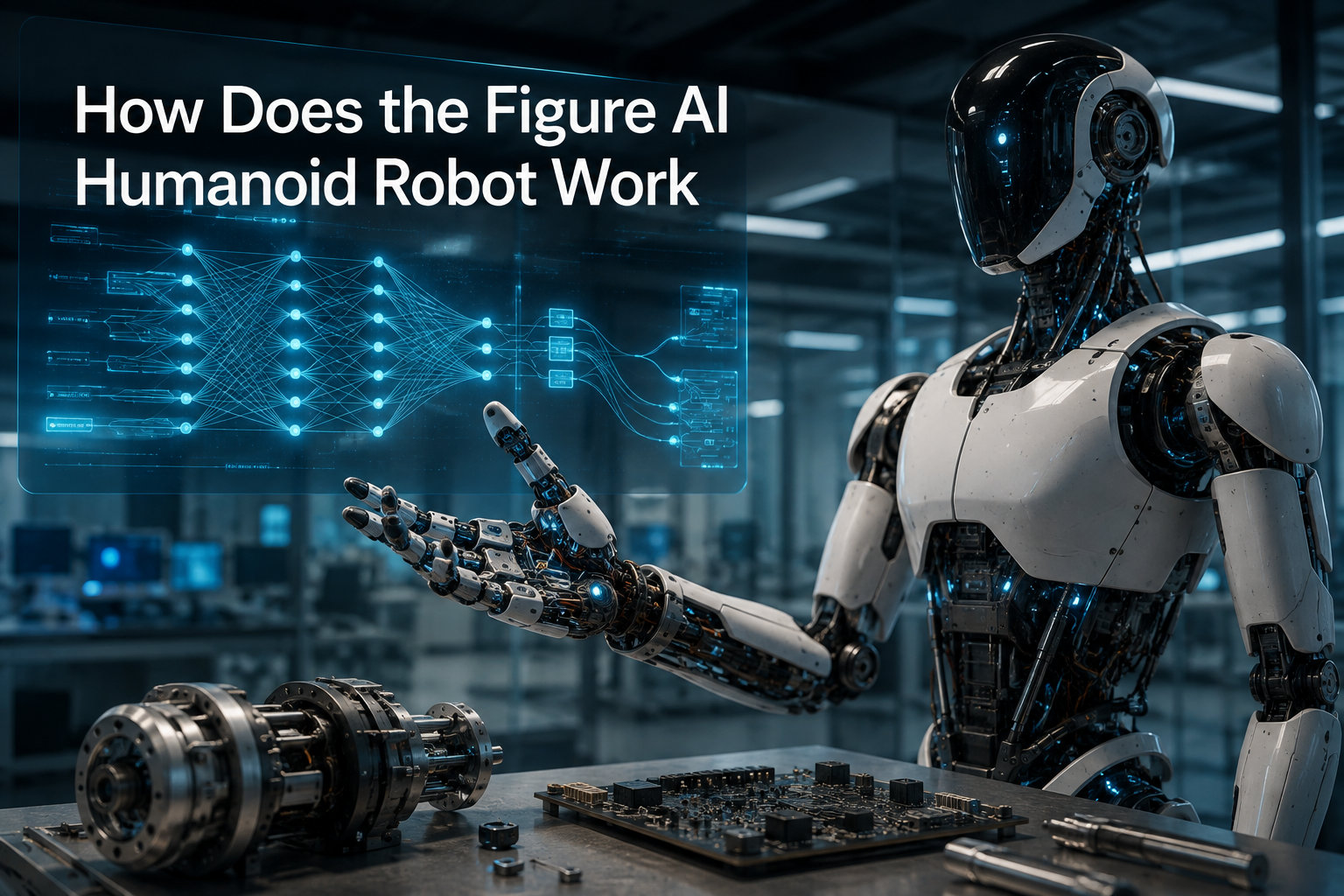
I’ve been following humanoid robotics closely for years, but the Figure AI humanoid robot is the first platform where I can explain the entire system, from the silicon in its head to the fingertips on its hands, in a single answer. In this guide I’ll walk you through how Figure AI’s robot actually works: the Helix AI brain, the cameras and tactile sensors, the actuators that move the limbs, the onboard compute, and the real-world demonstrations that prove the system runs without a human in the loop.
The Figure AI humanoid robot is a 5’8″ general-purpose robot built by Figure, a San Jose-based robotics company founded by Brett Adcock in 2026. What makes it different from a traditional industrial robot is that it is designed to operate in environments built for humans, using the same tools, the same doorways, and the same objects, and to do so with no custom programming. According to the company, more than 350 Figure robots have been deployed, mostly into commercial pilots such as the BMW manufacturing line. The company itself is privately held, recently valued at roughly $39 billion, with backing from Microsoft, OpenAI, Nvidia, and Jeff Bezos.
If you want a broader look at where this robot fits in the wider industry, the humanoid robotics industry overview at Smashing Robotics is a useful starting point. In the rest of this article I’ll focus on the engineering: how Figure’s robot perceives the world, decides what to do, and moves its body to actually get work done.
Table of Contents
What Is the Figure AI Humanoid Robot?
The Figure AI humanoid robot is a bipedal, human-shaped robot designed to perform general-purpose tasks. Figure has released three generations so far: Figure 01, Figure 02, and Figure 03. Each generation has improved the hardware, the AI, and the ability to operate autonomously in unstructured spaces.
Figure 03, the current model announced in October 2026, is roughly 5’8″ tall, weighs about 24 kg, has a 20 kg payload capacity, runs for about 2 hours per battery, and walks at up to 0.5 m/s. Those numbers matter because they put the robot squarely in human-scaled territory. It can reach countertops, open doors, sit at a table, and stand next to a person without forcing the environment to be redesigned around it.
The single most important thing to understand about how Figure AI’s humanoid robot works is that it is not a collection of pre-programmed routines. There is no script for “fold a shirt” or “load a dishwasher.” The robot is controlled end-to-end by a neural network called Helix that maps raw sensor input directly to motor commands in real time.
From Figure 01 to Figure 03: The Evolution of the Platform
Figure has shipped a new robot generation roughly every one to two years, and each version has re-architected the same basic system: perception, reasoning, and action. Looking at the three generations side by side makes the progress easier to see.
Figure 01 was Figure’s first working prototype, focused on validating the bipedal platform and basic manipulation. It had roughly 50 degrees of freedom, a basic camera-based perception stack, and was used primarily in controlled lab environments and early teleoperation pilots. The first round of public demos in early 2026 was driven by an OpenAI-trained language model, with the robot largely operating under teleoperation rather than full autonomy.
Figure 02 introduced onboard Helix compute, a refined 60-degree-of-freedom mechanical design, and the first deployments at BMW’s Spartanburg factory. It was the first generation designed to run for full shifts in industrial settings, with the inference engine sitting on the robot itself rather than in a remote data center. BMW reportedly became Figure’s first commercial customer, with robots performing sheet-metal handling and sub-assembly tasks in a live production environment.
Figure 03 is the current generation and the one that really demonstrates how Figure AI’s humanoid robot works at scale. It has higher-resolution RGB cameras, dedicated tactile sensors on every fingertip, a redesigned inductive charging dock, soft-material covering on the limbs for safer human contact, and a more efficient Helix model running on updated onboard GPUs. The third-generation robot is the one being produced at the BotQ factory at a rate of roughly one robot per hour, and the one that has performed the headline-grabbing autonomous tasks like sorting packages for hundreds of hours without intervention.
How the Helix AI System Works
Helix is the AI system that gives Figure’s humanoid robot its autonomy. It is a Vision-Language-Action model, often shortened to VLA. Understanding how a VLA works is the key to understanding how the entire robot works.
A VLA model combines three things that used to be separate AI systems. The “vision” part processes the live camera feeds and understands what the robot is looking at. The “language” part lets the robot understand natural language instructions and reason about tasks in words. The “action” part converts all of that understanding into motor commands that drive the arms, hands, torso, and legs. Helix is described as an end-to-end model, meaning sensor inputs go in one side and motor commands come out the other side, with no hand-written control rules in between.
What makes Helix different from a typical industrial robot controller is that it does not require task-specific programming. A traditional robot arm is given a list of waypoints and joint angles. Helix is given a stream of pixels from the cameras, a stream of audio from the microphones, and an optional natural language prompt like “sort the packages by size.” From that, it generates the joint trajectories for the whole body in real time. If a package is in a slightly different position than the training set, Helix still works because it learned the concept of “package” and “size,” not a specific set of coordinates.
Helix also runs entirely onboard. The model is small enough to fit on the GPU hardware mounted inside the robot’s torso, which means the robot does not depend on a stable cloud connection. Latency between perception and action is measured in tens of milliseconds, which matters when you are closing a gripper around a soft object or stepping over a cable on the floor. For a deeper look at the infrastructure side of training and deploying these models, Smashing Robotics has a good primer on physical AI infrastructure for robotics.
Helix has two main variants. System 1 is the fast, reflexive controller that runs at high frame rate and handles low-level motor control. System 2 is the slower, reasoning layer that plans multi-step tasks and interprets language. Both share a common visual encoder, which is what allows the robot to “think” and “react” using the same representation of the world.
Inside the Perception-Reasoning-Action Loop
Every autonomous action the Figure AI humanoid robot takes goes through the same closed loop. This is the core of how the robot works in practice.
Step 1: Perception
The robot continuously reads data from its sensor suite: six or more RGB cameras mounted in the head and torso, depth sensors, IMUs for balance, joint encoders, and tactile sensor arrays on the fingertips and palms. The cameras run at 30 Hz or higher, with a combined field of view wide enough to cover the robot’s whole working area without needing to rotate the head constantly. The tactile sensors measure pressure, slip, and contact geometry at sub-centimeter resolution, which is what lets the robot handle everything from a wine glass to a 20 kg payload.
Step 2: Reasoning
Helix’s language-and-planning layer fuses those sensor streams into a world model. It identifies objects, tracks their poses over time, predicts what is likely to happen next (a box tipping, a door swinging shut, a person stepping into the workspace), and decides which sub-task to attempt. The reasoning layer also listens for speech input and can accept natural language instructions from a human operator, like “pick up the blue package on the left and place it in the bin marked Medium.”
Step 3: Action
The action layer converts the plan into joint trajectories for the robot’s 60 degrees of freedom. The output is not a single position but a continuous stream of motor commands. Every few milliseconds the robot re-runs the entire loop, which means it can correct mid-movement if a package slips, a hand misses a target, or the environment changes unexpectedly. This continuous loop is what people mean when they describe Figure 03 as having “full-body autonomy.”
Because the loop runs onboard, the same robot can move from a BMW production cell to a home kitchen without any code changes. The hardware is the same, the AI is the same, only the camera feed and the objects in view are different.
Figure 03 Hardware: Sensors, Actuators, and Power
The software is only half of how the Figure AI humanoid robot works. The hardware is purpose-built to support a VLA model running in real time.
Sensors
Figure 03 uses a dense array of high-frame-rate RGB cameras placed around the head and chest, providing overlapping fields of view so the robot always has at least one unobstructed view of the workspace. Tactile sensors on the fingertips, similar in principle to GelSight-style sensors, give the robot a sense of touch comparable to a human hand covered in pressure-sensitive skin. IMUs, force-torque sensors at the wrists and ankles, and joint encoders complete the picture and feed the balance controller.
Actuators and Degrees of Freedom
The robot has about 60 degrees of freedom, distributed across the neck, shoulders, elbows, wrists, fingers, torso, hips, knees, and ankles. The hand alone has roughly 16 degrees of freedom, which is what makes dexterous tasks like folding a towel or opening a clamshell container possible. Custom electric motor and harmonic-drive actuator modules sit at each joint, balancing torque, speed, and back-drivability so the robot can be safely touched and pushed without becoming rigid.
Onboard Compute
Inside the torso, Figure 03 carries a multi-GPU inference engine. The compute is tuned for low-latency inference of the Helix models, with power and thermal budgets designed for continuous operation during an 8-hour shift. Because the VLA model fits entirely on the robot, there is no round-trip to a data center, and the robot keeps working even if the facility’s Wi-Fi goes down.
Power and Charging
Figure 03 runs for about 2 hours on a single battery and recharges through an inductive dock. The robot drives itself to the dock, aligns automatically, and tops up without human intervention, which is what makes continuous 8-hour shifts possible through a relay of charging cycles. For comparison with the broader battery landscape in robotics, the Smashing Robotics guide on robot battery technologies covers the tradeoffs between LiPo, NiMH, and Li-Ion options.
Real-World Applications and Demonstrations
The way Figure AI’s humanoid robot works in the lab is one thing. The way it works in real settings is what really matters.
At BMW’s Spartanburg plant, Figure 02 robots have been performing sheet-metal handling and parts placement in a live production environment. BMW reports that the robots have inserted sheet-metal parts with a success rate that meets production quality standards and have worked alongside human operators without cages in some cells. The point of the BMW pilot is not just to show that the robot can do the work, but to show that it can do the work without being surrounded by safety infrastructure.
Figure 03 has been shown sorting packages in logistics settings for sustained periods, including a 200-hour autonomous test in which the robot achieved 98.5% of human sorting efficiency. The robot has also been demonstrated folding laundry, loading and unloading a dishwasher, operating a coffee machine, climbing a ladder, and moving through an unfamiliar home environment while speaking with a human. Each of these tasks would have required a custom script in any earlier humanoid platform, but Helix handles them with a single model and a single inference loop.
Beyond the headline demos, Figure has run 8-day continuous livestreams where the robot performs household tasks on camera with no teleoperation, and an 8-hour shift comparison with a human intern that the company uses to benchmark real-world throughput. The intern and the robot ran the same sorting workflow head-to-head, and while the human was still faster overall, the gap was small enough to support the company’s claim that general-purpose humanoids are approaching economically useful performance in structured industrial settings.
How Figure Robots Learn New Tasks
One of the most common questions about how the Figure AI humanoid robot works is how it learns in the first place. The answer involves three complementary data sources.
First, Figure uses a large amount of simulation-based machine learning, where the robot is dropped into a high-fidelity physics simulator and practices millions of trials across millions of randomized household and factory environments. Tasks like grasping unknown objects, opening drawers, and walking across cluttered floors can be learned in simulation faster and cheaper than in the real world, and the results are then transferred to the real robot using a combination of domain randomization and real-world fine-tuning.
Second, Figure collects motion capture data from human operators wearing suits and head-mounted cameras. The company has used this data to teach the robot how humans reach, lift, twist, and manipulate tools. This gives the AI a baseline of human-like movement priors so it does not have to discover every motion from scratch in simulation.
Third, the robot learns from its own deployment data. Every Figure 03 in the field streams anonymized data back to the training pipeline, where it is used to fine-tune Helix against the kinds of edge cases the robots actually see: a chair in a hallway, a wet floor, a misaligned tote. This continuous learning loop is what allows the model to keep improving as more robots come online, without needing to be retrained from scratch each time.
Put together, the three streams mean the robot’s skills grow over time. A Figure 03 in 2026 is meaningfully more capable than a Figure 03 from a few years ago, because the underlying Helix model has been exposed to a wider set of real-world situations.
Figure AI vs Tesla Optimus and Other Humanoids
Figure AI is not the only company building general-purpose humanoid robots. The most common comparison is with Tesla Optimus, and there are also platforms from Boston Dynamics, Agility Robotics, Apptronik, and Unitree. How Figure’s robot works is meaningfully different from each.
Tesla Optimus leans heavily on Tesla’s in-house AI and the same vision stack used in Full Self-Driving. The platform is designed for high-volume manufacturing integration with Tesla’s own factories, and Tesla has emphasized lower-cost components and large-scale deployment. Optimus has shown similar autonomous tasks like folding laundry, but its commercial deployment is still very early, and detailed technical specifications of its AI system have not been disclosed.
Boston Dynamics’ Atlas is the long-time benchmark for dynamic humanoid movement, with hydraulic actuation that gives it unmatched agility for parkour, jumping, and acrobatics. Atlas is excellent for research and hazardous environments but is not designed for the kind of long-duration, battery-powered autonomous work Figure is targeting.
Agility Robotics’ Digit is already in real logistics work at Amazon and other partners, and it uses a different control philosophy that leans on reinforcement learning and simulation rather than a pure VLA approach. Apptronik’s Apollo is aimed at similar logistics and manufacturing applications, with Nvidia’s GR00T foundation model as its AI backbone.
What makes Figure’s approach distinctive is the combination of a single end-to-end VLA model, full onboard compute, dexterous hands with tactile sensing, and a real production line. If you want a more general view of how competing AI stacks are shaping the humanoid space, the Smashing Robotics write-up on alternative humanoid control systems covers the wider landscape, including Google’s Gemini Robotics 2 effort.
Safety Mechanisms, Limitations, and Controversies
Any honest explanation of how the Figure AI humanoid robot works has to cover safety and current limitations.
On the safety side, Figure 03 has soft coverings on the limbs to reduce the risk of injury from accidental contact, force-torque sensors at every major joint so the robot can detect collisions, and a layered control system that lets the robot freeze, slow down, or hand control back to a human when it is uncertain. The inductive charging system removes exposed high-voltage contacts, and the robot’s actuators are back-drivable so a human can manually move a limb if needed.
Figure has also faced public scrutiny over safety. A former employee filed a whistleblower lawsuit alleging that the company had ignored internal warnings about safety risks during early testing. Figure has pushed back, and the lawsuit is still working through the courts, but the situation has been widely covered in robotics and AI forums and is worth being aware of when evaluating the platform.
On the limitations side, the current Figure AI humanoid robot works best in semi-structured environments with good lighting and a known set of objects. The 2-hour battery life means shift work has to be planned around charging. Helix is not yet reliable enough for completely unstructured outdoor environments, and the robot’s social intelligence is still narrow, even though it can carry on a basic conversation. The robot is also expensive, which is why Figure has moved to a leasing model rather than selling units outright.
For a deeper look at the economic side, the Smashing Robotics analysis on economic challenges for humanoid robot adoption walks through why unit cost is the single biggest blocker to scaling platforms like Figure 03.
The Figure 03 BotQ Factory and Production Scale
The BotQ facility in San Jose is Figure’s purpose-built humanoid robot factory. It is one of the most under-reported parts of how Figure AI’s humanoid robot works, because the AI gets all the attention while the manufacturing line is what actually determines whether the company can deliver robots at scale.
BotQ is designed to produce roughly 12,000 humanoids per year once fully ramped, with current throughput around one robot per hour. The line is highly automated, with other Figure robots assembling parts of the robots themselves. The factory also houses a training dojo where new Helix models are evaluated in physical conditions that closely match the real world.
By 2026 Figure had delivered more than 350 robots to customers and partners, with the majority going to BMW and to internal fleet operations. The combination of a vertically integrated factory, an in-house AI stack, and a single end-to-end VLA model is what makes Figure’s approach different from companies that have to integrate off-the-shelf robot bodies, third-party controllers, and cloud APIs.
Frequently Asked Questions
How does the Figure AI humanoid robot work?
The Figure AI humanoid robot works by combining a bipedal mechanical body with the Helix Vision-Language-Action AI model running entirely onboard. Cameras and tactile sensors feed perception data to Helix, which reasons about the task in real time and outputs motor commands for all 60 degrees of freedom, forming a continuous perception-reasoning-action loop.
What is Helix AI?
Helix is Figure’s Vision-Language-Action AI model. It is an end-to-end neural network that takes in camera and audio input, understands natural language, and outputs motor commands that drive the entire body. Helix runs onboard the robot with no cloud dependency.
Is Figure AI fully autonomous?
Figure 03 is fully autonomous for the tasks it has been trained on, including sorting packages, folding laundry, loading dishwashers, and navigating unfamiliar homes. The robot does not rely on teleoperation for these tasks, although human supervisors can intervene and the system hands control back when it is uncertain.
How much does a Figure AI humanoid robot cost?
Figure does not sell robots directly. The company offers a leasing model that has been reported at around $2,000 per robot per month for commercial customers, with longer-term pricing still being defined as production scales.
Can I buy a Figure AI robot?
No. Figure AI is not selling humanoid robots to individual consumers. Robots are deployed through commercial pilots and a leasing model aimed at enterprise customers in manufacturing, logistics, and home assistance.
What can Figure robots actually do?
Figure robots have demonstrated laundry folding, dishwasher loading, package sorting, parts placement on automotive lines, ladder climbing, navigation in unfamiliar homes, and natural-language interaction. Performance varies by task and environment.
How does Figure compare to Tesla Optimus?
Both are general-purpose humanoid platforms, but Figure uses a single end-to-end VLA model with full onboard compute, while Tesla leans on its Full Self-Driving vision stack and tight factory integration. Figure is further along in commercial deployments, while Tesla has emphasized lower-cost components and in-house scale.
How does Figure learn new tasks?
Figure combines simulation-based machine learning, motion capture data from human operators, and continuous learning from real-world deployment. New tasks are first practiced in simulation, refined using teleop data, and then improved over time as the fleet encounters new situations in the field.
The Future of Figure AI Humanoid Robots
The way the Figure AI humanoid robot works today is already a meaningful step beyond what was possible two years ago. A single end-to-end VLA model, full onboard compute, a real production line, and a growing fleet of robots deployed in real commercial settings is a combination no other humanoid platform has matched.
The next set of advances will likely focus on longer battery life, more dexterous hands, faster inference, and broader deployment of the home assistance use case that Brett Adcock has consistently highlighted as the long-term goal. If Figure can keep the Helix model improving as fast as the fleet grows, the same robot that sorts packages at BMW today could be loading your dishwasher in 2026 a few years from now. The hard problems are still real, but the engineering direction is finally clear, and that alone is what makes the Figure AI humanoid robot worth understanding in detail.