
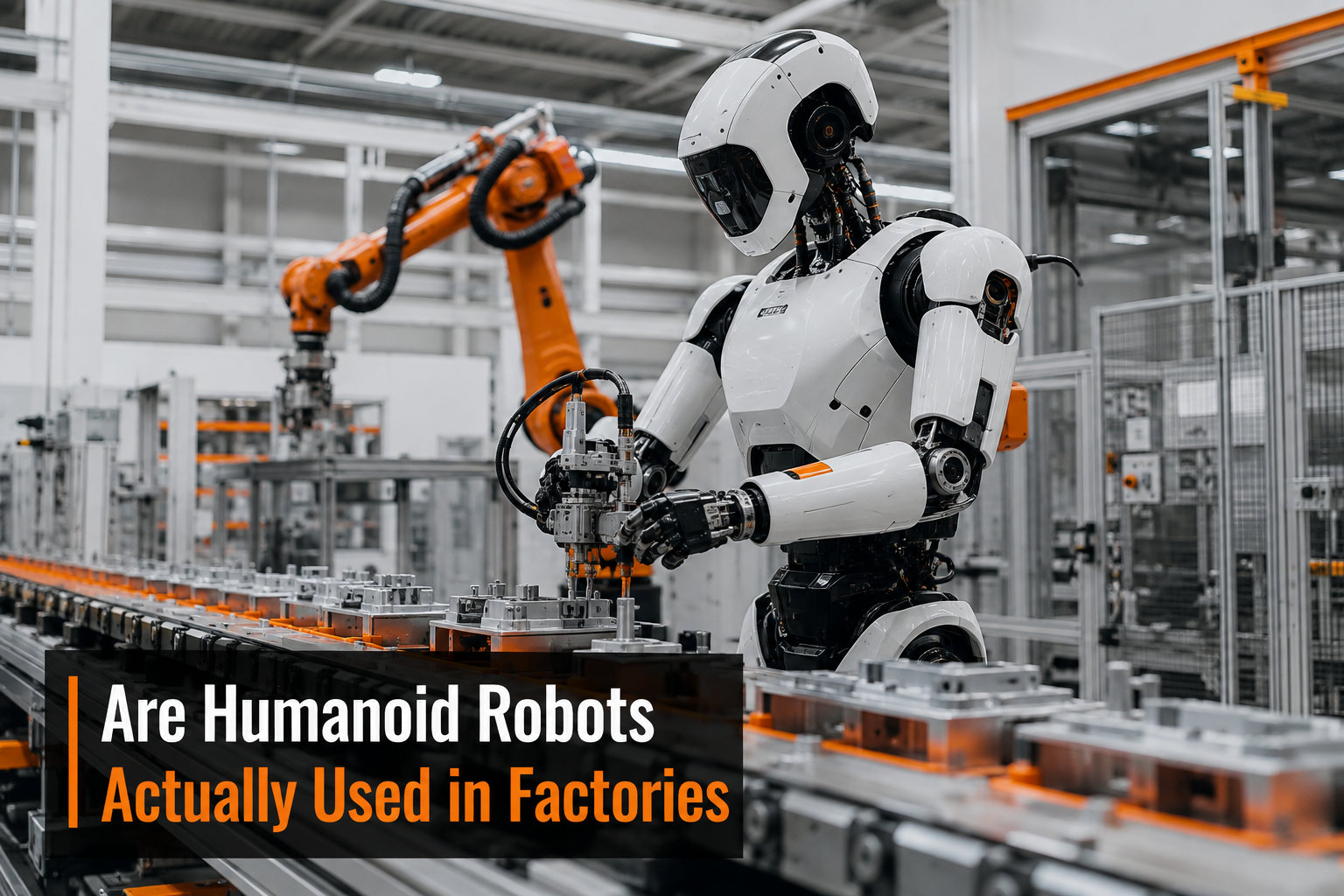
Yes, humanoid robots are being used in factories in 2026 – but only in narrow, carefully selected pilot programs at facilities like BMW, Schaeffler, and Tesla, not at mass-production scale. Real deployments from Figure, Tesla, UBTECH, Agility Robotics, and Apptronik are running today, yet most pilots are still hitting only 20% to 50% effectiveness compared to specialized industrial robots or human workers. Below, I walk through every named factory pilot, the cost economics, the real limitations, and a timeline for when you can expect humanoids to scale beyond pilots.
I have been tracking humanoid robotics for years on Smashing Robotics, and the gap between polished press renders and what is actually happening on factory floors has never been wider. So I pulled the data, the deployment records, the cost analyses, and the skeptic Reddit threads, and put together the most honest answer I can write for 2026.
By the end of this guide, you will know exactly which companies have real factory pilots, what tasks the robots are doing, how much they cost, why they are still hitting that 20-50% effectiveness band, and when analysts expect scaled adoption to begin. I have also included a decision framework so you can judge whether a humanoid makes sense for a given factory use case.
Table of Contents
Are Humanoid Robots Actually Used in Factories?
Yes, humanoid robots are used in factories today, but in pilots, not fleets. The most concrete signal in 2026 comes from Figure AI, which has run humanoid robots inside BMW’s Spartanburg plant and Schaeffler’s auto-parts facilities for months at a time. Tesla is using its Optimus robots inside its own production lines. UBTECH’s Walker S units are picking and placing components at BYD and Geely plants in China. Apptronik’s Apollo is moving totes at Mercedes-Benz and BMW warehouses. Agility Robotics’ Digit is moving boxes at GXO logistics hubs. None of these are 10,000-unit rollouts. They are hundreds of robots at most, learning the work and showing their limits.
The honest framing, which matches what IEEE and Forbes published in 2026, is this: humanoids are deployed, but in narrow, repetitive, carefully chosen tasks, where the robot’s general-purpose flexibility matters more than its speed. When you ask a humanoid to do something a specialized industrial robot already does well, like spot-welding, the humanoid loses on cost, speed, and reliability. When you ask it to traverse a human-scale factory floor, open a door, climb three stairs, and deliver a part to a workstation that is moved every six weeks, the humanoid suddenly looks like the only practical option.
The effectiveness story is the part most companies downplay. Most humanoid pilots in factories are running at 20% to 50% of the speed or success rate of a specialized robot or a trained human worker on the same task. That is not a deal-breaker, because the alternative is often no automation at all, but it explains why your factory will not be 100% staffed by humanoids in 2026.
Real Factory Deployments in 2026: Named Examples
Here is the list of named, confirmed humanoid pilots actually running inside factories and warehouses right now.
Figure 02 at BMW and Schaeffler
Figure AI’s Figure 02 humanoid has been working inside BMW’s Spartanburg, South Carolina assembly plant for the most sustained factory deployment of any Western humanoid. The robot has been on the floor for over a year in various pilot phases, performing sheet-metal handling and parts placement tasks. Schaeffler, the German auto-parts supplier, has also run Figure 02 pilots in its European plants. Figure’s $2.6 billion valuation is built largely on these deployments being real, not staged, which is why the company continues to attract investment from Microsoft, OpenAI, NVIDIA, and BMW itself.
Tesla Optimus Inside Tesla Factories
Tesla is using its Optimus Gen 2 humanoid inside its own production lines, sorting cells, moving totes, and assisting on the battery assembly line. The footage that has come out of Tesla’s shareholder events shows Optimus performing these tasks under supervised autonomy, with a human supervisor taking over when the robot gets stuck. This is the closest thing to a robot building the same product that the company makes at scale. Elon Musk has stated the goal of producing Optimus at high volume for both internal use and external sale, though current deployment counts remain in the low hundreds.
UBTECH Walker S in BYD, Geely, and Foxconn Plants
Chinese humanoid maker UBTECH has the most aggressive factory rollout in China. Walker S units are deployed in BYD, Geely, and Foxconn facilities performing parts sorting, quality inspection support, and inter-station material handling. The UBTECH story is a useful contrast: rather than one flagship deployment, the company runs many small pilots and iterates quickly on the data.
Apptronik Apollo at Mercedes-Benz and BMW
Apptronik’s Apollo humanoid is working inside Mercedes-Benz manufacturing facilities and BMW Group logistics operations, primarily on totes and kitting tasks. Apollo is the humanoid partner Google DeepMind selected for its Gemini Robotics foundation model work, which gives the platform unusually strong software momentum. Mercedes has talked publicly about using Apollo for repetitive, physically demanding assembly tasks where ergonomics limit human workers.
Agility Digit at GXO and Amazon
Agility Robotics’ Digit is the most deployed bipedal humanoid in commercial warehouse settings, with pilots at GXO and Amazon fulfillment centers. Digit handles recyclable tote moving, induction, and basic material transport. The robot is small (about 5’9″ but lightweight and designed for logistics) and is teleoperation-friendly, meaning GXO operators can take remote control when the autonomy gets stuck.
Leju Robotics: Robots Building Robots
The unusual case is in China, where Leju Robotics opened what it calls the world’s first mass-production facility for humanoid robots in 2026. The factory itself uses minimal human labor and relies on its own Kuavo humanoids to assemble sub-components. As of last count, Leju was reportedly producing one humanoid every 30 minutes. This is a different question, robots building robots rather than robots building cars, but it shows how quickly the production-side of the industry is maturing.
Key Companies and Their Factory Robots
Below is a snapshot of every major humanoid robotics company with a real factory or warehouse pilot, and the maturity of that program.
Figure AI (United States): Figure 02 is the most mature Western factory humanoid, with BMW Spartanburg and Schaeffler as anchor customers. Backed by a $2.6B valuation, the company is pushing toward commercial scale by 2027.
Tesla (United States): Optimus Gen 2 is being deployed inside Tesla’s own factories first, with public demos of battery-line and parts-handling tasks. Vertical integration gives Tesla an unusual advantage because it can tune the robot to its own line layout.
UBTECH (China): Walker S is deployed across multiple Chinese auto and electronics manufacturers including BYD, Geely, and Foxconn. The company has emphasized volume deployments over marquee partnerships.
Agility Robotics (United States): Digit is in commercial pilots at GXO and Amazon warehouses. The platform has logged more real warehouse hours than almost any competitor, and is teleoperation-friendly.
Apptronik (United States): Apollo is the humanoid partner for Google DeepMind’s Gemini Robotics model, with pilots at Mercedes-Benz and BMW Group logistics. Strong software story, but hardware is still in early production.
Boston Dynamics (United States): The new Atlas humanoid has been demonstrated in factory-style demos (part moves, sequencing), with Hyundai as an anchor partner, but commercial factory deployments are still limited.
Unitree (China): Unitree’s G1 and H1 models are lower-cost options, primarily sold to research labs and small pilots rather than full factory lines. Price disruption is Unitree’s main strategic contribution.
Leju (China): Focused on production scale rather than deployment scale, Leju’s Kuavo is used internally to assemble other Kuavo humanoids. A useful case study in how fast the supply side is moving.
XPeng (China): XPeng’s Iron humanoid has been shown performing factory-floor tasks at XPeng’s own EV plant, with goals of mass deployment for in-house use.
Why the Humanoid Form Factor Matters in Factories
The strongest argument for a humanoid shape in a factory is the simplest one: factories are built for humans. A factory’s aisles, stairs, ladders, door handles, control panels, tools, workbenches, and workstations are all dimensioned to a roughly 5’8″ body with two arms, two legs, and a hand that can grip a power tool. Asking a humanoid to walk the line means it can use the existing factory as-is, with no rebuild. That is a major cost saving compared to retrofitting a fixed-arm industrial robot, which can easily run into the millions per cell.
A traditional six-axis industrial arm bolted to the floor is faster, more precise, and cheaper to operate, but it cannot walk to the next station, climb a maintenance ladder, or open a cage door. That is the trade. When the task is highly repetitive and the station never changes, the fixed arm wins on every metric. When the task moves around the factory, when the layout changes every product cycle, when the part is heavy and there is no fixture, the humanoid starts winning on flexibility.
The dexterity argument is more nuanced. Humanoid hands still cannot match a trained human hand for fine assembly, but they can do 80% of the bin-picking, kitting, and material-handling work that today goes to humans. For that 80%, the humanoid trades a 50% effectiveness rate for the ability to work 24/7, which can still produce a positive ROI in high-wage regions.
Software is the bigger unlock. Foundation models like Google DeepMind’s Gemini Robotics are starting to give humanoids general-purpose manipulation skills that were not possible with task-specific code. As those models mature, the same robot that does kitting today could be doing inspection or machine tending with a software update rather than a hardware swap. If you want to read more about how whole-body control models are evolving, I covered the Gemini Robotics 2 announcement in detail on Smashing Robotics here.
Humanoid Robots vs. Traditional Industrial Robots
The most useful way to think about where humanoids fit is side-by-side with the two existing options: fixed industrial arms and collaborative robots (cobots). Here is how they compare on the criteria a factory manager actually cares about.
The takeaway is that a humanoid is rarely the right answer for high-volume, never-changing work. The fixed industrial arm will always win on cost per cycle there. The humanoid wins when the work is variable, the layout changes, the task involves walking, climbing, or operating human-scale interfaces, and the volume is too low to justify a custom cell.
Current Limitations: Why 20-50% Effectiveness
IEEE’s reporting in 2026 found that most factory humanoid pilots are still hitting 20% to 50% of the speed and success rate of a human worker on the same task. That is the single most important number in this whole article, so it is worth unpacking where that gap comes from.
Battery life and runtime: most bipedal humanoids can operate for 2 to 4 hours on a single battery, then need 30 to 60 minutes to swap or recharge. A human worker does an 8-hour shift. Until hot-swap battery systems and longer-life chemistries mature, this caps the humanoids’ effective duty cycle.
Manipulation reliability: hand-based tasks like wire harness insertion, small-parts kitting, and connector mating still fail in the 20-40% range per attempt. Force sensing and tactile skins are improving, but they are not yet at industrial-arm precision.
Locomotion and fall recovery: factory floors have cables, fluids, and unexpected obstacles. Humanoids still fall, and recovery is rarely fully autonomous. Every fall is downtime.
Software generalization: foundation models handle novel situations better than the old hand-coded stacks, but a humanoid still hits edge cases daily. The 20-50% effectiveness number is essentially the human-in-the-loop success rate, which is why every major pilot has a teleoperation supervisor watching the robot.
Manufacturer priorities: IEEE’s reporting made the point clearly: factory operators care about reliability first, then cost, and only then about the form factor. The humanoid shape is not a feature in their eyes; it is a tradeoff. Until reliability crosses 90% on real tasks, the form factor will not matter.
Cost and Economic Viability
The economics question is where the Reddit skeptics and the press releases most directly collide. The target threshold for a humanoid to make sense for general factory work is sub-$50,000 per unit, on par with a mid-range cobot. Today, no factory-ready humanoid ships at that price. Current price points sit in the $150,000 to $500,000+ range depending on the platform and pilot volume.
Unitree’s G1 has dropped the consumer-research price floor below $20,000, but that is a research platform, not a factory-rated system with the safety, payload, and reliability certifications a manufacturer needs. The race in 2026 is to drive factory-grade units to that $50k number, with Tesla, Figure, and Chinese players all publicly targeting it.
The TCO math is more forgiving than the upfront price suggests. A humanoid that can replace one human shift at a fully-loaded labor cost of $70,000 to $100,000 per year pays for itself in 2 to 3 years, even at $200k per unit, if it can hit 70-80% uptime on real tasks. Most pilots today cannot hit those numbers, but the math gets there quickly if reliability improves.
The honest answer is that the cost is still too high for most factory use cases in 2026, and that is the single biggest reason the pilots are pilots, not fleets. The market is waiting for sub-$50k factory-grade units with proven uptime before scaling.
China vs. US and Europe Deployment Landscape
The geographic split is stark. Chinese humanoid production surged roughly 10x in 2025, but actual real-world factory deployments grew only about 10%, a gap that the industry has been working hard to close. China is the production leader (UBTECH, Unitree, Leju, XPeng, Fourier, Agibot, Galbot all shipping or scaling in 2026) and has the deepest policy support.
The United States leads on the commercial software and AI-model side, with Figure, Apptronik, Agility, Boston Dynamics, and Tesla all headquartered in the US, and with Google DeepMind, OpenAI, and NVIDIA providing the AI backbone. Real US factory deployments are concentrated at BMW Spartanburg, Mercedes-Benz, Tesla, GXO, and Amazon.
Europe is the cautious middle, with strong deployments at BMW Group, Mercedes-Benz, Schaeffler, and Continental, but also with stricter worker-safety regulation that slows rollout. If you want to read more about how US import rules are shaping this picture, I wrote up the FCC expert reactions here.
The robot-builds-robot angle is uniquely Chinese. Leju’s automated humanoid factory, where Kuavo robots assemble Kuavo robots, has no direct Western equivalent. If supply-side scale keeps growing in China and demand-side reliability keeps growing in the US, the two ecosystems will look very different for the next 2 to 3 years before converging.
For comparison, autonomous mobile robots (AMRs) have been scaling in both regions for years, and you can read my report on AMR advances here for context on how that adjacent automation market is maturing.
Timeline: When Will Humanoids Scale in Factories?
The phased timeline that keeps showing up across Forbes, McKinsey, IEEE, and newmarketpitch in 2026 looks like this.
2024-2027: Pilot era. Hundreds of units, dozens of named deployments, effectiveness 20-50%, primarily internal pilots at the robot makers’ own factories or anchor partners. Cost is $150k to $500k+ per unit. We are here now.
2027-2030: Early commercial. First factory-scale rollouts, thousands of units, effectiveness 50-70%, cost trending toward $80k to $150k. Cobot and humanoid lines start to merge as cobot makers (Universal Robots, FANUC) add mobility.
2030s: Scaled adoption. Tens of thousands of units, effectiveness 70-85%, cost approaching $50k for factory-grade units. Humanoid is one option in the automation toolbox, not the headline.
None of the credible analyst projections expect a factory of 10,000 humanoids inside this decade. The math, the battery tech, and the AI maturity all point to a much more incremental rollout, which is the same pattern that fixed industrial arms followed in the 1970s and cobots followed in the 2010s.
Manufacturer Decision Framework: Humanoid, Cobot, or Fixed Automation?
If you are a factory decision-maker trying to figure out which technology to deploy, here is a simple framework that is not in any of the competitor articles. Start by answering four questions.
Is the task fixed or variable? If the task is the same motion in the same place for years, the answer is a fixed industrial arm. If the task moves, changes monthly, or has multiple variants, keep going.
Does the work stay in one cell or move across the factory? If it stays put, a cobot is usually the right answer. If it involves walking, climbing, or operating human-scale interfaces, a humanoid is the only option that does not require a facility retrofit.
What is the volume? Below 50,000 cycles per year, fixed automation rarely pays back. Above 500,000 cycles per year, a humanoid is overkill. The humanoid sweet spot is the messy middle.
Is the environment human-scale or already automated? In a brownfield factory built for humans, humanoids drop in. In a greenfield automated plant, fixed arms and AMRs are cheaper.
If you answer “yes, variable, walks around, mid-volume, human-scale environment” to most of those, a humanoid is worth piloting. If you answer “fixed, one cell, high volume, already automated,” a cobot or fixed arm is still the right answer. The humanoid is not a replacement; it is an additional tool for jobs that were previously un-automatable. For a deeper look at the actuation tech that powers all three categories, my piece on how servo motors work in robots is a good primer.
What Workers and Unions Are Saying
One gap in the existing coverage is the worker perspective. In the BMW Spartanburg pilot, the United Auto Workers has been engaged in ongoing talks about how humanoids fit into the existing workforce. The position from most Western unions is straightforward: any humanoid deployment must be a net-addition to headcount or a replacement of ergonomically damaging work, not a direct headcount reduction.
Inside the Chinese pilots, the labor dynamic is different. UBTECH and BYD have framed the humanoids as filling roles that are increasingly hard to staff, particularly repetitive night-shift and high-ergonomic-load work. The result has been less public union pushback, but the same underlying tension.
The honest read in 2026 is that humanoids in factories will not eliminate large numbers of manufacturing jobs in the next 5 years. They will replace specific high-ergonomic-load and hard-to-staff shifts, which is a smaller labor story than the headlines suggest, and a bigger ergonomics story than the displacement discussion implies.
Frequently Asked Questions
Are there humanoid robots working in factories?
Yes. Figure 02 is working at BMW Spartanburg and Schaeffler, Tesla Optimus is on Tesla production lines, UBTECH Walker S is at BYD, Geely, and Foxconn plants, and Apptronik Apollo is at Mercedes-Benz facilities. All of these are real, named, in-progress pilots in 2026, though none are at fleet scale yet.
Do humanoid robots really exist?
Yes. Working factory-grade humanoids in 2026 include Figure 02, Tesla Optimus Gen 2, UBTECH Walker S, Agility Digit, Apptronik Apollo, Boston Dynamics Atlas, XPeng Iron, and Leju Kuavo. Hundreds of units are operating in factories and warehouses globally, primarily in pilot programs rather than full commercial fleets.
Does the US have fully automated factories?
No, not yet. The US has many highly automated factories, especially in semiconductor fabs, automotive body shops, and large e-commerce fulfillment centers, but no fully human-free factory operates at scale in 2026. Humanoid pilots at BMW Spartanburg, Tesla, GXO, and Amazon run alongside human workers, not in place of them.
Is Elon Musk working on humanoid robots?
Yes. Tesla’s Optimus program, led by Elon Musk, is developing the Optimus Gen 2 humanoid and deploying it inside Tesla’s own production lines for tasks like cell sorting, totes moving, and battery-line support. Tesla is one of the few humanoid makers using its robots in its own factories at scale.
How effective are humanoid robots in factory pilots?
Most factory humanoid pilots in 2026 run at 20% to 50% of the speed and success rate of a human worker on the same task, per IEEE reporting. Effectiveness is improving, but reliability, battery life, and manipulation are still the main bottlenecks. The figure climbs toward 70-80% in controlled demos and drops back down in real factory variability.
How much does a factory humanoid robot cost?
Current factory-grade humanoids cost $150,000 to $500,000+ per unit in 2026. The industry target is sub-$50,000 to compete with mid-range cobots, and Tesla, Figure, and Chinese makers like Unitree are all pushing toward that price. A humanoid that replaces a $70k-$100k fully-loaded human shift pays for itself in 2 to 3 years if uptime exceeds 70-80%.
The Honest Bottom Line on Humanoids in Factories
So, are humanoid robots actually used in factories in 2026? Yes, in real, named, multi-month pilots at BMW, Schaeffler, Tesla, Mercedes-Benz, BYD, Geely, Foxconn, GXO, and Amazon. The deployments are real, not staged, and the robots are doing real work in the 20% to 50% effectiveness band on tasks that were previously un-automatable. The 10,000-humanoid factory is not happening this decade, but the 200-humanoid factory is already here, and the 2,000-humanoid factory is plausible by 2030 if cost and reliability targets hold.
For factory decision-makers, the right read is to pilot a humanoid in 2026 only where fixed automation and cobots are clearly insufficient, where the work is variable, where the layout is human-scale, and where the volume is mid-range. For everyone else, watch the data, watch the price, and revisit in 2027 when the cost curve should bend. I will keep tracking every named deployment, every price announcement, and every effectiveness datapoint here on Smashing Robotics, so check back as the picture keeps moving.