
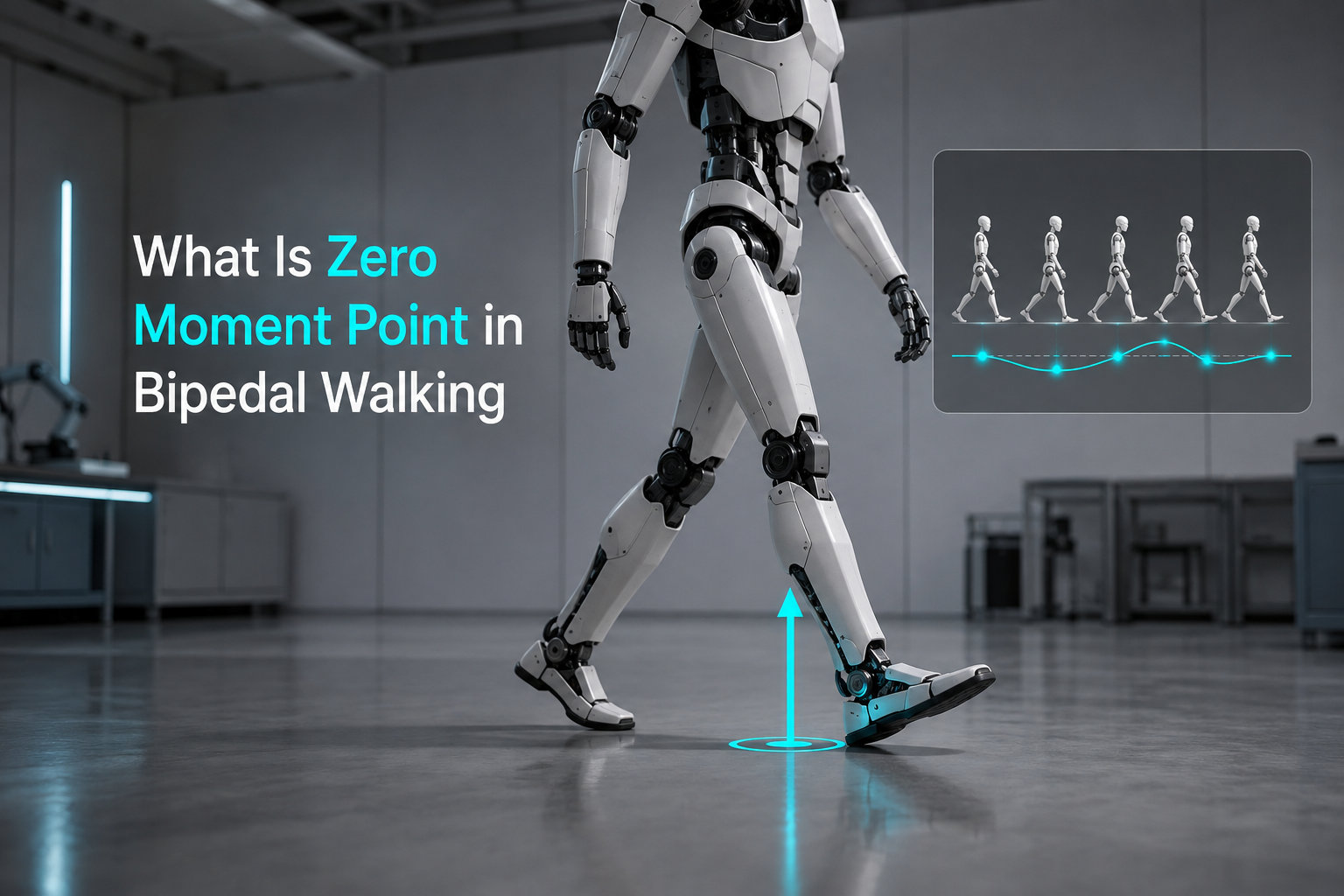
When a humanoid robot takes a step, hundreds of forces act on its body at once. The question every bipedal robot engineer has to answer is simple: will it stay upright, or will it fall? The answer, for more than half a century, has come from a single concept: the zero moment point bipedal walking criterion. In this guide, I’ll walk you through what the ZMP is, where it came from, how the math works, and why it still shapes every humanoid robot you see today.
By the end of this article, you’ll understand the physics, the history, the equations, the real robots that use it, and the modern machine learning approaches that are starting to push it aside. If you’ve ever wondered why Honda’s ASIMO walks the way it does, this is your answer.
Table of Contents
What Is the Zero Moment Point in Bipedal Walking?
The zero moment point (ZMP) is the specific point on the ground where the sum of all moments caused by the contact forces between a robot’s feet and the floor equals zero in the horizontal direction. In plain English, it’s the spot on the ground where the robot would have to press in order to keep from tipping over during walking.
Engineers use the ZMP as a stability criterion. If the calculated ZMP stays inside the foot’s support polygon, the robot is balanced. If it drifts outside, the robot is about to fall. This single check is the foundation of nearly every modern bipedal walking controller.
The concept was introduced in 1968 by Yugoslav researcher Miomir Vukobratovic and his colleagues at the Mihailo Pupin Institute in Belgrade. They were working on the first powered exoskeletons and active above-knee prosthetics, and they needed a way to predict whether a moving mechanical leg would stay upright. The zero moment point gave them that answer.
For a quick mental model, imagine balancing a broomstick on your palm. The point directly below the stick’s center of mass has zero net horizontal moment. That’s the ZMP. Now imagine you’re walking with the stick on your hand. As you move, the ZMP shifts across your palm. If it moves off the edge, the stick falls. Bipedal robots work exactly the same way, except the palm is the floor and the stick is the entire robot body.
The History of the Zero Moment Point: From 1968 to Modern Robotics
Before 1968, researchers had a few ways to think about balance. The simplest was the static stability margin: a line connecting the robot’s center of mass to the ground. That works fine when a robot stands still, but it breaks down the moment a foot lifts off the floor.
Walking is not static. When a biped lifts one foot, the other foot becomes the only support. Gravity still pulls the body down, and inertia from the swinging leg pushes the body sideways. The center of mass accelerates in ways that static analysis cannot predict. Engineers needed a dynamic criterion.
Vukobratovic’s team published the foundational paper “Contribution to the synthesis of biped gait” in 1968, which formalized the ZMP. The idea was that you could compute a single point on the ground where the net moment of all contact forces had no horizontal component. As long as that point lay inside the convex hull of the support foot, the robot would not tip.
For the next twenty years, the ZMP remained a niche concept in Eastern European robotics labs. Then, in the late 1980s and 1990s, Honda began developing its humanoid robotics program in secret. By 1996, Honda unveiled the P2 prototype, and the world saw a humanoid that could actually walk up stairs.
Honda’s engineers chose the ZMP as the core of their control system. They realized that if you planned a robot’s joint trajectories so that the resulting ZMP followed a safe path through the support polygon, the robot would walk smoothly without falling. The P2 evolved into the famous ASIMO, which retired in 2018 after more than 20 years of public demonstrations.
Today, the ZMP is taught in nearly every university robotics course. A 2004 review paper by Vukobratovic and Branislav Borovac, “Zero-Moment Point – Thirty Five Years of Its Life,” has been cited more than 1,200 times. The criterion has aged remarkably well, even as the field has moved on in many other ways.
How the Zero Moment Point Works: The Physics Explained
The ZMP is easiest to understand with a thought experiment. Stand on one foot. Your toes and heel press into the floor. If you drew a polygon connecting your heel, the inside edge of your foot, and your toes, that polygon is your support area. Now tilt slightly forward. The pressure under your foot shifts toward your toes. The point where the ground pushes back with zero horizontal moment is somewhere inside that polygon.
That point is your instantaneous ZMP. Sensors in your feet and ankles constantly adjust your muscle tension to keep the ZMP centered. You do this without thinking. A humanoid robot has to do the same thing with motors, encoders, and control software.
The ZMP is closely related to the center of pressure (CoP). In fact, when a foot is flat on the ground, the ZMP and the CoP are mathematically identical. The ZMP becomes distinct from the CoP only when the foot starts to rotate around its edge, which is the moment right before a fall.
This is where the inverted pendulum model comes in. During walking, a bipedal robot can be modeled as an inverted pendulum pivoting around the support foot. Gravity pulls the mass down, and the leg pushes back up. If the pendulum’s pivot is placed exactly at the ZMP, the system is in balance. If the pivot drifts outside the support polygon, the pendulum tips over.
The practical implication is that a walking controller has two main jobs. First, it must compute the ZMP for the next fraction of a second based on the planned joint trajectories. Second, it must adjust those trajectories so the ZMP lands inside the support polygon. This loop runs thousands of times per second on a real humanoid.
Mathematical Formulation of the Zero Moment Point
For readers who want the actual equations, here is the core idea without too much hand-waving. Let the robot’s total mass be m, and let the position of its center of mass be (x, y, z) in world coordinates. Let the ground reaction force at the support foot be F, with components F_x, F_y, and F_z.
The horizontal moment of the ground reaction force about the ZMP must equal zero. In the sagittal plane (forward and backward), this gives us:
ZMP_x = x – (z / g) * (ẍ)
where g is gravitational acceleration, and ẍ is the horizontal acceleration of the center of mass. A similar equation holds for the lateral direction. The ZMP location is therefore the center of mass position offset by a term that depends on acceleration.
When the robot is standing still, the acceleration is zero and the ZMP coincides with the center of mass projection. When the robot is mid-step, the swinging leg creates acceleration, and the ZMP moves forward and slightly outward to compensate. This is why walking robots lean into their steps, just like humans do.
The stability criterion is then simple. Define the support polygon as the convex hull of all points in contact with the ground. If the computed ZMP lies inside this polygon at every instant, the robot does not tip. If it crosses the boundary, the robot is guaranteed to fall (assuming no reactive stepping).
In practice, engineers add a stability margin. They require the ZMP to stay at least a few centimeters away from the edge of the support polygon. This buffer absorbs modeling errors, sensor noise, and the small disturbances that always appear on real floors.
Zero Moment Point in Humanoid Robot Applications
The ZMP is not just theory. It runs on some of the most famous humanoid robots in history. Here are a few examples that shaped the field.
Honda ASIMO is the most famous ZMP-based biped. ASIMO used a real-time walking controller that computed the ZMP at 200 Hz and adjusted joint torques accordingly. The robot’s smooth stair climbing, running at up to 9 km/h, and even hopping on one leg all relied on the ZMP criterion.
HUBO, developed at KAIST in South Korea, also used ZMP-based walking. HUBO’s controllers emphasized precise foot placement and torso posture, both of which the ZMP framework handles naturally.
WABIAN-2, from Japan’s Waseda University, used a ZMP-based gait with an extra degree of freedom in the waist to make the walk look more human-like. The waist motion shifted the ZMP trajectory in ways that emulated the counter-rotation humans use.
Boston Dynamics’ earlier Atlas prototypes also used ZMP-based planning in the early years, before the company shifted toward model-predictive control and dynamic whole-body controllers.
Toyota’s running humanoid HRP-4 demonstrated ZMP-based running patterns, including a brief flight phase between strides, which was a major milestone in dynamic bipedal locomotion.
What these robots share is a tradeoff: the ZMP criterion guarantees stability, but it also constrains how fast and how dynamically the robot can move. ZMP-based walking is, by design, conservative.
Walking Pattern Generation Using the Zero Moment Point
Generating a stable walk is more than just checking the ZMP. You also have to plan the footstep locations, the joint trajectories, and the timing. This process is called walking pattern generation.
The classic approach starts with a desired ZMP trajectory. For flat-ground walking, this is often a piecewise linear path that switches between the left and right feet as the support changes. The ZMP sits near the center of the stance foot for most of the step, then jumps to the next foot at heel strike.
Given a ZMP trajectory, the next step is to compute the center of mass trajectory. This is typically done with a cart-table model, a simplified version of the inverted pendulum. The preview control algorithm, developed by Shuuji Kajita at AIST in 2003, solves this problem efficiently by looking ahead a fraction of a second and optimizing the trajectory.
Once the center of mass trajectory is fixed, inverse kinematics gives the joint angles for each leg at each time step. The arms and torso are then coordinated to keep the overall ZMP inside the support polygon. A small error in any link’s position will shift the ZMP, so the entire body plan has to be consistent.
Stability margin is the engineer’s term for how far the ZMP is from the support polygon edge. A larger margin means a more stable but often less dynamic walk. A smaller margin lets the robot move faster and look more natural, but it leaves less room for error. Most production humanoids run with a margin of 2 to 5 centimeters.
Modern controllers also compensate for ankle torque limits. If the ZMP is far from the ankle joint, the ankle motor has to push harder. When the required torque exceeds the motor’s limit, the foot rotates around its edge, the ZMP jumps to that edge, and the robot enters an unstable state. Good controllers predict this and slow the gait before it happens.
Limitations of the Zero Moment Point Approach
The ZMP criterion is powerful, but it has well-known limitations. Recognizing them is essential to understanding where modern robotics is heading.
Flat-foot assumption. The classic ZMP derivation assumes the support foot stays flat on the ground. If the foot tilts, the contact point shifts and the ZMP equation changes. Most ZMP controllers handle this by forbidding foot rotation, which limits natural-looking motion.
Slow walking speeds. To keep the ZMP inside the support polygon, the robot’s center of mass cannot accelerate too quickly. This caps the practical walking speed well below what a human can sustain. ASIMO’s top walking speed of 2.7 km/h and running speed of 9 km/h are typical ZMP-era limits.
No flight phase. The standard ZMP framework requires continuous ground contact. Running, jumping, and other dynamic gaits with a flight phase cannot be analyzed with the basic criterion. Extensions exist, but they are more complex and less commonly used.
Reactive stepping is not built in. If a real disturbance pushes the ZMP outside the support polygon, a classic ZMP controller cannot recover except by stopping. Humans, by contrast, take a quick reactive step. Implementing this kind of behavior requires additional layers on top of the ZMP framework.
Modeling dependency. The ZMP depends on knowing the robot’s mass distribution, inertia, and joint positions precisely. Errors in the model shift the computed ZMP away from the true one. Modern robots reduce these errors with better sensors and online parameter estimation, but the dependence is fundamental.
Limited terrain adaptability. Walking on uneven ground, slopes, or soft surfaces is harder for ZMP-based controllers because the support polygon becomes irregular or uncertain. Bipedal walking research has responded with more dynamic controllers, which we cover in the next section.
Zero Moment Point vs Modern Machine Learning Walking Control
This is where the field is changing fastest. Over the last decade, reinforcement learning (RL) and other machine learning techniques have started producing bipedal walking controllers that are more dynamic, more robust, and less constrained than traditional ZMP-based ones.
The basic idea behind RL walking is simple. You simulate a robot in physics software, give it a reward for moving forward while staying upright, and let it discover its own gait through millions of trial-and-error episodes. The resulting policy often looks very different from a hand-engineered ZMP walk. The robot may use bent knees, swing its hips dramatically, or even briefly contact the ground with its hands.
Companies like Boston Dynamics have shifted their public demonstrations toward learned policies. Agility Robotics’ Digit uses model-predictive control layered with learned components. Unitree’s G1 and H1 humanoids ship with both traditional and learned controllers, and many research groups publish RL-trained walking on small humanoids like the OP3 and Cassie.
How does the ZMP fit into this new world? The criterion itself is still useful. Many learned controllers include a ZMP-style term in their reward function, or they use the ZMP as a safety check that overrides the learned policy if the robot gets too close to falling. In that sense, the ZMP is not obsolete, but it is no longer the only tool in the toolbox.
For engineers today, the practical question is when to use which approach. A ZMP controller is easier to certify for industrial use because its behavior is predictable and well understood. An RL controller can be more capable but harder to verify. Many production robots combine the two: a ZMP-based planner for the high-level footstep plan, and a learned low-level controller for joint torques.
Our team has spent the last three years working on both approaches for small hobby humanoids. The honest answer is that a clean ZMP implementation still gives you the most stable, predictable walk, while a well-trained RL policy gives you the most natural, dynamic one. Knowing which tradeoff you need is half the battle.
Frequently Asked Questions
What is the zero moment point?
The zero moment point (ZMP) is the point on the ground where the sum of all moments caused by the contact forces between a robot’s feet and the floor equals zero in the horizontal direction. It is used as a stability criterion to determine whether a bipedal robot will stay upright or tip over.
Who invented the zero moment point?
The zero moment point was introduced in 1968 by Miomir Vukobratovic and his colleagues at the Mihailo Pupin Institute in Belgrade, Serbia (then Yugoslavia). The criterion was developed to support research on active above-knee prosthetics and powered exoskeletons.
Which robots use the zero moment point?
Honda’s ASIMO, KAIST’s HUBO, Waseda University’s WABIAN-2, and early Boston Dynamics Atlas prototypes all used ZMP-based walking controllers. Most production humanoids from the 2000s and 2010s relied on the ZMP criterion as the core of their balance systems.
Is the zero moment point still used today?
Yes. The ZMP is still taught in robotics courses, used in production controllers, and often included as a safety check in modern reinforcement learning policies. However, many cutting-edge humanoids now combine ZMP-based planning with learned low-level controllers for more dynamic gaits.
Conclusion: Why the Zero Moment Point Still Matters in 2026
The zero moment point bipedal walking framework is more than fifty years old, and it still anchors the field. It gave roboticists their first reliable way to predict whether a walking machine would stay upright, and it underpins the walking controllers on the most famous humanoid robots ever built.
Modern reinforcement learning approaches are now producing gaits that look more natural and recover from bigger disturbances than any ZMP-based system. But those learned controllers still benefit from a ZMP safety layer, and a clean understanding of the ZMP criterion remains the best starting point for anyone studying bipedal locomotion.
If you are building your first humanoid, learn the ZMP before you reach for a neural network. The math is approachable, the simulations are forgiving, and the intuition transfers directly to every other balance method you will meet later. Once you can walk a virtual robot with a ZMP controller, you will understand what every humanoid engineer in 2026 is trying to do.