
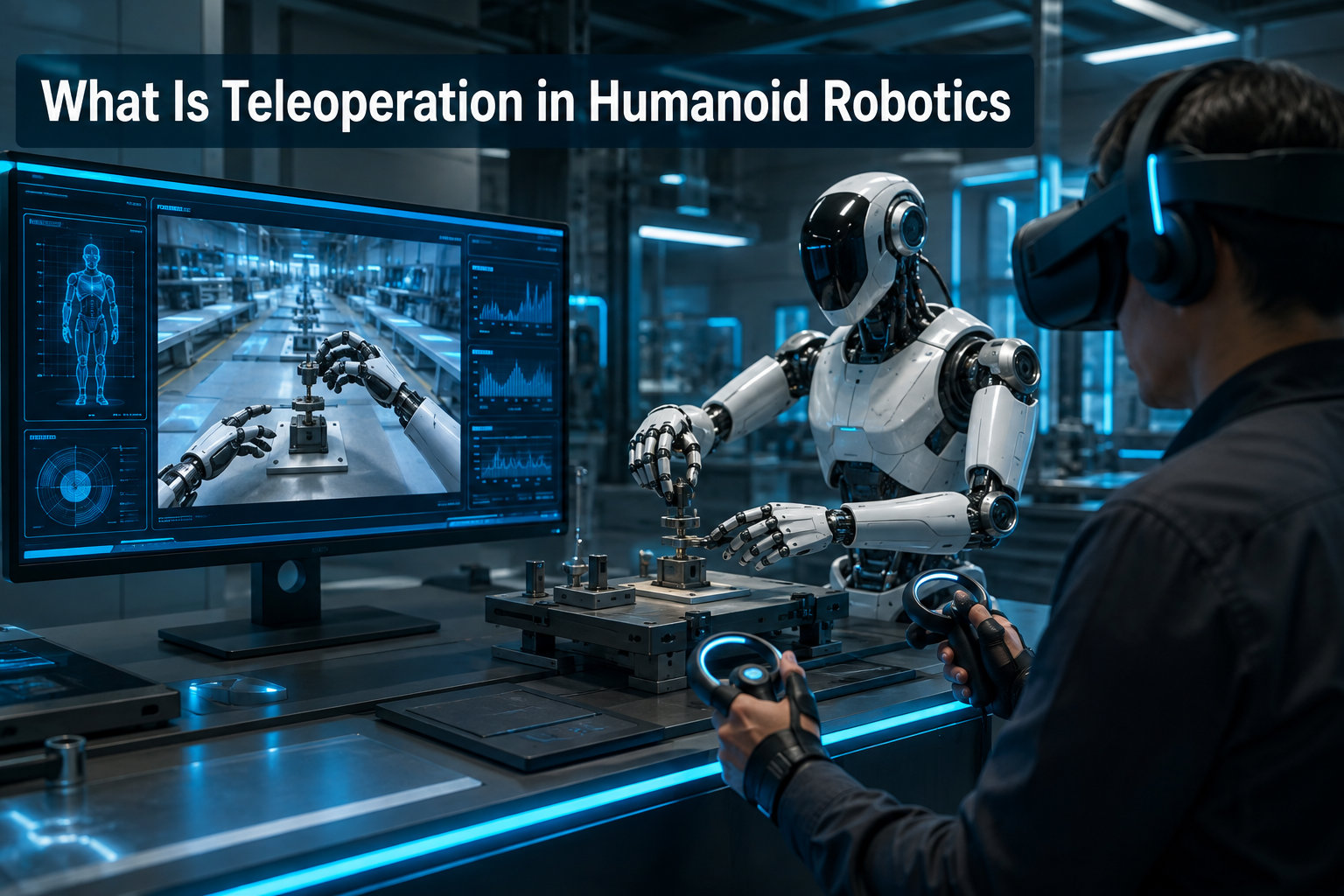
If you have watched a humanoid robot demo lately and wondered whether it was actually thinking on its own, you are asking the right question. Many of the most viral clips from 2026 show a person in another room, headset on, silently moving a robot body halfway across the world. That is teleoperation in humanoid robotics, and it is the quiet backbone of the entire industry right now.
I have spent the last several months following humanoid teleoperation closely, talking to researchers, watching conference demos, and reading papers like the Darvish survey on arXiv. This guide is the result. I will walk you through what teleoperation in humanoid robotics actually means, how the systems work under the hood, where they are already changing real industries, and where they are heading next.
Table of Contents
What Is Teleoperation in Humanoid Robotics
Teleoperation in humanoid robotics is the remote control of a humanoid robot by a human operator, where the robot mirrors the operator’s movements and intent in real time while the operator receives feedback from the robot’s environment. It is the practical bridge that lets human cognitive skills team up with robot physical capabilities for jobs that are too dangerous, too precise, or too unstructured for current AI alone.
The core idea is simple. A human stays in the loop. Sensors, cameras, and haptic devices on the operator’s side capture intent. That intent travels over a network to a humanoid robot at a distance. The robot’s joints, hands, and head replicate the motion. Sensor data flows back so the operator can see, hear, and sometimes feel what the robot is doing. The result feels like piloting a very expensive avatar.
You will see this term overlap with related concepts. Here is a quick reference for the language you will meet throughout the article.
- Teleoperation: Remote operation of a machine at a distance, similar in meaning to “remote control.”
- Telerobotics: Teleoperation applied specifically to robotic systems, often with semi-autonomous assistance.
- Telepresence: A subset focused on the operator feeling “present” in the remote location, usually through immersive video and audio.
- Master-slave system: The classic architecture where the “master” device the operator wears controls the “slave” robot.
- Bilateral control: A control loop that sends motion commands forward and force feedback backward.
- Haptic feedback: Physical sensations like pressure, texture, or resistance delivered back to the operator.
- Motion retargeting: Translating human motion onto a robot body that has different proportions and joint limits.
- Latency compensation: Software techniques that predict or smooth out the delay in a teleoperation loop.
The Wikipedia page on teleoperation puts it cleanly: teleoperation indicates operation of a system or machine at a distance, similar in meaning to “remote control.” When we attach the humanoid label, we narrow that idea to robots with a human-like body, which is where things get interesting and unusually hard.
History and Evolution of Teleoperation
Teleoperation is not new. The first working radio-controlled boat appeared in the 1870s, demonstrated by Nikola Tesla himself in 1898. By the 1940s, the U.S. Atomic Energy Commission was funding master-slave manipulators so workers could handle radioactive material from behind shielded walls. Those early hands were the ancestors of every modern surgical robot and humanoid controller you see today.
The 1990s added a new twist. Researchers at places like NASA JPL and the University of Tokyo began adding force feedback and predictive displays to deal with time delay, especially for space telerobotics. The famous ROTEX experiment on the Space Shuttle in 1993 used a combination of teleoperation and shared autonomy that still influences humanoid research today.
Humanoid teleoperation, as a focused field, really took off after 2015. Three things converged. Affordable whole-body motion capture suits, low-latency 5G and high-speed fiber, and humanoid platforms like Atlas, NAO, and later the Unitree G1. By 2026, almost every commercial humanoid demo you can name uses some form of human-in-the-loop control, even when the company prefers to call it “imitation learning data.”
Reddit’s r/robotics community has been blunt about this transition. Regular posters point out that what looks like AI is often a human at a keyboard or in a VR headset, and the debate about how much teleoperation to disclose is now part of the industry’s reputation game.
How Teleoperation Works: The Core Architecture
Every teleoperation system, no matter how flashy, follows a master-slave architecture. The operator side captures intent. The network carries that intent. The robot side executes it. Sensors and feedback close the loop. Let me break down each part.
The Operator Side: Capturing Human Intent
On the operator side, you find the input devices that turn human motion into robot commands. Common setups include VR headsets for vision and head tracking, motion capture suits or cameras for full-body pose, handheld controllers for fine finger work, and exoskeletons for force-input on arms and hands. Some experimental rigs even use EMG armbands to read muscle signals directly.
The software here does a job called motion retargeting. Human arms are not robot arms, so the system has to map shoulder yaw, elbow pitch, and wrist roll onto the robot’s joint space while respecting balance, joint limits, and the robot’s own proportions. A well-tuned retargeter is what makes a teleoperated humanoid look graceful instead of twitchy.
The Network: The Real-Time Control Link
Between operator and robot sits the network. For local setups, this is often a wired gigabit connection with sub-10 ms latency. For long-distance work, teams rely on fiber, 5G, or dedicated radio links. Anything above 100 ms of round-trip delay starts to feel like driving through mud, and the system must either slow down or hand off to autonomy.
This is where latency compensation earns its name. Predictive displays extrapolate the robot’s motion so the operator can see where things will be, not where they are. Wave-variable transforms and passivity controllers mathematically guarantee that the system stays stable even when the network misbehaves. These are not optional extras for serious teleoperation. They are the difference between a working system and an unstable one.
The Robot Side: Executing the Commands
On the robot side, low-level controllers take the incoming pose targets and run forward and inverse kinematics to figure out joint angles. Impedance control makes the arms compliant so they do not crush objects or fight the operator. Whole-body controllers coordinate arms, torso, and legs to keep the robot balanced while the upper body is being driven remotely.
Visual and audio feedback flow back through the same network. Most setups stream stereoscopic video from head-mounted cameras, with optional chest and wrist cameras for peripheral awareness. The better systems also send haptic cues so the operator can feel contact, which is critical for delicate tasks like surgery or picking fruit.
Common Control Interfaces for Humanoid Robots
The interface is where the human and the robot actually meet, so it is where the engineering gets personal. Here is what you will find in practice.
VR Headsets and Motion Capture
This is the most common setup in 2026. An operator puts on a Meta Quest or Varjo headset, picks up the controllers, and the humanoid across the room mirrors their head, hands, and arms. Cameras on the robot stream back into the headset. This combo is cheap, fast to set up, and good enough for warehouse pick-and-place trials.
Exoskeletons and Haptic Suits
For tasks that need real force feedback, teams use upper-body exoskeletons like the ones from Haption or Force Dimension. The operator’s arms physically meet resistance when the robot’s hands hit a wall. The whole-body suits from companies like Tesla’s Optimus demo and Apptronik’s Apollo use similar principles, often paired with custom gloves that capture every finger joint.
Joysticks, Spacemice, and Surgeon-Style Consoles
For precision work, especially in surgery and micro-manipulation, hand-held devices like the SpaceMouse or surgical consoles still rule. These were the original teleoperation interfaces and they remain the gold standard when you need millimeter accuracy without operator fatigue.
Brain-Computer Interfaces
This is the experimental frontier. Early research from labs at Carnegie Mellon and the University of Houston has shown that operators can drive simple robot motion with EEG-based brain-computer interfaces. The latency and signal noise mean BCIs are not ready for general use, but they hint at where hands-free teleoperation could eventually go.
Teleoperation vs Full Autonomy vs Telepresence
These three terms get tangled in the press, but they describe different points on the same spectrum. The table below lays it out cleanly.
| Approach | Who is in control | Best fit | Trade-off |
|---|---|---|---|
| Teleoperation | Human operator, full real-time control | Unknown or unstructured environments, edge cases, training data | Expensive to scale, depends on network quality |
| Shared autonomy | Human and AI together, AI fills gaps | Tasks where AI handles 80 percent and a human handles the rest | More complex to design, but reduces operator load |
| Full autonomy | Onboard AI, no human in the loop | Repetitive tasks in known environments | Brittle on edge cases, hard to certify |
| Telepresence | Human, but focus is on feeling “there” | Remote meetings, inspections, social robots | Less focus on physical manipulation |
Most production humanoid deployments today sit in the teleoperation or shared autonomy columns. Even the most aggressive autonomy roadmap in the industry still keeps a remote operator on call for the moments the AI cannot handle. The “autonomy gap” is real, and teleoperation is how serious teams cross it safely.
Real-World Applications and Use Cases
Teleoperation in humanoid robotics is no longer a lab demo. It is moving real value in several industries right now. Here are the use cases I have seen working as of 2026.
Remote Surgery and Medical Procedures
Humanoid and semi-humanoid platforms are starting to assist in operating rooms and recovery wards. The Unitree G1, for example, has been used in teleoperated demonstrations of patient handling and instrument passing. Surgical teleoperation is older than humanoid robots, but the addition of a human-shaped body makes bedside assistance and rehab work much more natural.
Hazardous Environments
Disaster response, nuclear cleanup, and deep-sea inspection were the original use cases for teleoperation and they remain the most defensible. Sending a humanoid into a collapsed building or a contaminated zone, with a human operator safely kilometers away, is a clear win. Robots like the NASA Valkyrie and several Boston Dynamics derivatives are designed with teleoperation as a primary control mode for exactly these missions.
Training Data Collection for AI
This is the quietest but biggest use of teleoperation humanoid robotics. Every time a human teleoperates a robot to do a useful task, the system can record joint angles, video, and force data. That data trains the next generation of autonomous policies. Tesla, Figure, 1X, and Unitree have all confirmed that teleoperation sessions are feeding their imitation learning pipelines. The robot is, in effect, teaching itself by watching a human work.
Elderly Care and Home Assistance
1X Technologies’ NEO humanoid is operated by home office teams, reportedly in Vietnam and Norway, who pilot the robot through domestic chores for customers in the U.S. and Europe. The model is a stepping stone. As the AI improves, fewer hours of teleoperation will be needed per task, but human control remains the safety net for fragile environments like a private home.
Industrial Manipulation and Logistics
Warehousing and manufacturing have become the testing ground for teleoperated humanoids. Companies use remote operators to handle edge-of-edge cases, odd-shaped items, and exceptions that break the autonomous stack. The pitch to the customer is simple: 99 percent autonomous, 100 percent productive.
Challenges and Limitations
Teleoperation is powerful, but it is not magic. Anyone planning a deployment needs to understand the hard problems.
Latency is the constant enemy. Even a 50 ms delay makes fine manipulation feel like driving with a laggy steering wheel. Multiplied across a warehouse or a home network, it can ruin a session. The best systems engineer around this with predictive displays and shared autonomy, but it never fully goes away.
Scalability is the economic challenge. A human operator can drive one robot well, maybe two with the right tooling. If you want a fleet of 10,000 humanoids, you need either dramatic AI improvements or a much larger operator pool. Most companies today plan for both, with operators handling the long tail of difficult cases while autonomy handles the easy 80 percent.
Operator training is a real cost. Piloting a humanoid well is closer to flying a helicopter than playing a video game. Companies like 1X run dedicated training programs, and the Reddit r/robotics community regularly flags operator fatigue as an underappreciated risk.
Transparency is the trust challenge. Several Reddit threads have accused humanoid companies of quietly teleoperating robots during flashy “fully autonomous” demos. Honest disclosure is becoming a brand issue, and the most respected teams now mark their teleoperated runs clearly in conference talks.
Ethics and job displacement are the social questions. If a teleoperator in another country is doing a job that used to be a local worker, who is responsible for working conditions, pay, and oversight? There are no clear answers yet, but the questions are surfacing in policy debates in California, the EU, and parts of Asia.
The Future of Teleoperation in Humanoid Robotics
The future of teleoperation humanoid robotics is not fewer humans, it is smarter humans-in-the-loop. Three trends are worth watching.
First, shared autonomy is getting serious. Models like Google’s Gemini Robotics 2 are starting to predict operator intent and pre-fill motions, so the operator confirms rather than controls every joint. This is one of the most exciting frontiers in whole-body humanoid control right now.
Second, training data from teleoperation is unlocking new levels of autonomous behavior. Every teleoperated session becomes a labeled dataset for imitation learning. The companies that build the best teleoperation infrastructure today will own the autonomous policies of 2026 plus two or three.
Third, regulation and standards are catching up. With new import and safety rules emerging for humanoid robots, teleoperation is likely to become a required disclosure rather than an implementation detail.
There is also the broader question of humanoid robotics infrastructure. The same data centers and simulation stacks that power modern AI will quietly power teleoperation, and the industry is starting to look a lot like a distributed workforce problem with robots as the endpoint.
If you want a longer read on the industry side, the piece on recent humanoid and mobile robotics deals is a good snapshot of where capital is flowing.
Frequently Asked Questions
What are teleoperated humanoid robots?
Teleoperated humanoid robots are human-shaped robots that a remote human operator controls in real time. The operator wears devices like VR headsets, motion capture suits, or exoskeletons, and the robot’s body mirrors their movements. Sensors on the robot stream video and haptic feedback back so the operator can see and feel what the robot is doing. This setup is the most common way humanoid robots perform useful work in 2026.
What does teleoperation mean in robotics?
In robotics, teleoperation means operating a robot from a distance. The operator is not physically next to the machine, but is connected through a network that carries control commands forward and sensor data backward. The term is used interchangeably with remote control and telerobotics, and it is the foundation of how most humanoid robots are deployed today.
Is the Tesla robot teleoperated?
Tesla’s Optimus demonstrations have included a mix of autonomous routines and teleoperated sequences. Elon Musk has stated that future Optimus units will operate fully autonomously, but several Optimus videos released in 2024 and 2025 were either fully or partially teleoperated, according to engineers and observers on Reddit. Tesla is widely believed to use teleoperation to collect training data for its autonomy stack.
What is teleoperation for robots?
Teleoperation for robots is the practice of controlling a robot from a distance using joysticks, VR rigs, exoskeletons, or other input devices. It is used in environments that are hazardous, remote, or simply too unstructured for autonomous AI. For humanoid robots, teleoperation also doubles as a way to record high-quality demonstration data that trains the next generation of autonomous behaviors.
How does teleoperation differ from full autonomy?
Full autonomy means the robot makes all of its own decisions without a human in the loop. Teleoperation keeps a human operator actively controlling the robot in real time. Most real-world humanoid deployments in 2026 sit between the two, using shared autonomy, where the AI handles routine parts of a task and a remote human steps in for edge cases. Teleoperation is the safety net that makes autonomy deployable today.
Conclusion
Teleoperation in humanoid robotics is the simple, often-overlooked reason the humanoid industry actually works in 2026. A human operator, somewhere on the network, drives the robot, feels what the robot feels, and gets the job done. That operator also generates the data that trains tomorrow’s autonomous policies.
It is the bridge between today’s AI and the full autonomy we keep being promised. If you are following humanoid robotics, watch teleoperation closely. The teams that build the best interfaces, the lowest latency, and the cleanest data pipelines are the ones who will set the pace for the next several years. I will keep tracking them, and I will keep you posted.