
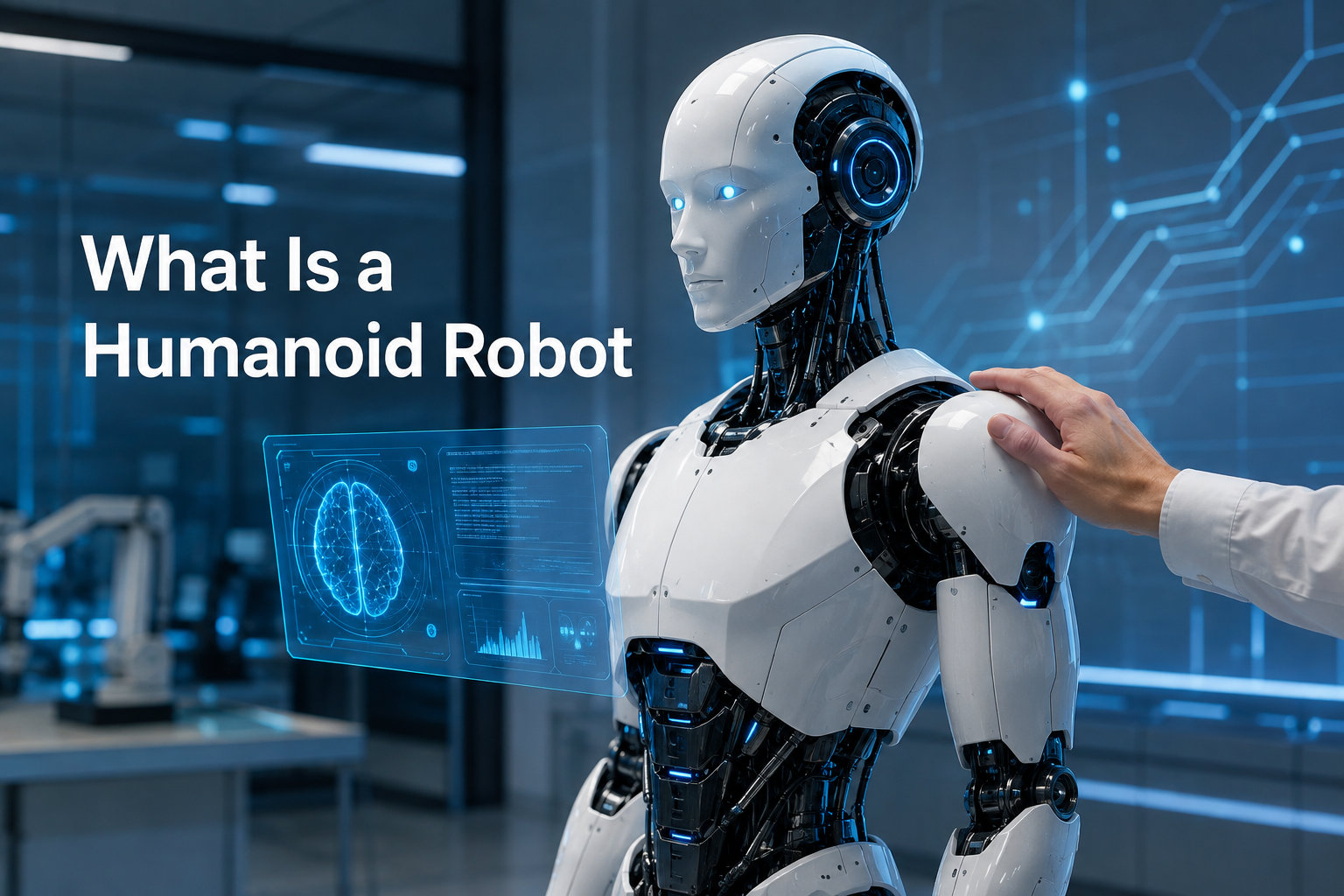
A humanoid robot is a machine built to look and move like a human body, typically featuring a head, a torso, two arms, and two legs. We have tracked humanoid robotics for over a decade on Smashing Robotics, and 2026 feels like the year the technology stopped being a research demo and started showing up on factory floors, in warehouses, and even on sprint tracks. In this guide, I will break down what defines a humanoid robot, why engineers keep building them in our shape, what is actually inside them, and where the industry honestly stands today.
You will get a clear definition, a tour of the key components, an honest look at how humanoid robots work, the leading models on the market, and the real challenges still holding them back. If you have ever wondered whether a humanoid robot is just a fancy gimmick or a genuine tool, this is the answer.
Table of Contents
What Is a Humanoid Robot
A humanoid robot is a robot whose body is modeled after the human form. Most designs include a head, a torso, two arms, and two legs, even if some elements are simplified. The term covers anything from a bipedal walker with a screen for a face to a fully actuated android with dexterous hands and expressive eyes.
The shape is not just for show. The humanoid form factor lets the machine fit into environments built for people. It can use our tools, climb our stairs, walk through our doorways, and sit in our chairs. That is why engineers at Tesla, Figure, Agility, 1X, and Unitree are all converging on roughly the same body plan.
Not every robot that looks human is a humanoid. Social robots like Pepper are wheeled, and android heads on display counters are usually static. To qualify as a humanoid robot, the machine generally needs bipedal locomotion, a torso, two arms, and some level of autonomous behavior driven by AI.
Humanoid vs Android vs Bipedal Robot
The terms get used loosely, so it helps to be precise. A bipedal robot walks on two legs but may not have a human-like upper body. An android is a humanoid designed to closely resemble a human, often with skin-like materials and facial features. A humanoid robot is the broader category covering both, and includes robots whose faces are just screens or sensor housings.
In practice, the industry uses humanoid robot for almost any general-purpose, two-legged, two-armed machine. Whether it has hair, eyelids, or a metallic skull is less important than whether it can stand, walk, and manipulate objects in a human environment.
Why Build Robots in Human Form
If humanoid robots are harder to build than wheeled or stationary machines, why bother? This is the question I see most often on Reddit’s r/robotics and r/humanoids. The short answer is that the world is already built for human bodies.
Every doorway, stair, tool, control panel, and conveyor station was designed around our dimensions and reach. A humanoid robot can drop into a factory, a hospital, or a home without requiring the space to be rebuilt. Specialized robots like AGVs and robotic arms cannot make that claim.
There are four specific reasons the form factor keeps winning:
- Universal tool use: A humanoid can grip a wrench, push a cart, open a fridge, and turn a valve with the same end effectors.
- Environmental fit: No need to retrofit stairs, ramps, or narrow aisles. The robot navigates the space as built.
- Easier training data: AI models learn faster when the robot’s body matches the human demonstrations they were trained on.
- Human comfort: People find human-shaped robots more predictable to work alongside, which matters in warehouses and elder care.
This is also why humanoid robotics is getting so much investment. A general-purpose humanoid is a single platform that can be retasked. Specialized robots are many platforms, each doing one job.
Key Components of a Humanoid Robot
Open up any modern humanoid robot and you will find the same basic anatomy: a head full of sensors, a torso housing the compute and battery, two arms with dexterous hands, and two legs that handle balance and walking. Here is what each part actually does.
Head and Sensors
The head is mostly sensors. RGB cameras handle vision, depth cameras map the 3D world, and increasingly, event cameras and LiDAR add range and speed. Microphones capture speech, and inertial measurement units track the robot’s orientation. A few humanoids, like 1X’s Neo, replace the eyes with softer panels to reduce the uncanny valley effect.
Torso and Central Compute
The torso is the robot’s chest cavity. It holds the battery pack, the main AI processors, and the power distribution system. Most humanoids run on lithium-ion packs good for 2 to 4 hours of active work. The onboard compute handles perception, planning, and the high-level control loops that keep the robot upright.
Arms and Dexterous Hands
Each arm typically has 6 to 7 degrees of freedom, mirroring a human shoulder, elbow, and wrist. The hands are where things get interesting. Current designs have 11 to 22 actuated joints per hand, with tendon-driven fingers that can grasp everything from a screw to a soft piece of fruit. Figure’s 02 and Tesla’s Optimus Gen 2 both have highly articulated hands with opposable thumbs.
Legs and Bipedal Locomotion
Each leg has 5 to 7 degrees of freedom spanning the hip, knee, and ankle. Bipedal walking is one of the hardest problems in robotics because the robot is essentially balancing on a single foot for part of every step. Force sensors in the feet and gyroscopes in the torso feed data to a balance controller running hundreds of times per second.
How Humanoid Robots Work
Three systems have to work in tight coordination for a humanoid to do anything useful: the actuators that move the body, the sensors that tell it where it is, and the AI that decides what to do next. Here is how each layer actually runs.
Actuators and Degrees of Freedom
Actuators are the muscles of the robot. Most modern humanoids use electric motors, often paired with harmonic drives or planetary gearboxes for torque. Each joint is one degree of freedom, and a full-body humanoid typically has between 30 and 60 degrees of freedom in total. More joints mean smoother motion and more human-like dexterity, but also more weight, more power draw, and more things that can break.
Some humanoids, like Unitree’s H1 and G1, use quasi-direct-drive actuators that are lighter and more back-drivable, which makes them safer around people.
Sensors and Perception
A humanoid robot is covered in sensors. Cameras, depth sensors, IMUs, force-torque sensors at the wrists and ankles, joint encoders at every actuator, and tactile sensors in the fingertips all stream data into a perception stack. That stack builds a real-time model of the world: where objects are, where the robot is, and which surfaces are stable enough to step on.
AI and Autonomous Control
On top of perception sits the AI layer. Foundation models trained on human video are now being used to teach robots new tasks by demonstration. Tesla, Figure, and 1X have all shown humanoids folding laundry, sorting packages, and handing tools to workers, mostly driven by end-to-end neural networks rather than hand-coded scripts. Balance and locomotion are still handled by classical control loops because they need millisecond-level response, but task planning and manipulation are increasingly AI-driven.
Current Applications and Real-World Use Cases
Humanoid robots are no longer just walking across stages at tech conferences. In 2026, they are working. Here is where the deployments actually are.
Manufacturing is leading. BMW, Mercedes-Benz, and several Chinese automakers are running pilot programs where humanoids move parts, hold workpieces, and handle inspection on the same line as human workers. Agility Robotics’ Digit has been operating in a real Spanx warehouse in Georgia, moving totes between conveyors and workers.
Healthcare and elderly care are next. Hospital pilots in Japan and Singapore are testing humanoids for delivery tasks, restocking supply rooms, and assisting with patient transfers. In Korea, several elder care facilities are piloting humanoids for companionship and reminders.
Warehouse logistics is the second largest market. Amazon has tested Digit, and Apptronik’s Apollo is working with Mercedes-Benz on parts handling. The repetitive, structured nature of warehouse tasks makes them a good fit, even with the current 20 to 50 percent effectiveness rates seen in early pilots.
Search and rescue, hazardous environment work, and space exploration are still mostly research. NASA’s Valkyrie and several DARPA-funded humanoids continue to be refined for disaster response, but real deployments are limited.
Leading Humanoid Robots and How Much They Cost
The commercial humanoid market in 2026 is dominated by a handful of well-funded players. Here is who is shipping or close to shipping, and roughly what they cost.
Tesla Optimus is targeting a price under 30,000 dollars at scale, though current production units cost significantly more. Elon Musk has repeatedly said the long-term goal is a mass-market humanoid cheaper than a car.
Figure 02, the second-generation robot from Figure AI, is priced around 150,000 dollars per unit in its current commercial configuration. Figure has raised over 700 million dollars and signed deals with BMW Manufacturing.
1X Neo is a home-focused humanoid from the Norwegian-American startup 1X Technologies. It is designed for assisted living and household help, with a launch price targeting consumer accessibility.
Unitree H1 and G1 come from China’s Unitree Robotics. The G1 starts around 16,000 dollars, making it the most affordable full-sized humanoid on the market. Unitree is also known for fast iteration cycles.
Agility Robotics Digit and Apptronik Apollo are both in industrial pilots. Digit has been in real warehouse work for over a year, and Apollo is being tested with Mercedes-Benz on factory floors.
At these prices, a humanoid needs 4 to 5 years of labor savings to pay back its upfront cost, assuming it works a human shift. That payback math is one of the central questions facing the industry.
Challenges and Limitations in 2026
I have read thousands of forum threads and watched pilots in person, and the honest truth is that humanoid robots are not yet general-purpose workers. Here are the limitations that engineers and operators are actually running into.
Effectiveness in factories sits between 20 and 50 percent of a human worker’s throughput in current pilots. The robots are slower, need more supervision, and frequently stop for recalibration or recovery from falls.
Cost is still high. At 150,000 dollars per unit, the payback period only works in regions with high labor costs and around-the-clock shift patterns. Household humanoids remain 10 to 30 years away for tasks like folding laundry reliably.
Balance and reliability are ongoing problems. Bipedal walking on uneven terrain or in cluttered human spaces is hard, and falls still happen. Battery life of 2 to 4 hours means shift changes or hot-swapping are required.
The uncanny valley still affects adoption. Many users report unease around humanoids with realistic faces, which is why some manufacturers like 1X have chosen softer, friendlier designs.
Critics on Reddit and Hacker News are quick to point out that a wheeled robot or a fixed robotic arm would do most of these jobs cheaper and faster. They are often right for a single task. The bet on humanoids is that general-purpose flexibility will eventually win out, but that bet is not yet proven at scale.
The Future of Humanoid Robots
The next 2 to 3 years will determine whether humanoid robots become the next personal computer or the next Segway. Three things are worth watching.
First, the 2026 World Humanoid Robot Games held in Beijing showed just how far the hardware has come. Robots beat Usain Bolt’s 100m record in 9.39 seconds, competed in soccer and martial arts, and demonstrated increasingly agile gaits. These events are not just spectacle. They push the field forward the way Formula 1 pushed automotive engineering.
Second, AI is improving faster than hardware. Foundation models trained on internet video are teaching robots to do household and industrial tasks with very few demonstrations. If this trend holds, the value of humanoids will rise even if the bodies stay the same.
Third, Chinese manufacturers are bringing prices down fast. Unitree’s G1 at 16,000 dollars suggests that within 5 years, a capable humanoid could cost less than a used car. That price point would open up entirely new markets.
My honest take after 12 years covering this space: humanoid robots in 2026 are real, useful in narrow industrial settings, and improving fast. They are not yet the home helpers that some marketing videos suggest, but they are no longer research toys either. The form factor is winning because the world is built for our shape, and once the price drops below 20,000 dollars and effectiveness climbs above 70 percent, the deployment curve will look like drones did between 2015 and 2020.
If you want to keep up with new models, deployment news, and competition results, bookmark our humanoid robots category page. We update it weekly.
Frequently Asked Questions
What is the difference between a humanoid and a robot?
A robot is any machine that can sense, process, and act on its environment. A humanoid robot is a specific type of robot whose body is shaped like a human, with a head, torso, two arms, and two legs. Most robots are not humanoid, including robotic arms, drones, and wheeled vacuum cleaners.
What will humanoid robots do?
Humanoid robots are being deployed for repetitive physical work that fits human environments. In 2026, they are moving totes in warehouses, handling parts on automotive assembly lines, restocking hospital supply rooms, and assisting with elder care. Home help tasks like folding laundry and tidying rooms remain 10 to 30 years away for reliable performance.
How much does a humanoid robot cost?
Prices in 2026 range from about 16,000 dollars for a Unitree G1 to 150,000 dollars for a Figure 02. Tesla has stated a long-term goal of under 30,000 dollars for Optimus. At current prices, a humanoid needs 4 to 5 years of labor savings to pay back its upfront cost.
Does the US have any humanoid robots?
Yes. The US has several leading humanoid robot companies including Tesla (Optimus), Figure AI (Figure 02), Agility Robotics (Digit), Apptronik (Apollo), and 1X Technologies (Neo), which is Norwegian-American. These robots are being piloted in US factories operated by BMW, Mercedes-Benz, Amazon, and other major companies.
Final Thoughts on Humanoid Robots
A humanoid robot is a machine built in the human image, with a head, torso, two arms, and two legs, designed to work in spaces and with tools that were made for people. In 2026, the technology has moved past curiosity into commercial pilots in warehouses, factories, and hospitals.
The path forward depends on three things: cheaper hardware, smarter AI, and clearer evidence that a general-purpose humanoid actually beats specialized automation on real work. Watch the price tags, watch the effectiveness numbers, and watch what happens when the next generation of foundation models lands on these bodies.
We will keep tracking the deployments, the failures, and the breakthroughs. If you want a single feed for everything humanoid, our humanoid robots hub is the easiest place to follow along.