
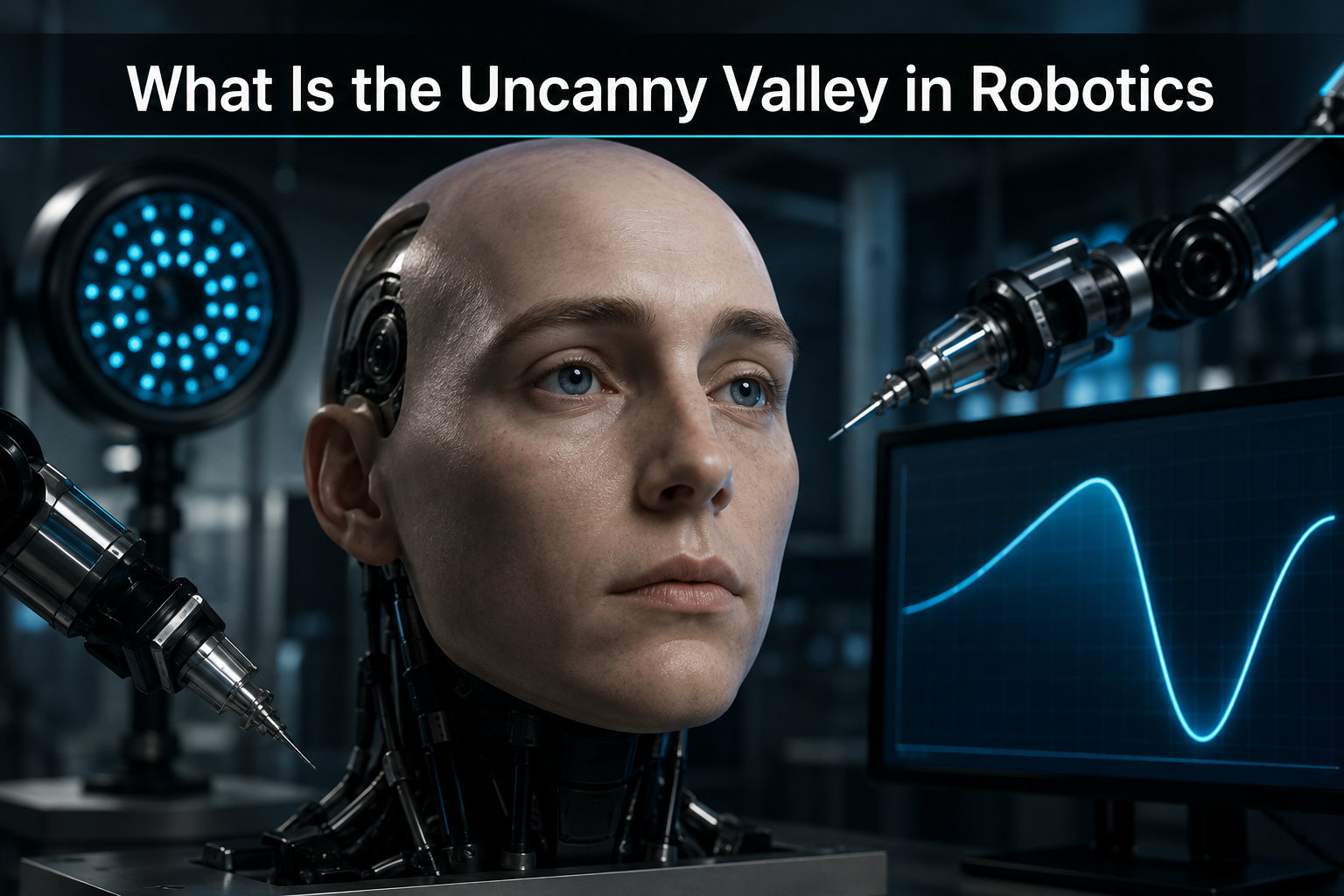
If you have ever looked at a humanoid robot and felt a sudden wave of discomfort, you have already met the uncanny valley in robotics. That uneasy feeling, somewhere between fascination and revulsion, is one of the most discussed topics in modern robotics. It shapes how we design human-like machines, how we judge CGI characters, and even how we respond to AI chatbots with human avatars.
I first ran into the concept while watching a robotics demo video where a mechanical face moved almost like a real human, but not quite. Something felt deeply wrong, even though I could not explain why. That reaction, repeated by millions of people, is exactly what Masahiro Mori described more than 50 years ago.
In this guide, I will walk you through the full story of the uncanny valley robotics phenomenon. You will learn where the theory came from, how the famous graph works, why movement makes the effect worse, and what designers and engineers are doing today to either avoid the valley or cross it entirely.
Table of Contents
What Is the Uncanny Valley in Robotics? A Clear Definition
The uncanny valley in robotics is a psychological hypothesis that describes how human emotional response shifts as a robot’s appearance approaches, but fails to reach, true human likeness. As a robot looks more human, our affinity for it rises, then suddenly plummets into a zone of eerie discomfort, and only climbs back up if the design becomes indistinguishable from a real person or fully commits to a non-human look.
The term was coined by Japanese roboticist Masahiro Mori in 1970, in an essay originally titled Bukimi no Tani, which translates to “the valley of eeriness.” Mori noticed that prosthetic hands and certain humanoid robots triggered a strange, gut-level revulsion in observers, even when the same people were fascinated by clearly mechanical robots.
For a quick mental model, picture a graph. On the horizontal axis sits human likeness, ranging from a clunky industrial arm to a fully biological human. On the vertical axis sits affinity, our positive emotional response. The line rises steadily, then dips sharply into a “valley” right before reaching true humanity, then rises again. That dip is the uncanny valley.
The Origin Story: Masahiro Mori and the 1970 Essay
To really understand uncanny valley robotics, you have to go back to 1970 in Japan. Masahiro Mori was a professor at the Tokyo Institute of Technology and a pioneer in the field of humanoid robotics. He had spent years building machines that mimicked human motion, and he noticed something that puzzled him.
The more lifelike his robots became, the more people responded positively, until a certain point. Then their reactions shifted. Instead of delight, they showed discomfort, unease, and even fear. Mori wrote about this in an essay for the Japanese robotics journal Energy, calling the effect bukimi no tani, the uncanny valley.
Mori’s insight was ahead of its time. In 1970, most robots were bolted to factory floors, and the idea of a humanoid companion robot seemed like science fiction. Yet his observations about prosthetic hands, wax figures, and even corpses pointed to a deeper truth: the human brain is wired to react strongly to things that look almost, but not exactly, like us.
The essay went largely unnoticed outside Japan for decades. It was translated into English in 2005 and 2012, after which it exploded into the robotics, design, and AI communities. Today, every serious discussion of human-like robots references Mori’s original 1970 paper.
How the Uncanny Valley Graph Works
The graph that defines uncanny valley robotics is simple but powerful. The horizontal axis measures human likeness, the degree to which a robot or character resembles a real person. The vertical axis measures affinity, our comfort, warmth, or positive feeling toward that entity.
As you move from left to right on the graph, the curve climbs steadily. A clearly mechanical robot, like a Roomba or a factory arm, sits low on affinity. As designs gain more human features, like a friendly mascot robot, affinity rises. But just before the design reaches true human appearance, the curve plunges into a deep valley. That trough represents peak eeriness. Then, on the far right, the curve climbs again for healthy humans, the gold standard of familiar appearance.
There are a few key points to understand about this graph. First, the valley is not at zero human likeness. It is at high, but not perfect, human likeness. Second, the depth and width of the valley can vary between individuals and cultures. Third, the graph is not a law of physics. It is a hypothesis, and one that continues to be tested in labs around the world.
Why Movement Makes the Valley Deeper
Mori made a second, often overlooked point: movement dramatically deepens the uncanny valley. A static image of a near-human robot can be unsettling, but a moving one is far worse. That is because movement activates a different part of our perception, the part that watches for signs of life, intention, and consciousness.
When a robot’s face moves in ways that do not match how a real human face moves, our brain flags it as wrong. A blink that is too slow, a smile that is too symmetrical, a head tilt that arrives a beat late, all of these small mismatches compound into full-blown creepiness. This is why CGI characters in early motion capture often felt more disturbing than the same characters in still images.
Modern robotics engineers treat movement as a critical design factor. The slightest timing error in facial actuators, the wrong eye blink rate, or an unnaturally smooth gesture can all push a robot deep into the valley.
Why Does the Uncanny Valley Happen? Theories Explained
Researchers have proposed several explanations for why uncanny valley robotics produces such a strong reaction. None of them alone fully explain the effect, but together they paint a convincing picture.
The Pathogen Avoidance Hypothesis
One leading theory suggests that the uncanny valley is an evolutionary defense mechanism. From an evolutionary standpoint, a human who looks mostly normal but slightly “off” could be sick, infected, or genetically compromised. Avoiding such individuals would have been a survival advantage.
Our brains may have evolved to flag near-human figures as potential disease carriers, triggering a disgust response that kept our ancestors away from danger. A robot that looks 95% human but moves in subtly wrong ways may inadvertently activate the same ancient alarm system, even though we know logically that a robot cannot be sick.
Evolutionary Mismatch and Category Ambiguity
Another explanation focuses on category ambiguity. Our visual system likes to sort what we see into clean categories: human, animal, machine, and so on. A robot that lands between two categories, neither fully human nor clearly mechanical, creates cognitive tension. We cannot easily classify it, and that uncertainty produces discomfort.
This is why cartoon robots like R2-D2 or Wall-E feel charming. They sit firmly in the “machine” category. But a robot with realistic skin, eyes, and hair but mechanical joints sits in an uncomfortable middle ground. The brain struggles to file it away, and the result is that unmistakable creepy feeling.
The Consciousness Illusion Theory
A third theory, sometimes called the consciousness illusion hypothesis, suggests that the uncanny valley exists because we are hard-wired to detect signs of a real mind. When a robot moves, we instinctively look for evidence of thought, intention, and feeling. If the cues are present but inconsistent, our mind invents a “consciousness” that is somehow broken, like a zombie or a sleepwalker.
This theory explains why the effect is so much stronger with motion. Movement suggests mind. A near-human robot that moves in slightly wrong ways feels like a mind trapped in a flawed body, which is the very definition of horror fiction.
Real-World Examples of the Uncanny Valley in Robots, Film, and Animation
The uncanny valley is not just a theory. It shows up everywhere, from humanoid robots to blockbuster films, and even in everyday objects like dolls and mannequins.
Humanoid Robots That Trigger the Effect
Some of the most cited examples in uncanny valley robotics come from real humanoid robots. Sophia, the famous robot developed by Hanson Robotics, sparked intense debate. Many people found her engaging, while others reported a strong sense of unease, particularly when she moved her face while speaking. Her skin looked human, but the tiny muscle twitches underneath felt slightly mechanical.
Engineered Arts’ Ameca, often called one of the most realistic humanoid robots ever built, sits right at the edge of the valley. When it tilts its head, blinks, and smiles, viewers are captivated for a moment, then visibly disturbed. Designers at Engineered Arts have openly discussed trying to climb out of the valley by adding more expressive, but stylized, gestures.
Boston Dynamics’ Atlas is an interesting counterexample. Even though Atlas is an advanced humanoid, it usually avoids the uncanny valley because its motion is clearly mechanical. There is no attempt to make it look like it has skin or facial expressions, so our brains file it cleanly as a machine.
CGI, Animation, and the Polar Express Problem
The uncanny valley is not limited to physical robots. It famously haunts the world of computer animation. The Polar Express (2004) is the textbook example. The film used motion capture to translate real actors into animated characters, but the result fell into the valley. Audiences reported the characters’ eyes as “dead” and their faces as “creepy,” and the film became a cautionary tale for CGI studios.
The same issue has surfaced in video games, virtual reality avatars, and AI-generated video. When digital humans get close to photorealism but miss the mark, viewers often feel deep discomfort. The closer the design gets to a real human, the more our brains scrutinize it, and the easier it is to find flaws.
Prosthetic Hands, Wax Figures, and Mannequins
Long before humanoid robots, Mori pointed to prosthetic hands as an uncanny valley trigger. A realistic prosthetic hand is often more disturbing than a hook, because it is so close to the real thing. Wax figures in Madame Tussauds and even high-end mannequins can trigger the same response, especially when viewed from certain angles or in dim lighting.
These examples show that the uncanny valley is not unique to robotics. It is a feature of how human perception handles any near-human object. The robotics field just happens to be where the effect has the most practical consequences.
How Designers Try to Avoid or Cross the Uncanny Valley
If you are building a human-like robot, you cannot simply ignore the uncanny valley. The good news is that engineers and designers have developed several strategies to deal with it.
Stylization and Intentional Abstraction
One of the most reliable approaches is to never get close to the valley in the first place. Designers intentionally style robots so they clearly read as machines. Think of Pepper, Jibo, or LOVOT, robots with friendly, cartoonish features that never pretend to be human. Their mechanical nature is obvious, so our brains accept them without triggering the creepiness response.
This is the path most consumer robots take, and it works well for assistants, companions, and educational machines. The trade-off is that these robots cannot do jobs that demand a realistic human appearance, like medical training or certain types of therapy.
Crossing the Valley with Modern AI
Some labs are trying to do the opposite: cross the valley and reach the far side, where the design is indistinguishable from a real human. The idea is that if the resemblance is truly perfect, affinity rises again. This is the strategy behind ultra-realistic androids like Hiroshi Ishiguro’s Geminoid series.
Modern AI is starting to make this approach more practical. Generative models can produce skin textures, micro-expressions, and voice tones that are nearly impossible to tell apart from real humans. Companies working on digital humans for customer service, entertainment, and healthcare are betting that the valley can be crossed rather than avoided.
Practical Tips for Robot Engineers
For engineers working on human-like robots, a few practical guidelines have emerged. First, match the level of realism across all systems. A realistic face with cartoonish hands looks worse than either both realistic or both stylized. Second, study human motion timing carefully. The smallest deviation in blink rate, breathing, or gaze direction can drop a robot deep into the valley.
Third, test with real users early and often. The uncanny valley is subjective, and the only way to know if your design triggers it is to watch real people interact with it. Fourth, consider context. A robot in a hospital setting may be judged more harshly than the same robot in a toy store, because the stakes feel higher.
Is the Uncanny Valley Real? What Current Research Says
So is the uncanny valley in robotics actually real, or is it just a catchy metaphor? The honest answer is that it is supported by a lot of evidence, but it is not a finished science. Brain imaging studies have shown that near-human robots activate regions associated with threat detection and disgust, which is consistent with the effect being a real neurological response.
However, individual sensitivity varies. Some people barely notice the uncanny valley, while others feel it intensely. Cultural background, age, and prior exposure to robots can all change how strongly someone reacts. Researchers continue to refine the original 1970 graph, and some have proposed alternative curves that account for personality, voice, and context.
What is not in doubt is that the uncanny valley is one of the most important ideas in uncanny valley robotics. Every serious designer of human-like machines plans around it, and every major failure to do so is publicly remembered.
Frequently Asked Questions
What is the uncanny valley theory of robots?
The uncanny valley theory of robots is a hypothesis by Masahiro Mori that says human emotional response increases as a robot looks more human, but drops sharply into a zone of discomfort when the robot looks almost-but-not-quite human, then rises again for indistinguishable or clearly non-human designs.
Who started the Uncanny Valley trend?
Masahiro Mori, a Japanese roboticist and professor at the Tokyo Institute of Technology, started the uncanny valley concept in 1970 with an essay called Bukimi no Tani, which translates to the valley of eeriness. The essay was later translated into English and became widely known in the 2000s.
When do people notice the uncanny valley effect?
People notice the uncanny valley most often when a robot or CGI character looks highly realistic but still has small flaws in skin texture, eye movement, facial timing, or body proportions. The closer a design gets to a real human without reaching it, the stronger the discomfort tends to be.
Why do human-like robots or dolls sometimes make people feel uneasy?
Human-like robots and dolls can make people feel uneasy because the brain struggles to classify them. They look almost human, so the brain expects a real mind and natural movement, but the small mismatches in motion, skin, or expression trigger an instinctive discomfort tied to disease avoidance and category ambiguity.
What are some examples of the uncanny valley in movies or technology?
Common examples of the uncanny valley in movies and technology include the 2004 film The Polar Express, video game characters that aim for photorealism but miss the mark, near-human robots like Sophia and Ameca, realistic prosthetic hands, wax figures, and modern digital humans used in customer service and entertainment.
How do designers and engineers try to avoid the uncanny valley effect?
Designers and engineers try to avoid the uncanny valley by using stylization, keeping robots clearly non-human, matching realism levels across all parts of the design, carefully tuning movement timing, and testing with real users. Some labs instead try to cross the valley by making robots indistinguishable from real humans.
Is the uncanny valley actually real?
The uncanny valley is supported by a large body of psychological and neuroscience research, but it is not a finished scientific law. Individual sensitivity varies, and researchers continue to study its exact causes. Most working roboticists, however, treat it as a real and important design constraint.
Final Thoughts: Why the Uncanny Valley Still Matters in 2026
The uncanny valley in robotics is more than a curiosity. It is a real psychological phenomenon that shapes how we design, build, and accept human-like machines. From Mori’s 1970 essay to today’s AI-powered androids, the valley has guided the field for over 50 years, and it remains just as relevant in 2026 as it was back then.
If you are building, buying, or simply curious about humanoid robots, understanding the uncanny valley helps you see why some designs feel charming while others feel deeply wrong. It also gives you a framework for judging the wave of new AI-driven human-like systems entering our homes, hospitals, and workplaces. The valley is not going away. The robots that learn to respect it, or to cross it, will define the next era of human-robot interaction.