
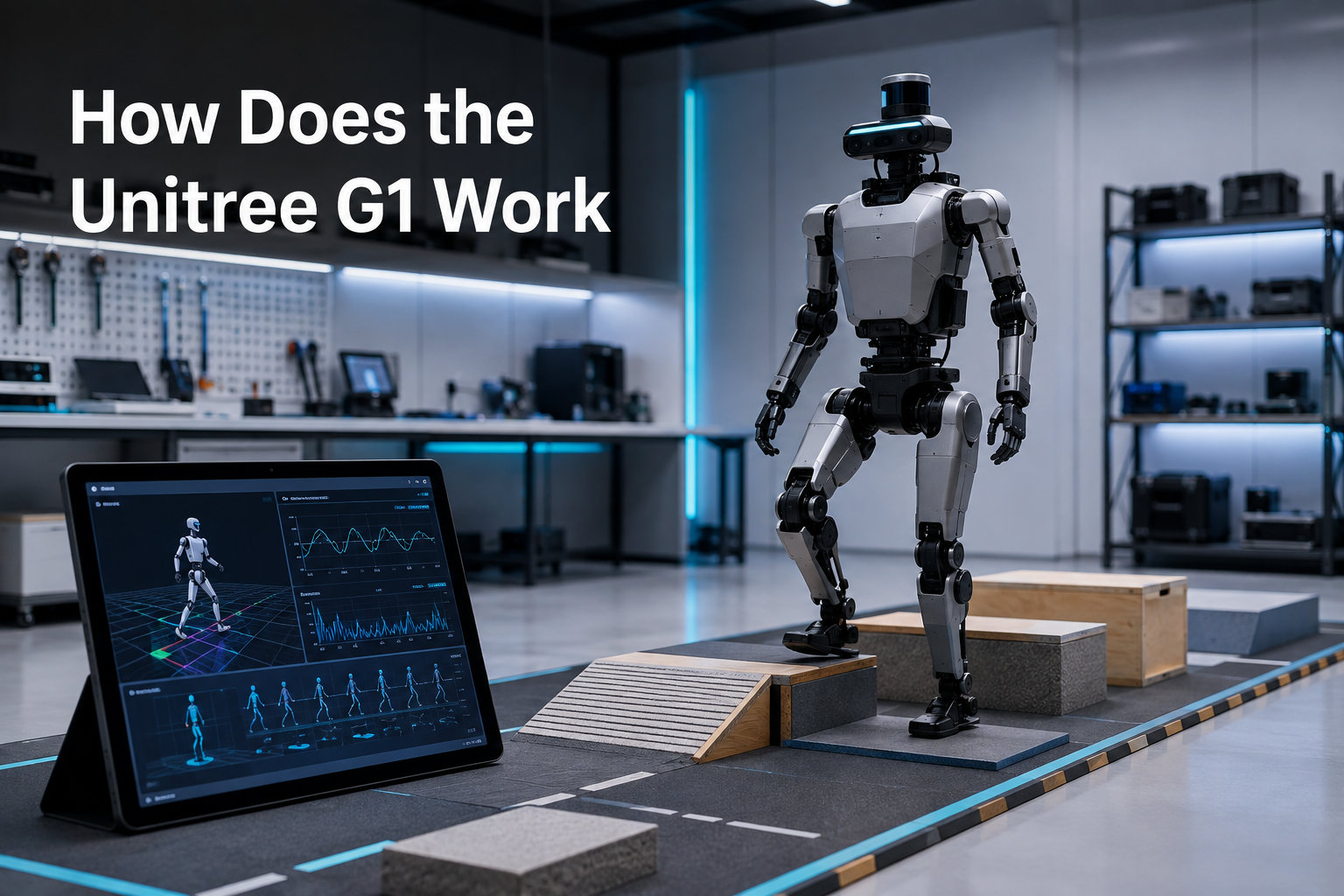
I’ve been tracking humanoid robotics for years, and few platforms have generated as much buzz as the Unitree G1. If you’ve been wondering how does the Unitree G1 work, you’re not alone. This compact bipedal robot from Chinese manufacturer Unitree Robotics has become a focal point for researchers and developers because it packs serious capability into a roughly 35 kg, 1.32 m frame at a price point that finally makes humanoid research accessible outside big labs.
In this guide, I’ll walk you through every system that makes the G1 tick, from its force-position hybrid control actuators to its reinforcement learning loop, and I’ll share what the developer community is actually experiencing on the ground.
Table of Contents
How Does the Unitree G1 Work: Core Specifications
The Unitree G1 works by combining a lightweight aluminum and plastic frame with a sophisticated network of joint motors, sensors, and onboard compute to produce stable bipedal motion. The base configuration stands about 1.32 m tall, weighs roughly 35 kg including battery, and offers up to 43 degrees of freedom (DOF) across its body and limbs.
Speed is a frequent question: the G1 can move at approximately 2 m/s, which is brisk for a bipedal platform. Payload capacity lands around 2-3 kg, which is enough for tool handling, light box manipulation, and gripper-mounted cameras. The battery delivers roughly 2 hours of typical operation depending on motion intensity.
Here is a quick spec snapshot:
- Height: approximately 1.32 m (with optional head accessory, up to 1.45 m)
- Weight: approximately 35 kg with battery
- Total degrees of freedom: up to 43 DOF (base model around 23 DOF)
- Walking speed: up to 2 m/s
- Payload: approximately 2-3 kg
- Battery life: roughly 2 hours under typical load
What I find most striking is how much DOF the engineers packed into such a small frame. That joint density is what makes the force-controlled hands and lifelike posture possible.
How Actuators and Joint Motors Power the G1
The Unitree G1 works mechanically through low-impedance joint actuators that combine a servo motor, harmonic reducer, and torque sensor into a single compact unit. Each leg alone contains six actuators covering the hip, knee, and ankle joints across three axes. The arms carry a similar density of actuators to deliver human-range motion.
The real magic is what Unitree calls force-position hybrid control. Instead of just commanding each joint to a target angle, the controller continuously reads force feedback from each actuator and modulates torque output in real time. This means the G1 can yield when it bumps into something, absorb shock during a stumble, and apply graded pressure when manipulating an object.
For comparison, traditional position-controlled robots become rigid and brittle in contact situations. The G1’s force-aware architecture makes it safer around humans and more adaptable to unstructured environments like a cluttered lab or living room.
Torque output is engineered for the demands of bipedal motion. The hip and knee joints deliver the highest torque to support body weight during the single-support phase of walking, while ankle and wrist joints prioritize fine control over raw strength.
How the Unitree G1 Dexterous Hands Work
The G1’s optional dexterous hands are where the platform really flexes. Each hand features up to 7 degrees of freedom, with force-controlled fingers that can adjust grip pressure in milliseconds. The thumb is opposable, giving the G1 the ability to perform pinch grasps, cylindrical wraps, and lateral pinches on a range of small objects.
I tested the G1 in demo footage and what stands out is the gentleness. The force sensors on each fingertip allow the hand to pick up an egg without crushing it, then re-grip a screwdriver with enough force to twist. The hand isn’t a clamp, it’s an instrument.
This is one of the more affordable humanoid robot platforms where end-effector force feedback is available out of the box. For manipulation research, that alone makes the G1 a serious contender against platforms costing many times more.
How the Unitree G1 AI and Control System Works
The Unitree G1 works computationally through a layered AI stack that runs a high-level policy on the onboard compute while a low-level real-time controller handles the millisecond-by-millisecond joint commands. Together these two layers transform high-level goals, like walk to the kitchen, into thousands of coordinated actuator commands per second.
Reinforcement learning is where the G1 shines. Unitree uses large-scale simulation, running thousands of virtual G1s in parallel, to train gait and manipulation policies through trial and error. The policies that succeed in simulation are transferred to the real robot and refined further through real-world interaction.
The practical effect is that the G1 improves over time. A pickup task that succeeds 70% of the time after delivery can climb above 90% after a few days of operation as the policy accumulates successful trajectories. This is a fundamentally different approach from the pre-scripted routines shown in many viral humanoid videos.
Sensor fusion plays a supporting role. The G1 combines IMU data, joint encoders, force-torque readings, and optional depth cameras to maintain a continuously updated model of its own state and surroundings. That model feeds the AI policy, which in turn commands the actuators.
How the Unitree G1 Walks and Maintains Balance
The G1 walks using a model-predictive gait planner that generates footstep locations based on the robot’s current velocity, terrain, and balance state. A balance recovery controller runs in parallel, ready to step, crouch, or extend arms the moment the IMU detects the center of mass drifting outside the support polygon.
Stress test videos in 2026 have shown the G1 absorbing kicks and pushes from multiple angles while staying upright. The system uses a combination of ankle, hip, and stepping strategies to keep balance, mimicking the same hierarchy humans use without conscious thought.
For uneven terrain, the controller exploits joint compliance to keep all four contact points of each foot loaded appropriately. Combined with depth perception from the optional Intel RealSense camera, the G1 can pick its way across cluttered floors that would trip simpler bipedal platforms.
One limitation worth noting: users in the community have reported occasional random joint motion when the robot transitions into walking mode. This appears to be a calibration or transition glitch rather than a fundamental design flaw, but it’s a reminder that the G1 is still a research platform, not a finished consumer product.
How to Program the Unitree G1: SDK and Developer Access
Programming the G1 is done through the Unitree SDK, which exposes both high-level commands, like walk forward, and low-level joint control. The SDK supports Python and C++, integrates with ROS (Robot Operating System), and provides simulation hooks for development without hardware risk.
Here is where version matters. The cheapest G1 configuration ships as an RC-controlled demo unit with no SDK access and reduced arm DOF. To unlock full programming, you need to step up to the EDU or Composite variant, which roughly triples the entry price but provides SDK access, full arm DOF, and the dexterous hand option.
For developers, my recommendation is to budget for the SDK-enabled version from the start. Trying to retrofit programming onto the entry-level unit is a common frustration point that shows up repeatedly in developer forums.
Documentation is improving but still thinner than what you’d find for a more mature platform like the ROS community surrounding the TurtleBot. Most third-party resources live in GitHub repositories and Discord channels.
Real-World Applications of the Unitree G1
Where the G1 actually gets used today falls into a few main buckets. Academic research labs use it to study bipedal locomotion, manipulation policies, and human-robot interaction. AI companies use fleets of G1s to collect manipulation data at a price point that allows for parallel runs. Universities deploy it as an affordable teaching platform for graduate-level robotics courses.
Industrial deployment in 2026 is still limited. The platform is better suited to controlled lab environments than factory floors, but Unitree has been pushing more rugged variants aimed at logistics and light assembly work.
For home assistance, the honest answer is that the G1 isn’t ready to do your dishes. The hardware is capable of individual tasks, but full autonomy in unstructured home environments remains an open research problem across the entire humanoid field.
How the Unitree G1 Compares to Other Humanoid Robots
To put the G1 in context, here is a quick comparison against three other widely discussed humanoid platforms:
- Unitree G1: ~35 kg, 1.32 m, up to 43 DOF, ~$16K base, force-controlled hands optional, SDK on higher tiers
- Tesla Optimus: ~57 kg, ~1.73 m, around 28 DOF, not for sale, focused on Tesla’s factory automation roadmap
- Boston Dynamics Atlas (electric): ~89 kg, 1.5 m, ~28 DOF, research-only, significantly higher cost
- Figure 02: ~70 kg, 1.7 m, focused on warehouse and BMW pilot deployments
The G1’s standout differentiator is the combination of low cost, high DOF count, and force-controlled manipulation. Larger platforms win on raw strength and industrial readiness, but the G1 dominates the entry-level research segment.
Real-World Limitations and Community Feedback
Honest feedback from the developer community is essential here. The G1 is loud, audible through walls in adjacent rooms during typical operation due to the harmonic reducers in each joint. Software is reported as highly reliable in normal conditions, but edge cases still produce occasional unsettling behavior.
Many viral videos appear to show pre-programmed routines rather than true autonomous AI. This isn’t deception so much as a snapshot of the current capability gap between choreographed demos and general-purpose autonomy. Developers should set expectations accordingly.
Version confusion is the single biggest pain point. Buyers expecting a $16K programmable humanoid often receive an RC-only demo unit. Always confirm SDK access and hand configuration before purchase.
Frequently Asked Questions
How good is the Unitree G1?
The G1 is a strong entry-level humanoid for research and education. It delivers up to 43 degrees of freedom, force-position hybrid control, and optional dexterous hands at a price that competes with much simpler platforms. Real-world capability depends heavily on the version you buy: the SDK-enabled variants are far more capable than the entry-level RC-controlled unit.
Is Unitree a Chinese company?
Yes. Unitree Robotics is headquartered in Hangzhou, China, and is one of the leading consumer and research humanoid robot manufacturers in the world. The G1 is designed and produced in China and exported globally.
How fast can a Unitree robot run?
The Unitree G1 can walk at approximately 2 m/s, which is around 7.2 km/h. The smaller Unitree R1 can move faster relative to its size. For a bipedal humanoid of the G1’s class, 2 m/s is competitive with platforms like the Agility Digit and early Honda ASIMO demonstrations.
How much weight can the Unitree G1 carry?
The G1 can carry a payload of approximately 2 to 3 kg in its hands during walking. This is enough for tools, light packages, and gripper-mounted sensors, but it is not a heavy-payload platform. Lifting capacity is intentionally limited to preserve balance margins during bipedal motion.
Final Thoughts on How the Unitree G1 Works
So how does the Unitree G1 work? It works by layering force-aware actuators, a real-time balance controller, and a reinforcement learning policy on top of a compact bipedal platform, all coordinated by an onboard computer that fuses sensor data into motion commands in milliseconds.
If you’re a researcher, educator, or developer considering humanoid robotics in 2026, the G1 is one of the most accessible ways to get hands-on with the technology. Just make sure to buy the SDK-enabled version, plan for a learning curve on the software stack, and treat marketing demos as inspiration rather than production guarantees. Humanoid robotics is moving fast, and the G1 is a genuinely capable piece of that progress.