
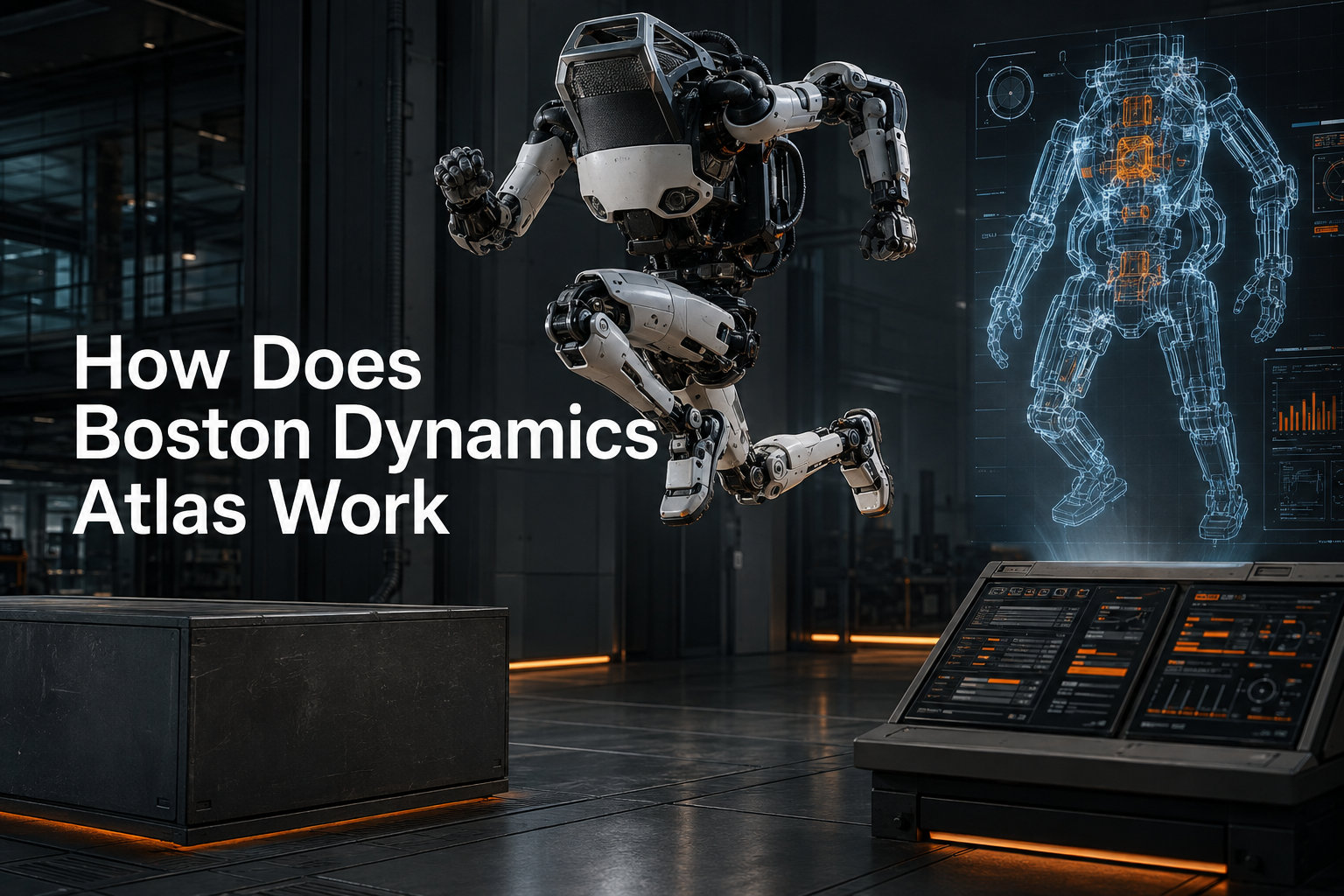
If you have ever watched a Boston Dynamics Atlas video and wondered how a robot can backflip, sprint across a warehouse floor, and pick up a heavy engine block without falling over, you are in good company. I have spent the last several weeks digging through Boston Dynamics engineering posts, DARPA documentation, and a year of YouTube demonstrations to answer one simple question: how does Boston Dynamics Atlas work, really?
Atlas is not magic. It is a stack of carefully engineered hardware and software layers that work together so the robot can see, think, and move like a human. In this guide I will walk you through every layer, from the 28 electric actuators that power its limbs, to the LIDAR and stereo cameras that give it vision, to the machine learning models that let it pick up a car seat on a factory floor.
By the end, you will understand the full picture of how does Boston Dynamics Atlas work, including how it compares to Tesla Optimus, whether you can actually buy one, and what makes it different from every other humanoid robot on the planet.
Table of Contents
What Is Boston Dynamics Atlas?
Atlas is a bipedal humanoid robot built by Boston Dynamics, the American robotics company now owned by Hyundai Motor Group. It stands about 5 feet tall, weighs roughly 190 pounds, and is designed to operate in environments that were built for humans.
The first Atlas prototype was unveiled in 2013 as a hydraulically actuated research platform funded by the U.S. Defense Advanced Research Projects Agency, also known as DARPA. Back then, Atlas was a loud, tethered machine designed to compete in the DARPA Robotics Challenge, where it had to drive a car, clear debris, and open doors.
In April 2024 Boston Dynamics retired the hydraulic version and released a fully electric Atlas. The new model is quieter, stronger, and more dexterous. It can rotate its joints through 360 degrees, pick up heavier objects than its predecessor, and run reinforcement learning models that teach it new skills inside simulation rather than on the factory floor.
So when people ask how does Boston Dynamics Atlas work in 2026, the short answer is: it works through three integrated systems. There is a hardware layer of electric actuators, a perception layer of cameras and LIDAR, and a software layer of AI models. I will cover each one in detail in the next sections.
How Does the Electric Actuation System Work?
The electric actuation system is the muscle and skeleton of Atlas, and it is the single biggest difference between the 2024 electric model and every Atlas that came before it. Instead of hydraulic pumps, the new Atlas uses high-torque electric motors at every joint.
Atlas has 28 degrees of freedom, which is the engineering term for the number of independent ways the robot can move. Each leg has 6 degrees of freedom, each arm has 7, the torso has 3, and the neck adds 1. That gives Atlas the same kind of flexibility a human body has, including the ability to twist at the waist and bend backward at the hips.
Inside each joint, Boston Dynamics uses a custom rotary actuator built around a high-torque electric motor, a planetary roller screw, and a neodymium magnet rotor. The planetary roller screw converts the spinning motion of the motor into linear force, which lets the joint produce up to several thousand newtons of push or pull. That is how Atlas can lift objects heavier than its own body without shaking apart.
Every actuator also includes a precision joint encoder that tells the controller the exact angle of the limb at all times. The controller runs at more than 1,000 cycles per second, so Atlas can react to small slips or pushes before they turn into a fall. This is also why the new electric Atlas looks so much smoother on video than the hydraulic version. The electric motors respond faster and the controllers are not fighting against fluid compression in hoses.
If you want the one-sentence answer to how does Boston Dynamics Atlas work on a hardware level, it is this: 28 electric motors, 28 precision encoders, and a real-time controller all talking to each other thousands of times per second.
How Does Atlas See the World?
Atlas has no eyes in the human sense, but its head is packed with sensors that give it a much richer picture of the world than we get. The perception system is what makes the difference between a robot that walks on a flat track and a robot that can find a specific crate in a messy warehouse.
Atlas uses three main sensor types. It has a LIDAR unit that sends out laser pulses and measures how long they take to bounce back, which builds a 3D map of every surface around the robot. It has stereo cameras, which are two regular cameras set slightly apart so the system can compare the two images and figure out how far away every object is, similar to how human eyes work. It also has depth cameras that combine color images with distance data for close-up work.
The perception team at Boston Dynamics describes their approach in three layers. The first layer is 2D awareness, which answers the question: what objects are in the environment? The system runs an object detection model on every camera frame and labels things like crates, ladders, and toolboxes. The second layer is 3D awareness, which answers: where is each object relative to Atlas? It fuses the 2D labels with LIDAR and depth data so Atlas knows a crate is 3.2 meters ahead and slightly to the right.
The third layer is object pose estimation, which answers the most important question: how should Atlas physically interact with the object? To do that, the system uses a tool called SuperTracker, which I will cover in the next section. The result is that Atlas can locate a specific car seat, understand which way it is facing, and figure out the right grip points to pick it up.
So when you ask how does Boston Dynamics Atlas work in real environments, the perception system is the answer. Without it, the robot would be blind, no matter how good its motors are.
How Does Atlas Use AI and Machine Learning?
This is the part I find most interesting, because the AI system is where Boston Dynamics has pushed the furthest beyond classic robotics. Most industrial robots run pre-programmed scripts. Atlas runs learned behaviors.
The core of the AI stack is what Boston Dynamics calls Athletic Intelligence. In a blog post from September 2026, the team described Athletic Intelligence as a set of behaviors and foundation models that give Atlas human-like whole-body coordination. Rather than hard-coding a routine for every possible task, the team trains behaviors in simulation using reinforcement learning, then transfers the learned policy to the real robot.
One of the most important AI components is SuperTracker. SuperTracker is a vision system that takes a 3D model of an object, for example a car seat, and tracks that object in real time as Atlas moves around it. It uses a render-and-compare approach: it renders the 3D model from the robot’s current viewpoint, compares that rendering to the actual camera image, and adjusts the robot’s position until the two line up. The result is millimeter-level object pose estimation, which is the difference between grasping a handle and missing it by an inch.
Another key component is keypoint detection. For tasks where there is no clean 3D model, the system predicts a small set of anchor points on the object, like the corners of a bin or the holes in a bracket. This is called fixture localization, and it lets Atlas align itself with parts that are messy, partially hidden, or hard to model exactly.
The latest models also use a foundation vision model that is trained on huge amounts of general visual data. Foundation models let Atlas recognize new objects with very little extra training, which is critical for factory environments where product designs change every few months.
So when someone asks me how does Boston Dynamics Atlas work so fluidly, my answer is: the AI layer turns raw sensor data into actions, and the AI is trained, not scripted. That is the real breakthrough.
How Does Atlas Move and Balance?
Atlas moves the way it does because of a combination of model-predictive control, whole-body coordination, and a behavior library trained through reinforcement learning. The controller plans several steps into the future, then executes the best motion it can find in the available time.
Model-predictive control means the controller solves a small optimization problem at every tick. It asks: given the current state of every joint and the goal I want to reach, what motor commands keep me balanced and on track? It solves that problem 20 to 30 times per second, which is why Atlas can recover from a shove or a stumble without falling over.
Whole-body coordination means Atlas does not control its arms, legs, and torso separately. It treats the body as one system, so it can swing its arms for balance the way a tightrope walker does, or lean into a heavy lift with its hips while keeping its arms steady. This is the difference between a robot that walks and a robot that moves like a person.
Behavior libraries trained in simulation cover a long list of skills: walking on flat ground, climbing stairs, crouching, jumping, and the famous parkour routines. Each behavior is a small neural network that maps sensor input to motor commands, and the team composes these behaviors like Lego blocks. If a routine needs a backflip followed by a sprint, the controller hands off from one behavior to the next.
For balance, Atlas uses its inertial measurement unit, which is a combination of gyroscopes and accelerometers, to track its orientation in space. When the IMU detects a tilt, the controller adjusts the joints in milliseconds. This is also why Atlas can crouch to pick something off the floor and stand back up without falling backward. The whole-body controller is constantly calculating the center of mass and keeping it over the support polygon defined by the feet.
How Does Atlas Manipulate Objects?
Manipulation is where all the layers I have described so far come together. Picking up a car seat is not just about closing a gripper. Atlas has to see the seat, understand its pose, move its body to the right position, and then apply just enough force to lift it without crushing it or losing balance.
The hands themselves are compact, custom-built grippers with three fingers arranged for both pinch grasps and power grasps. The fingertips have tactile sensors that detect contact and slip, so Atlas can adjust its grip the moment a part starts to slide.
The manipulation pipeline works in four steps. First, the perception system finds the target object and estimates its pose. Second, the planner decides how Atlas should position its body relative to the object. Third, the motion controller generates a smooth trajectory for every joint. Fourth, the gripper closes and the tactile sensors confirm a stable hold.
For tasks that involve putting a part into a fixture, the system uses render-and-compare. Atlas renders the expected view of the fixture, compares it to the camera image, and uses the difference as an error signal to move itself into alignment. This is how the robot can line up a battery module with bolt holes that are a few millimeters wide, even when the parts are different from anything the robot saw during training.
What I love about this design is that nothing is hard-coded. The same pipeline that lets Atlas pick up a car seat can let it pick up a crate, a tool, or a box, as long as the perception system can identify the object and estimate its pose.
Atlas vs Tesla Optimus: How Do They Compare?
This is the comparison everyone wants, so let me give you a direct answer. Yes, Atlas is more advanced than Optimus in most of the dimensions that matter for real-world humanoid robotics in 2026.
On hardware, Atlas has 28 degrees of freedom, while Optimus has been described with around 40 actuators, but the engineering quality of Boston Dynamics’ rotary actuators and planetary roller screws is widely considered best in class. On perception, Atlas has a mature LIDAR plus stereo vision stack, while Optimus relies primarily on vision. On autonomy, Atlas can sequence complex industrial tasks in unstructured environments, while Optimus demos have so far focused on simpler, scripted routines.
The honest difference is this. Atlas is a research and pilot-deployment platform, refined over 13 years and used in real factory pilots with Hyundai. Optimus is a younger program with very ambitious goals but fewer public deployments. Both are impressive in their own way, and the field benefits from both programs. But if you measure by what is actually working in an industrial setting today, Atlas is the more advanced platform.
Where Is Atlas Used in the Real World?
Atlas is no longer just a YouTube star. In 2026, Boston Dynamics is running pilots with Hyundai at several manufacturing facilities, including the Hyundai Motor Group Innovation Center in Singapore. The robot is used for sequencing tasks in factory cells, particularly for parts that are awkward, heavy, or hard to automate with traditional robotic arms.
Typical real-world tasks include picking up large subassemblies, sorting parts between bins, and moving items between conveyors. These are the dull, dirty, and sometimes dangerous jobs that factories have struggled to automate with fixed robots because the parts are too big, the layouts change too often, or the work happens in spaces designed for human workers.
Outside of automotive, Boston Dynamics has positioned Atlas for use cases like warehouse material handling, search and rescue, and any environment that is too dangerous for humans. Search and rescue in particular was one of the original DARPA motivations for the platform, and the electric Atlas is the first version that is actually practical to deploy in a disaster zone because it does not need a hydraulic power supply.
The bigger picture is that humanoid robots like Atlas are about filling the labor gap in industries that cannot find enough workers, and about taking people out of the most physically punishing jobs. That is why the Hyundai partnership matters so much: it is the first time Atlas has had a real customer with real production lines.
Frequently Asked Questions
Can I buy a Boston Dynamics Atlas?
No. As of 2026, Boston Dynamics does not sell Atlas to individual buyers. Atlas is a research and pilot-deployment platform offered to select commercial partners, primarily through the Hyundai Motor Group pilot programs and other enterprise partnerships.
Is Atlas more advanced than Tesla Optimus?
By most technical measures, yes. Atlas has 28 degrees of freedom, a mature LIDAR and stereo vision perception stack, and is already running real factory pilots. Optimus is an ambitious program with rapid progress, but in 2026 it has fewer public industrial deployments.
How much does one Atlas robot cost?
Boston Dynamics has not published a price for Atlas. Because the platform is built around custom rotary actuators, custom controllers, and a custom software stack, industry estimates place the cost of a single Atlas in the high six figures, but exact figures are not public.
Is Atlas autonomous or remote controlled?
Atlas is autonomous. The perception system, planning layer, and behavior library run on the robot itself. Operators do not joystick Atlas in real time. They set high-level goals, like pick up that seat, and the robot figures out how to do it.
What makes Atlas different from other humanoid robots?
Three things: the quality of its electric rotary actuators, the depth of its perception stack, and the use of reinforcement learning to teach whole-body behaviors in simulation. That combination is what allows Atlas to do real industrial work, not just lab demos.
Final Thoughts on How Atlas Works
So how does Boston Dynamics Atlas work? It works because three very different systems, electric actuation, multi-modal perception, and learned AI behaviors, were engineered to work as one. None of the layers on their own is enough. The actuators without perception would be a fancy marionette. The perception system without learned behaviors would be a scanner. The AI without real hardware would be a simulation. Put them together and you get a robot that can walk into a factory, find a part, pick it up, and hand it to a human coworker without anyone writing a single line of code for that specific task.
What excites me most about Atlas in 2026 is that it is no longer a research curiosity. It is running real shifts in real factories through the Hyundai partnership. That is the moment when humanoid robotics stops being a YouTube genre and starts being an industry.
If you want to keep following the field, I would bookmark the Boston Dynamics blog, the official YouTube channel, and the Atlas Wikipedia page. Every few months they release new technical posts that peel back another layer of how this platform works. I will keep updating this guide as more details come out, because the answer to how does Boston Dynamics Atlas work changes every quarter.