
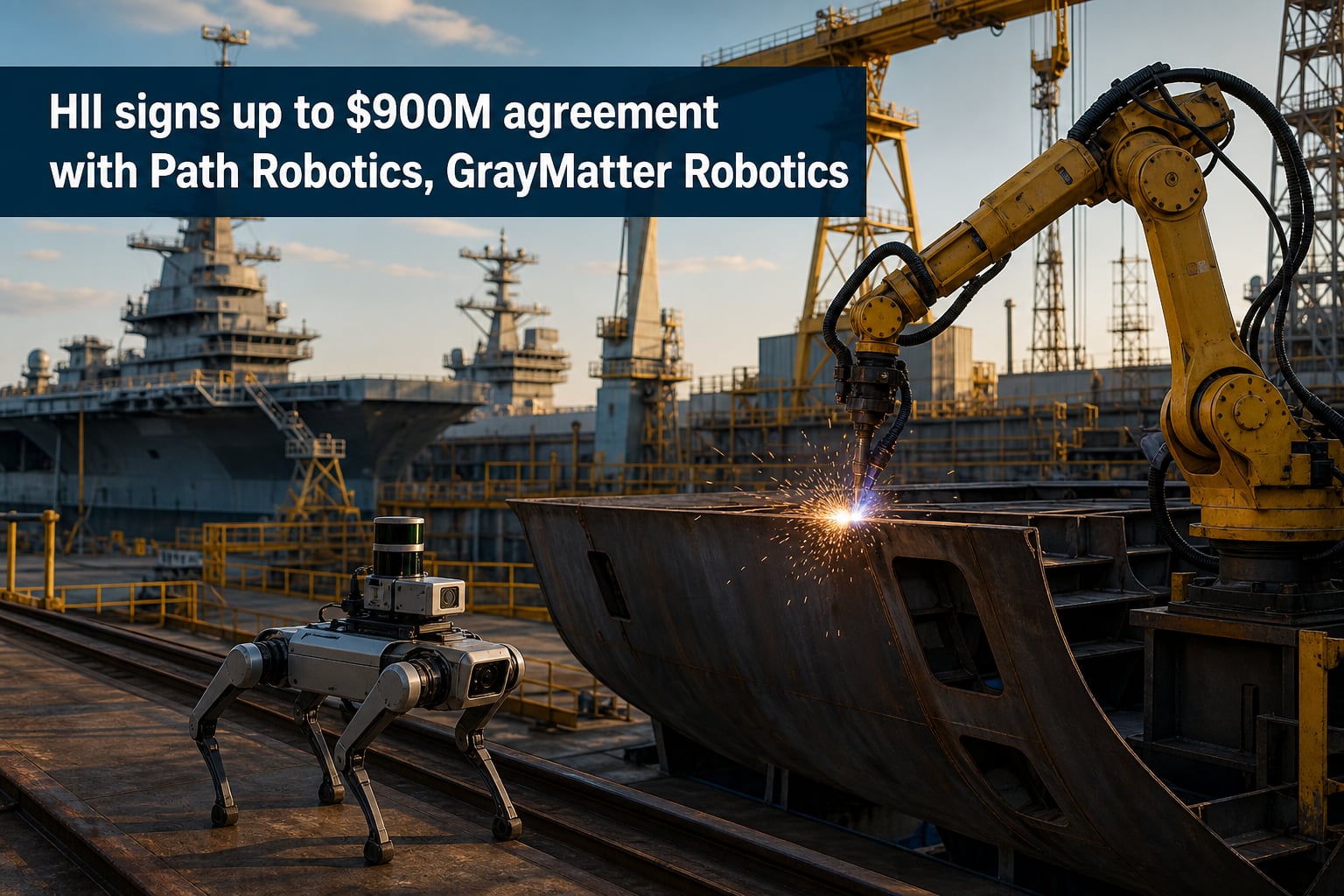
Huntington Ingalls Industries (HII) just signed a multi-year deal worth up to $900 million with two robotics companies to bring physical AI into U.S. Navy shipyards. I covered the announcement on August 6, 2026, and the scale of this agreement caught my attention immediately.
The seven-year, performance-based production agreement names Path Robotics and GrayMatter Robotics as the first industry partners under HII’s HYPR (High-Yield Production Robotics) program. Our team has been tracking HII’s automation investments for a while, and this is the largest single commitment the shipbuilder has made to date.
Path Robotics contributes its Obsidian physical AI model, while GrayMatter brings AI-powered robotic grinding, sanding, blasting, and painting systems. Together, they will help HII ramp up production of aircraft carriers, submarines, destroyers, amphibious ships, and unmanned surface vessels at a time when the Navy needs more hulls faster than ever.
Table of Contents
What Is the HYPR Program and Why Does It Matter
HYPR stands for High-Yield Production Robotics, and HII designed it as the centerpiece of its shipyard modernization strategy. The program is built on an open, modular architecture that lets multiple robotics vendors plug into the same production backbone.
I see HYPR as HII’s answer to a long-standing problem: shipbuilding capacity has lagged behind demand, and traditional automation has struggled with the variability of naval steel fabrication. The program gives HII a structured way to test, qualify, and scale new automation before committing it to high-stakes Navy work.
For Path Robotics and GrayMatter, joining HYPR means their systems go through a formal Navy-grade development stage with testing, qualification, and oversight. Only after passing that gate does HII source actual production work from them under the performance-based funding model.
Meet the Players: HII, Path Robotics, and GrayMatter Robotics
HII is America’s largest military shipbuilder, with major operations at Newport News Shipbuilding in Virginia and Ingalls Shipbuilding in Mississippi. The company builds nuclear-powered aircraft carriers and submarines at Newport News, and destroyers, amphibious ships, and Coast Guard cutters at Ingalls.
Path Robotics is a Cleveland-based startup known for its self-programming welding systems. The company’s flagship product, Obsidian, is a physical AI model trained to handle complex welding tasks without explicit programming. Path Robotics pairs Obsidian with a quadruped robot in a platform called Rove, which can navigate shipyard floors and reach awkward weld joints.
GrayMatter Robotics is a Los Angeles-based firm focused on AI-powered surface finishing. Its robots handle grinding, sanding, blasting, and painting with the kind of consistency that is hard to achieve with manual labor. CEO Ariyan Kabir has positioned the company around a concept he calls Factory SuperIntelligence, where multiple robotic cells coordinate to finish entire assemblies.
Physical AI at Work: Welding, Grinding, Sanding, and Inspection
Physical AI is a term that covers AI systems that perceive and act on the physical world, not just generate text or images. In a shipyard, that means robots that can see a steel plate, figure out the weld path, and execute it without a human programming every joint.
Welding is the headline application for Path Robotics. Complex naval steel structures have hundreds of unique weld joints, and programming each one by hand is slow and error-prone. Obsidian watches the part, plans the welds in real time, and adapts to dimensional variation on the fly.
GrayMatter’s robots handle the labor-intensive surface finishing work that follows welding. Grinding welds smooth, sanding surfaces for paint, blasting for coating prep, and applying marine paint are all physically demanding and repetitive. Our team has seen firsthand how robotic finishing cells can keep a consistent surface profile across thousands of square feet without fatigue.
Inspection is the fourth pillar. Both companies are building computer-vision systems that can check weld quality, surface finish, and dimensional accuracy before a part moves down the line. That closes a feedback loop that is hard to achieve when humans perform every check.
Which Navy Programs Will Benefit From the Robotics Deal
The agreement covers a broad swath of the U.S. Navy’s shipbuilding portfolio. HII has been explicit that the automation will support aircraft carriers and submarines out of Newport News, and destroyers, amphibious ships, and unmanned surface vessels out of Ingalls.
Aircraft carriers are the largest steel structures HII builds, and the Ford-class program has been a particular focus for capacity improvements. Submarines, including the Virginia-class and the future Columbia-class ballistic missile boats, demand extremely tight tolerances and intensive welding.
Destroyers like the Arleigh Burke class and the future Constellation class are produced at Ingalls, along with amphibious transport docks and landing helicopter assault ships. Unmanned surface vessels are a growing Navy priority, and HII wants to build them on the same production lines as crewed hulls, which is where modular robotics really pays off.
Development Stages, Milestones, and 2026 Capacity Goals
The agreement follows a two-stage structure. Stage one is a Navy-grade development phase in which Path Robotics and GrayMatter validate their systems for the strict tolerances of warship construction. That includes testing, qualification, and oversight by HII engineers.
Stage two is the delivery phase, where HII begins sourcing shipbuilding work from the two companies under performance-based funding. Each milestone is tied to measurable quality and throughput metrics. Funding only releases when the systems hit those targets.
HII has stated it plans to outsource roughly 2.5 million hours of shipbuilding work to automation partners in 2026, which would be a 30% increase over its 2025 outsourcing volume. The longer seven-year runway gives both robotics companies room to scale capacity, hire, and refine their technology without scrambling for short-term contracts.
What the Executives Are Saying
HII leadership has framed the deal as a step toward industrial base resilience and distributed shipbuilding. The company wants to be able to surge production across multiple yards rather than concentrating risk at one site.
Path Robotics executives have highlighted Obsidian as the first physical AI model built specifically for welding complex steel structures. The Rove quadruped platform is positioned as proof that mobile manipulation is ready for harsh shipyard environments.
GrayMatter’s Kabir has called the deal a vote of confidence in the Factory SuperIntelligence vision, where AI coordinates not just one robot but whole production cells. The two-stage structure gives GrayMatter the runway to prove that vision on real Navy work.
How much is the HII Path Robotics GrayMatter agreement worth?
HII intends to award up to $900 million in total shipbuilding work to Path Robotics and GrayMatter Robotics across a seven-year performance-based production agreement announced in 2026.
What is the HYPR program?
HYPR stands for High-Yield Production Robotics. It is HII’s modular program for testing, qualifying, and scaling AI-powered automation across U.S. Navy shipbuilding programs.
What AI company does HII use to build ships?
HII is partnering with Path Robotics, whose Obsidian physical AI model powers self-programming welding systems, and GrayMatter Robotics, whose AI platform handles robotic grinding, sanding, blasting, painting, and inspection.
Which Navy programs will benefit from the robotics deal?
The agreement covers aircraft carriers and submarines built at Newport News Shipbuilding, and destroyers, amphibious ships, and unmanned surface vessels built at Ingalls Shipbuilding.
What is physical AI in shipbuilding?
Physical AI refers to AI systems that perceive and act on the physical world. In shipbuilding, that means robots that can see a steel part, plan weld or finishing paths in real time, and adapt to dimensional variation without explicit programming.
What This Means for U.S. Shipbuilding Capacity
This is the largest single commitment HII has made to shipbuilding automation, and it lands at a moment when the Navy is asking private yards to deliver more hulls on tighter timelines. Our team views the deal as a real test of whether distributed, AI-powered production can close the capacity gap that has dogged U.S. naval shipbuilding for years.
Workforce questions will follow. Skeptics on forums I follow point to the highly automated Chinese shipyards that reportedly produce hundreds of vessels per year, and ask whether HII can match that pace without disrupting its existing welders, painters, and shipfitters. The two-stage structure at least gives HII room to reskill workers into higher-value roles while robots take on the most physically punishing tasks.
For Path Robotics and GrayMatter, the next eighteen months will be the proof point. If their systems clear Navy-grade qualification and start hitting throughput milestones, expect HII to expand HYPR to additional vendors. If they do not, the $900M ceiling could stay theoretical. Either way, this agreement sets the template for how America’s largest military shipbuilder plans to bring physical AI into the shipyard.