
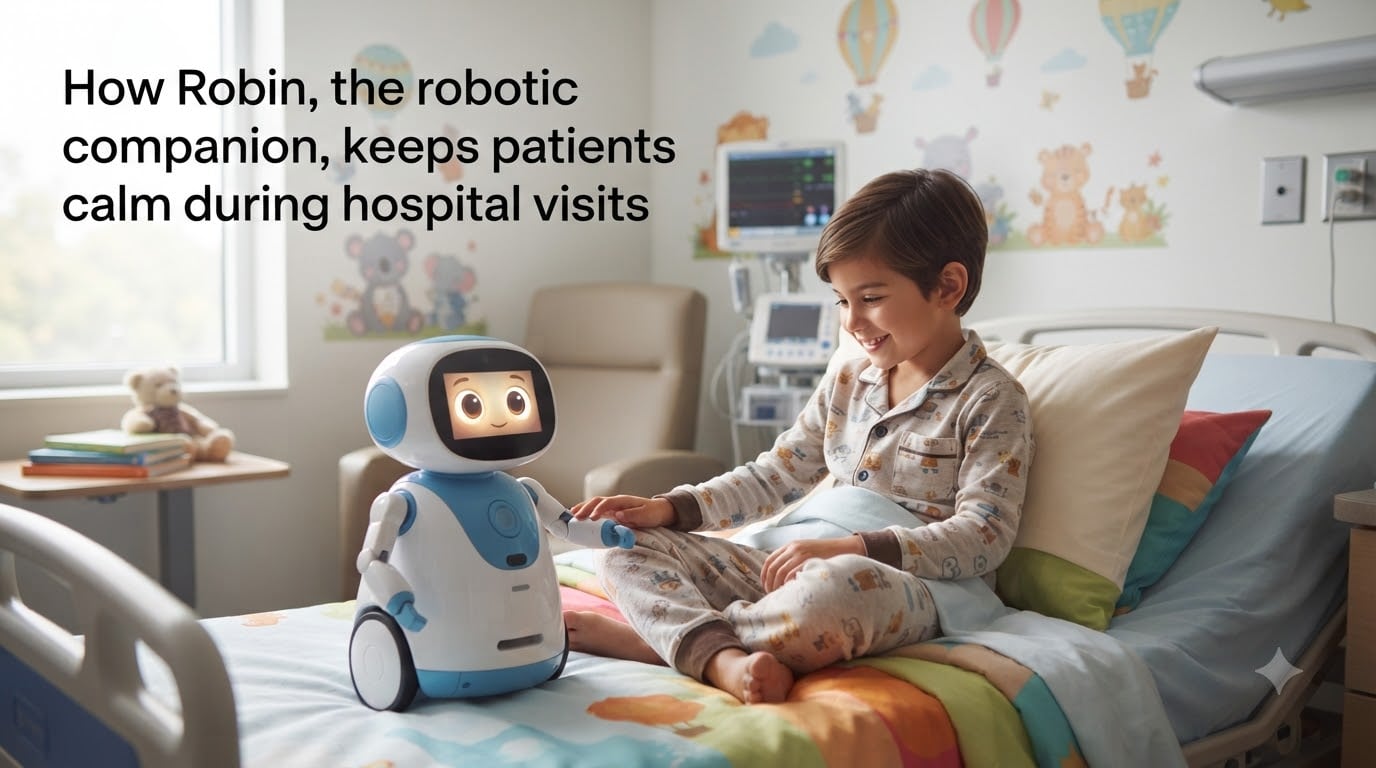
I first came across Robin the robotic companion in a video from a children’s hospital, where a small wheeled robot was helping a kid laugh through a blood draw. The moment stuck with me because the child genuinely looked calmer within seconds. That’s the kind of result Robin promises, and in 2026 it has become one of the most talked-about therapeutic robots in healthcare.
Robin is a socially assistive robot built by Expper Technologies to reduce anxiety and loneliness among hospitalized patients. Instead of performing medical tasks, Robin focuses on emotional support, acting as a peer that kids, adults, and seniors can talk to. Recent research, including a UCLA study, shows measurable improvements in patient mood and parent satisfaction. In this guide I’ll walk you through how Robin works, where it is deployed, what the research says, and the limitations worth knowing about.
Table of Contents
What Is Robin and Why Was It Built
Robin is a therapeutic robot designed to provide emotional support in clinical settings. It was created by Expper Technologies, a company founded during the COVID-19 pandemic when hospital visitation restrictions left many patients isolated. The founder, who used an early Robin prototype at home with his own child, noticed that the robot’s friendly presence had a calming effect far beyond what a tablet or video call could offer.
Robin’s design is intentional. It is programmed to act like a 7-year-old girl, complete with curious questions, expressive eyes, and an age-appropriate way of speaking. That persona makes it relatable to children facing scary procedures while still feeling approachable to adults. Expper built Robin to act as a peer rather than a clinical tool, which is a meaningful shift in how companion robots are positioned in healthcare.
How Robin the Robotic Companion Works
Robin operates on a hybrid model that combines artificial intelligence with human teleoperation. About 30% of Robin’s behavior is autonomous. The robot can move on its own, recognize faces, follow speech, and initiate simple conversations on its own. The remaining 70% is guided by remote operators who watch the interaction through Robin’s cameras and steer conversations when needed.
The technical build reflects this dual approach. Robin rides on a wheeled base that lets it navigate hospital corridors and patient rooms. It uses speech recognition and natural language processing to understand what patients say, then responds with expressive eyes, head movements, and a warm voice. Operators working from Expper’s control center can step in to redirect the conversation, introduce a specific topic, or pull up a game if the patient seems bored. This setup lets Robin adapt in real time to chaotic hospital environments where no two interactions look the same.
Safety is built into the teleoperation layer. Every interaction can be monitored, paused, or overridden by a human operator. Robin is designed for unpredictable settings, so the robot will not perform any medical action, will avoid bumping into people or equipment, and can be stopped instantly if a clinician steps in. That blend of AI autonomy with human oversight is what lets Robin operate in places where a fully autonomous robot would feel risky.
Where Robin Is Deployed in Healthcare
Robin shows up in three main settings today. Pediatric hospitals are the largest deployment category, where Robin works alongside child life specialists during procedures like blood draws, IV insertions, and pre-surgery prep. Dental clinics also use Robin to keep young patients calm during cleanings and fillings, situations where a relaxed child makes the clinician’s job much easier.
The third major setting is eldercare. Nursing homes and assisted living facilities use Robin to combat loneliness among residents, particularly those with limited family visits. In those environments Robin plays memory games, asks about favorite songs, and simply chats with seniors who might otherwise go long stretches without a meaningful conversation. More than 30 healthcare organizations now run Robin in clinical settings, according to the company.
How Robin Helps Patients Stay Calm
The core of Robin’s value is anxiety reduction. When a child is about to get a shot, the fear often spikes before the needle even comes out. Robin steps in as a peer companion, asking questions about favorite cartoons, playing quick word games, or explaining what the procedure will feel like in kid-friendly terms. That distraction gives the medical team a calmer patient and gives the child a sense of control during an otherwise overwhelming moment.
For elderly patients, the dynamic shifts toward companionship. Robin listens without judgment, remembers small details from previous conversations, and reacts warmly to stories residents share. Loneliness is a serious health risk in nursing homes, linked to higher rates of depression and cognitive decline. A companion robot that genuinely engages with a senior for 20 minutes can change the texture of their whole day.
The UCLA study on Robin produced some striking numbers. Hospitalized children who received a video visit from Robin showed a 29% increase in positive affect compared with a control group using a standard tablet. Roughly 90% of parents reported satisfaction with the robot visit. Child life specialists noted that children were more cooperative during procedures after spending time with Robin beforehand.
How Robin Supports Healthcare Teams
Healthcare teams are stretched thin, and Robin is positioned as a complement rather than a replacement. Child life specialists use Robin as a tool to extend their reach. The specialist sets up the robot, steps out, and lets Robin hold the patient’s attention while they handle other cases. That division of labor means more patients get emotional support without requiring a proportional increase in staffing.
For nurses and clinicians, Robin offers a window of calm. A child who is relaxed before a procedure takes less time, requires fewer restraints, and tends to recover faster. One Reddit user who tested a similar therapy AI described feeling genuinely seen by the interaction, which hints at how meaningful the engagement can be even outside a hospital room. In eldercare, Robin gives activity directors an extra set of hands during peak hours, freeing them to focus on residents who need more intensive support.
What the Research Shows About Robin
The most cited study on Robin came out of UCLA Health in 2021. Researchers compared hour-long video visits between hospitalized children and either Robin or a standard tablet. The methodology was straightforward: randomize children into two groups, run the same kind of interaction through each medium, and measure changes in mood and affect before and after.
The results favored Robin. Children in the Robin group showed significantly higher positive affect, lower negative affect, and better engagement than the tablet group. Parents overwhelmingly preferred Robin, and child life specialists observed that Robin’s physical presence and persona made a tangible difference. The findings suggest that robot telepresence provides more comfort than a flat screen, largely because of how the embodied interaction feels to a child.
Since then, additional deployments and smaller studies have reinforced those conclusions. Facilities using Robin report fewer procedure cancellations, calmer patients on the day of surgery, and improved staff morale in units where the robot is a regular presence. Long-term effectiveness studies are still limited, but the early signal is consistent.
Considerations and Limitations of Care Robots
One common concern with care robots is that they might replace human connection. In practice, Robin is designed to supplement it. The robot cannot perform medical procedures, make clinical decisions, or replace a trained child life specialist. Its role is to handle the moments of waiting, distraction, and gentle conversation that stretch clinical teams thin.
Cost is a real barrier. Specific pricing isn’t published, but therapeutic robots like Robin represent a meaningful investment for healthcare facilities, which means adoption tends to favor larger hospitals and well-funded eldercare networks. Smaller clinics and rural facilities often cannot justify the expense, which limits access.
Other limitations include the need for staff training, occasional connectivity issues during teleoperation, and ethical questions about how much emotional attachment patients should form with a robot. These are solvable problems, but they are worth flagging for any facility considering deployment.
Frequently Asked Questions About Robin the Robotic Companion
What is one possible negative side of using robots for elderly care?
The most cited concern is reduced human contact, since residents may interact with a robot instead of a caregiver during busy hours. There are also concerns about emotional overreliance, privacy around recorded conversations, and the cost barrier that limits access to well-funded facilities.
How can a robot assist a doctor in the hospital?
A therapeutic robot like Robin helps doctors by calming patients before procedures, reducing anxiety during blood draws and pre-surgery prep, and freeing child life specialists and nurses to focus on clinical tasks. It acts as a peer companion that supports the care team rather than performing medical work itself.
How much does an elderly care robot like Robin cost?
Expper Technologies does not publish Robin’s pricing publicly, but therapeutic robots in this category typically represent a significant capital investment for healthcare facilities. Costs usually include the hardware, teleoperation service, and ongoing staff training.
Is a robot programmed to act like a 7-year-old girl really used to combat fear and loneliness in hospitals?
Yes. Robin is programmed with the persona of a curious 7-year-old girl to make it relatable to children and approachable to adults. It is actively deployed in pediatric hospitals, dental clinics, and nursing homes to reduce fear during procedures and ease loneliness among elderly patients.
The Future of Robin and Therapeutic Robots in Healthcare
Robin the robotic companion shows what thoughtful design can do in healthcare. By focusing on emotional support rather than clinical tasks, and by pairing AI autonomy with human teleoperation, Expper has built a robot that genuinely calms patients during hospital visits. The UCLA research backs it up, and adoption across more than 30 healthcare organizations suggests the model works in the real world.
Looking ahead to the rest of 2026 and beyond, expect more hospitals to pilot therapeutic robots as clinician burnout and patient anxiety continue to climb. Robin isn’t a replacement for human caregivers, but it has earned a place alongside them.