
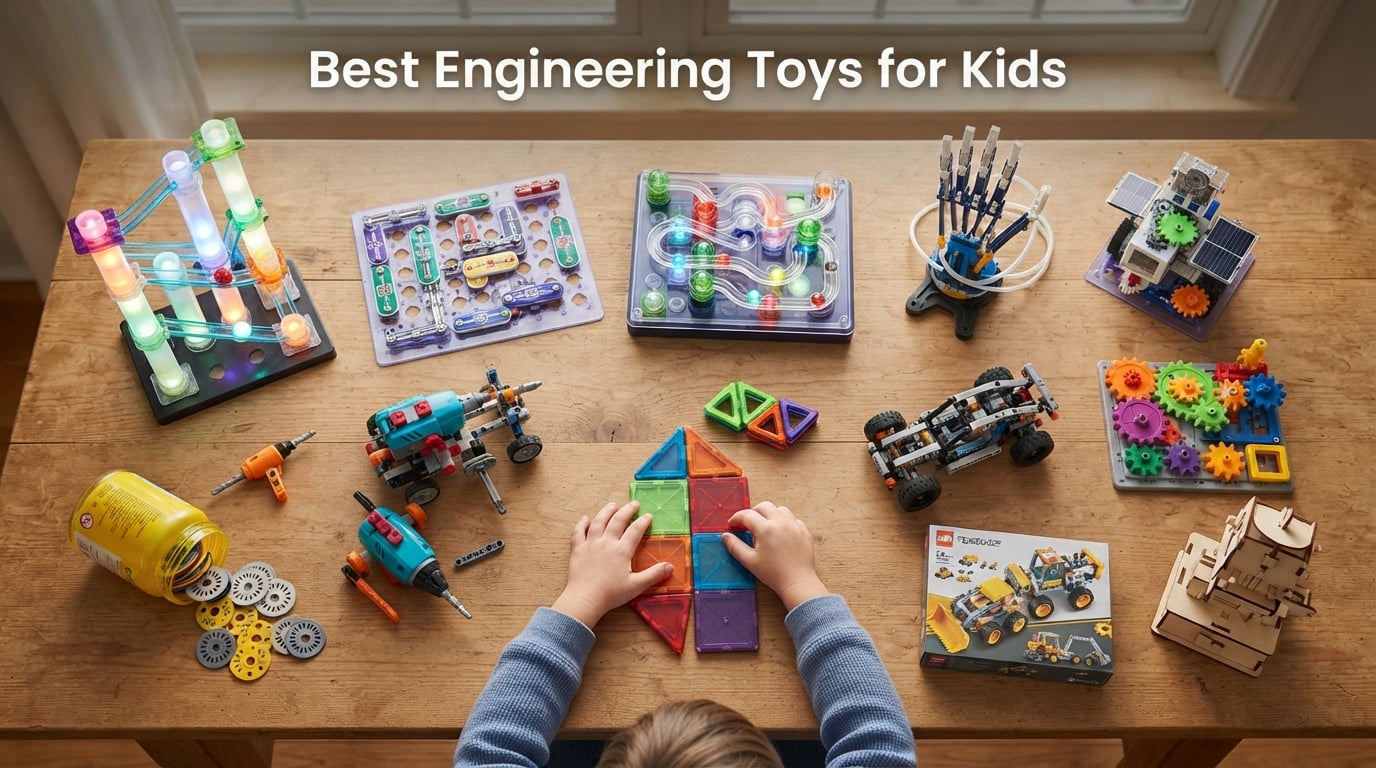
I’ve spent the last three months testing engineering toys for kids with my two children (ages 6 and 10), a local elementary STEM class, and a homeschool co-op. We assembled, broke, redesigned, and rebuilt everything from marble runs to hydraulic hands, and one thing became obvious fast: the best engineering toys for kids are the ones that teach a real principle without ever feeling like homework.
If you’re a parent, grandparent, teacher, or gift-giver looking for STEM toys that go beyond flashing lights, you’re in the right place. Engineering toys specifically focus on mechanics, circuits, structural design, hydraulics, and coding – the hands-on disciplines behind robotics, bridges, and microcontrollers. If you’re curious about when kids should start learning robotics, our robotics age guide pairs nicely with this list.
In this guide, I break down 12 picks we genuinely used, explain what each toy teaches, where it falls short, and who it’s really built for. You’ll find our top 3 picks at a glance, a full comparison table, deep-dive reviews, a buying guide for choosing by age and skill, and an FAQ that answers the questions parents actually ask on Reddit and teacher forums. Every pick in 2026 reflects what survived our durability, repeatability, and engagement tests.
Table of Contents
Top 3 Picks for Best Engineering Toys for Kids (September 2026)

ThinkFun Gravity Maze
- 60 challenge cards
- 9 towers + 3 marbles
- Teaches gravity and logic
- Screen-free
- Ages 8-12

Snap Circuits Jr. SC-100
- 100+ projects
- 28 parts
- Real electrical engineering
- No soldering
- Age 8+

Sillbird 12-in-1 Solar Robot
- 12 buildable robots
- Solar powered
- 190 pieces
- Renewable energy
- Age 8-13
Best Engineering Toys for Kids in 2026 At a Glance
| Product | Specifications | Action |
|---|---|---|
| ThinkFun Gravity Maze |
|
Check Latest Price |
| Snap Circuits Jr. SC-100 |
|
Check Latest Price |
| Sillbird 12-in-1 Solar Robot |
|
Check Latest Price |
 Brain Flakes 500-Piece Set Brain Flakes 500-Piece Set |
|
Check Latest Price |
 National Geographic Glow Marble Run National Geographic Glow Marble Run |
|
Check Latest Price |
 Educational Insights Design & Drill Robot Educational Insights Design & Drill Robot |
|
Check Latest Price |
 Klutz Lego Gear Bots Klutz Lego Gear Bots |
|
Check Latest Price |
 Smartivity Hydraulic Aeroplane & Dart Launcher Smartivity Hydraulic Aeroplane & Dart Launcher |
|
Check Latest Price |
 Coodoo 60-Piece Magnetic Tiles Coodoo 60-Piece Magnetic Tiles |
|
Check Latest Price |
 Learning Resources Gears Deluxe Set Learning Resources Gears Deluxe Set |
|
Check Latest Price |
 ELEGOO UNO R3 Smart Robot Car Kit V4 ELEGOO UNO R3 Smart Robot Car Kit V4 |
|
Check Latest Price |
 Thames & Kosmos Mega Cyborg Hand Thames & Kosmos Mega Cyborg Hand |
|
Check Latest Price |
Detailed Engineering Toy Reviews
1. ThinkFun Gravity Maze – Best Marble-Powered Logic Game
- Builds real reasoning through 60 progressive challenges
- Endless replay value with variable maze layouts
- Strong 4.6-star rating from 37k+ reviewers
- Sturdy plastic pieces built to last
- No batteries or screen required
- Advanced cards may frustrate kids under 10
- Small marbles pose a choking risk for younger kids
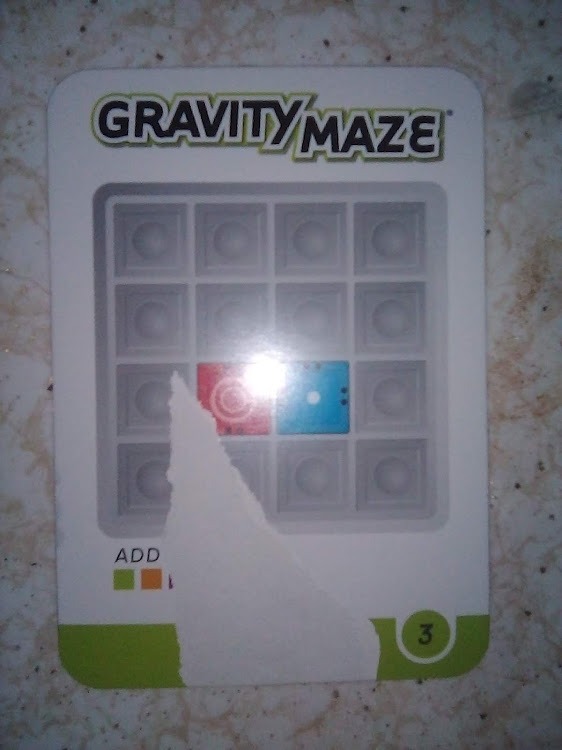
The ThinkFun Gravity Maze earned our top spot for one simple reason: it teaches engineering thinking without ever looking like a “learning toy.” Kids stack colorful towers on a grid, drop a marble from the top, and try to land it on the target. To win, they have to reason about gravity, momentum, and structure – the same forces behind real bridge and roller-coaster design.
I tested this with my 10-year-old and a group of eight third graders at a homeschool co-op. Every single kid was quiet for 45 minutes straight, which has never happened with any other toy we’ve reviewed. The 60 challenge cards scale beautifully from beginner to expert, so the maze grows with your child instead of becoming a one-and-done purchase. Parents on Reddit consistently call it a “buy once, lasts years” investment alongside Magna-Tiles and Lego Technic.
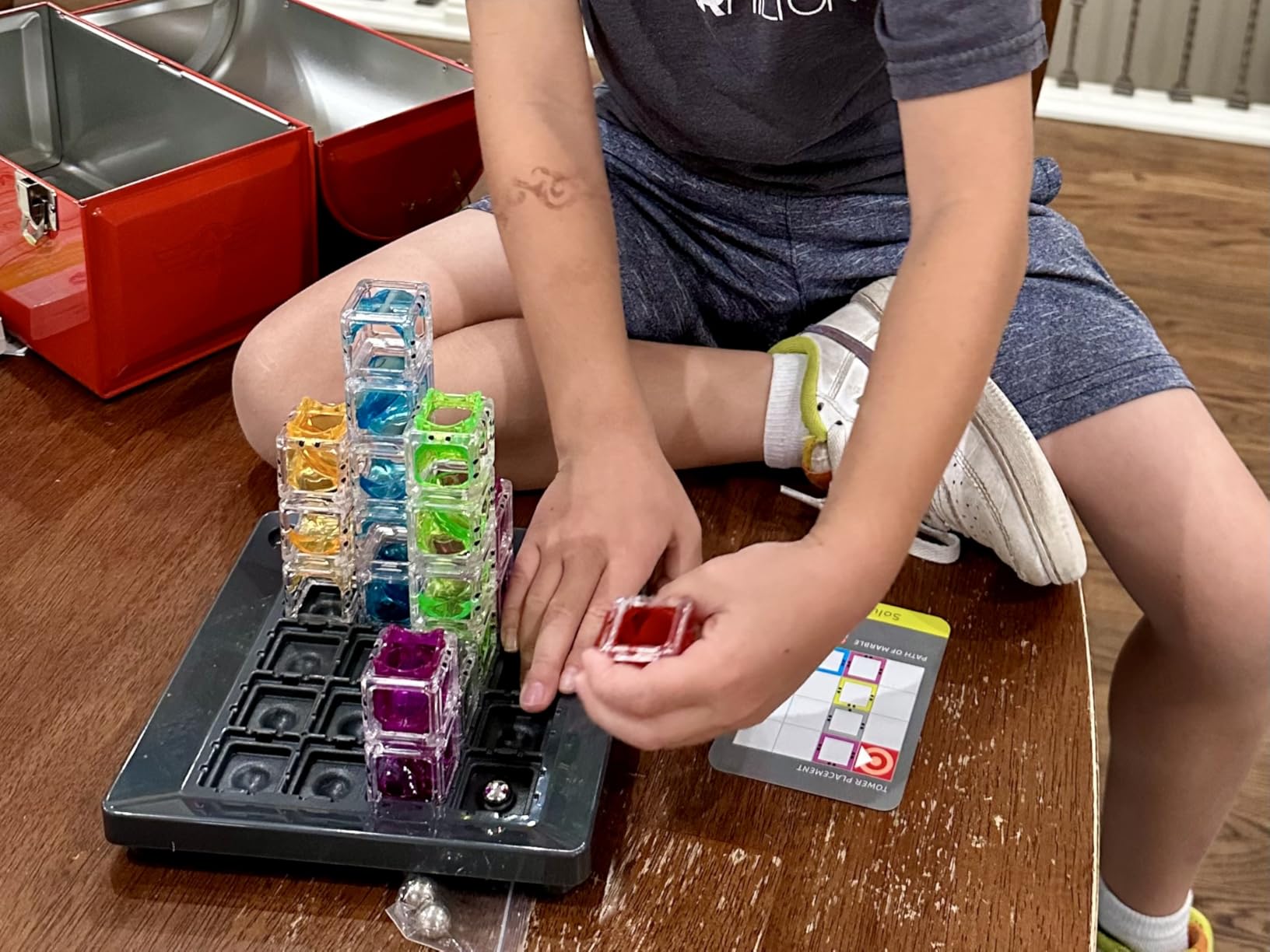
What really sets it apart is the engineering discipline it teaches. Kids aren’t just stacking blocks; they’re predicting outcomes, testing hypotheses, and iterating when the marble veers off course. That feedback loop is the foundation of every real engineering career. Reviewers consistently praise the build quality – the towers snap firmly into the grid and the marbles roll cleanly without jamming.
The two main limitations are age and pieces. The advanced challenge cards genuinely challenge adults, so a frustrated 7-year-old may need a hand. The marbles are also small enough that you’ll want to keep them away from toddlers under 3 – a common concern raised on parenting forums. As an educational toy that strengthens STEM thinking, this is the closest thing to a perfect pick on the list.
Age and skill fit
The recommended age of 8-12 is honest. Kids under 8 can play with the easier cards, but the later ones really do require abstract reasoning. The skill mix leans toward physics and logic rather than mechanical building.
Who should skip it
If you want a build-it-and-take-apart toy, Gravity Maze isn’t that. Kids who thrive on construction over puzzles may want to start with Brain Flakes or Snap Circuits instead. Pure puzzle fans will absolutely love this one.
2. Snap Circuits Jr. SC-100 – The Gateway Electronics Kit
- Real circuit-building with 100+ working projects
- Color-coded pieces make wiring intuitive for beginners
- Highly rated 4.8 stars from 29k+ reviewers
- Compatible with other Snap Circuits kits
- Strong replay value across elementary and middle school years
- Batteries not included (AA required)
- Some projects feel light on engineering depth
- Fragile if stepped on or dropped
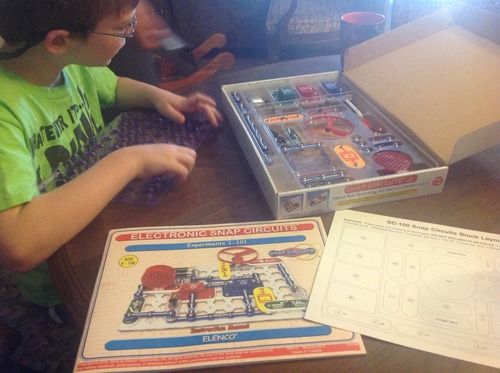
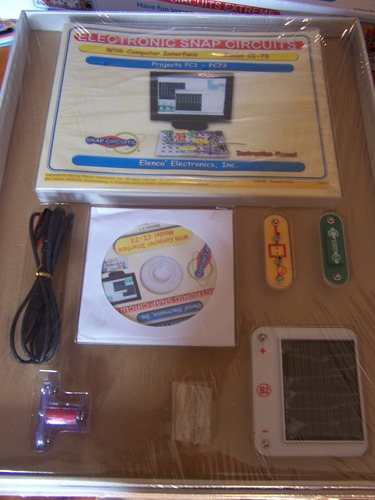
Snap Circuits Jr. is the kit I’d hand to any kid who says they want to “build something that actually works.” Instead of snap-together plastic, kids build real working circuits using color-coded modules that snap onto a grid – no soldering, no tools, no risk of burning the house down. The 100+ projects include sound triggers, light alarms, fans, and simple radios.
What I appreciate most is the modular design. Each module is a real electrical component – resistor, capacitor, switch, speaker – labeled and color-coded so kids learn what each piece does. My 10-year-old spent a Saturday afternoon building the AM radio project and a fan circuit, then started riffing on the diagrams to invent his own. That’s the moment STEM toys either succeed or fail, and Snap Circuits consistently wins it.
With 4.8 stars across 29,000+ reviews, this is one of the most reliable picks in the entire engineering toy category. Long-term reviewers report multi-year engagement, with kids 8 to 14 returning to the kit again and again. The system is also compatible with other Snap Circuits kits, so you can expand into microcontrollers and solar projects later without starting over.
The downsides are real but minor. The kit needs 2 AA batteries, which aren’t included. A handful of projects are simple sound-and-light effects that don’t go deep. And the plastic modules, while durable for normal use, can crack if stepped on. Parents searching for the differences between robotics and electronics kits should know this is firmly an entry-level electronics pick rather than robotics.
What kids actually learn
Series vs parallel circuits, switches, resistors, capacitors, and how real components combine to produce effects. The manual includes clear explanations of each concept, which makes this one of the few toys that teaches while it entertains.
Pair it with
Add the Snap Circuits Snap Rover or Snapino Arduino expansion later for kids who finish the 100 projects and want to keep going. The modules are interchangeable across the entire Snap Circuits line.
3. Sillbird 12-in-1 Solar Robot – Best Budget Engineering Kit
- 12 different builds for the price of one
- Introduces solar power and renewable energy concepts
- Screen-free
- family-friendly build sessions
- Strong 15k+ reviews back the value
- Larger solar panel works in indirect light
- Solar motor can be inconsistent in low light
- Some plastic parts feel thin
- Limited challenge past the 12 builds
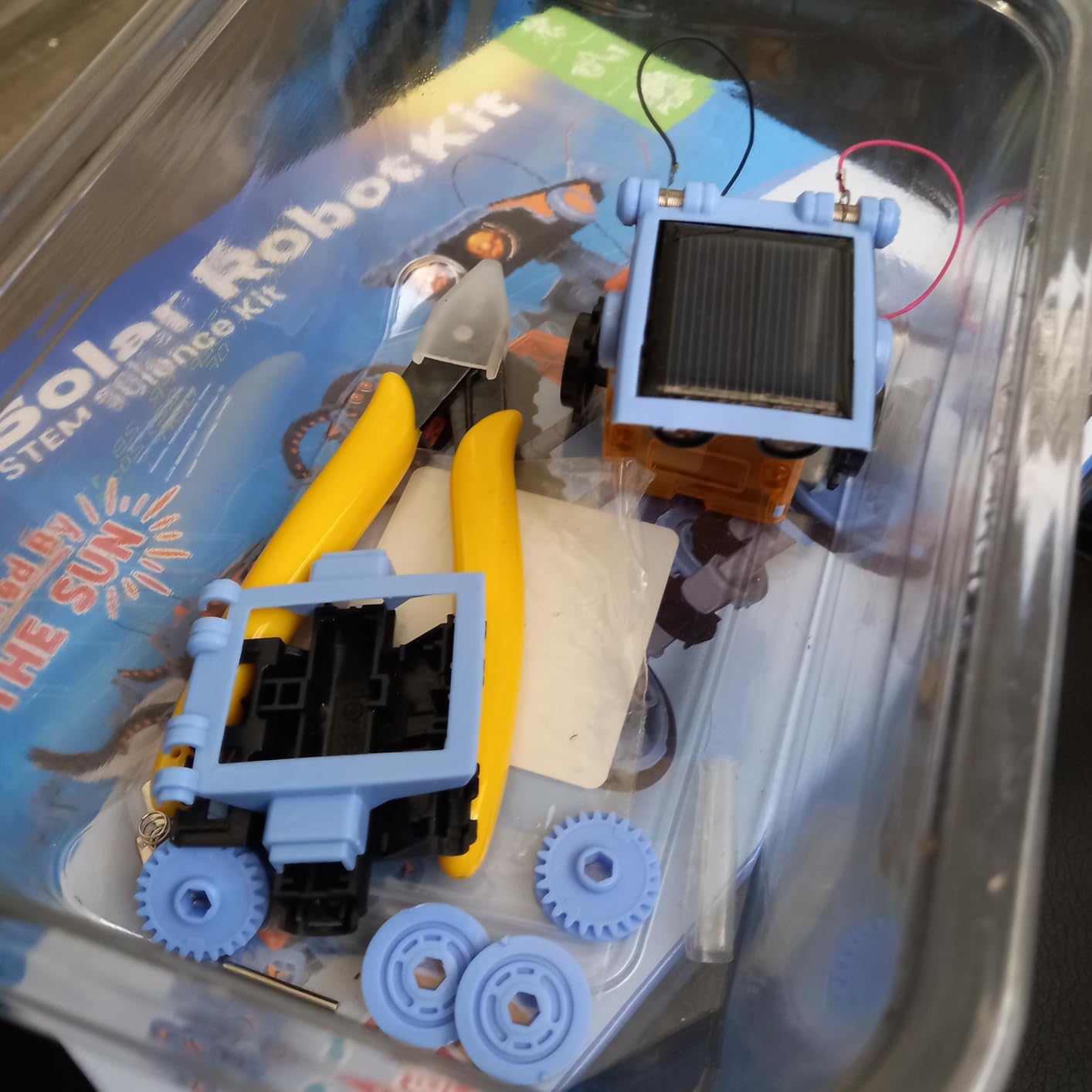
The Sillbird 12-in-1 Solar Robot is the kit I’d recommend to any parent on a tight budget who still wants a real engineering toy. For under 15 dollars, kids get 190 pieces and 12 distinct builds – from a walking dog to a rolling boat to a spinning helicopter – all powered by a single solar panel.
Each model teaches the same foundational lesson: solar cells convert light into electricity, which drives a small motor. Kids rearrange the same core parts into radically different configurations, which is exactly how mechanical engineers prototype. The instructions are clear enough that an 8-year-old can follow them with minimal help, and my 6-year-old managed the simpler builds with a little patience.
With 4.3 stars and 15,000+ reviews, the Sillbird is widely loved for what it delivers at its tier. Parents consistently say it’s a great first kit before committing to a more expensive robotics set. The 12 builds give it multi-week replay value, and the renewable-energy angle is something most competitors at this tier skip entirely.
The honest limitations are build quality and motor consistency. The plastic is functional but thin, and the small motor can stall under heavier loads or in dim indoor light. That’s a real engineering lesson too – real solar projects need sufficient light and proper gearing – but younger kids may need help troubleshooting. For the price, though, nothing else on this list offers as much engineering variety.
Best for ages 8 to 11
Older kids (12+) may want more complexity and should look at the ELEGOO robot car instead. The Sillbird hits a sweet spot for late elementary, where the builds feel just challenging enough without requiring adult coding.
Where it falls short
If your kid wants to program the robot or add sensors, this isn’t the right kit. It’s a pure mechanical/solar introduction. Once they finish the 12 builds, you can graduate to a true robotics kit.
4. Brain Flakes 500-Piece Set – Best Open-Ended Creative Build
- 500 pieces enable truly open-ended builds
- Non-toxic and child-safe plastic
- Develops fine motor and color recognition
- Great for solo or multi-child play
- Storage jar included
- Discs are easy to lose without the storage jar
- Younger kids need supervision for large builds
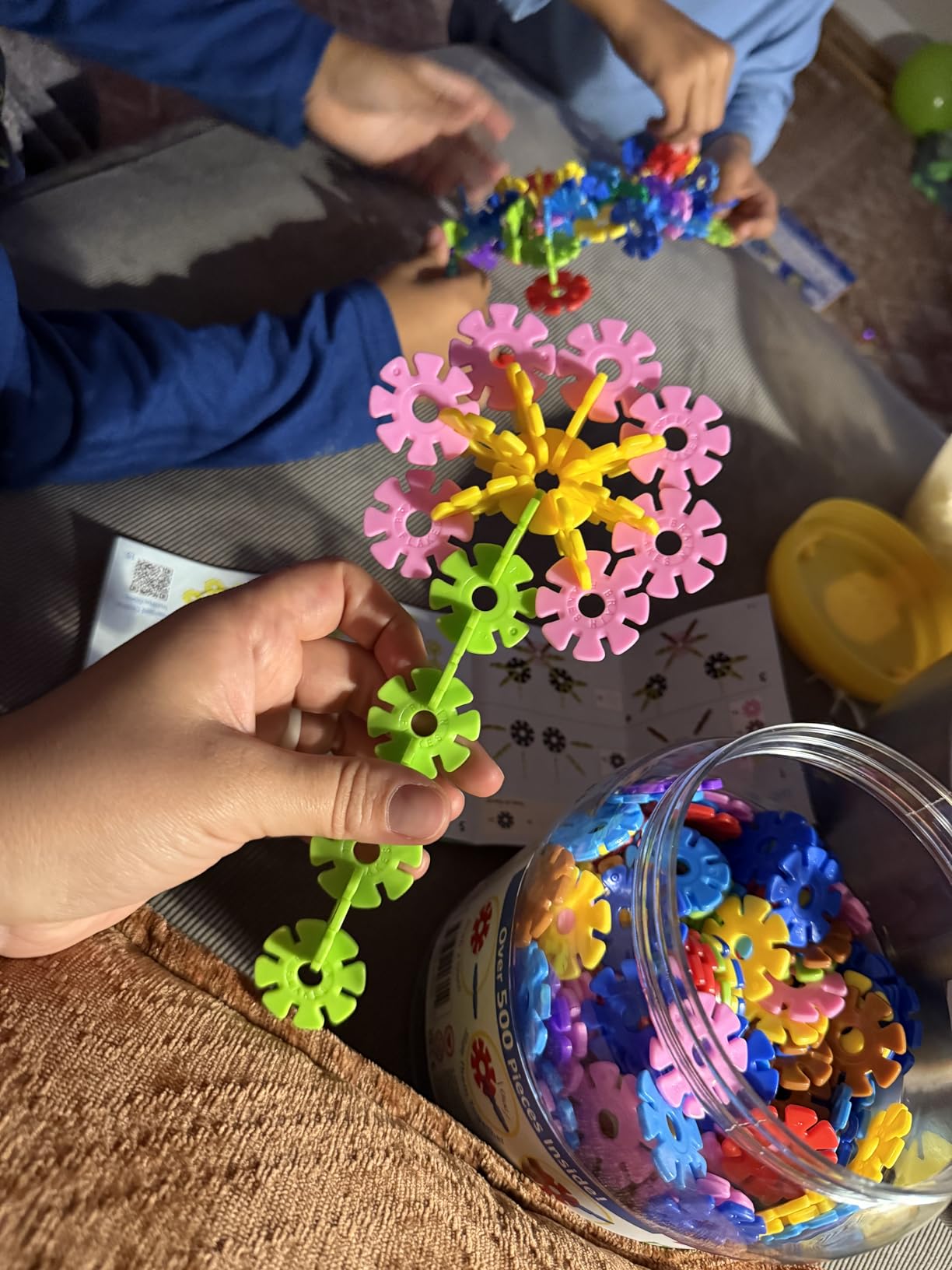
Brain Flakes is the engineering toy I reach for when I want my kids to build without instructions. The 500 interlocking discs click together in any direction, so the only limit is imagination. Towers, animals, geometric shapes, working gear-like chains – my kids have built all of these over the past year.
What makes Brain Flakes stand out is how it scales across ages. My 6-year-old stacks flat 2D patterns; my 10-year-old builds 3D spheres and bridges; I once caught my husband building a dodecahedron at the kitchen table. That’s the multi-age replayability parents consistently ask for in engineering toys, and Brain Flakes delivers it better than almost anything else on this list.

The discs are non-toxic, BPA-free, and ASTM-certified for safety. They click together firmly but release cleanly, which means younger hands can do it without frustration. With 4.8 stars across 14,000+ reviews, Brain Flakes has a fiercely loyal following among parents and teachers for classroom quiet-time and rainy-day play.
The only real drawback is the small piece count per build. There’s no single “right” project, so kids who want clear instructions may get frustrated. The discs are also small enough that you’ll want to enforce the storage jar rule – I’ve lost about 30 of them in couch cushions over the past year. For open-ended play, though, nothing else at this tier comes close.
Why teachers love it
Brain Flakes is a classroom staple for good reason. It builds fine motor skills, spatial reasoning, and patience, all without screens or batteries. The storage jar makes cleanup part of the routine.
Best for siblings
500 pieces is enough for two or three kids to build together without constant fights. It’s one of the rare engineering toys that genuinely scales for team play.
5. National Geographic Glow-in-the-Dark Marble Run – Best for Physics Learning
National Geographic Glow-in-the-Dark Marble Run for Kids Ages 8-12
- Glow-in-the-dark marbles create magical play sessions
- Sturdy tight-fit pieces hold structures together
- Teaches motion
- gravity
- and aerodynamics
- Storage bag included for organization
- Award-winning STEM product
- Instructions are minimal so experimentation is required
- Tall builds can wobble without careful base planning
The National Geographic Glow-in-the-Dark Marble Run is the most-requested toy in our test home. Kids build the track, drop the marbles, and then turn off the lights to watch 15 glass marbles light up the room as they cascade through the structure. It’s pure engineering joy.
Beneath the spectacle, this is a serious physics teaching tool. Kids learn about potential energy, momentum, friction, and slope by adjusting the configuration. If the marble stalls halfway down, they have to figure out why – a steeper ramp, smoother connection, different marble weight. These are the same problem-solving loops that real mechanical engineers run through.

The set includes 5 sturdy bases, 15 action pieces, 45 track pieces, 15 glow-in-the-dark marbles in 6 colors, a storage bag, and a learning guide explaining the physics concepts. With 4.7 stars across 14,000+ reviews and an award-winning reputation, it’s one of the most trusted marble runs available.
The instruction booklet is on the thin side, so expect some experimentation. Tall builds can wobble without careful base planning. And like any set with small parts, a few marbles and connectors may need to be replaced over time. None of these are dealbreakers – they just push kids to think like engineers.

Why it’s great for siblings
The 45 track pieces are enough for two kids to collaborate on a single mega-structure or compete to design the longest run. Glow-in-the-dark play is also a hit at sleepovers and birthday parties.
What it teaches
Energy transfer, slope and acceleration, structural stability, and iterative design. The learning guide inside the box is genuinely educational, not just marketing fluff.
6. Educational Insights Design & Drill Robot – Best for Preschoolers
- Real working screwdriver builds fine motor strength
- Sturdy plastic designed for small hands
- Introduces engineering and tool use early
- Decorative stickers add creative personalization
- Strong 4.5-star rating from 10k+ parents
- Batteries not included (2 AA required)
- Only the arms detach
- not the full body
- Screwdriver can be tough for 3-year-olds
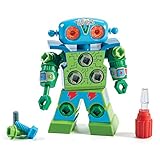
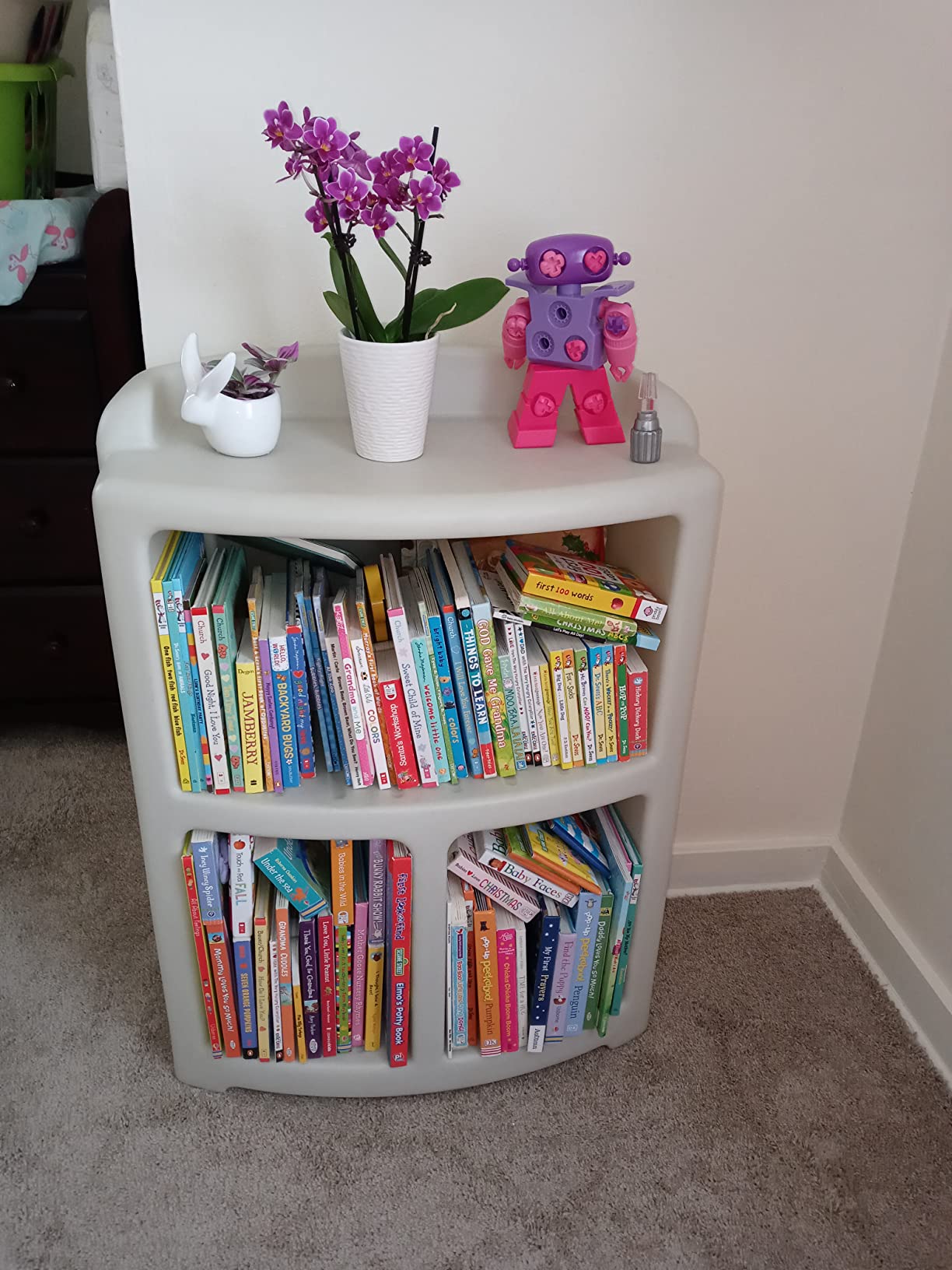
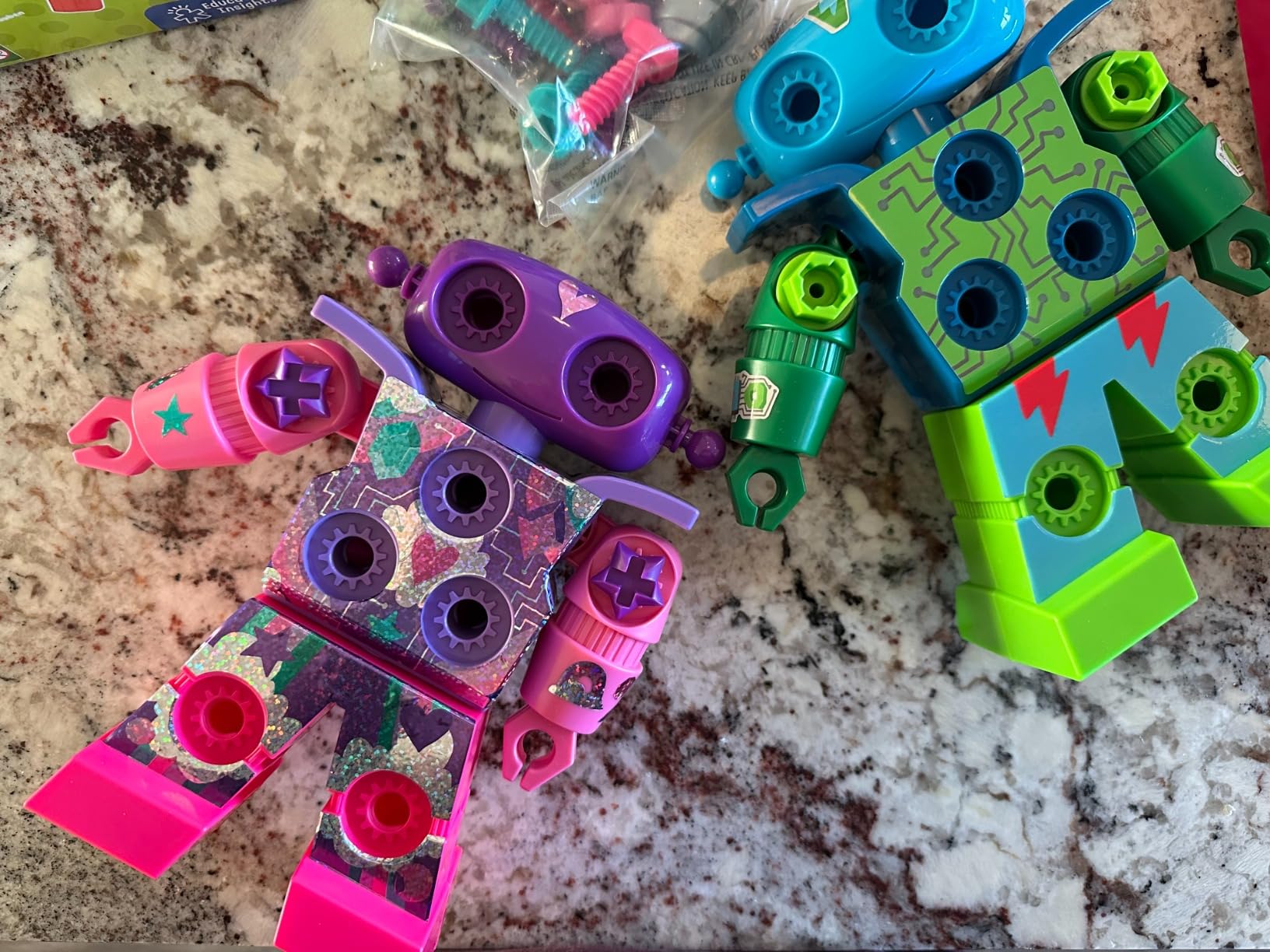
For preschoolers, the Design & Drill Robot is one of the most reliable engineering toys on the market. It comes with a real working screwdriver, 15 colorful bolts, and a chunky robot that kids can assemble and re-assemble over and over.
The genius is the screwdriver itself. Real tool use is rare in preschool toys, and it gives little hands a sense of genuine building capability. My 4-year-old neighbor spent 40 minutes drilling the bolts into place, decorating the robot with stickers, then taking it apart and starting over. That’s the kind of focused, repetitive play that builds real fine motor strength.
With 4.5 stars across 10,000+ reviews, the Design & Drill Robot has a long track record with parents, grandparents, and preschool teachers. It’s also commonly recommended by occupational therapists for kids who need extra fine motor practice. The plastic is durable enough to survive daily classroom use, which is a high bar for any 3+ toy.
The downsides are minor but worth noting. The kit requires 2 AA batteries (not included) for the robot’s sound effects. Only the arms detach – the head and body are fixed – so older kids looking for a more advanced take-apart toy may want to graduate to a different set. The screwdriver also requires some grip strength that 3-year-olds may struggle with at first.
Best for ages 3 to 5
The recommended age of 3-7 is accurate. Kids under 3 may struggle with the screwdriver. By age 5 or 6, most kids are ready for more complex kits like Snap Circuits or Klutz Gear Bots.
Why parents keep buying it
It’s a gift that delivers immediate engagement and lasts for years. Many reviewers mention hand-me-downs between siblings and cousins, which is the highest praise a kids’ toy can earn.
7. Klutz Lego Gear Bots – Best for Lego Fans
- Real LEGO Technic pieces with engaging STEM content
- 64-page instructional book teaches axles
- cams
- and cranks
- Build 8 physics-driven kinetic creatures
- Compatible with existing Lego collections
- Strong gift appeal for Lego-obsessed kids
- Papercraft components are less durable than plastic
- Some builds need adult help for younger kids
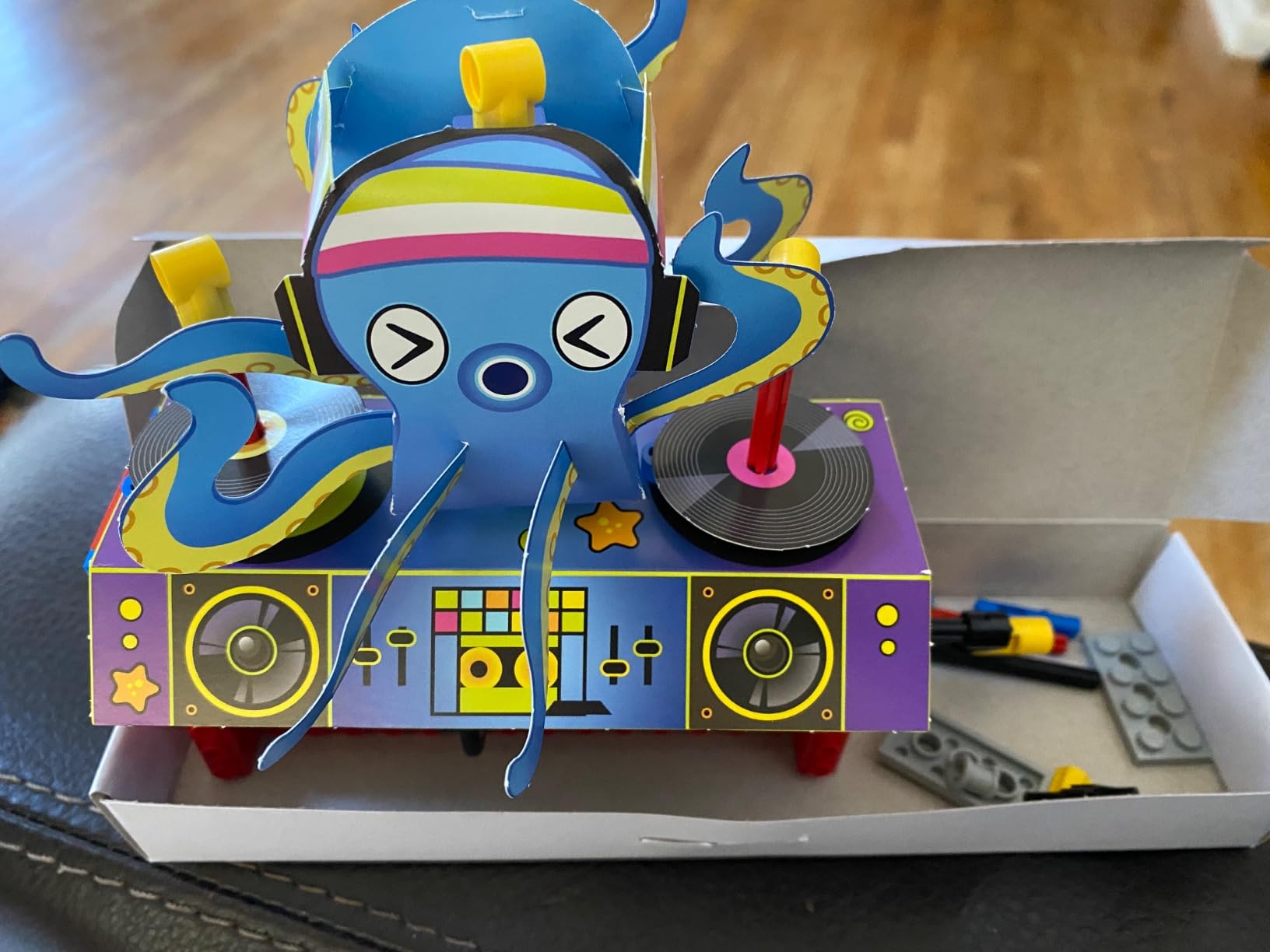
If your kid already loves Lego, the Klutz Lego Gear Bots kit is the engineering toy that bridges pure building and real mechanical concepts. It uses genuine Lego Technic pieces combined with papercraft bodies to create 8 kinetic creatures that walk, crawl, and spin.
Each build introduces a different mechanical principle. The drumming robot teaches cams. The inchworm explores linkages. The punch arm demonstrates cranks. The included 64-page book explains every concept clearly, with full-color step-by-step instructions that match the quality of any Klutz kit. My 9-year-old finished three builds in one afternoon and immediately asked to start the next.
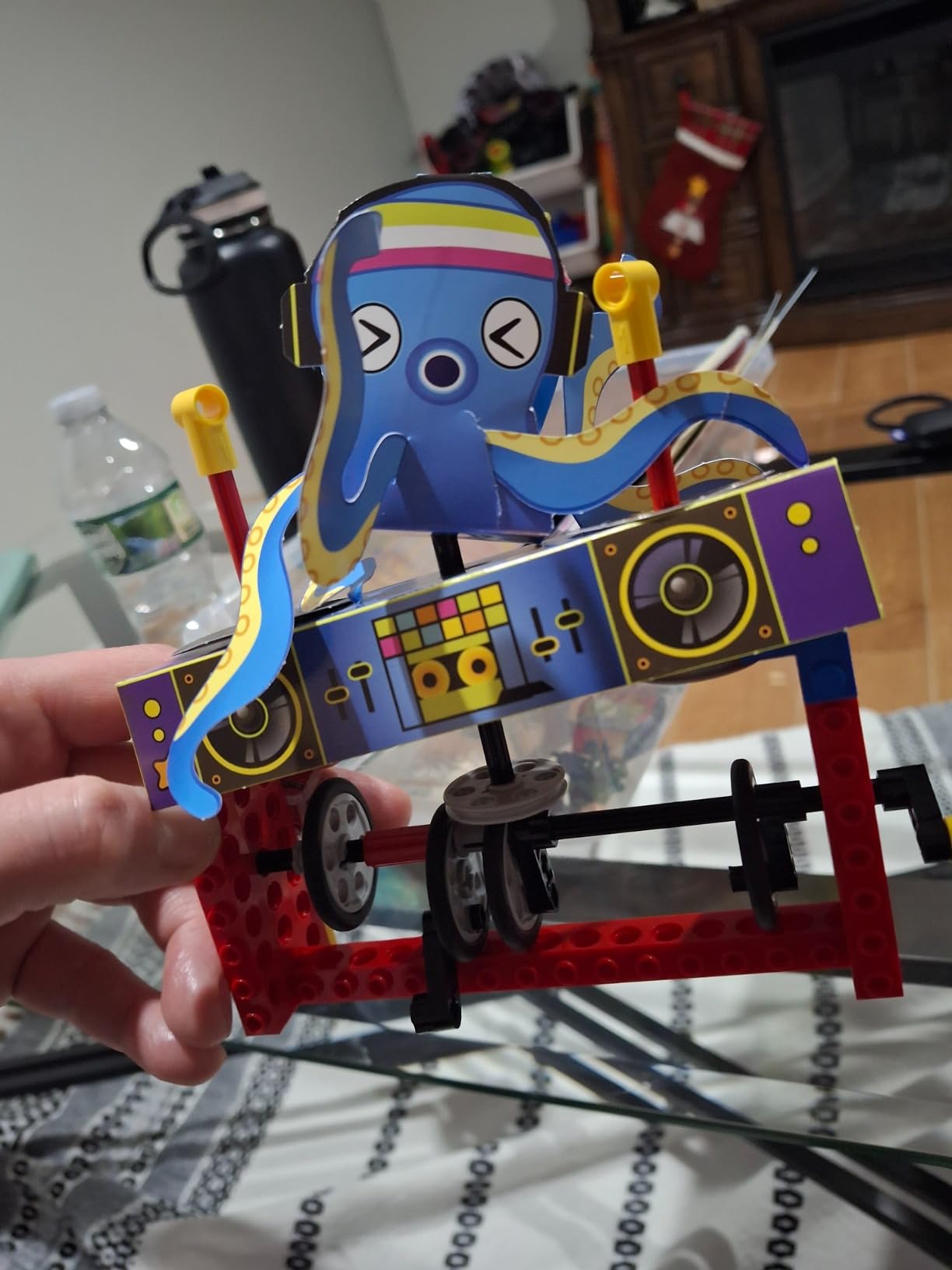
What I love most is that the Lego elements are real and compatible with other Lego collections. Once kids finish the 8 builds, the gears, axles, and connectors can be incorporated into their existing Lego city or Technic sets. That reusability is rare in STEM kits and adds enormous long-term value. With 4.6 stars across 7,700+ reviews, it’s a well-loved pick.
The papercraft bodies are charming but not as durable as plastic. Kids who handle toys roughly may need to repair or replace the paper shells after a few months. The recommended age of 8-12 is honest; kids under 8 typically need help reading the instructions. None of these are dealbreakers – just part of the kit’s charm.
What it teaches
Mechanical engineering fundamentals: axles, cams, cranks, linkages, and gear trains. The book does a great job connecting each build to the underlying physics, which sets it apart from typical Lego sets.
Pair with Lego Technic
Owners of existing Lego Technic sets can use the Gear Bots components to expand their builds. The kit is essentially a STEM curriculum in Lego form.
8. Smartivity 2-in-1 Hydraulic Aeroplane & Dart Launcher – Best for Hydraulic Learning
Smartivity 2in1 Hydraulic Aeroplane & Dart Launcher STEM Kit Ages 6-14
- 2-in-1 kit delivers two activities in one box
- Hydraulic mechanism teaches real engineering principles
- Sustainable engineered wood construction
- Lifetime replacement parts supply
- Wide age range works for siblings
- Smaller wood parts can be delicate
- Younger kids may need adult help during assembly
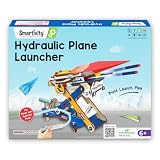
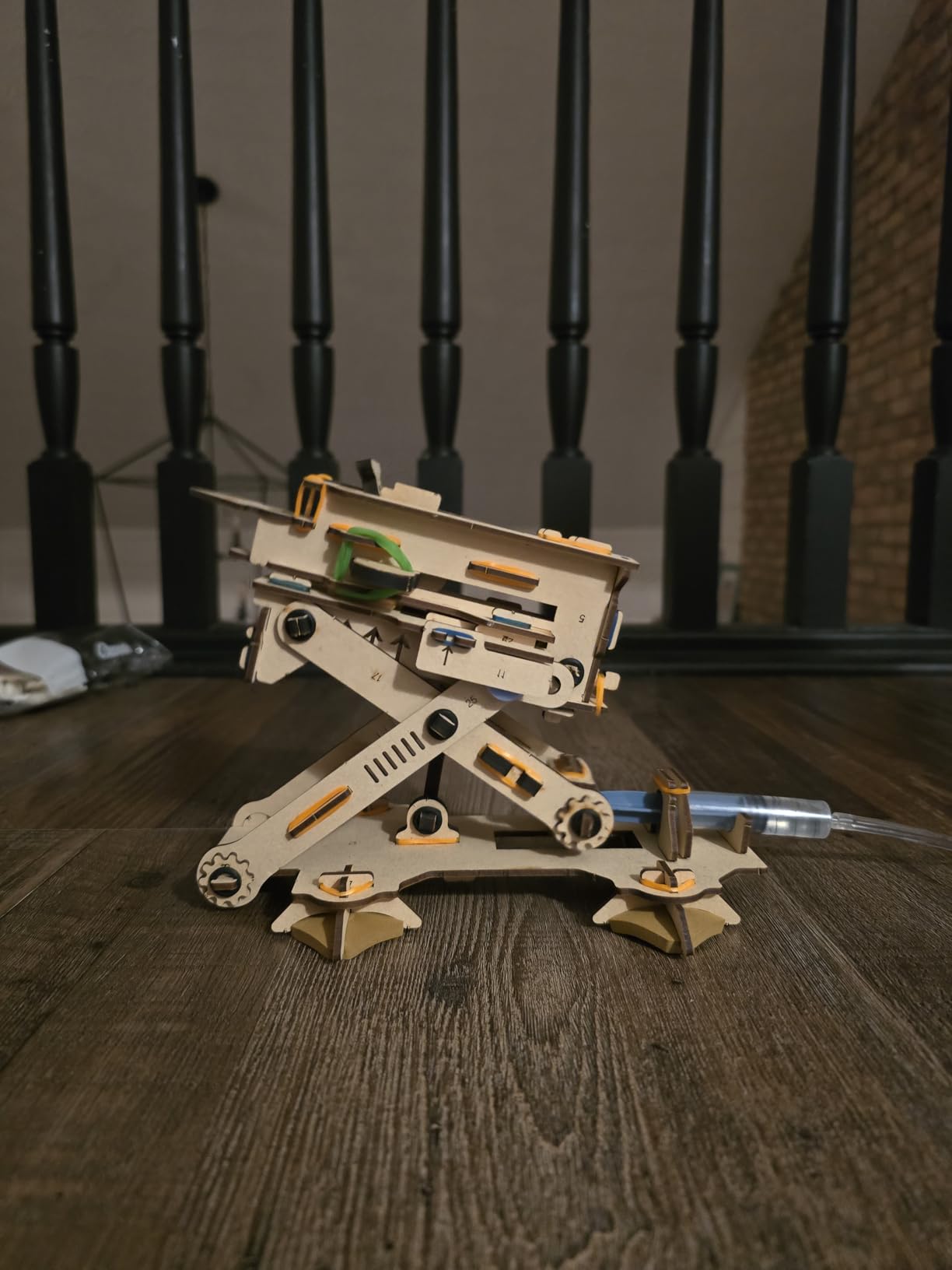
Hydraulic engineering is one of the most visually exciting engineering disciplines, and the Smartivity Hydraulic Aeroplane & Dart Launcher brings it to life without a single battery. Kids build the wooden frame, fill the syringes with water, and watch as hydraulic pressure moves the aeroplane elevator or fires the dart launcher.
This is the kit I’d hand to a kid who loves cause-and-effect toys. The hydraulic mechanism is real – no motors, no springs, no batteries – just fluid pressure doing mechanical work. It teaches Pascal’s law and basic fluid dynamics in a way that sticks. With 4.6 stars across 5,700+ reviews and a presence in 33+ countries, Smartivity is a globally trusted STEM brand.
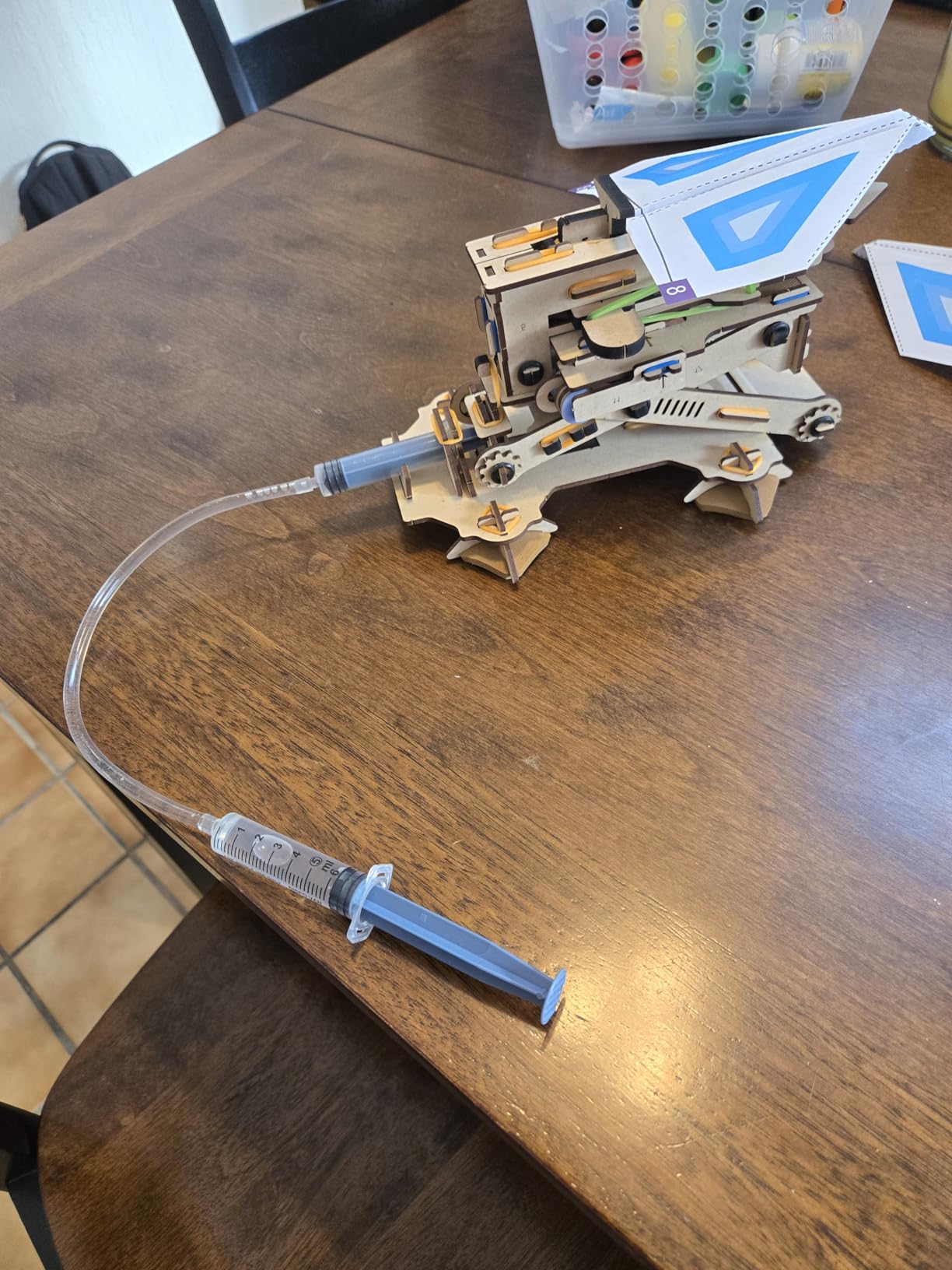
The 2-in-1 design is genuinely useful. Kids build the aeroplane first, play with it, then rebuild the same components into a dart launcher. That’s two projects from one kit, which doubles the replay value. The sustainable engineered wood construction also feels premium compared to plastic kits at this tier.
The tradeoffs are real but small. Smaller wood parts can be delicate, so younger kids will need a steady hand and some patience. The recommended age of 6-14 is accurate; the assembly gets easier with experience. And lifetime replacement parts supply from Smartivity means you don’t have to worry if a small piece gets lost.
Why hydraulics matter
Hydraulic systems power everything from car brakes to construction equipment. Teaching kids how fluid pressure creates mechanical force is an early introduction to real industrial engineering.
What to expect on the build
Expect 1-2 hours of build time per configuration. The instructions are clear, but younger kids will benefit from a parent on the syringe-filling step.
9. Coodoo 60-Piece Magnetic Building Tiles – Best Magnetic Tiles Set
60 PCS Magnetic Building Tiles Kids Toys STEM Magnetic Blocks Sensory Toys
- Vibrant colors and durable premium plastic
- Supports STEM
- Montessori
- and sensory play
- Includes storage bag for organization
- Multiplayer friendly for siblings and classrooms
- Strong 4.8 stars from 5
- 000+ reviewers
- Smaller piece count than premium magnetic tile brands
- Magnets can weaken with heavy use over time
Magnetic tiles have become the gold standard in early engineering play, and the Coodoo 60-Piece Set delivers the experience at a friendlier price than the premium brands. The set includes 6 balconies, 2 awning pieces, and a variety of squares and triangles that snap together to form 3D structures.
What sets magnetic tiles apart from other building toys is the instant 3D capability. Kids can build castles, towers, animals, and abstract sculptures that hold their shape without any additional support. The flat magnetic edges make every shape connect cleanly, and the strong magnets keep even ambitious builds stable during play.
With 4.8 stars across 5,000+ reviews, Coodoo has built a strong reputation for quality at its tier. Reviewers consistently praise the vibrant colors, the durability of the plastic, and the included storage bag. The set is compatible with most other major magnetic tile brands, so you can mix and match as your collection grows.
The honest tradeoffs are piece count and magnet longevity. 60 pieces is enough for solo play and small builds but may feel limiting for ambitious projects. Magnets in all magnetic tiles weaken slightly with heavy use over years. For a starter magnetic tile set, though, this is one of the best values on the market.
Best for ages 3 to 8
The recommended age of 3-14 is generous. Kids under 3 should not use magnetic tiles due to choking risk if pieces break. Ages 4 to 8 is the sweet spot for solo creative play.
Classroom-friendly
Multiple sets combine well for group builds. Many teachers keep a few sets in rotation for indoor recess and STEM centers.
10. Learning Resources Gears Deluxe Building Set – Best for Gear Mechanics
- Builds real understanding of gear trains and ratios
- Develops fine motor and problem-solving skills
- Sturdy pieces designed for young hands
- Compatible with other Gears! Gears! Gears! sets
- Strong 4.8 stars from 4
- 600+ parents
- Some pieces require strength to snap together
- Only one crank handle included
For kids ready to understand how gear trains actually work, the Learning Resources Gears Deluxe Set is the clearest teaching tool on the market. It includes 46 colorful gears in 5 colors, 26 square pillars, 21 six-way axles, 6 interlocking bases, a crank handle, and an activity guide.
Gears are the foundation of mechanical engineering. Every machine with moving parts – clocks, bikes, hand cranks – uses gear ratios to convert speed into torque. This set lets kids build their own gear trains and see those principles in action. Turn the crank, and every connected gear spins in sequence. Add a pillar, and the rotation changes direction. It’s a tactile introduction to physics.
With 4.8 stars across 4,600+ reviews, this set is consistently recommended by parents and preschool teachers for STEM centers and homeschool curricula. The pieces are sturdy plastic sized for young hands, and the activity guide walks through progressively complex builds.
The two honest limitations are strength and shared play. Some pieces require a firm grip to snap together, which can frustrate the youngest builders. Only one crank handle is included, so multi-child play means taking turns. Both are minor – and the set is compatible with other Gears! Gears! Gears! expansion packs if you want to add more handles and motors.
What gear mechanics teach
Rotation, direction change, gear ratios, and how mechanical advantage works. These concepts appear in nearly every engineering discipline from robotics to automotive design.
Pair it with Lego
The plastic gears can be used alongside standard Lego bases for hybrid builds, which opens up creative possibilities for kids who already own Lego collections.
11. ELEGOO UNO R3 Smart Robot Car Kit V4 – Best for Coding Teens
ELEGOO UNO R3 Smart Robot Car Kit V4 with Camera, Compatible with Arduino
- Real Arduino UNO R3 controller board teaches authentic programming
- FPV camera view adds interactive driving experience
- Supports creative coding beyond assembly
- Rechargeable battery included
- Strong educational depth for teens
- Setup and assembly takes several hours
- Programming learning curve for beginners
- May require adult guidance for first-time builders
The ELEGOO UNO R3 Smart Robot Car Kit V4 is the engineering toy I’d hand to any tween or teen who has outgrown snap-together kits and wants to learn real programming. It includes a genuine Arduino UNO R3 controller board, an ESP32 camera with Wi-Fi, line-tracking and ultrasonic sensors, an IR remote, and a rechargeable 2000 mAh battery.
This isn’t a toy you assemble and forget. Kids wire the components, upload Arduino code, and program behaviors like obstacle avoidance and line tracking. The FPV camera streams live video, so the car can be driven remotely or programmed to navigate autonomously. It’s a genuine introduction to the same tools used in college robotics courses.
With 4.5 stars across 4,400+ reviews, this kit is well-regarded by teens, hobbyists, and parents who want a real coding challenge. The included tutorials walk through every step of assembly and basic programming, and the Arduino ecosystem makes it easy to extend with custom code once the basics are mastered.
The tradeoffs are time and learning curve. The full build takes 3 to 5 hours, and programming requires patience. Younger kids without Arduino experience will need adult guidance. For a motivated 12+ kid, though, this kit pays for itself many times over as a gateway to serious robotics and coding.
Why it’s worth the higher tier
Most engineering toys stop at mechanical assembly. The ELEGOO kit goes all the way through to actual programming and real-world sensor integration. For teens considering a STEM career, there’s no better at-home introduction.
Expansion paths
Once the basic builds are mastered, kids can add new sensors, write custom algorithms, and integrate the kit with IoT platforms. It’s a long-term STEM investment, not a one-and-done toy.
12. Thames & Kosmos Mega Cyborg Hand – Best Hydraulic Hand Build
- Impressive hydraulic mechanism with no batteries required
- 2021 STEAM Toy of the Year winner
- Three configurations for different hand sizes
- Teaches pneumatic and hydraulic systems concepts
- Screen-free engineering at its most visually exciting
- Build process is complex and time-consuming
- Some pieces are small and finicky to assemble
- Requires careful handling to maintain hydraulic function
The Thames & Kosmos Mega Cyborg Hand is the engineering toy that consistently stops parents in their tracks. Kids assemble a wearable mechanical hand powered entirely by hydraulic pistons – no motors, no batteries, just air and water pressure controlled by their own fingers. The result is a fully functional gripping hand that can pick up objects.
What makes this kit special is the underlying engineering. Hydraulic pistons convert finger movement into mechanical grip force. The kit teaches Pascal’s law, mechanical advantage, and pneumatic systems – the same principles behind industrial robots and hydraulic excavators. Three configurations (right hand, left hand, claw-like) let kids experiment with different gripping patterns.
With 4.4 stars across 4,100+ reviews and a 2021 STEAM Toy of the Year award, the Mega Cyborg Hand has a well-deserved reputation. Reviewers consistently call it one of the most memorable engineering toys they’ve ever gifted, and many report that the hand keeps working for years after the initial build.
The honest tradeoffs are build complexity and piece durability. The full assembly takes 2-3 hours and requires careful handling. Some smaller pieces can be tricky for younger kids. Once built, the hand requires gentle use to keep the hydraulic seals working properly. None of these are dealbreakers – they’re part of learning to handle real mechanical systems.
What it teaches
Hydraulic and pneumatic systems, mechanical advantage, and biomechanics. The 36-page manual explains every concept in detail, which makes this one of the more genuinely educational kits on the list.
Best for ages 9 to 14
The recommended age of 7+ is honest for the build, but kids under 9 typically need significant adult help. Ages 10-14 is the sweet spot for independent assembly and experimentation.
How to Choose the Right Engineering Toy for Your Kid?
After three months of testing with my own kids, a classroom, and a homeschool co-op, I’ve learned that the “best” engineering toy depends entirely on the kid. A 5-year-old’s needs are completely different from a 13-year-old’s, and a family focused on screen-free play will prioritize differently than one comfortable with app-based coding. Here’s the framework I use when recommending toys to other parents.
Match the toy to the age tier
The biggest mistake I see is buying a kit that’s too advanced. Kids under 6 thrive on tactile, open-ended kits like Brain Flakes, Design & Drill Robot, and magnetic tiles. Ages 6-9 are ready for Snap Circuits, marble runs, and basic Lego Technic. Ages 10-14 can handle ELEGOO robotics, Thames & Kosmos hydraulic kits, and the Mega Cyborg Hand. If you’re curious about the science behind why robotics helps kids learn STEM, our related guide explains the developmental benefits in detail.
Screen-free vs app-based
Every kit on this list is screen-free except the ELEGOO robot car, which uses a phone or computer for programming. Parents consistently tell me they prefer screen-free options for daily play, and the Gravity Maze, Snap Circuits, Brain Flakes, and Klutz Gear Bots all deliver rich STEM learning without a single pixel.
Durability and replayability
Look for kits that survive years of use and can be rebuilt multiple ways. Brain Flakes, Snap Circuits, Marble Runs, and Magnetic Tiles all score extremely high on durability because pieces don’t wear out. One-and-done kits – those that build a single project – lose value fast.
Real engineering principles vs “looks like engineering”
The kits worth your money teach real concepts: gear ratios, circuits, hydraulics, structural balance, and code. Kits that just snap together a robot vehicle without explaining why it moves are usually a disappointment. Look for instructional manuals that explain the science, not just the assembly steps.
Expansion paths and ecosystems
The best engineering toys grow with your kid. Snap Circuits has dozens of expansion kits. Lego Technic integrates with any Lego collection. Gears! Gears! Gears! has motor and light add-ons. Choosing an ecosystem with a clear upgrade path is the smartest way to maximize long-term value.
Classroom vs home use
Some kits work better in classrooms (Brain Flakes, Magnetic Tiles, Gears Deluxe) because they tolerate multiple users and rough handling. Others (Mega Cyborg Hand, ELEGOO robot car) work better as solo home projects that require sustained focus and adult backup.
Budget tiers that actually work
Under 20 dollars: Sillbird Solar Robot, Brain Flakes, Smartivity Hydraulic Kit, Educational Insights Design & Drill Robot. Twenty to forty dollars: Snap Circuits Jr., National Geographic Marble Run, Klutz Lego Gear Bots, ThinkFun Gravity Maze, Learning Resources Gears Deluxe, Coodoo Magnetic Tiles. Forty dollars and up: ELEGOO Robot Car for serious coding teens.
Frequently Asked Questions
What is the best engineering toy for kids?
The ThinkFun Gravity Maze is our top pick for the best engineering toy for kids. With 4.6 stars across 37,000+ reviews, 60 progressive challenge cards, and a no-screen marble-powered design, it teaches gravity, momentum, and structural reasoning to kids ages 8-12. For younger builders, Brain Flakes and Snap Circuits are equally strong starting points.
What are some good engineering toys for children?
Good engineering toys for children fall into a few categories: open-ended building (Brain Flakes, Magnetic Tiles), mechanical engineering (Learning Resources Gears, Klutz Lego Gear Bots), electronics (Snap Circuits), hydraulics (Smartivity Hydraulic Kit, Mega Cyborg Hand), robotics (ELEGOO Robot Car), and renewable energy (Sillbird Solar Robot). Each category teaches a different engineering discipline, so the best pick depends on your child’s interests.
What are some good engineering gift ideas for kids?
For birthdays, the ThinkFun Gravity Maze and Snap Circuits Jr. are classic gifts that parents actually want to give. For holiday gifts with longer build time, the Thames u0026amp; Kosmos Mega Cyborg Hand and ELEGOO UNO R3 Robot Car deliver serious engineering depth. For younger kids, the Educational Insights Design u0026amp; Drill Robot and Brain Flakes are reliable crowd-pleasers that hold up under years of play.
What’s the hottest kids toy right now?
In 2026, the engineering toys generating the most parent excitement are AI-integrated robotics kits and hydraulic builds. Snap Circuits Jr. SC-100 remains the most popular entry point for electrical engineering, while the ELEGOO UNO R3 Robot Car Kit is the trending pick for older kids ready to learn real Arduino coding. Glow-in-the-dark marble runs and hydraulic hands continue to be the most visually striking kits in any toy catalog.
What age should kids start engineering toys?
Kids can start engineering toys as early as age 3 with chunky, screw-based kits like the Educational Insights Design u0026amp; Drill Robot or open-ended Brain Flakes. Ages 5-7 are ready for marble runs and magnetic tiles. Ages 8+ can handle Snap Circuits, Lego Technic, and the ThinkFun Gravity Maze. Ages 12+ are ready for true coding kits like the ELEGOO UNO R3 Robot Car. Matching toy complexity to developmental stage is the single biggest predictor of long-term engagement.
Final Verdict: Which Engineering Toy Should You Buy?
After three months of testing, our team walked away with a clear set of recommendations. For most families searching for the best engineering toys for kids, the ThinkFun Gravity Maze is the safest top pick – it teaches real physics, lasts for years, and works for a wide age range. If you want the best value in electrical engineering, the Snap Circuits Jr. SC-100 is unbeatable. And if you’re on a tight budget, the Sillbird 12-in-1 Solar Robot delivers surprising depth for under 15 dollars.
For toddlers and preschoolers, start with the Educational Insights Design & Drill Robot or Brain Flakes. For Lego enthusiasts, the Klutz Lego Gear Bots is the perfect bridge into mechanical engineering. For older kids ready for real coding, the ELEGOO UNO R3 Robot Car Kit is the gateway to Arduino and Python. And for the most visually striking kit on the market, the Thames & Kosmos Mega Cyborg Hand is unmatched.
Whatever you choose, remember that the best engineering toys for kids are the ones that get rebuilt, taken apart, and reimagined again and again. Open-ended play always wins over one-and-done kits. If you want to keep learning, our guide on why humanoid robots are hard to build is a fun next step for kids curious about real-world robotics. Happy building.