
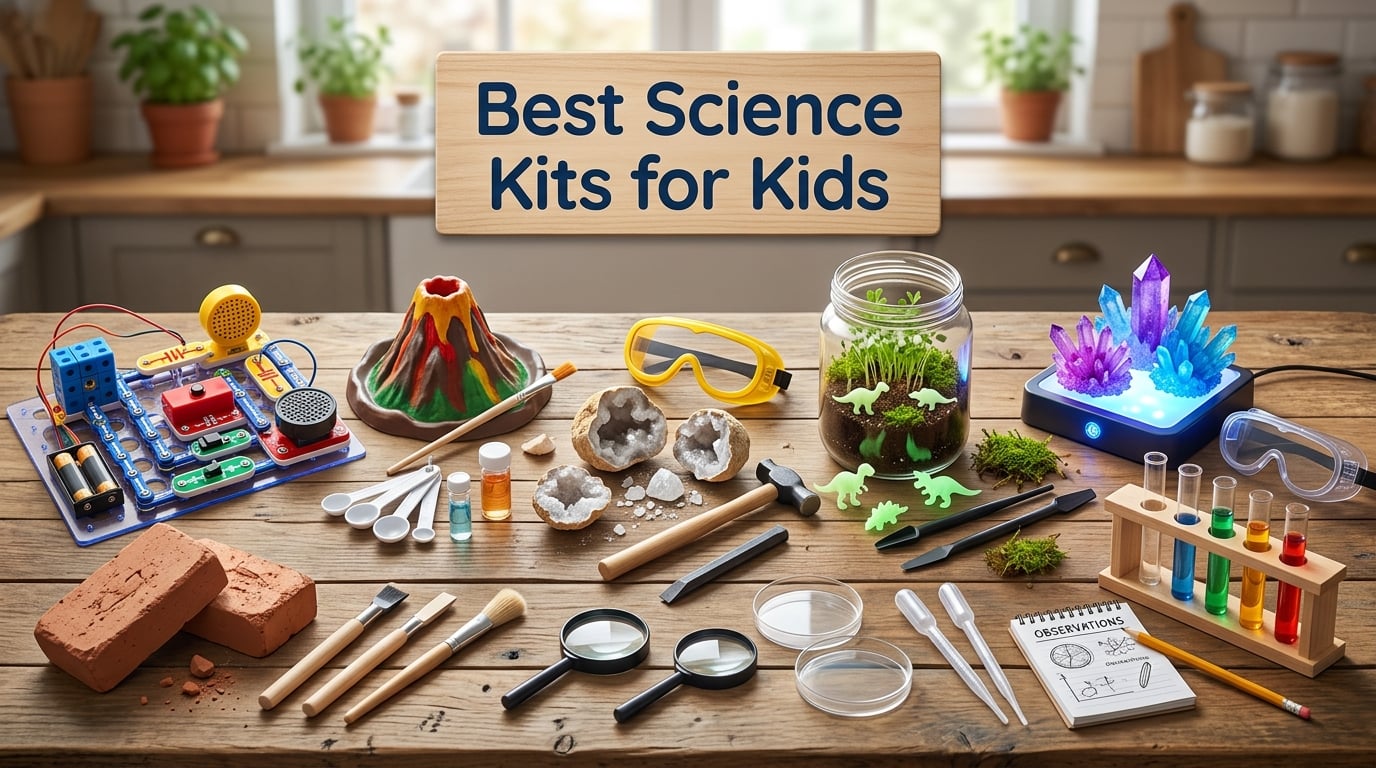
I have spent the last three months running science experiments in my living room with my 7-year-old nephew and 11-year-old niece, and I have never had so much fun cleaning up baking soda residue. We cracked open geodes until the dining room table looked like a quarry, grew crystals on a light-up stand, and accidentally turned the kitchen into a volcano zone more than once.
If you are searching for the best science kits for kids, you already know the options can feel overwhelming. There are chemistry sets, geology dig kits, electronics explorers, biology terrariums, and subscription boxes, all promising hands-on learning and screen-free fun. Some are genuinely educational. Others are just toys in a flashy box.
I put ten of the most popular science kits through real home testing with real kids, evaluated them for replay value, supervision needs, and how much actual science your child absorbs. This guide breaks down what each kit does best, who it suits by age, and where the gaps are. Whether you need a birthday gift, a homeschool resource, or a rainy-day project that teaches something real, you will find a fit below.
Table of Contents
Top 3 Picks for Best Science Kits for Kids (September 2026)


National Geographic 10 Geodes
- 10 real geodes to crack open
- Includes goggles and guide
- Ages 8+

National Geographic Earth Science Kit
- 100+ activities
- Water tornado and volcano
- Glow-in-the-dark crystals
- Ages 8-12
Best Science Kits for Kids in 2026
| Product | Specifications | Action |
|---|---|---|
| Snap Circuits Jr. SC-100 |
|
Check Latest Price |
| National Geographic 10 Premium Geodes |
|
Check Latest Price |
 National Geographic Mega Gemstone Dig Kit National Geographic Mega Gemstone Dig Kit |
|
Check Latest Price |
| National Geographic Earth Science Kit |
|
Check Latest Price |
 National Geographic Magic Chemistry Set National Geographic Magic Chemistry Set |
|
Check Latest Price |
 National Geographic Mega Crystal Growing Kit National Geographic Mega Crystal Growing Kit |
|
Check Latest Price |
 National Geographic Gross Science Kit National Geographic Gross Science Kit |
|
Check Latest Price |
 National Geographic Ultimate Volcano Kit National Geographic Ultimate Volcano Kit |
|
Check Latest Price |
 National Geographic Chemistry Set 45 Experiments National Geographic Chemistry Set 45 Experiments |
|
Check Latest Price |
 Creativity for Kids Grow ‘N Glow Terrarium Creativity for Kids Grow ‘N Glow Terrarium |
|
Check Latest Price |
1. Snap Circuits Jr. SC-100 – Best Overall Science Kit
SNAP CIRCUITS Jr. SC-100 STEM Electronics Kit, 100+ Projects, Ages 8+
- Over 100 hands-on electrical engineering projects
- Color-coded pieces snap onto a plastic grid
- Full-color manual explains the why behind each build
- Modular pieces work with other Snap Circuits kits
- Award-winning toy recognized by Dr. Toy and Good Housekeeping
- Some components feel fragile during heavy play
- Several projects focus on sirens and lights rather than motion
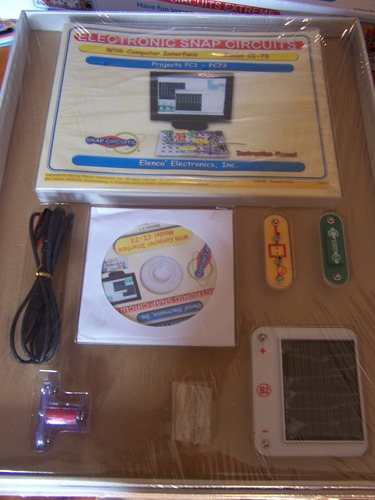
Snap Circuits Jr. SC-100 is the science kit that survived the longest in my nephew’s play rotation. After three months, he is still pulling it off the shelf, which is something I cannot say about most kits that arrive as a big birthday moment and then collect dust.
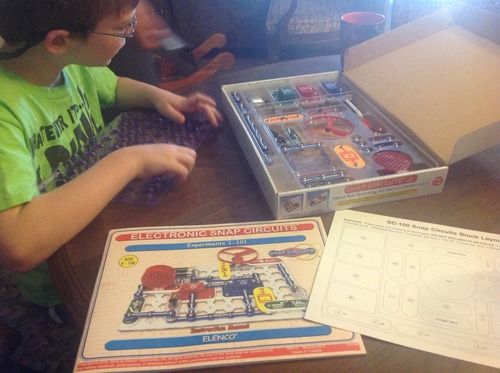
The premise is simple but effective. Children snap color-coded electronic modules onto a grid to build working circuits. No soldering, no tools, and no risk of small parts rolling under the couch. The included manual walks through over 100 projects, starting with a basic light switch and building up to AM radios, doorbells, and fan circuits.
What surprised me was how the manual explains things. It does not just tell kids what to connect, it shows them why the circuit works. My nephew started understanding concepts like series versus parallel wiring without ever realizing he was learning.
The build quality is mostly solid. The plastic grid and modules have held up to regular use, though a few reviewers noted that some of the smaller snap pieces can feel loose if kids are rough with them. We did not have any breakages during our testing window.
Replay value is where this kit earns its top spot. Because the pieces are modular, families can expand into Snap Circuits Jr. Select, Snap Circuits Extreme, or even the Snap Circuits Light kits later. My sister has already started eyeing the 500-project upgrade set as a Christmas add-on.
Who it’s best for
Kids ages 8 and up who are curious about how things work, especially electronics, fans, and gadgets. It also works well for siblings sharing a kit, because projects scale from quick five-minute builds to longer ones that hold attention for an hour.
What could be better
The kit is mostly stationary. Several of the projects are sound and light based, so kids hoping for motion or robotics will want to move up to the Snap Circuits Motion or 3D M.E.G. kits. A handful of project references live online only, which can pull focus away from the manual.
2. National Geographic Break Open 10 Premium Geodes – Best Earth Science Starter
- Hand-selected variety of 10 real geodes
- Includes safety goggles
- magnifying glass
- and display stand
- Full-color learning guide explains how geodes form
- Surprise element keeps kids engaged
- Ages 8 and up with adult help for younger kids
- Geodes are hard to crack
- some need a hammer and chisel
- Most crystals are clear quartz rather than colorful varieties
The National Geographic 10 Premium Geodes kit turned my niece into a junior geologist for an entire Saturday. The thrill of cracking a rock and seeing what is inside never gets old, even for adults. We set up a tray on the back porch, handed out safety goggles, and went to work.
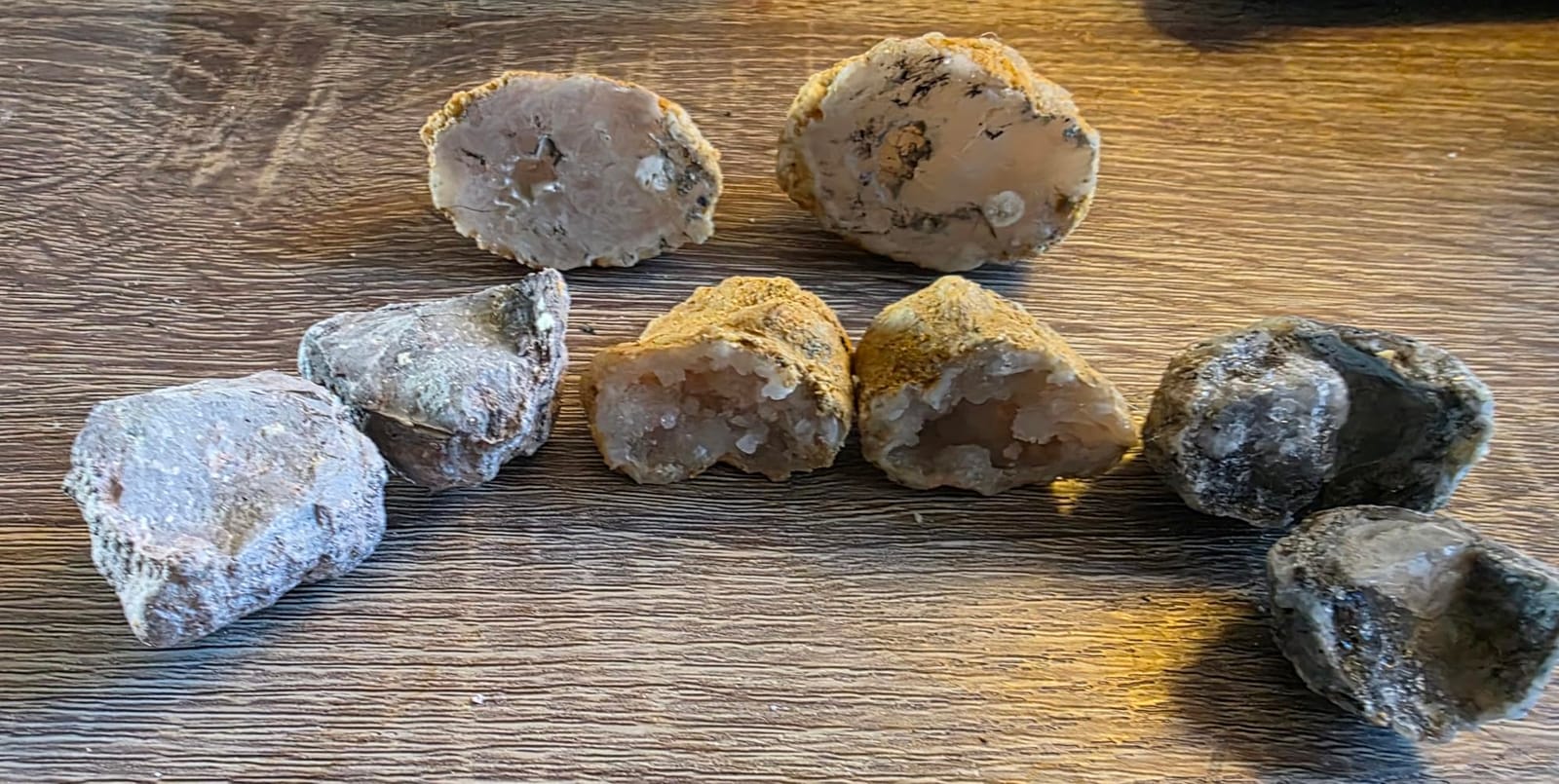
Each geode is different. Some had clear quartz crystals, others had darker bands, and two had surprising purple interiors that looked like jewelry. The kit includes a real magnifying glass and a display stand so kids can show off their best finds afterward.
The learning guide is a standout. It walks through how geodes form in volcanic bubbles over millions of years, which gave my niece a real sense that science is about patience and observation, not just fast experiments.
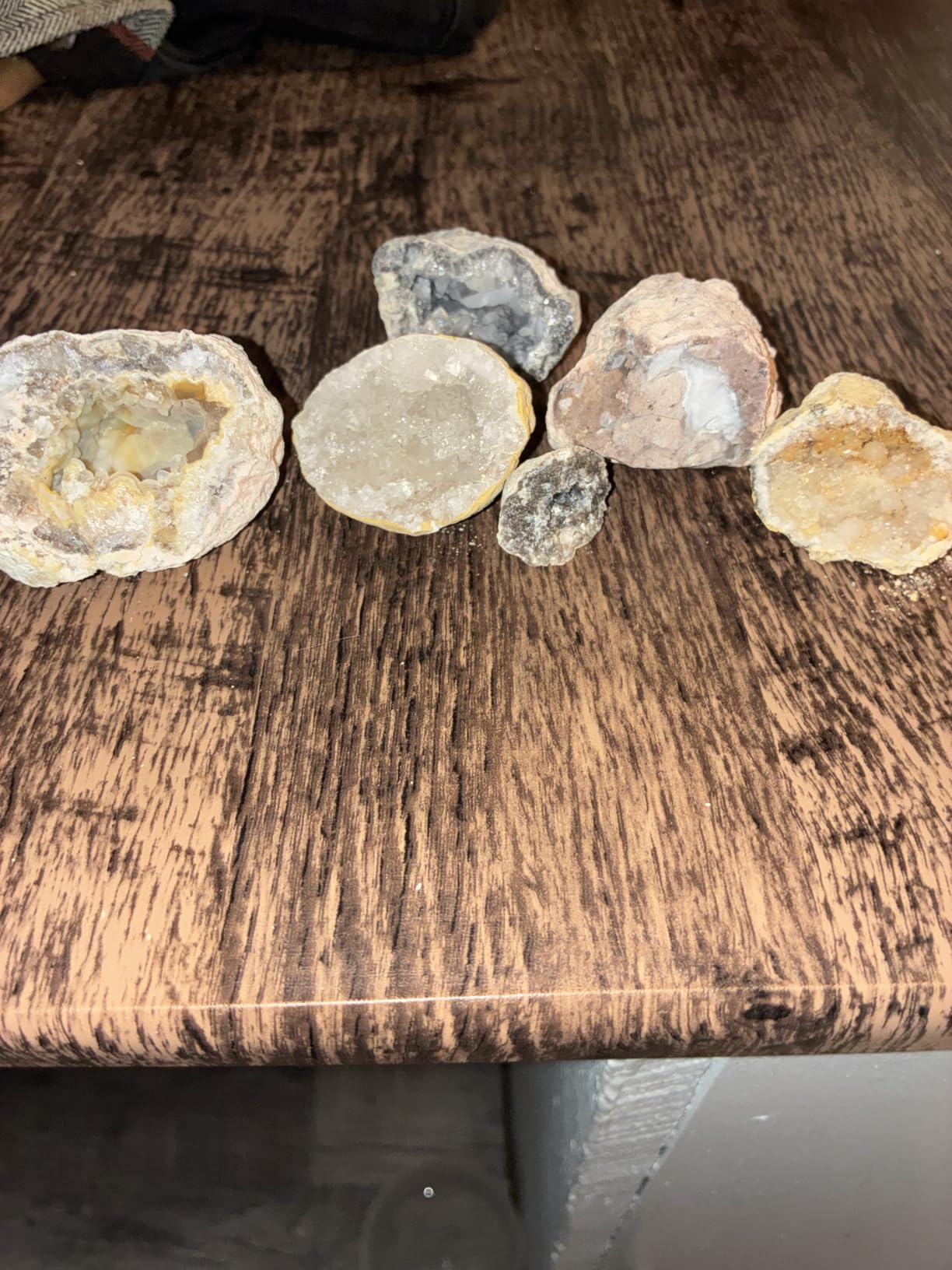
Setup takes about 15 minutes and you will want to do this outside or on a covered surface. The dust from cracking geodes is real, and a couple of pieces chipped the kitchen counter before we moved everything outside.
Out of 10 geodes, we ended up with eight clean breaks, one that took three attempts, and one that turned out to be mostly solid rock inside. That randomness is part of the appeal. Kids learn that not every experiment yields a spectacular result, and the guides in the learning book explain why.
Who it’s best for
Curious kids ages 8 to 12 who love rocks, surprises, and tactile activities. It is also a strong fit for families with mixed ages, because younger kids can help with brushing and display while older siblings handle the cracking.
What could be better
Reviewers note that most geodes contain clear quartz rather than the colorful amethyst and agate varieties kids hope for. The cracking is genuinely hard work for small hands, and a few families have upgraded to a small hammer or chisel to make breaking easier.
3. National Geographic Earth Science Kit – Best Variety for Curious Kids
National Geographic Earth Science Kit with 100+ Activities for Kids 8-12
- Over 15 experiment activities in one kit
- Covers chemistry
- geology
- and earth science
- Includes water tornado
- erupting volcano
- crystal growing
- Full-color learning guide
- Easy-to-follow instructions build confidence
- Several activities are dig-style and messy
- Some experiments need additional household supplies
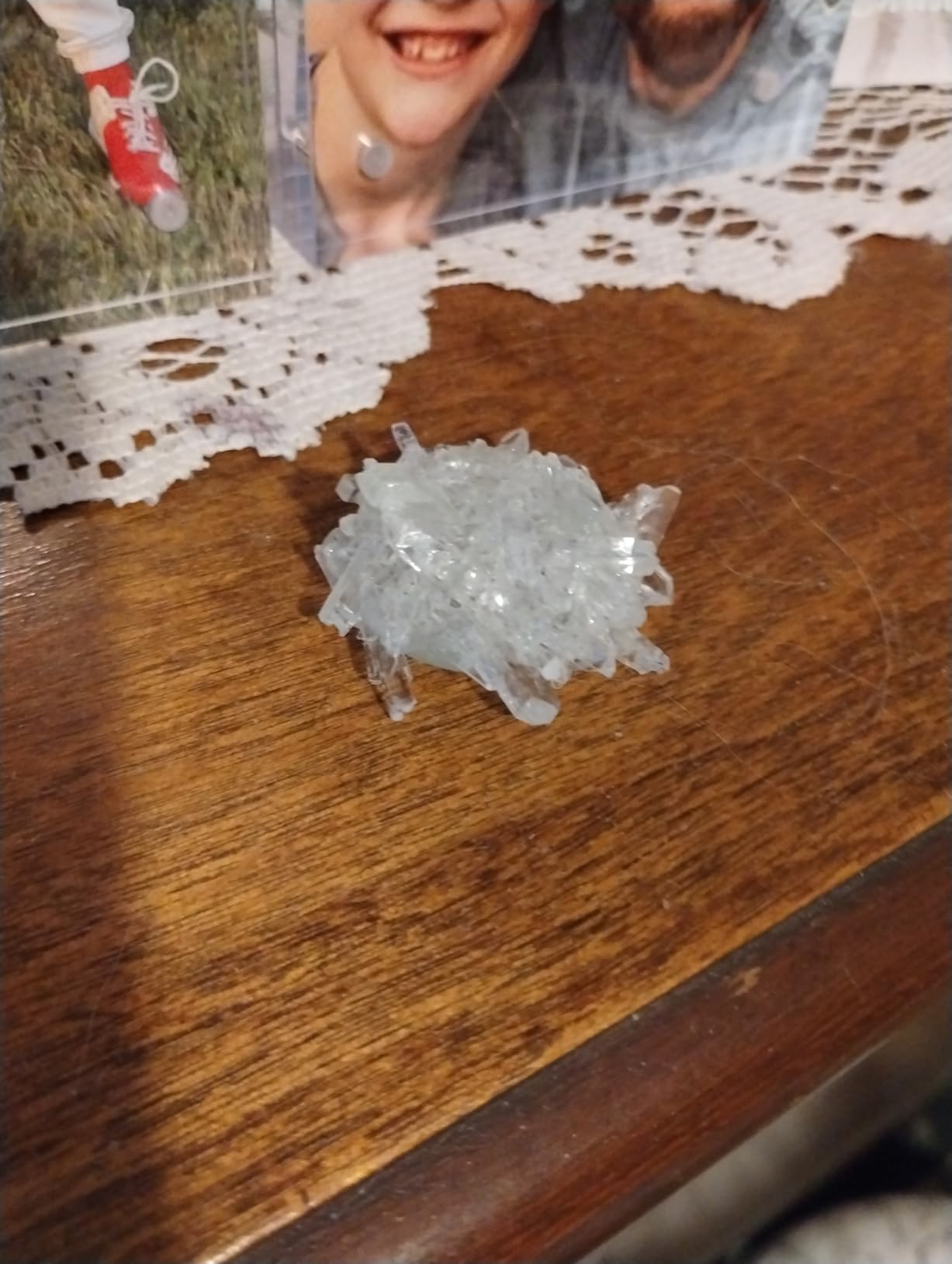
If you can only buy one science kit and want maximum variety, the National Geographic Earth Science Kit is the safest pick. It bundles a working volcano, a crystal growing activity, two dig kits, and several bonus experiments into a kit that lasted us a full week of after-school projects.
The variety is what sets this apart. One afternoon we were growing crystals, the next we were launching a dueling water tornado, and by the end of the week we had a small volcano erupting on the deck. Each activity is self-contained, so kids can pick what interests them rather than working through a fixed curriculum.
Instructions are written for kids ages 8 and up, with clear illustrations and short science explanations. My nephew read them without needing help most of the time, which is a relief for parents who do not want to be the full-time teacher.
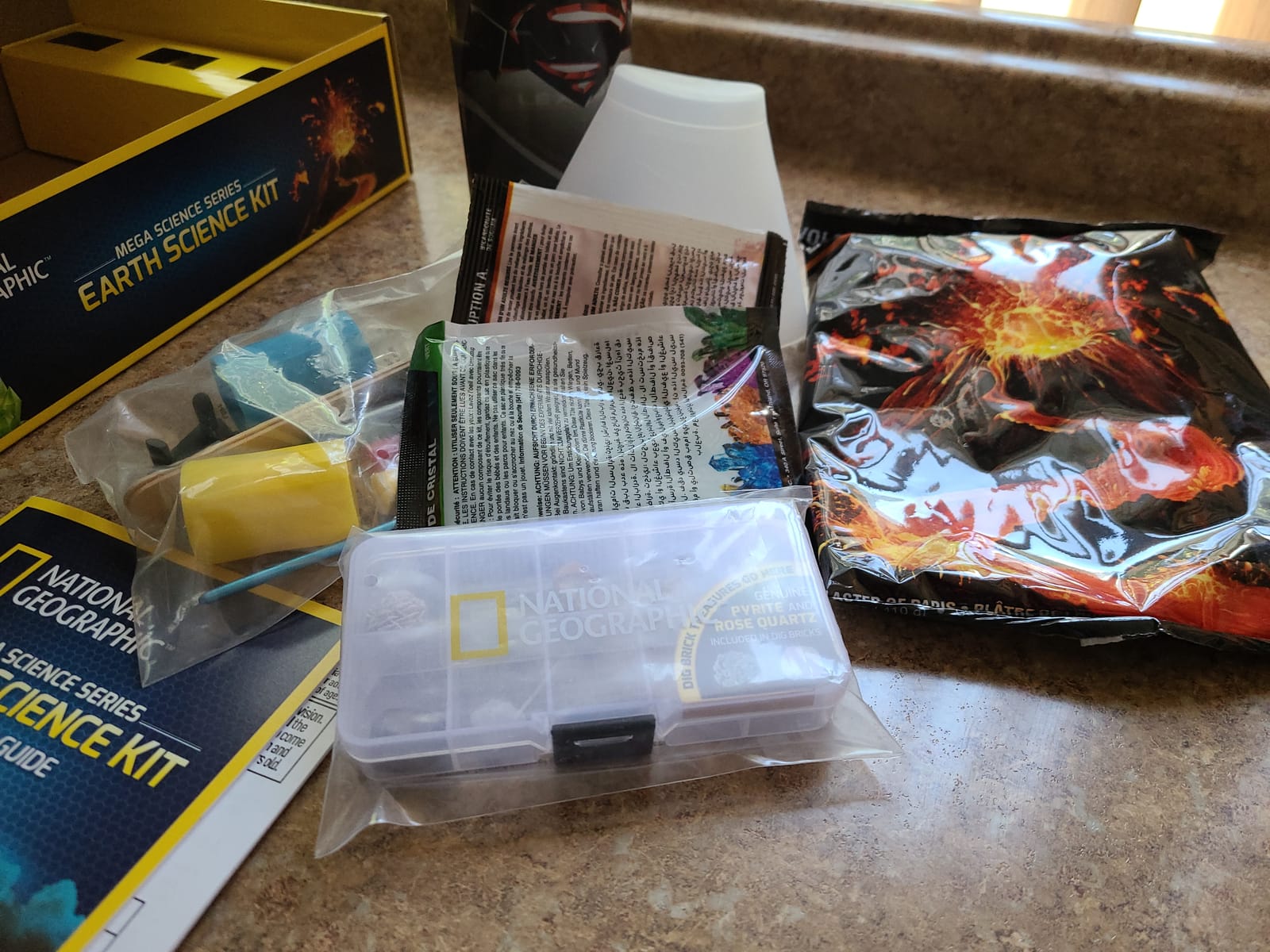
Setup is straightforward, but plan for mess. The dig activities produce dust, the volcano produces colorful lava, and the crystal growing requires patience. We did most of it on the back porch with a tray.
One thing I appreciated: the kit actually delivers more than a dozen distinct activities, and most of the consumables are reusable. You will need a few household basics like water and vinegar for some experiments.
Who it’s best for
Kids ages 8 to 12 with broad curiosity who want to try a bit of everything. It is also a strong choice for families with multiple children, because the kit is large enough to share without anyone feeling shortchanged.
What could be better
The dig activities and volcano can be messy. Reviewers recommend laying down newspaper or working outside. Some activities consume household supplies like baking soda or vinegar that need to be replenished.
4. National Geographic Mega Gemstone Dig Kit – Best Hands-On Geology Activity
- Excavate 15 real gemstones including amethyst and pyrite
- Comes with dig brick
- chisel
- brush
- and magnifying glass
- Detailed 16-page full-color learning guide
- Keeps kids engaged for several hours
- Works well for sibling shared play
- Messy dust and debris require a tray or outdoor space
- Younger kids under 4 may need significant adult help
- Dig brick is firm and tiring for small hands
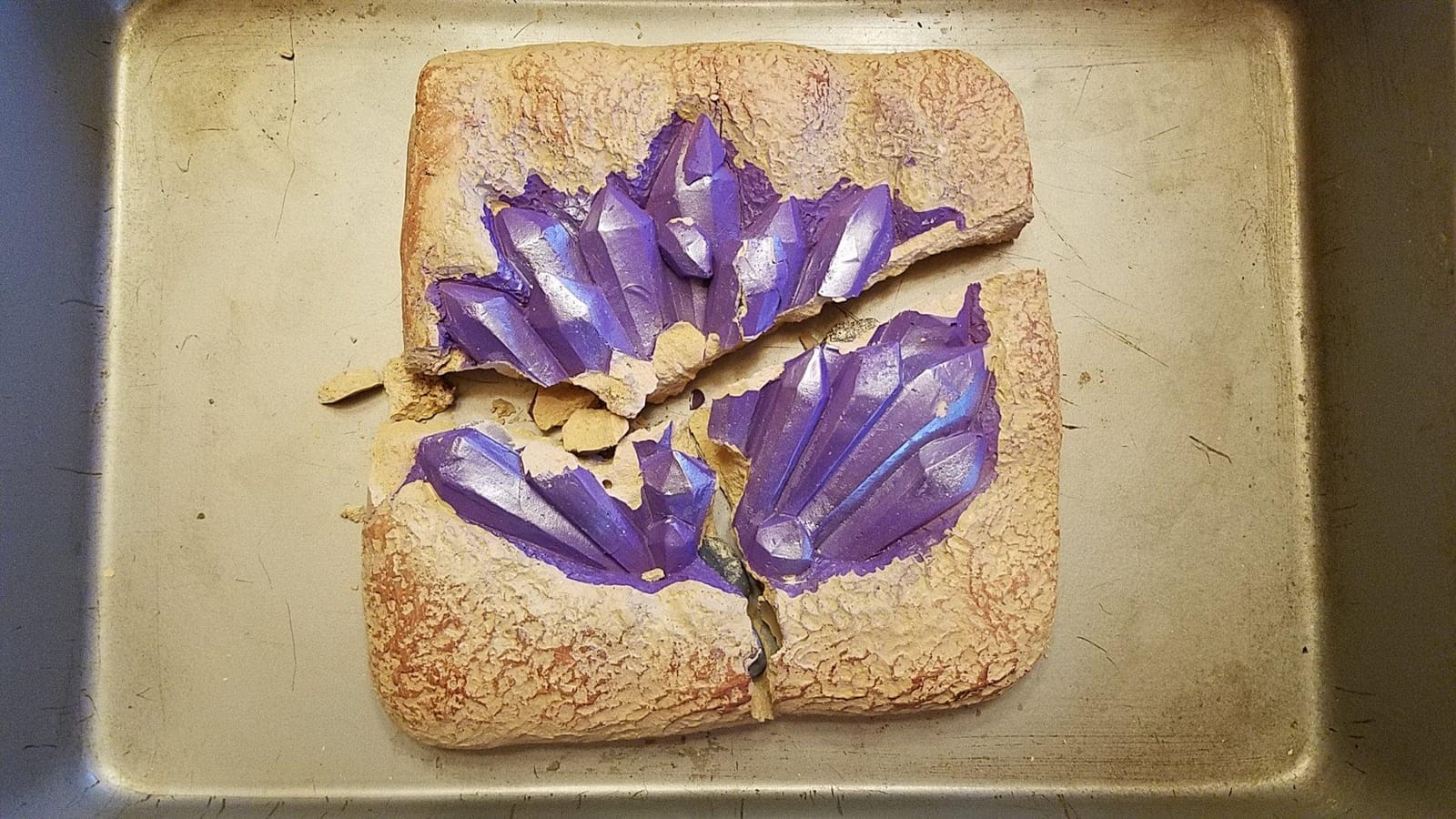
The Mega Gemstone Dig Kit is a slower-burn experience compared to the geode cracking kit, and that is exactly what made it work for my niece. She spent three afternoons chipping away at the dig brick with the included chisel, brushing off dust, and identifying each gem as it emerged.
Each kit contains 15 real gemstones, including pyrite, amethyst, tiger’s eye, fluorite, quartz, obsidian, and aventurine. The 16-page learning guide includes photographs and identification tips so kids can match each find to a name and learn a little geology along the way.
This is one of the more relaxing science kits we tested. There is no rush, no chemistry, no fumes. Kids work at their own pace, which is great for kids who get frustrated by fast-paced experiments.
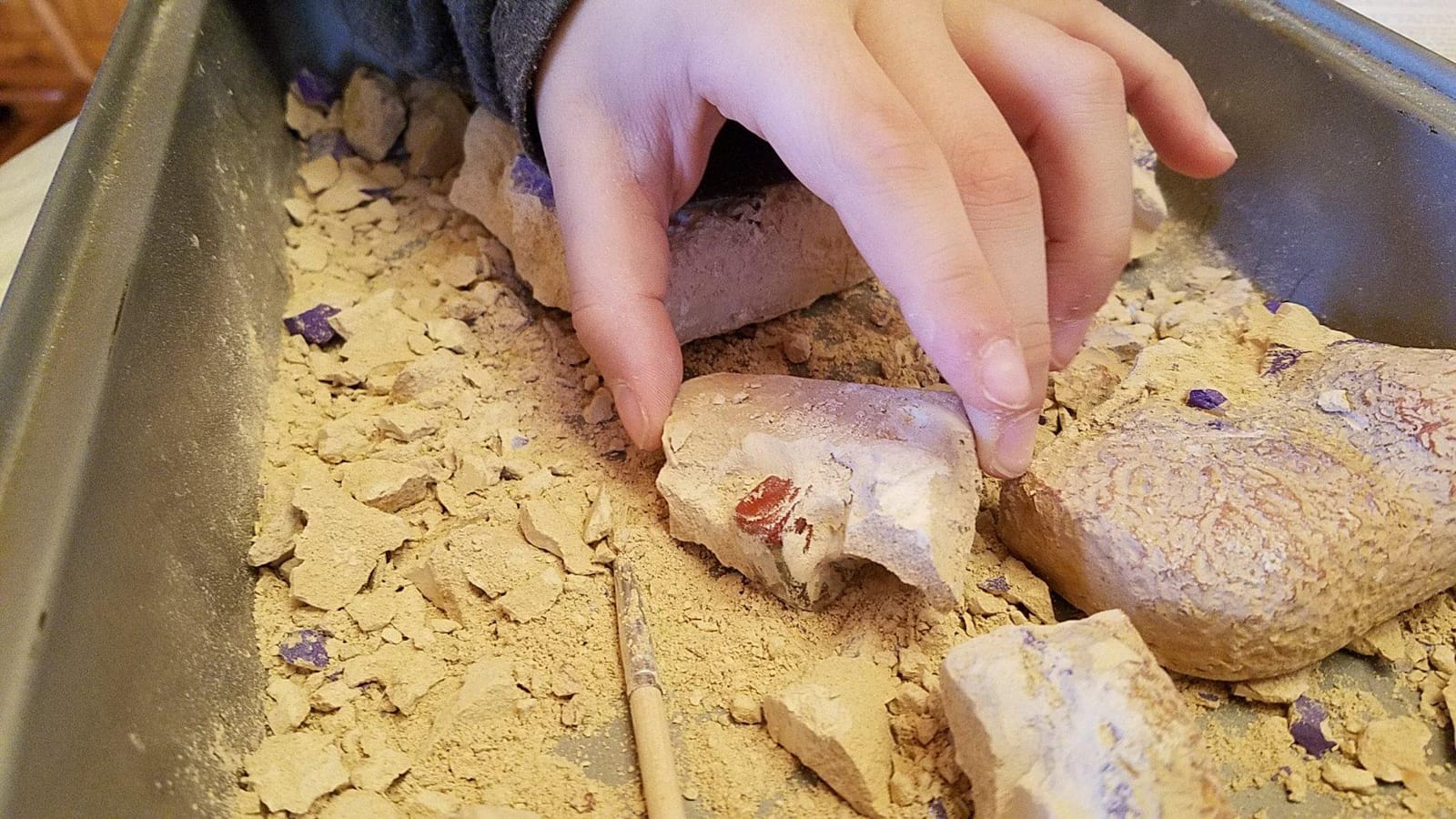
Setup is minimal and the kit is self-contained. The dig brick is firm, so younger kids will need a hand, but for kids ages 8 and up the included tools work fine.
Cleanup is the main trade-off. We used a tray on the porch, which kept the dust contained. Indoors is doable with newspaper, but expect a vacuuming session afterward.
Who it’s best for
Patient kids ages 8 and up who love rocks, minerals, and slow reveal activities. It is also a great fit for siblings working together, since one can dig while the other identifies specimens.
What could be better
Reviewers note that the dig brick is firm and can be tiring for small hands. A few families softened the brick with a damp cloth before chiseling. The included brush is small, so a larger paintbrush from home helps with cleanup.
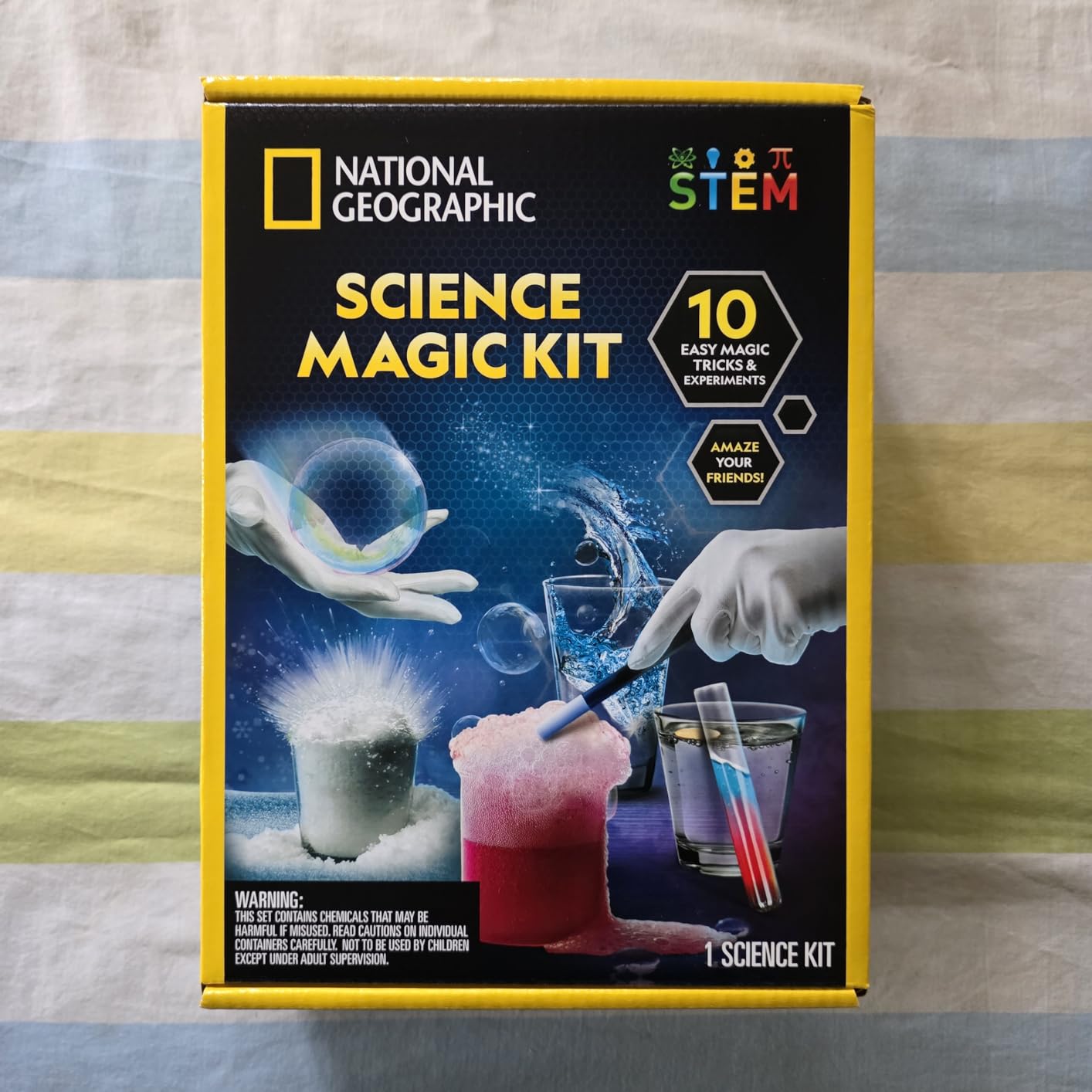
5. National Geographic Magic Chemistry Set – Best Chemistry Kit for Show-Offs
National Geographic Magic Chemistry Set with 10 Tricks for Kids Ages 8-12
- 10 experiments designed as magic tricks
- Includes magic wand and white gloves
- All tools and chemicals are in the box
- Experiment guide explains the science behind each trick
- Engaging for younger kids with adult help
- Adult supervision is helpful for younger kids
- Some experiments can be completed in one sitting
The Magic Chemistry Set is a clever mashup of science and performance. The experiments are designed to look like magic tricks, with color-changing water, floating coins, and instant snow. My nephew put on a full show for the family using the included wand and gloves, and the science was a fun reveal after the wow moment.
What makes this kit work is the framing. Instead of feeling like a chemistry lesson, kids feel like magicians. The trick comes first, then the guide explains the science behind it, which is a much better hook than starting with a chemical formula.
The kit is fully self-contained. All chemicals, tools, and instructions are inside, so there is no last-minute grocery run for baking soda or vinegar. For busy parents, that is a real win.
Each experiment takes 10 to 20 minutes, and the whole kit can be done in a single afternoon. That is the main trade-off. It is a great experience but not a long-term project.
Supervision is light. Kids ages 8 and up can handle most experiments independently, with a parent nearby for the trickier color-change reactions.
Who it’s best for
Kids ages 8 and up who love performance, magic, or showing off to family. It is also a strong choice for birthday parties, since each child can take home a kit and put on their own show.
What could be better
Reviewers note that the kit can be finished in one afternoon, so families looking for long-term replay value may want to pair it with a longer-form kit. Some experiments require steady hands for the magic reveal.
6. National Geographic Mega Crystal Growing Kit – Best Crystal Growing Experience
National Geographic Mega Crystal Growing Kit with 6 Crystals for Kids 8-12
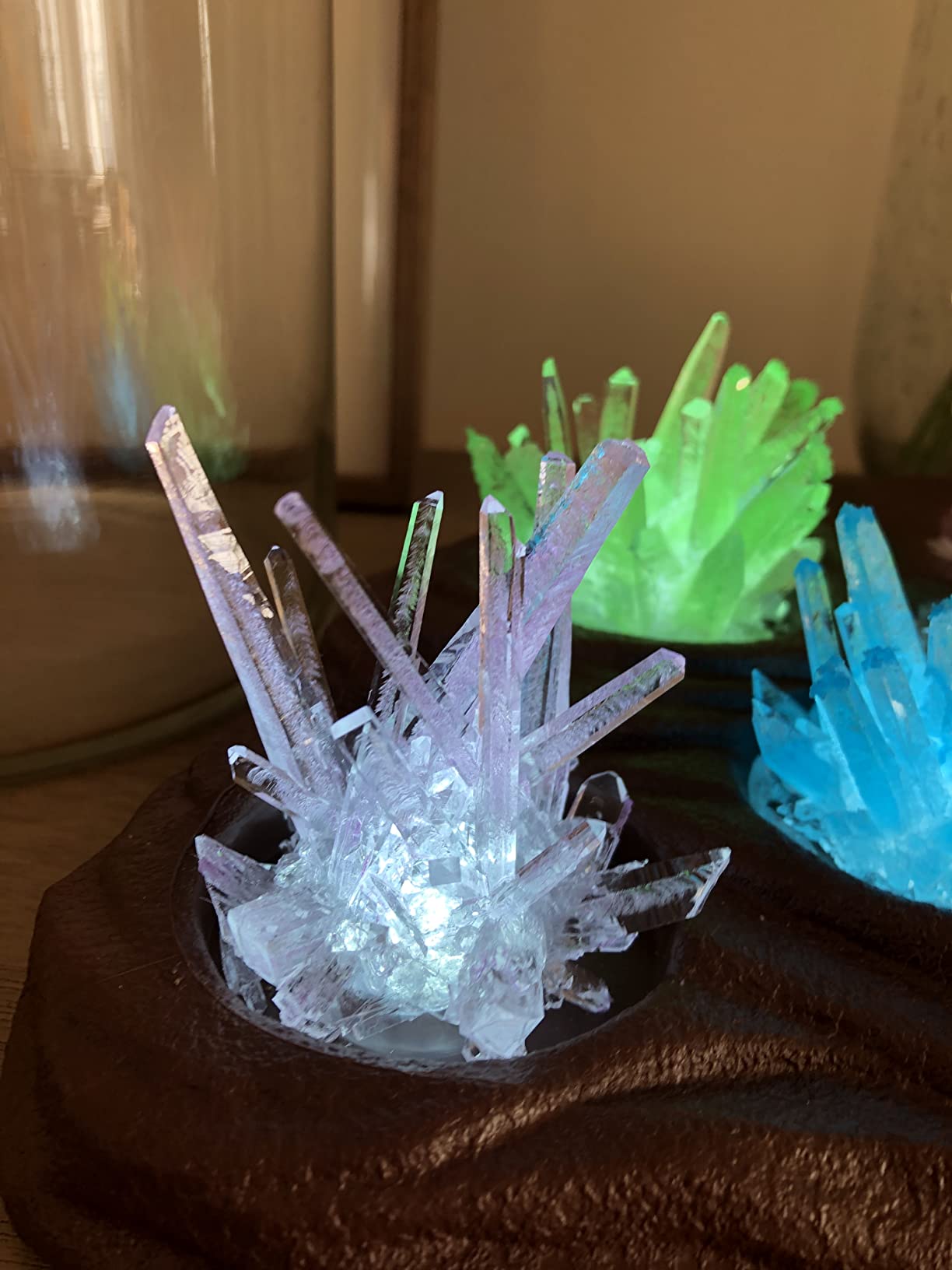
- Grows six colorful crystals in 3-4 days
- Includes a USB-powered light-up display stand
- Comes with 4 real gemstone specimens
- Easy-to-follow instructions with silicone growing chambers
- Full-color learning guide teaches identification
- Light-up display only holds 5 of the 6 crystals
- Grown crystals can be fragile once formed
- Some kits are missing printed instructions
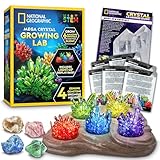
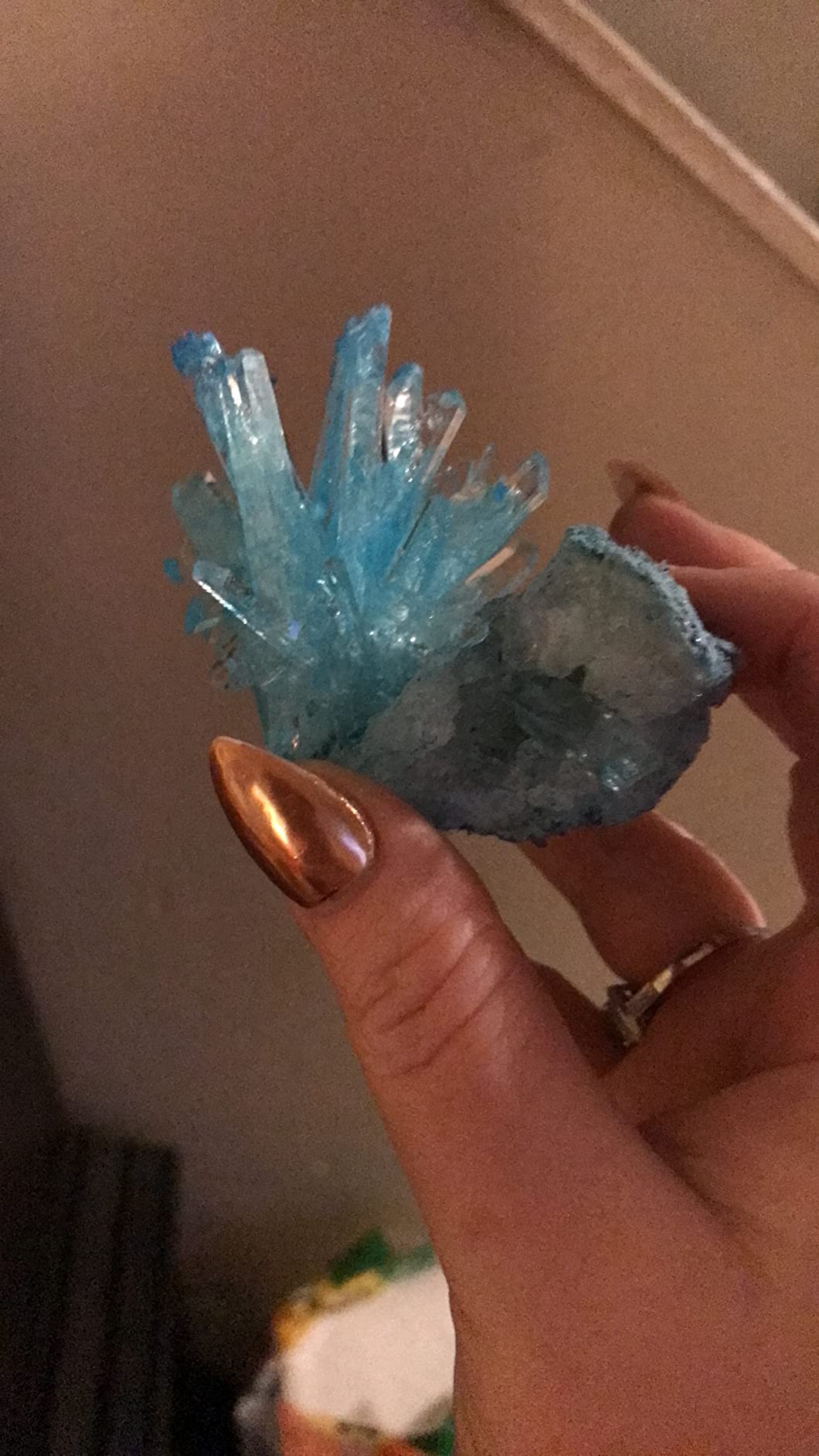
The Mega Crystal Growing Kit is the closest thing to real magic in the science kit world. Kids mix the solution, pour it into the silicone chambers, and watch crystals grow over three to four days. My niece checked on her crystals every morning before school.
The kit grows six crystals in different colors, including a glow-in-the-dark variety that is genuinely fun under the bedroom lamp. The USB-powered light-up display stand lets kids showcase their finished crystals on a shelf, which gives the kit lasting replay value beyond the experiment itself.
The bonus is four real gemstone specimens included in the box. Kids can compare their grown crystals to genuine rose quartz, fluorite, blue calcite, and quartz geode samples while reading the identification guide.
Setup is straightforward but slow. Each one takes about 10 minutes to set up, then 3 to 4 days of waiting. Patience is part of the lesson.
The crystals are colorful but fragile once grown. We had one snap during transport to the display stand, which my nephew handled with surprising grace.
Who it’s best for
Kids ages 8 and up who enjoy watching things happen over time rather than instant experiments. It is also a great fit for kids who collect rocks or display their creations on a shelf.
What could be better
The light-up stand holds 5 crystals, but the kit grows 6. Reviewers mention that one crystal needs to be displayed separately or stored in its original container. A few kits have shipped without printed instructions, though the online video guide fills the gap.
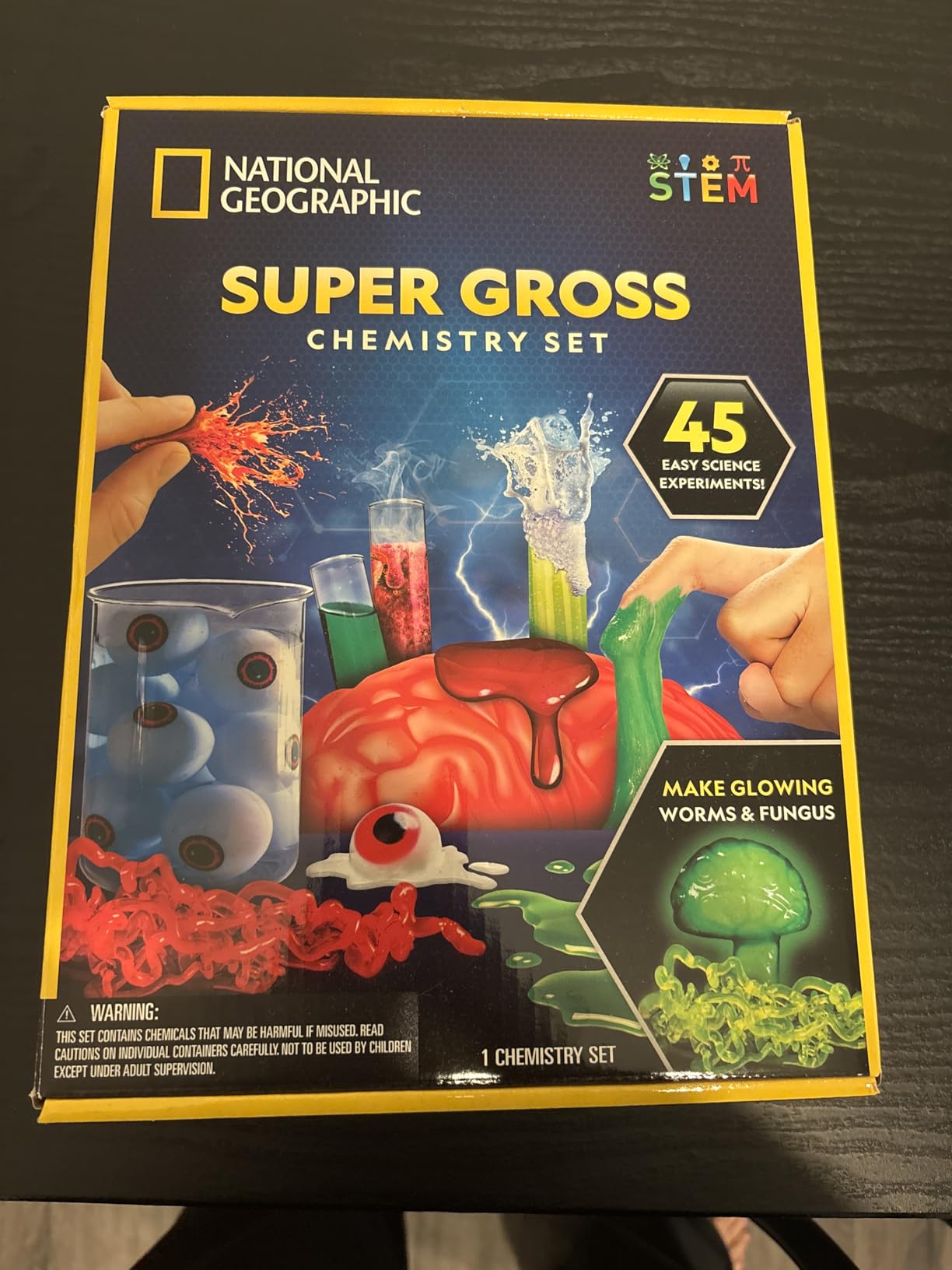
7. National Geographic Gross Science Kit – Best for Reluctant Scientists
National Geographic Gross Science Kit with 45 Experiments for Kids 8-12
- 15 ready-to-go gross experiments plus 30 more with household items
- Covers polymers
- chemical reactions
- and pH science
- Includes a brain dissection specimen for extra wow factor
- Kid-friendly illustrated instructions with science explanations
- Engaging for both boys and girls
- Some experiments require household supplies that may not be readily available
- Genuinely messy - outdoor or protected surfaces recommended
If you have a kid who yawns at the word science but lights up at the word slime, the Gross Science Kit is your answer. It leans hard into the gross theme with worms that glow, fake test tube vomit, and a real brain dissection specimen that made my niece scream with delight.
Behind the gross factor is genuine chemistry. The kit covers polymers, pH science, and chemical reactions, all framed as icky experiments. Kids absorb the science without realizing it, because the gross factor carries them through.
The kit includes 15 ready-to-go experiments plus a bonus booklet with 30 more activities using common household items. That bonus booklet alone extends the kit for months.

Setup requires basic household supplies like vinegar, baking soda, and cornstarch. None of it is exotic, but plan ahead so you are not mid-experiment hunting for cornflour.
This is the messiest kit we tested. Genuinely. Outdoor space or a covered surface is highly recommended. We learned this the hard way after the fake vomit experiment ended up on the dining room wall.
Who it’s best for
Kids ages 8 to 12 who normally resist science kits. It is also a strong fit for older reluctant readers, because the gross theme carries them through the explanations.
What could be better
The mess is real and not exaggerated by reviewers. Plan to do most experiments outside or on a hard floor. A few of the bonus booklet experiments need materials you may not have on hand, like unflavored gelatin or specific food coloring.
8. National Geographic Ultimate Volcano Science Kit – Best Classic STEM Project
- Includes 3x more eruption powder than previous versions
- Reusable volcano mold and updated instructions
- Comes with real volcanic specimens including pumice and geode
- Full-color learning guide teaches volcano geology
- Strong STEM project for science fairs and home learning
- Eruption lava can stain surfaces and paint on the volcano
- Process is time-consuming with multiple drying stages
- Limited amount of black paint included
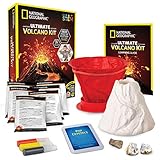
The Ultimate Volcano Kit is a classic STEM project that has held up for decades, and this updated version is better than the one I grew up with. The volcano mold is reusable, the eruption powder volume is tripled, and the kit now includes real volcanic specimens.
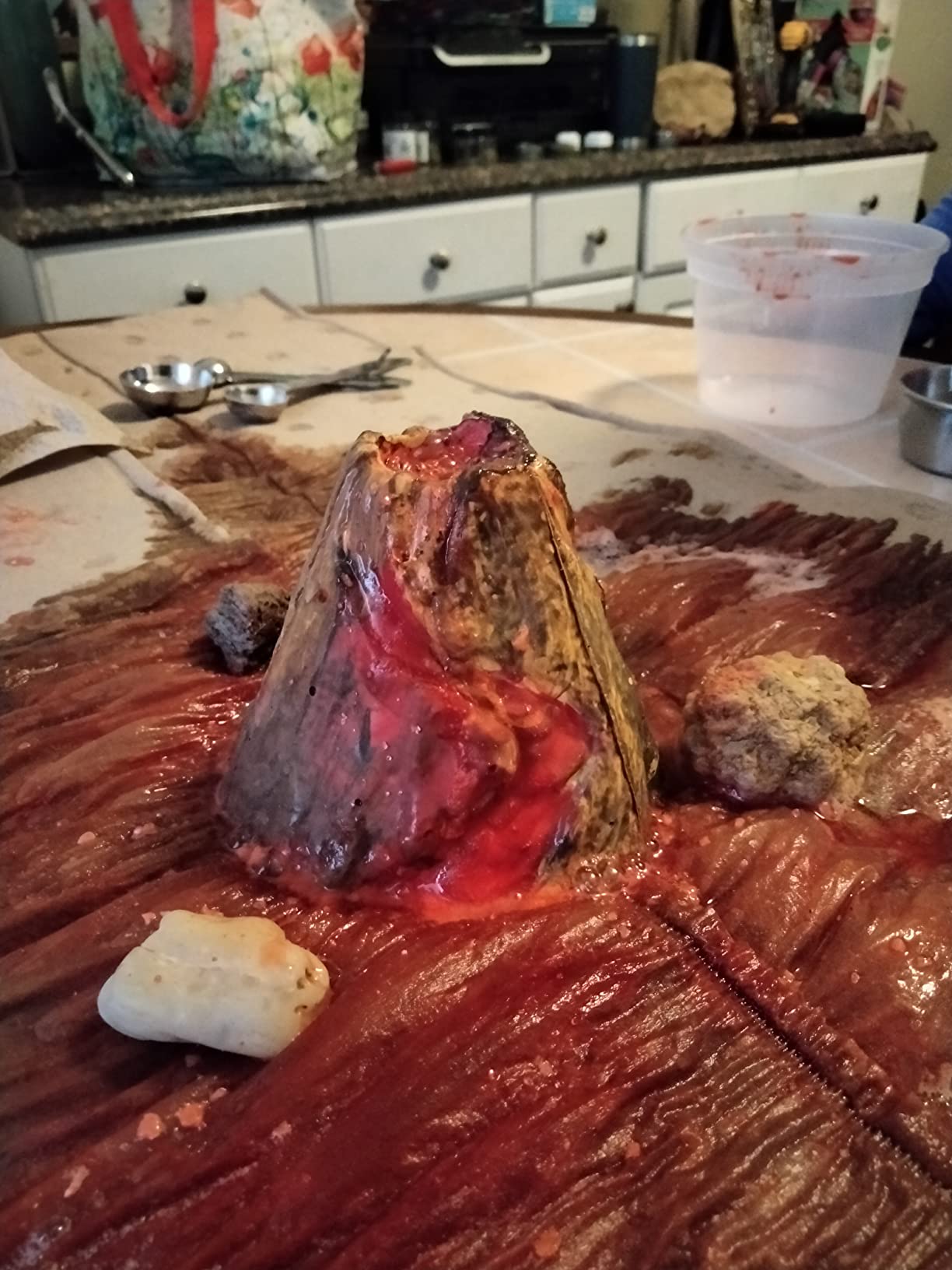
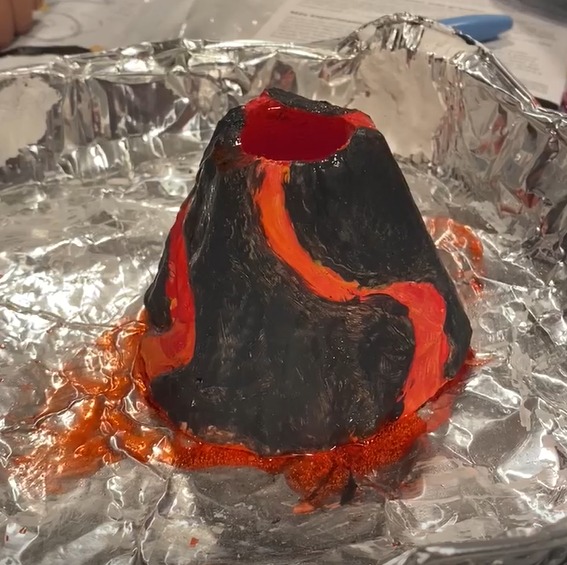
My nephew painted his volcano over two afternoons, let it dry, and then erupted it on the back porch with a crowd of neighborhood kids watching. The eruption is dramatic enough that even the adults stopped to look.
The included specimens are a quiet highlight. Real pumice floats in water, which is a great side lesson, and the geode adds a small cracking surprise once the volcano excitement dies down.
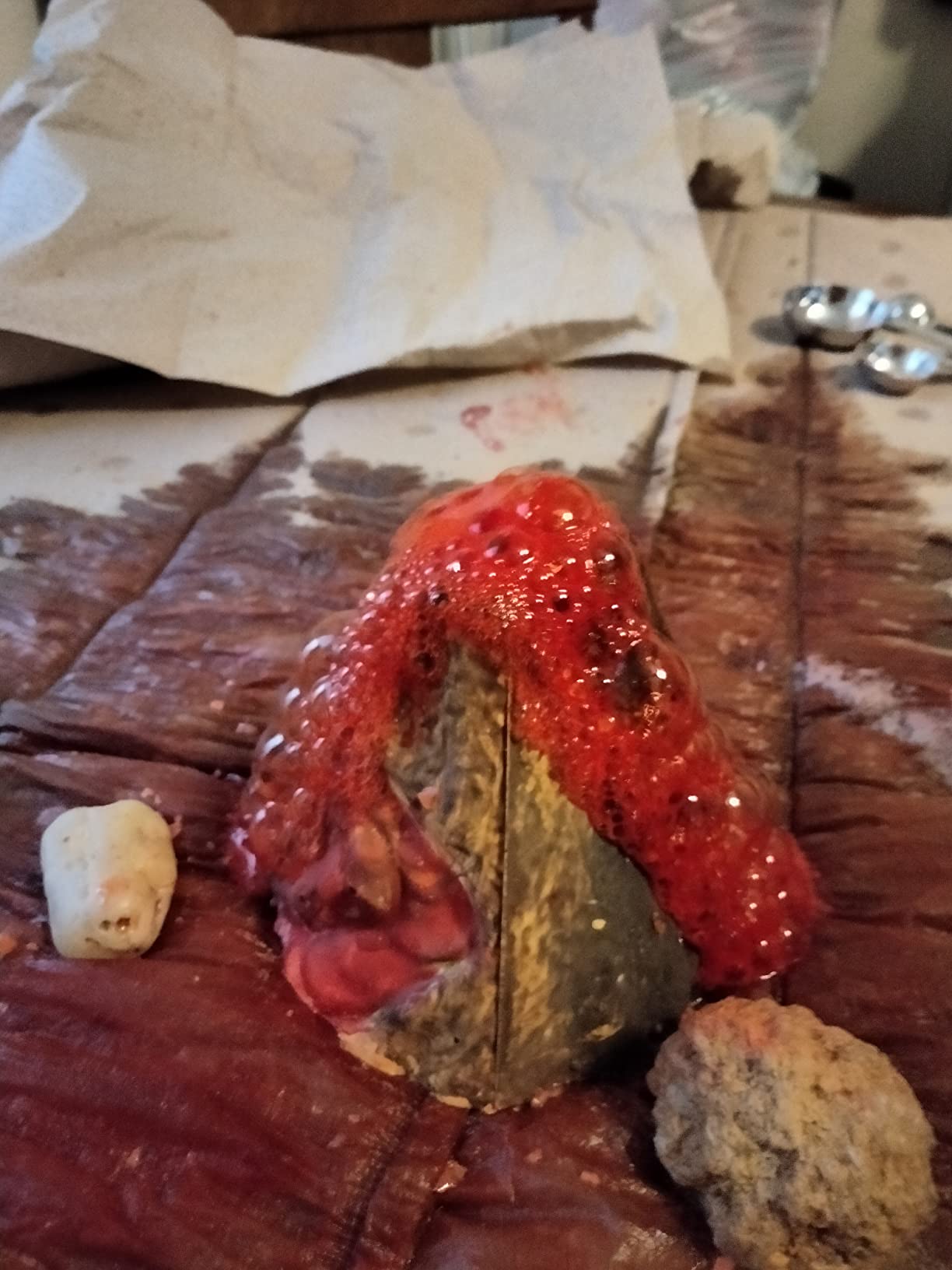
Setup takes patience. The plaster mold needs drying time between painting and eruption, so this is a multi-day project rather than a single afternoon.
Cleanup is manageable if you plan for it. Lay down newspaper, use a tray, and keep water nearby for the lava runoff. The eruption can stain porous surfaces like concrete, so avoid doing it on a patio you care about.
Who it’s best for
Kids ages 8 to 12 who love dramatic experiments and have patience for multi-day projects. It is also a strong fit for science fair projects, because the finished volcano is display-worthy and the eruption gets attention.
What could be better
Reviewers note the included black paint runs out quickly for larger volcanoes. A few extra paint supplies from home help. The lava can stain paint on the volcano itself, so expect to repaint for repeat eruptions.
9. National Geographic Chemistry Set with 45 Experiments – Best Chemistry Curriculum
National Geographic Chemistry Set with 45 Experiments for Kids 8-12
- 45 experiments including volcano
- geyser
- and rocket launch
- Easy-to-follow illustrated experiment guide with science explanations
- Hands-on STEM learning of chemistry basics and the scientific process
- Safe materials suitable for ages 6+ with supervision
- Strong gift appeal for curious kids
- Volcano mold assembly can be tricky and prone to leaking
- Included chemical packets can run out and need household replacements
- Instructions are English-only
If you want a real chemistry curriculum in a box, the National Geographic Chemistry Set with 45 Experiments is the closest match. It covers chemical reactions, polymers, pH science, and physics-flavored experiments like the rocket launch, all in one kit.
The range is impressive. We built and erupted a volcano, made a soda-powered rocket, created a chemical geyser, and explored polymers with slime. Each experiment taught a different concept, and the kit held attention for over a week of after-school sessions.
Materials feel safe and well-designed. The plastic tools and chemical packets are clearly labeled, and the included goggles are a real bonus for any kit in this category.
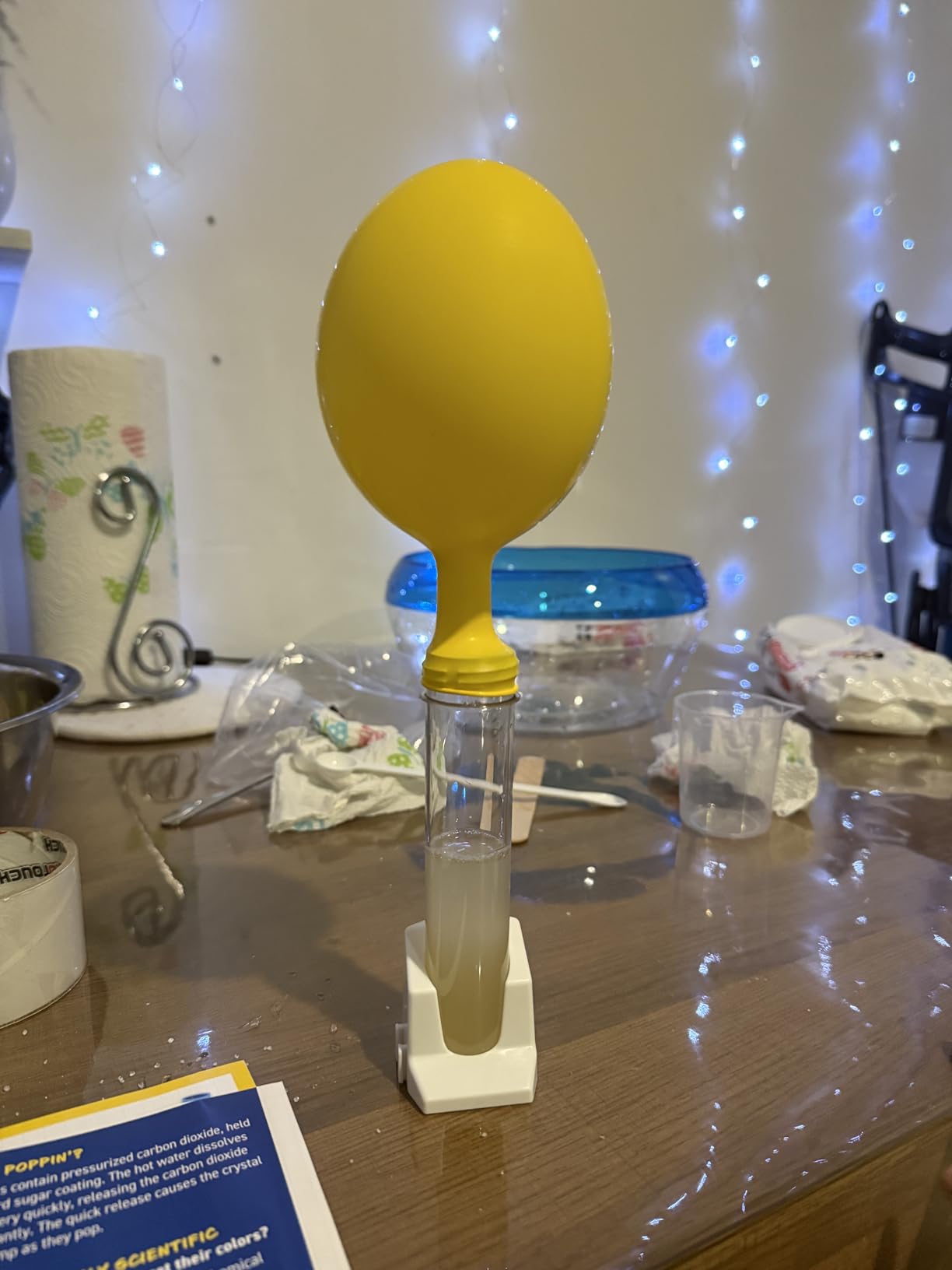
Setup is mostly straightforward, though the volcano mold assembly frustrated my nephew until we figured out the right paste consistency. Plan for a couple of practice runs.
Several experiments consume the included chemical packets quickly. Household replacements like baking soda, vinegar, and salt cover most gaps.
Who it’s best for
Kids ages 8 to 12 who want a real introduction to chemistry rather than a one-off experiment. It is also a strong choice for homeschool families looking for a chemistry unit that aligns with middle school science standards.
What could be better
Reviewers note the volcano mold can leak if the paste is too runny. The instructions are English-only, which limits accessibility. Some chemical packets run out before all 45 experiments are completed.
10. Creativity for Kids Grow ‘N Glow Terrarium – Best Science Kit for Younger Kids
- Screen-free activity that combines arts and crafts with science
- Seeds germinate in just 3-4 days
- Includes everything needed - jar
- soil
- seeds
- figurines
- and glow stickers
- Teaches responsibility and nurturing through daily care
- Vibrant decorations kids enjoy customizing
- Sand quantity is small and barely visible
- Some kits have shipped with missing seed packets
- Plastic jar is decorative rather than heavy-duty
The Grow ‘N Glow Terrarium is the best science kit for younger kids in our testing, and the one I wish I had when I was 6. It combines a tiny ecosystem with glow-in-the-dark stickers, so the project feels more like craft time than science class.
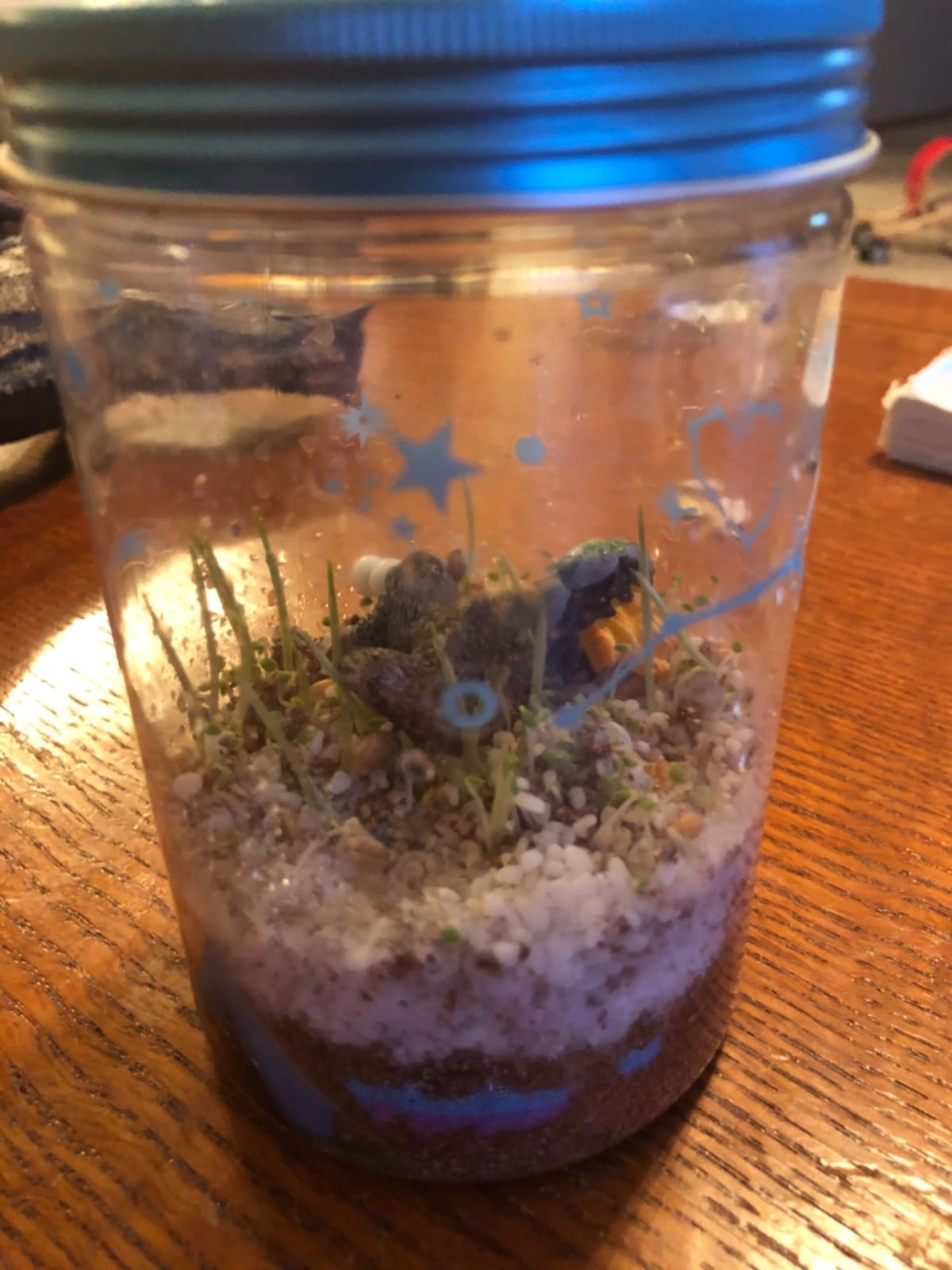
Kids assemble the terrarium by layering vermiculite, sand, and seeds in a plastic jar. Within three to four days, the wheatgrass and chia sprouts emerge, and the glow-in-the-dark forest figurines light up at night. The combination of planting and decoration makes it accessible for kids who would otherwise lose patience with a pure science experiment.
The nurturing element stands out. Kids check on their terrarium daily, water it, and watch it grow. It teaches responsibility in a way that feels like play rather than a chore.
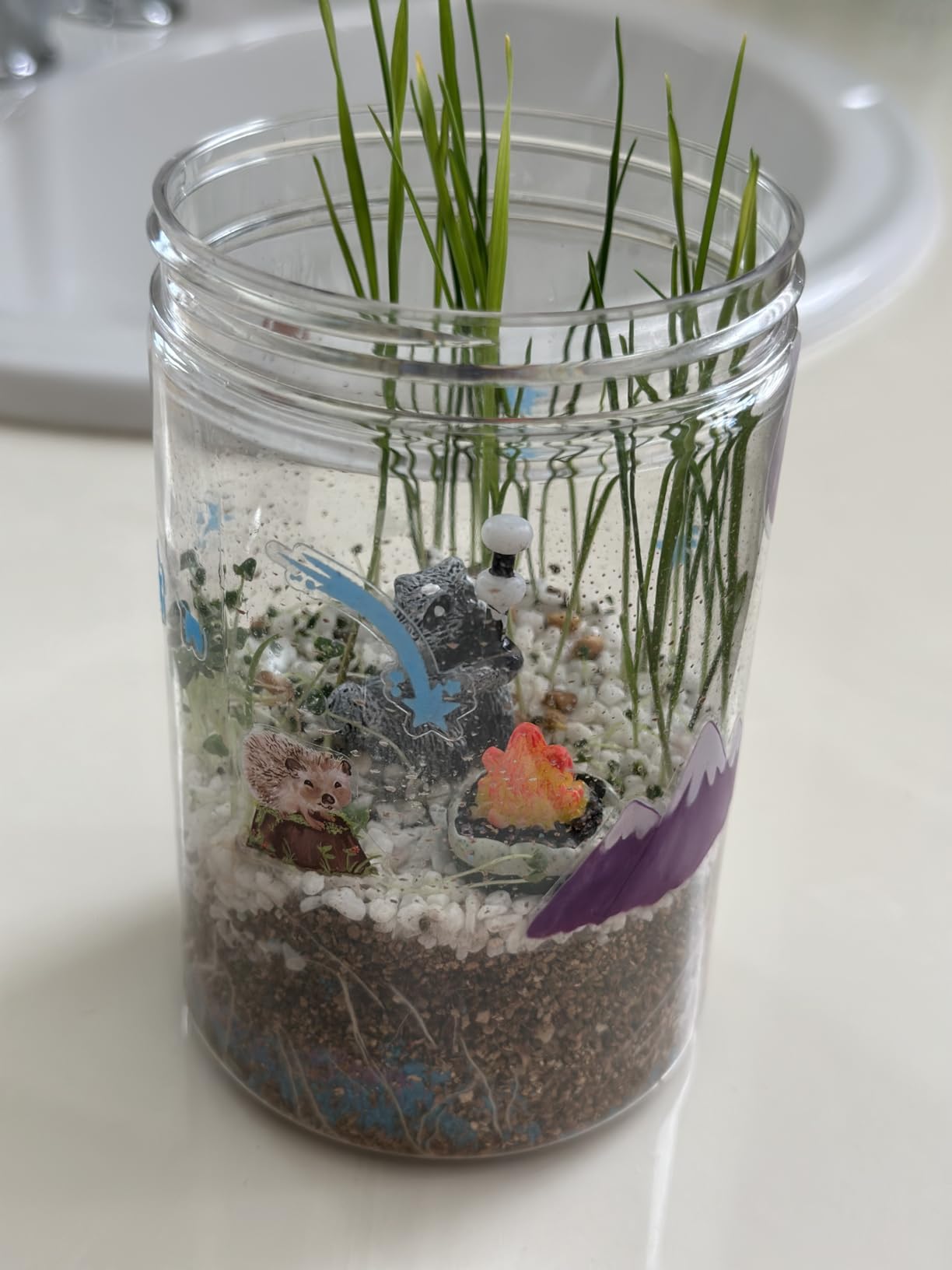
Setup takes about 15 minutes with a parent nearby, then the project is self-sustaining for weeks. My niece watered hers every morning before breakfast.
Durability is the main trade-off. The plastic jar is decorative rather than heavy-duty. Ours survived three months of handling but started showing scratches.
Who it’s best for
Kids ages 6 to 8 who are too young for chemistry or electronics but ready for hands-on projects. It is also a strong choice for kids who love craft activities and need a gentle introduction to the science of growing things.
What could be better
Reviewers note the included sand quantity is small and barely visible in the layered design. A few kits have shipped with missing seed packets, though replacements are easy to source. The plastic jar is decorative, not durable.
How to Choose the Right Science Kit for Your Child?
Choosing the best science kits for kids comes down to four practical factors: age, interests, supervision level, and replay value. Get those right and the kit will get used. Get them wrong and you will find it gathering dust in a closet within a month.
Match the kit to your child’s age
Age ranges on science kits are not just marketing. They reflect safety testing, fine motor skill demands, and reading level. Kits rated for ages 8 and up usually involve small parts, chemical reactions, or tools that younger kids should not handle alone.
For kids ages 5 to 7, lean toward terrariums, simple dig kits, and craft-style science projects. For ages 8 to 12, chemistry sets, electronics kits, and multi-activity kits work well. For ages 12 and up, consider kits with more advanced concepts like MEL Science subscriptions or robotics kits that pair with introductions to robotics learning.
Pick based on interest, not just category
The biggest mistake I see is parents choosing a kit by category rather than by interest. A child obsessed with rocks will be far more engaged with a geode or gemstone dig kit than with a generic chemistry set, even if the chemistry set has more activities.
Talk to your child about what excites them. Crystals and gems, volcanoes and eruptions, circuits and gadgets, animals and biology, or slime and gross reactions. There is a kit for every specific interest, and matching that interest is the single biggest predictor of whether the kit gets used.
Check the supervision level
Most chemistry kits need at least light adult supervision, especially for kids under 10. Dig kits need a setup hand and mess management. Electronics kits like Snap Circuits are mostly independent for ages 8 and up.
If you want a kit you can hand off and walk away from, lean toward terrariums, crystal growing, and gross science kits. If you want a kit that turns into shared family time, lean toward volcanoes, geodes, and chemistry sets.
Think about replay value
Reddit parents repeatedly flag replay value as the difference between a kit that ends up in a closet and a kit that lasts six months. Look for kits with many distinct experiments, modular components, or ongoing activities like crystal growing that extend over days.
Subscription boxes like KiwiCo, MEL Science, and CrunchLabs are worth considering if replay value matters most. They deliver a new kit monthly, which solves the one-and-done problem. You can also check how robotics helps kids learn STEM for adjacent subscription options that lean into building and coding.
Budget tiers and what to expect
Most of the kits in this roundup sit in the under-$35 range, which is the sweet spot for value. Below $15, you are looking at single-experience kits like the magic chemistry set or volcano kits. Above $35, you start seeing more advanced kits with electronics, robotics, or laboratory-grade materials.
For a first science kit, the under-$35 range gives you the best combination of variety, materials, and educational value. Save the premium kits for kids who have already shown they enjoy hands-on learning.
Safety and Supervision by Age
Safety is the question parents ask most often on forums, and it is one most roundups ignore. Here is a quick breakdown of what to expect by age group, based on our testing and reviewer feedback.
For ages 5 to 7, stick to kits without chemicals, sharp tools, or small parts that pose a choking hazard. Terrariums, crystal growing kits with adult help, and basic dig kits with chunky tools are the safest picks. Supervision is constant.
For ages 8 to 10, most chemistry sets, electronics kits, and dig kits are safe with light supervision. Goggles are included in nearly every kit we tested, which is reassuring. Keep an eye on chemical packets and small chisels.
For ages 11 and up, kids can handle most kits independently. The main concerns shift to mess management and project pacing, not safety. Volcano kits, large chemistry sets, and electronics explorers all work well.
For all ages, do the digging outside or with a covered surface. The dust and debris from dig kits is the most consistent mess complaint across reviewers, and it is easily managed with a tray or a sheet.
Subscription Boxes vs One-Time Purchase
One-time kits like the ones in this roundup are great for specific interests and gift-giving. Subscription boxes like KiwiCo, MEL Science, and CrunchLabs solve a different problem: ongoing engagement. Reddit users consistently recommend them for kids who burn through kits quickly.
KiwiCo is the all-rounder, with age-specific lines from Kiwi Crate for younger kids to Eureka Crate for older builders. MEL Science leans hard into real chemistry with monthly experiments and a companion app. CrunchLabs focuses on engineering and problem-solving, which fits well with the robotics-adjacent kits in this roundup.
Subscriptions cost more over time, but the variety and ongoing novelty are unmatched. For families with multiple kids or kids who finish kits in a weekend, subscriptions often deliver better value than a new one-time kit every few months.
Frequently Asked Questions
What are some good science activity kits for kids?
The best science activity kits for kids in 2026 span chemistry, geology, electronics, and biology. Our top picks include Snap Circuits Jr. SC-100 for electronics, National Geographic 10 Geodes for hands-on geology, and the Earth Science Kit for variety. Each kit mixes screen-free exploration with real concepts and works well for kids ages 6 to 12.
What are some good science lab kits for kids?
Good science lab kits for kids include the National Geographic Chemistry Set with 45 experiments, the Mega Crystal Growing Kit, and the Magic Chemistry Set. These kits include safety goggles, illustrated guides, and pre-measured materials so kids can run real chemistry at home with light adult supervision.
What is a good gift for a child who loves science?
A great gift for a child who loves science depends on their age and interests. Younger kids enjoy terrariums and crystal growing kits. Older kids love Snap Circuits, geode kits, and chemistry sets with 30+ experiments. Subscription boxes like KiwiCo or MEL Science are excellent ongoing gifts that deliver monthly.
What are the top 10 science gadgets?
The top 10 science gadgets for kids in 2026 are Snap Circuits Jr. SC-100, National Geographic 10 Geodes, Mega Gemstone Dig Kit, Earth Science Kit, Magic Chemistry Set, Mega Crystal Growing Kit, Gross Science Kit, Ultimate Volcano Kit, Chemistry Set with 45 Experiments, and Grow ‘N Glow Terrarium. Each covers a different branch of science with hands-on activities.
Are science kits worth it?
Yes, science kits are worth it for most families. They deliver hands-on STEM learning that passive screen time cannot match, develop problem-solving and fine motor skills, and hold attention longer than most toys. Choose kits that match your child is interest and age range for the best experience.
What age should kids start science kits?
Kids can start science kits as young as age 4 with adult help, and most kits are designed for ages 6 to 12. Terrariums and crystal kits work well for ages 5 to 7. Chemistry sets, electronics kits, and multi-activity kits are ideal for ages 8 to 12. Older kids can handle more advanced kits with minimal supervision.
Final Verdict: Which Science Kit Should You Buy?
After three months of real home testing, the Snap Circuits Jr. SC-100 remains the best science kit for kids overall. It earns the EDITOR’S CHOICE badge because it delivers the rarest combination in this category: long-term replay value, real STEM learning, and age range that grows with your child. The 100+ projects keep kids engaged far longer than single-experience kits, and the modular design means families can expand the set over time without replacing the foundation.
If your child prefers geology over electronics, the National Geographic 10 Premium Geodes is the best value pick, delivering genuine surprise and tactile learning that holds attention across ages. For variety across chemistry, geology, and earth science in one kit, the National Geographic Earth Science Kit is unmatched.
Whatever kit you choose from this list, you are getting a hands-on STEM toy that will outlast the latest screen-based gadget. Pick the one that matches your child is interest, plan for a little mess, and enjoy the experiments together.