
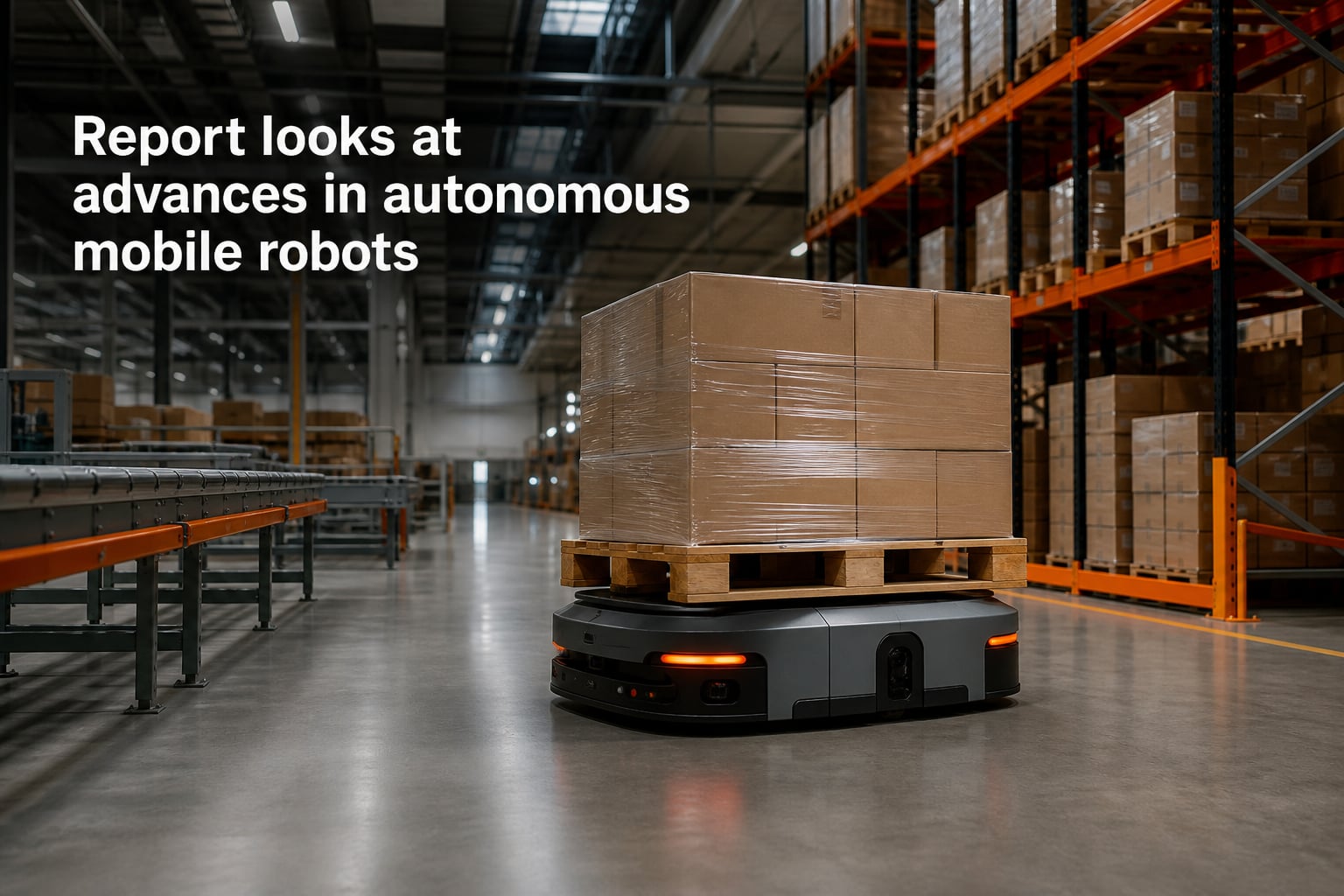
Autonomous mobile robots have moved from experimental demos to the backbone of modern warehouse and factory operations. A wave of industry reports from analysts like Interact Analysis and ABI Research now tracks how fast this technology is evolving, and the numbers tell a striking story of growth, investment, and real-world deployment. If you want to understand where autonomous mobile robots advances are heading in 2026, the latest research paints a clear picture.
Our team has been following AMR technology for years, reading through market reports, academic reviews, and forum discussions from robotics professionals who deploy these systems daily. What stands out in 2026 is how quickly the field has matured. Sensors are cheaper and more capable, AI models are smarter, and fleet management software can now coordinate hundreds of robots without human intervention.
This article breaks down what the major reports and research papers say about advances in autonomous mobile robots. We cover market growth, the technologies driving navigation and perception, how AMRs compare to older AGV systems, industry applications, and the challenges that still slow adoption. Whether you are a warehouse manager evaluating automation or a robotics enthusiast tracking the field, this guide brings together the key findings in one place.
Table of Contents
What Are Autonomous Mobile Robots (AMRs)?
Autonomous mobile robots, or AMRs, are self-navigating robots that move through their environment without following fixed paths, wires, or magnetic strips. They use onboard sensors, AI-powered software, and real-time mapping to understand their surroundings and chart their own routes. This independence is what separates them from older automated guided vehicles that require installed infrastructure.
Think of an AMR as a robot that can walk into a new warehouse, map the layout on its own, and start moving pallets or totes within hours. If a shelf gets moved or a forklift blocks a hallway, the robot recalculates its path on the fly. That kind of operational flexibility was unthinkable a decade ago.
The core components of an AMR include a drive system for movement, a sensor suite for perception, a processing unit for running navigation algorithms, and software for fleet communication. Modern AMRs also carry payloads ranging from small packages to full pallets, depending on their design class. Some look like low platforms that slide under carts, while others resemble driverless forklifts.
How Big Is the Autonomous Mobile Robot Market?
The autonomous mobile robot market is growing at a pace that surprises even seasoned industry analysts. According to The Business Research Company, the market was valued at approximately $6.83 billion in 2026 and is projected to reach $13.35 billion by 2030, growing at a compound annual growth rate of 18.2 percent. MarketsandMarkets offers a slightly more conservative estimate, projecting growth from $2.75 billion to $7.07 billion between 2026 and 2032 at a 14.4 percent CAGR.
Either way, the trajectory is unmistakable. Warehousing and logistics account for the largest share of deployments, driven by e-commerce growth, persistent labor shortages, and the need for faster order fulfillment. Manufacturing follows closely, especially in automotive and electronics assembly where parts need to move between stations continuously.
Reports from Interact Analysis note that the market experienced a temporary dip during supply chain disruptions but has since rebounded strongly. Investment in AMR startups and established manufacturers continues to climb, with billions flowing into companies developing navigation software, perception systems, and robot hardware. The consensus across reports is that AMR adoption will accelerate through the decade as costs decline and capabilities improve.
Key Advances in AMR Technology
The biggest reason AMRs have taken off is the rapid improvement in the technologies that power them. Reports from ISA, IMTS, and academic systematic reviews all point to several breakthroughs that transformed AMRs from niche experiments to mainstream tools. Here is what the research highlights.
Artificial Intelligence and Machine Learning
AI and machine learning have become the brains behind modern AMRs. Deep learning models now handle object detection, scene understanding, and behavioral prediction with accuracy that was impossible five years ago. Instead of just seeing an obstacle, an AMR can classify whether it is a person, a forklift, or a pallet, and adjust its behavior accordingly.
Reinforcement learning is increasingly used for path optimization. Robots learn from millions of simulated journeys to find the most efficient routes through complex warehouse layouts. This learning transfers to the real world through techniques like sim-to-real training, cutting down deployment time significantly.
Sensor Fusion and LiDAR
No single sensor can give an AMR a complete picture of its environment. That is why sensor fusion, combining data from multiple sources, has become the standard approach. A typical modern AMR carries a 2D or 3D LiDAR unit for precise distance measurement, cameras for visual recognition, ultrasonic sensors for close-range detection, and IMUs for orientation.
LiDAR prices have dropped dramatically, making 3D mapping accessible for mid-range robots. At the same time, the quality of budget LiDAR units has improved enough for reliable warehouse navigation. This cost reduction is one reason AMR prices have fallen to a point where mid-sized businesses can justify the investment.
Computer Vision and Perception
Computer vision has advanced to the point where AMRs can read text on boxes, identify product SKUs, detect empty shelf slots, and recognize human gestures. Neural networks trained on massive datasets process camera feeds in real time, giving robots a level of visual understanding that approaches human perception in controlled environments.
This matters because warehouses are not clean, predictable spaces. Boxes fall, people walk unpredictably, and lighting changes throughout the day. Robust computer vision lets AMRs handle this chaos without stopping or requiring human intervention.
Navigation and Mapping Breakthroughs
Navigation is the single most important capability for any mobile robot, and the advances here have been remarkable. The dominant technology is SLAM, which stands for Simultaneous Localization and Mapping. SLAM allows a robot to build a map of an unknown environment while simultaneously tracking its own position within that map.
Modern SLAM implementations fuse LiDAR scans, camera data, and wheel odometry to create accurate real-time maps. A systematic review published on ScienceDirect found that recent SLAM algorithms have dramatically reduced drift errors and can handle large-scale warehouse environments that would have confused earlier systems. Some advanced AMRs now use visual SLAM powered by stereo cameras, which works well even in environments where LiDAR struggles, such as long featureless corridors.
Obstacle avoidance has seen similar leaps. Older robots would stop when they encountered something unexpected, waiting for a human to clear the path. Today’s AMRs use dynamic path planning to navigate around obstacles in real time. They can slow down, reroute, or even reverse if necessary, all while coordinating with other robots in the same fleet.
Path planning algorithms have also become more sophisticated. Instead of simply finding the shortest route, modern systems optimize for factors like traffic congestion, battery life, and task priority. Some fleet management platforms use AI to predict where bottlenecks will form and reroute robots proactively before delays happen.
AMR vs AGV: What Has Changed
The shift from automated guided vehicles (AGVs) to autonomous mobile robots represents one of the most significant transitions in industrial automation. AGVs have been around since the 1950s, following fixed paths defined by wires embedded in the floor, magnetic tape, or painted lines. They are reliable but rigid. Change the warehouse layout, and you have to reinstall the guidance infrastructure.
AMRs do not need any of that. They map the space themselves and can adapt when the environment changes. If you add a new storage rack or reroute a conveyor, an AMR simply updates its internal map and carries on. This flexibility is why reports from IMTS and other industry sources describe AMRs as the next generation of mobile automation.
Here is a quick breakdown of the key differences. AGVs follow fixed paths with minimal onboard intelligence. AMRs navigate dynamically using sensors and AI. AGVs require physical infrastructure installation. AMRs need only a software deployment. AGVs struggle with unexpected obstacles. AMRs reroute around them automatically. AGVs are best for repetitive, predictable routes. AMRs excel in dynamic environments where conditions change frequently.
That said, AGVs still have a place in highly structured environments where the same task repeats indefinitely. Many facilities use a mix of both, with AGVs handling fixed routes and AMRs managing variable tasks. Industry reports suggest the AMR segment is growing much faster, but AGVs are not disappearing overnight.
Industry Applications Driving Adoption
The reports we reviewed consistently point to warehousing and logistics as the dominant application for AMRs, but the technology has spread far beyond distribution centers. Here is where AMRs are making the biggest impact in 2026.
Warehouse Automation and Goods-to-Person
The goods-to-person model has become the signature use case for warehouse AMRs. Instead of workers walking aisles to pick items, robots bring storage racks or tote bins directly to picking stations. This approach can triple or quadruple pick rates while reducing worker fatigue. Companies like Amazon, DHL, and thousands of mid-sized operations have adopted this model at scale.
For a deeper look at how AI is transforming warehouse operations, check out our coverage of AI in warehouse robotics. The intersection of policy and technology is shaping how fast these systems roll out.
AMRs also handle sortation, carton transport, trailer loading, and returns processing. In pharmaceutical distribution, robots move sensitive products through temperature-controlled zones with precision tracking. The operational flexibility of AMRs means the same hardware can be repurposed for different tasks as seasonal demands shift.
Manufacturing and Assembly
In manufacturing, AMRs transport parts between workstations, deliver raw materials to production lines, and remove finished goods. Unlike conveyors, which are permanent installations, AMRs can be redeployed as production lines change. Automotive plants use them heavily, and electronics manufacturers rely on AMRs for clean-room material handling.
Many AMRs in manufacturing work alongside robot end effectors and robotic arms to form complete automated workflows. The robot arm does the precise assembly work while the AMR handles the logistics of getting parts to and from the station.
Fleet Management and Orchestration Software
Hardware is only half the story. The software that coordinates fleets of AMRs has undergone its own revolution. Modern fleet management platforms, sometimes called orchestration software, can manage hundreds of robots simultaneously, assigning tasks based on availability, battery level, and proximity.
These platforms solve complex optimization problems in real time. When fifty robots need to move through the same intersection, the fleet manager sequences their movements to avoid deadlock. When a robot’s battery runs low, the system routes it to a charging station and dispatches a replacement without interrupting operations.
Cloud connectivity has become standard, allowing managers to monitor fleets remotely and receive real-time analytics on throughput, dwell times, and error rates. Over-the-air updates let manufacturers push software improvements without taking robots offline. For an example of how fleet management platforms work in practice, our coverage of AMR fleet management platforms highlights a real deployment in the automotive sector.
Interoperability is the next frontier. In the past, robots from different manufacturers could not communicate with each other. Industry groups are now developing standards like VDA 5050 that allow mixed fleets to work together under a single orchestration layer. This is a big deal for facilities that want to mix and match robots from multiple vendors.
5G, Energy Efficiency, and Emerging Trends
Several emerging trends received less coverage in the reports we analyzed but are shaping the next wave of AMR advances. These are the areas where we expect the biggest changes over the next few years.
5G connectivity is starting to matter for AMRs. With ultra-low latency and high bandwidth, 5G allows robots to offload heavy computation to edge servers, reducing the processing hardware each robot needs to carry. This can lower robot costs and extend battery life. It also enables more responsive fleet coordination, since data moves between robots and central systems almost instantaneously. Few competitors cover this angle, which makes it a key area to watch.
Battery technology and energy efficiency are improving steadily. Newer AMRs use lithium iron phosphate batteries that charge faster, last longer, and handle more charge cycles than older chemistries. Some models support opportunity charging, where the robot tops up its battery during brief idle moments rather than requiring dedicated charging downtime. Reports suggest energy management will become a major differentiator as fleets scale up.
Human-robot collaboration is advancing through improved safety systems. Modern AMRs use layered safety approaches, combining physical bumpers, proximity sensors, and AI-based human detection to operate safely alongside people. The goal is collaborative robots that work in shared spaces without safety cages, and the technology is getting close.
Integration Challenges Still Facing AMR Adoption
Despite the enthusiasm in industry reports, real-world adoption is not without friction. Forum discussions on Reddit communities like r/robotics and r/MobileRobots reveal pain points that vendor marketing often glosses over. Understanding these challenges is just as important as knowing the capabilities.
High initial investment remains the top barrier. While AMR prices have dropped, deploying a fleet still requires significant capital for the robots, software licenses, integration services, and infrastructure modifications. Small and medium businesses in particular struggle to justify the upfront cost, even when the long-term ROI is positive. Practical guidance on ROI calculations is a content gap we noticed across most reports.
Integration with existing warehouse management systems can be complex. AMRs need to communicate with WMS, ERP, and order management software to receive task assignments and report completion. Legacy systems were not designed for real-time robot communication, and bridging that gap often requires custom middleware or expensive integration projects.
Safety in human environments is a persistent concern. While AMRs are generally safe, users on robotics forums emphasize that real-world reliability depends on layered AI systems that can occasionally fail in edge cases. Mapping and localization in dynamic warehouses, where layouts change hourly, remains technically demanding. Training operators and maintenance staff adds another layer of complexity that facilities underestimate.
Frequently Asked Questions About AMR Advances
What are the latest advances in autonomous mobile robots?
The latest advances include AI-powered object detection and behavioral prediction, 3D LiDAR at lower costs, visual SLAM for complex environments, dynamic obstacle avoidance, and cloud-based fleet orchestration that can coordinate hundreds of robots simultaneously. Battery technology and 5G connectivity are also emerging as key differentiators.
How big is the autonomous mobile robot market?
The AMR market was valued at approximately $6.83 billion in 2026 and is projected to reach $13.35 billion by 2030, growing at an 18.2 percent CAGR according to The Business Research Company. MarketsandMarkets projects growth from $2.75 billion to $7.07 billion by 2032 at a 14.4 percent CAGR.
What technologies enable AMR navigation?
AMR navigation relies on SLAM (Simultaneous Localization and Mapping), sensor fusion combining LiDAR, cameras, ultrasonic sensors, and IMUs, AI-based path planning algorithms, and real-time obstacle avoidance systems. These technologies work together to let robots map environments and navigate without fixed paths.
What are the main applications for AMRs?
The main applications include goods-to-person warehouse fulfillment, parts delivery in manufacturing, sortation, carton picking, pharmaceutical distribution, and logistics operations. Warehousing and e-commerce fulfillment represent the largest deployment segment, followed by automotive and electronics manufacturing.
How do AMRs compare to AGVs?
AMRs navigate dynamically using sensors and AI without requiring installed infrastructure, while AGVs follow fixed paths defined by wires, magnetic tape, or painted lines. AMRs can reroute around obstacles and adapt to layout changes automatically, whereas AGVs are better suited for repetitive, predictable routes in stable environments.
The Road Ahead for Autonomous Mobile Robots
The reports, academic reviews, and forum discussions we examined all point to the same conclusion. Autonomous mobile robots advances are accelerating, driven by cheaper sensors, smarter AI, better software, and growing demand from industries facing labor shortages and efficiency pressures. The market is projected to roughly double within five years, and the technology underpinning these robots improves with every generation.
What makes this moment different from past automation waves is the convergence of multiple breakthroughs at once. AI models, sensor hardware, fleet software, and connectivity are all maturing simultaneously. That convergence is pushing AMRs from experimental tools to essential infrastructure faster than most analysts predicted. Facilities that adopted AMRs early are already seeing measurable gains in throughput, accuracy, and labor efficiency.
Challenges remain. Integration complexity, upfront costs, and safety validation still slow adoption, especially for smaller operations. But the trajectory is clear. As prices fall, interoperability standards mature, and software becomes easier to deploy, the barriers will shrink. The next few years will determine which companies gain a competitive edge through early adoption and which fall behind.
If you are tracking autonomous mobile robots advances, keep your eyes on three areas: 5G-enabled edge computing, human-robot collaboration safety, and fleet interoperability standards. These are the frontiers where the next major breakthroughs will happen, and the reports coming out in 2026 are only the beginning of the story.