
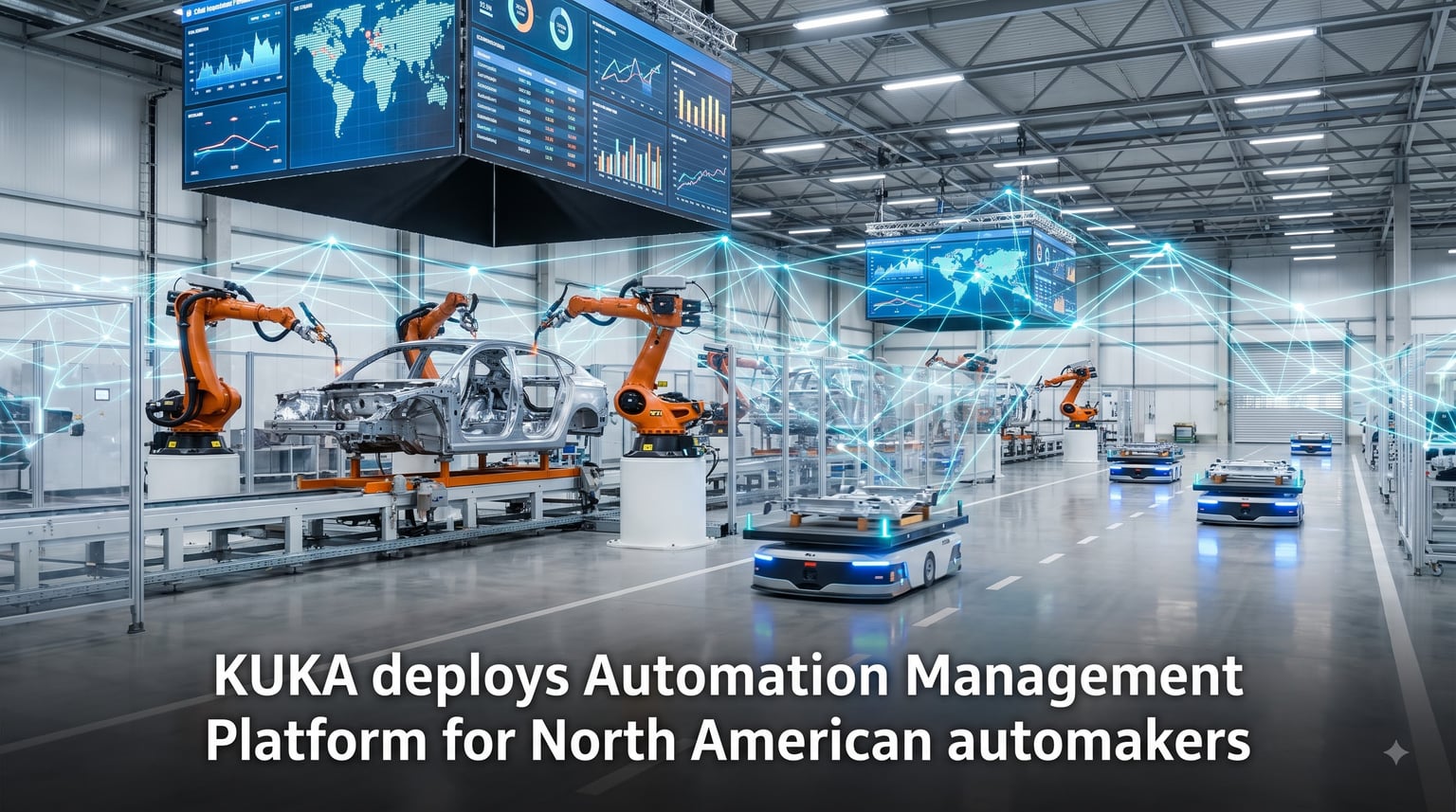
KUKA has deployed its new Automation Management Platform (AMP) at KUKA Toledo Production Operations (KTPO) in Ohio, marking the first live installation of the AI-powered system at a major North American automotive facility. The rollout places KUKA AMP inside a 335,000 square foot body-in-white plant that produces Jeep Wrangler and Gladiator bodies, runs more than 285 robots, and connects over 60,000 devices across the production line.
This launch matters because it moves KUKA AMP out of the press release stage and into real production, where it now orchestrates the daily work of machines, software systems, autonomous mobile robots, and data pipelines that build hundreds of vehicle bodies per day. For our team, this is one of the clearest signals yet that Physical AI is moving from concept to factory floor.
Table of Contents
What Is the KUKA Automation Management Platform (AMP)?
KUKA Automation Management Platform (AMP) is an AI-powered open orchestration platform that connects industrial automation systems, mobile robots, machines, and production data into a single unified layer. It uses a modular API and a shared context layer to give manufacturers a real-time view of their operations and a way to coordinate complex workflows.
Rather than replacing existing automation assets, KUKA AMP is designed to sit on top of them. The platform continuously collects data from connected equipment, applies AI-driven decision making, and feeds those insights back into production. That closed-loop approach turns isolated islands of automation into a coordinated system that learns from every cycle.
For manufacturers, the practical effect is a unified control plane for robots, software, and operational data. Engineers can monitor and adjust processes from one place instead of switching between vendor-specific tools, which reduces changeover times and helps plants scale intelligent automation without ripping out proven equipment.
KTPO Facility: Where KUKA AMP Goes Live in Ohio
The first deployment site for KUKA AMP is the KUKA Toledo Production Operations (KTPO) facility in Ohio, a long-running automotive manufacturing hub that has built Jeep Wrangler bodies since 2006 and Jeep Gladiator bodies since 2019. The plant spans 335,000 square feet, houses more than 285 robots, and runs over 60,000 connected devices that handle welding, joining, and material movement for body-in-white production.
On a typical day, KTPO produces more than 300 vehicle bodies. KUKA AMP is now the orchestration layer that ties together the robots building those bodies, the autonomous mobile robots (AMRs) moving parts, and the production software tracking each step. That makes KTPO one of the most heavily automated automotive production sites in North America and a natural proving ground for the platform.
For our readers tracking the industry, KTPO is interesting because it is not a greenfield project. It is a working plant with decades of installed automation, which makes it a real test of whether KUKA AMP can add value without disrupting existing lines.
Physical AI and the Vision Behind KUKA AMP
KUKA AMP is built around a concept the company calls Physical AI, which describes the next generation of industrial automation where machines understand their physical environment and improve over time. Instead of following static scripts, systems guided by Physical AI use continuous data collection and AI-driven decision making to adapt to changing conditions on the shop floor.
Leading that push is Marc Fleischmann, KUKA’s Chief Software and AI Officer, who joined the company in July 2025 after a career in Silicon Valley. Fleischmann has framed KUKA AMP as the foundation for an autonomous factory, one where production data feeds AI models that help machines better understand what they are doing and why.
The platform was first announced at NVIDIA GTC 2026, where KUKA positioned AMP as a way to bring generative and physical AI together inside industrial automation. Now that it is live at KTPO, the company has a real site to point to when discussing the roadmap.
Key Benefits for North American Automakers
KUKA says AMP delivers five practical wins for manufacturers running high-mix, high-volume automotive production. Each one maps to a specific pain point our team hears about from factory engineers.
First, it increases operational flexibility. Plants running multiple vehicle variants on shared lines can reconfigure workflows faster because AMP coordinates machines and AMRs through a shared context layer rather than hard-coded sequences.
Second, it enhances productivity. By continuously analyzing production data, the platform surfaces bottlenecks and recommends adjustments that reduce cycle time and unplanned downtime.
Third, it reduces changeover times. When a line switches from one body style to another, AMP helps synchronize robots, tooling, and mobile robots so the transition takes minutes instead of hours.
Fourth, it unlocks greater value from existing data. Most plants already collect terabytes of operational data that nobody has time to read. AMP turns that dormant data into actionable insights through its closed-loop system.
Fifth, it scales intelligent automation. Because AMP is built on an open orchestration platform with a modular API, manufacturers can add new robots, software tools, or analytics without rewriting their integration stack.
What KUKA AMP Means for the Future of Factory Automation
The KTPO deployment puts KUKA alongside FANUC, ABB, and Yaskawa in the race to define the software layer for next-generation factories. Where traditional automation vendors still focus on the robot itself, KUKA is leaning into the orchestration layer that connects robots, AMRs, and enterprise systems.
That positioning matters for North American automakers specifically. Plants in the United States, Canada, and Mexico are under pressure to modernize without scrapping existing assets, and KUKA AMP is explicitly pitched as a way to add AI capabilities on top of equipment already in service. In forums where engineers compare KUKA vs Fanuc or debate robot programming complexity, the discussion is shifting from which arm to buy toward which platform can tie everything together.
If the KTPO rollout delivers measurable gains in changeover time and throughput, expect other Tier 1 suppliers and OEMs to pilot KUKA AMP in their own plants before the end of 2026. The platform’s open design also makes it a candidate for retrofit projects, not just new lines.
Does Tesla use KUKA?
Tesla has historically used a mix of robotics suppliers, including KUKA robots, in portions of its vehicle production lines, particularly in body-in-white welding cells. However, Tesla also relies on in-house automation and other vendors, so KUKA is one part of a broader automation strategy rather than a sole supplier.
Who is KUKA owned by?
KUKA AG is owned by Midea Group, a Chinese appliance and industrial technology company that completed its takeover of KUKA in 2017. Midea is publicly traded and headquartered in Foshan, China, and it has continued to operate KUKA as a largely independent subsidiary focused on industrial automation and robotics.
What companies use KUKA robots?
KUKA robots are used by a wide range of manufacturers including BMW, Volkswagen, Mercedes-Benz, Ford, General Motors, and Stellantis, as well as aerospace firms like Airbus, electronics manufacturers, and medical device producers. The company is particularly strong in automotive body-in-white production, welding, and material handling applications.
Who are the big 4 in the industrial robotics industry?
The big four industrial robotics companies are typically considered to be FANUC, Yaskawa, ABB, and KUKA. These firms dominate global robot shipments and compete closely in automotive, electronics, and general manufacturing, each bringing different strengths in software, hardware, and systems integration.
Final Take on the KUKA AMP Deployment
KUKA’s decision to deploy its Automation Management Platform first at KTPO is a signal of where the company thinks the next wave of factory value will come from. The body-in-white line that builds Jeep Wrangler and Gladiator bodies is a tough test bed, with 285 robots, 60,000+ connected devices, and hundreds of bodies per day all needing to stay in sync.
If AMP delivers the productivity and flexibility gains KUKA is promising, the North American automotive market will get a concrete reference site for AI-driven orchestration by the end of 2026. That gives plant managers, systems integrators, and automation engineers a real place to study how Physical AI performs outside the lab.
For our team, the takeaway is straightforward. KUKA AMP is no longer just a platform on a roadmap. With KTPO live in Ohio, the conversation has shifted from whether AI orchestration belongs on the factory floor to how quickly competitors will respond with their own connected platforms.