
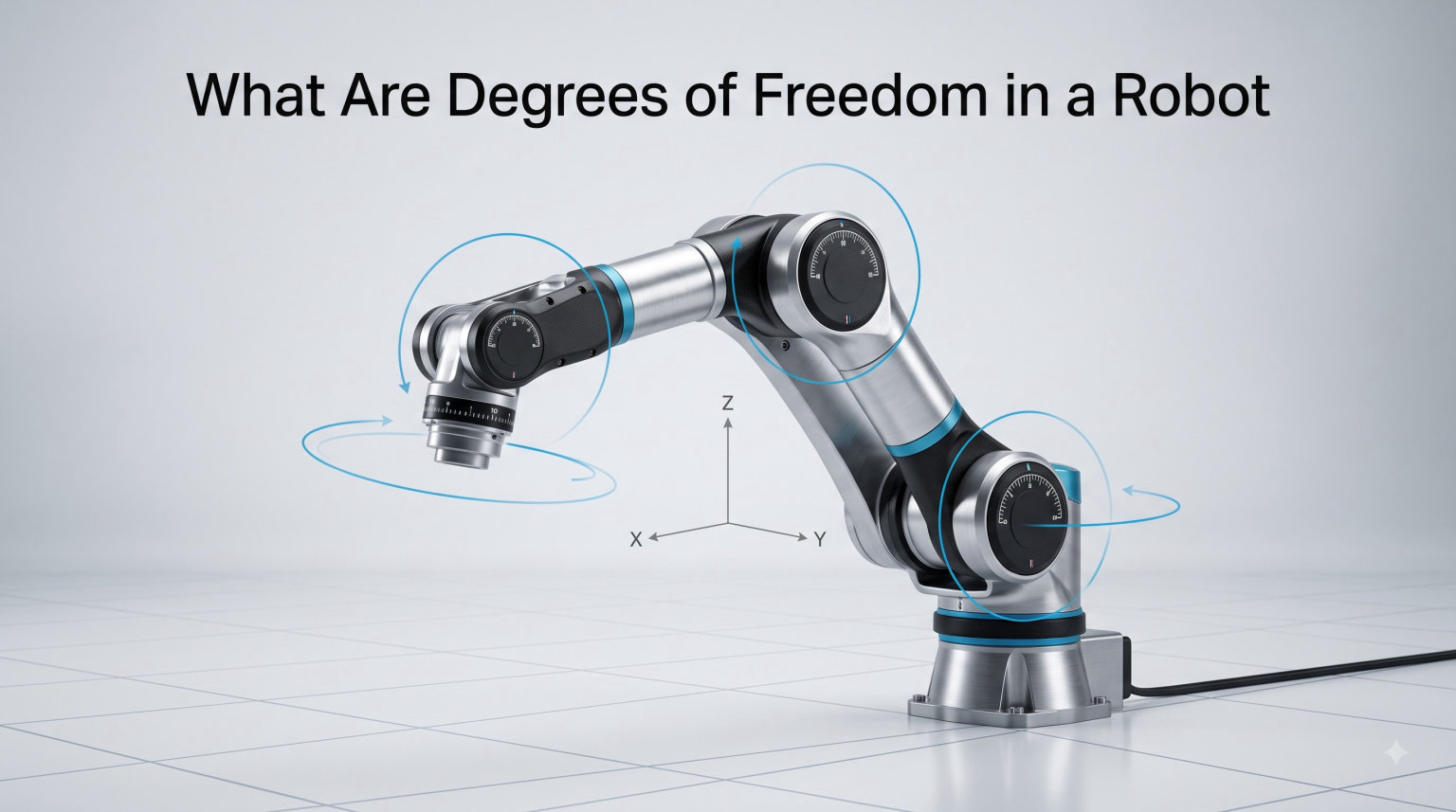
When I first started learning about robotics, the term “degrees of freedom” came up constantly. I heard it in tutorials, on spec sheets, and in research papers. But nobody gave me a clear, plain-language explanation right away.
After years of building and testing robots on our workbench, I finally understand why this concept matters so much. Degrees of freedom in a robot decide how it moves, where it can reach, and how naturally it can interact with the world around it.
Degrees of freedom (DoF) describes the number of independent movements a robot can make. Each joint or axis that a robot can control adds one degree of freedom. Whether you are picking a robotic arm for manufacturing or designing a humanoid for research, DoF shapes everything.
In this guide, I will walk you through what DoF means, how the famous 6 DoF system works, the joints that create movement, and how engineers choose the right number of DoF for each task. By the end, you will have a clear mental model that makes every spec sheet easier to read.
Table of Contents
What Are Degrees of Freedom in a Robot?
Degrees of freedom in a robot is the count of independent movable joints or axes that the robot can control to position or orient itself in space. The higher the DoF, the more distinct ways the robot can move. Each joint contributes one independent movement, and the total of those movements is the robot’s degrees of freedom.
Picture a single rigid object floating in 3D space. It can move forward and backward, side to side, and up and down. It can also tilt, pan, and roll. That gives exactly six independent movements. This is the foundation of robotics: any free object in 3D space has a maximum of six DoF.
Here is the six DoF breakdown you will see in nearly every robotics textbook:
- Surge (X-axis translation): Move forward and backward along the horizontal axis.
- Sway (Y-axis translation): Move left and right along the horizontal axis.
- Heave (Z-axis translation): Move up and down along the vertical axis.
- Roll (rotation around X): Rotate around the forward/backward axis.
- Pitch (rotation around Y): Rotate around the left/right axis, like nodding your head.
- Yaw (rotation around Z): Rotate around the vertical axis, like shaking your head.
Three of these are translational (they change position), and three are rotational (they change orientation). Together, they describe the complete pose of an object in 3D space. This is why the “6 DoF” number keeps showing up in robotics.
The 6 Degrees of Freedom Explained
Let me break down each of these six movements so you can picture them clearly. I find it helpful to imagine a drone hovering in your living room, because it can do all six movements without any wheels or legs.
3 Translational Movements
The translational DoF cover straight-line motion through space. The first is surge. Surge moves the robot forward or backward along the X-axis. The second is sway, which slides the robot left or right along the Y-axis. The third is heave, which raises or lowers the robot along the Z-axis.
For a robotic arm, these translational DoF show up at the base joint. A SCARA robot, for example, sweeps its arm left and right (sway) and forward and back (surge), while a Cartesian gantry uses all three translations to draw precise patterns in 3D space.
3 Rotational Movements
The rotational DoF control how an object spins or tilts. Roll rotates the robot around its forward axis, like a boat rocking side to side. Pitch rotates around the left/right axis, like nodding your head “yes.” Yaw rotates around the vertical axis, like shaking your head “no.”
Most robotic arms use these three rotations at the wrist. The wrist assembly can usually roll, pitch, and yaw to align the gripper with whatever it is picking up. Without these three rotations, the end-effector could only point in a single direction, and even simple tasks like grabbing a tilted object would be impossible.
Together, the 3 translations and 3 rotations give a robot full control over its position and orientation in 3D space. That is what makes 6 DoF the sweet spot for most industrial and research robots.
Types of Joints That Create DoF
Now that you know what DoF represents, let me explain how it actually gets built. Every movement in a robot comes from a joint. The two most common joint types are revolute and prismatic, and each contributes one DoF to the system.
Revolute Joints
A revolute joint lets one link rotate around a fixed axis, similar to a hinge or your elbow. Each revolute joint adds one rotational DoF. Most robotic arms are built almost entirely from revolute joints stacked together. The shoulder, elbow, and wrist of an industrial arm are all revolute joints. They give the arm the ability to swing, bend, and twist, which is why humanoid robots can mimic human movements so closely.
Prismatic Joints
A prismatic joint lets one link slide in a straight line, the way a drawer pulls out. Each prismatic joint adds one translational DoF. Cartesian robots and many 3D printers use prismatic joints for accurate linear movement. You will also see prismatic joints in telescoping actuators for camera sliders or linear gantries.
Other Joint Types
Beyond revolute and prismatic, there are a few other joint types worth knowing. A cylindrical joint combines one revolute and one prismatic motion in a single axis. A spherical joint acts like a ball-and-socket, allowing rotation around multiple axes at once. Planar joints allow motion in a flat plane. Each of these joints contributes to the total DoF count, depending on how many independent movements they enable.
DoF vs Functions: Clearing Up the Confusion
One of the most common questions I see in robotics forums is the difference between “degrees of freedom” and “functions.” They sound similar, but they describe very different things. Let me clear this up.
Degrees of freedom is a hardware count. It tells you how many independent joints the robot has. Functions, on the other hand, describe what the robot can actually do. A robot with 6 DoF might only have 4 functions if its gripper can only open and close and rotate in one direction.
I think of it this way: DoF is the robot’s potential, and functions are what it puts that potential to work on. A robotic arm might have 6 DoF, but if its gripper only opens and closes linearly, it can only perform certain tasks. Adding a rotation to the gripper adds another function, but the DoF count stays the same. Understanding this distinction helps you read spec sheets accurately and avoid overpaying for features you will never use.
Common DoF Configurations in Robots
Different applications call for different numbers of DoF. Here is how engineers typically match DoF count to the work at hand.
3-DoF Robots
A 3-DoF robot can position its end-effector somewhere in space but cannot control its orientation fully. Pick-and-place machines, simple XY plotter setups, and basic delta robots often use 3 DoF. They are fast, cheap, and reliable for repetitive tasks like moving small parts from a conveyor to a tray.
4-DoF Robots (SCARA)
A SCARA robot usually has 4 DoF. It can move in three translations plus one rotation of the gripper. SCARA arms are extremely popular in electronics assembly because they are fast horizontally and rigid vertically. They are perfect for press-fit tasks and high-speed pick-and-place work, even though they cannot tilt the tool.
6-DoF Robots (Articulated Arms)
A 6-DoF articulated arm is the workhorse of modern robotics. With three translations and three rotations, it can reach nearly any position and orientation inside its workspace. Welding, painting, machining, dispensing, and complex assembly are all classic 6-DoF applications. About 80% of industrial robots fall into this category.
7-DoF Robots (Redundant)
A 7-DoF robot has more joints than strictly needed to position and orient the end-effector. The extra joint gives the arm flexibility to avoid obstacles, reach into tight spaces, or stay in a comfortable posture while still placing the tool exactly where it needs to go. The extra joint is what makes robots like the Kinova arm and many humanoid arms feel so natural.
Under-Actuated, Fully Actuated, and Redundant Robots
Once you understand DoF, you will see engineers describing robots as under-actuated, fully actuated, or redundant. These terms describe how the DoF count compares to what the robot needs to do.
An under-actuated robot has fewer DoF than the task requires. A simple 2-DoF pan-tilt camera mount is under-actuated for grabbing objects, but it is fully actuated for the job of looking around. Under-actuation is common in cost-sensitive designs or in robots where simplicity matters more than flexibility.
A fully actuated robot has exactly the number of DoF needed to complete its task. A 6-DoF industrial arm is fully actuated for placing a part in any orientation inside its workspace. No joint is wasted, and the control system is straightforward to plan.
A redundant robot has more DoF than the task requires. The extra joints let the robot choose between many valid configurations for the same end-effector pose. This is incredibly useful for avoiding obstacles, managing joint limits, and working in cluttered environments like inside a car seat or next to other equipment.
Real-World Examples of DoF in Action
Looking at real robots helps you see how DoF plays out in practice. Let me walk through a few examples I have worked with or studied closely.
Human Arm: 7 DoF
Your own arm has 7 DoF. Three come from the shoulder (pitch, yaw, roll), one from the elbow (flexion), and three from the wrist (pitch, yaw, roll). That extra DoF compared to the minimum 6 is what lets you reach behind your head, scratch your back, or pick up a coin from a flat surface while keeping your wrist comfortable.
Industrial Articulated Arms
A standard 6-axis robotic arm like those from FANUC, ABB, or KUKA has 6 DoF. The base joint rotates (yaw), the shoulder pitches, the elbow bends, and the wrist has three rotations. This configuration covers nearly every industrial task in a factory cell.
Humanoid Robots
Modern humanoid robots such as Atlas or Optimus have dozens of DoF. Each leg has 6 DoF, each arm has 7 DoF, and the torso and hands add more. That high DoF count is what makes their movements look so human. We covered this in detail in our piece on humanoid robot anatomy.
Mobile Robots and AGVs
A typical wheeled mobile robot only has 2 or 3 DoF: drive forward, steer, and sometimes rotate the body. To do useful work, they often pair with a robotic arm. The combined system gives the vehicle freedom to move through the warehouse and the arm freedom to manipulate objects.
Frequently Asked Questions
What is the degree of freedom in robotics?
Degrees of freedom in robotics is the number of independent movements a robot can make. Each movable joint or axis adds one degree of freedom. A rigid object in 3D space can have at most six DoF, which is three translations (X, Y, Z) and three rotations (roll, pitch, yaw).
What do degrees of freedom mean in a robotic arm?
In a robotic arm, degrees of freedom refer to the number of independent joints that can move the arm. Each joint, whether revolute (rotating) or prismatic (sliding), contributes one degree of freedom. A 6-DoF robotic arm can position and orient its end-effector anywhere in its workspace, which is why most industrial arms use six joints.
What is 3 degrees of freedom in robotics?
A 3-DoF robot can move its end-effector to any position in 3D space, but it cannot fully control its orientation. Delta robots and simple Cartesian gantries typically use 3 DoF. These robots are well suited to fast pick-and-place tasks where the tool always points the same direction.
What is the degree of freedom of a humanoid robot?
A humanoid robot has between 20 and 40 or more degrees of freedom, depending on the design. Each leg usually has 6 DoF, each arm has 7 DoF, and additional joints are added in the torso, hands, fingers, and neck. This high DoF count is what allows humanoids to walk, balance, and manipulate objects the way humans do.
Key Takeaways on Degrees of Freedom in a Robot
Degrees of freedom in a robot is the simplest way to describe how a robot can move. Six DoF is the magic number for full position and orientation in 3D space, and most robots are designed around that limit, with some adding extra joints for redundancy.
In our experience, the biggest mistake beginners make is thinking more DoF always means better. A 7-DoF arm costs more, has heavier control needs, and can be harder to program than a 6-DoF arm for the same task. But for cluttered environments or human-like motion, that extra joint is priceless.
Now that you understand degrees of freedom in a robot, you can read any robotic arm spec sheet with confidence. You can match DoF to the task, choose between joint types, and even plan your own robot builds around the kinematics you need. If you want to explore more, our archive is full of 2026 robotics guides covering actuators, end-effectors, and motion planning.