
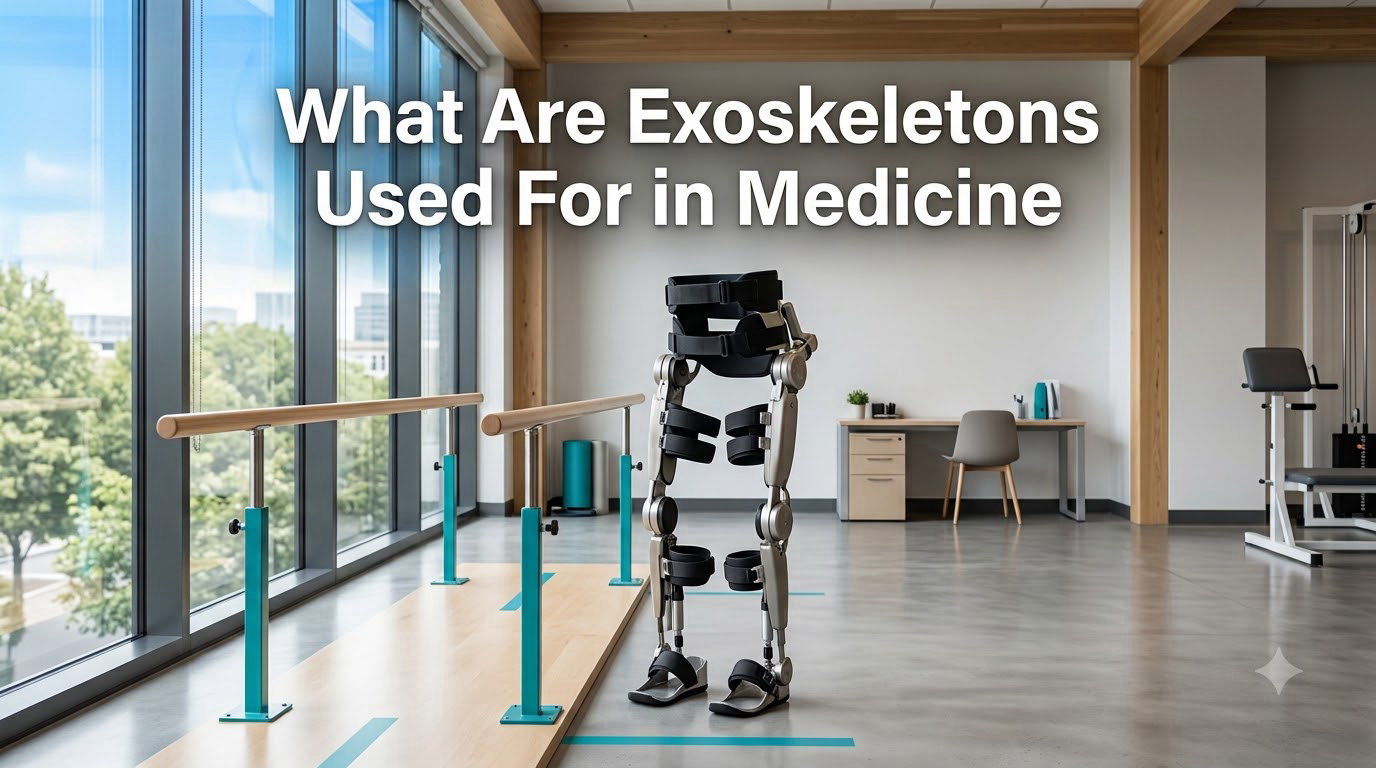
Medical exoskeletons are wearable robotic devices that help patients stand, walk, and move again after injury, illness, or surgery. When I first started following this field a decade ago, the technology lived almost entirely in research labs. Today, FDA-cleared exoskeletons are used every day in hospitals, rehab centers, and even living rooms around the world. The category we call exoskeletons used for in medicine now spans everything from gait-training robots in stroke clinics to back-support suits worn by surgeons in the operating room.
In this guide I’ll walk you through the real medical applications I have seen on the ground and in the literature. We will cover the technology itself, the specific conditions being treated, the difference between clinical and home use, the insurance landscape, and the limitations you should know about. I have also pulled in patient forum stories and peer-reviewed research to give you a balanced picture, not a sales pitch.
Here is the short version before we get into the details. The most common medical applications are spinal cord injury rehabilitation, stroke recovery, multiple sclerosis therapy, surgical assistance, elderly mobility support, and nursing injury prevention. The technology is no longer experimental for many of these use cases, but access, cost, and insurance coverage are still the biggest practical barriers.
Table of Contents
How Do Medical Exoskeletons Work?
A medical exoskeleton is a powered or semi-powered wearable frame that moves with the user’s body. According to the National Institutes of Health, it is a device that “augments, enables, assists, or enhances motion and physical activity through mechanical interaction with the user’s body.” Think of it as a robot you strap on, with motors at the joints doing the work your muscles can no longer do on their own.
The core components are simple to describe but complex in execution. Actuators at the hips, knees, and ankles provide the torque to move the legs. Sensors track joint position, force, and the user’s intent. A control system, often a small onboard computer, decides when to assist and how much. A battery pack, usually worn at the hip or back, powers everything for two to four hours of active use.
There are two main types you will encounter. Powered exoskeletons use electric motors to actively move the limbs and dominate the medical rehab market. Passive exoskeletons use springs, dampers, and clever mechanical linkages to store and release energy without motors, and they are more common in workplace and nursing applications. Soft exosuits, a newer category, replace rigid metal frames with fabric and cable systems and are mostly in research and pilot programs as of 2026.
For the user, the experience looks like this. You step into the device, secure it at the feet, shins, thighs, and waist, and use crutches or a walker for balance. You initiate movement with a lean, a button press, or a weight shift, and the motors respond by moving your legs through a normal walking pattern. The body still has to do some work, which is the whole point during rehabilitation.
Exoskeletons for Spinal Cord Injury Rehabilitation
Spinal cord injury, or SCI, is where the modern medical exoskeleton story really begins. Ekso Bionics launched the first commercial device in this space, and competitors like ReWalk, Indego, and REX soon followed. The use case is direct: when the spinal cord cannot send movement signals to the legs below the level of injury, a powered exoskeleton provides the motion that the body cannot produce on its own.
In a typical clinical session, a patient with paraplegia stands up from a wheelchair with the help of a therapist, walks a set distance, sits back down, and repeats. Over weeks and months, this produces real physical changes. Users report improved bone density, better circulation, reduced spasticity, and relief from pressure sores simply because they are upright and moving again. The psychological benefit is just as significant. One SCI patient in a Reddit AMA said the first time he made eye-level conversation with his kids while standing in an exoskeleton was “the most emotional moment of my adult life.”
The evidence is strongest for incomplete injuries and for people with some preserved motor function. Complete thoracic-level injuries can still benefit, but the training is more demanding and progress slower. The FDA has cleared multiple exoskeletons specifically for SCI rehabilitation in clinical settings, and the same manufacturers offer lighter personal-use versions for home and community ambulation.
For therapists, the device is essentially a high-tech treadmill for the real world. It lets them deliver hundreds of precise, repeatable gait cycles in a single session, far more than a single therapist could deliver with manual assistance. That repetition is what drives neuroplastic recovery in patients with some remaining function.
Exoskeletons for Stroke Recovery and Neurorehabilitation
Stroke is the single largest cause of long-term adult disability in most countries, and gait recovery is the top priority for many survivors. Medical exoskeletons have become one of the most studied tools in this space. In a typical stroke rehab program, a wearable robot supports the patient’s legs while they practice walking on a treadmill or over ground, and the device gradually reduces its assistance as the patient regains strength and coordination.
The principle behind the therapy is task-specific, high-repetition training. The brain rewires itself through repeated, meaningful movement, and an exoskeleton can deliver thousands of clean gait cycles per session with less therapist fatigue than traditional methods. Clinical trials cited by the NIH show measurable improvements in walking speed, endurance, and balance when exoskeleton-assisted gait training is added to conventional physical therapy.
Upper-limb exoskeletons are also used after stroke, though less commonly. These devices support the shoulder, elbow, and hand during reach-and-grasp practice, which is critical for regaining independence in dressing, eating, and self-care. The technology is more challenging because the arm has more degrees of freedom than the leg, but the principle is the same: lots of repetition, with the robot filling in for the movement the patient cannot yet produce.
For patients, the practical question is usually about timing. Most research shows that earlier intervention produces better outcomes, but meaningful gains are still possible months and even years after a stroke. Insurance coverage, discussed later, often dictates when and how long someone can access this kind of therapy.
Surgical Assistance and Doctor Fatigue Prevention
Exoskeletons are not just for patients. In the operating room, surgeons wear lightweight support devices that hold their arms, neck, and back in a neutral position during long procedures. Spine, neurosurgery, and microsurgery are particularly demanding because the surgeon must hold a fixed posture for hours, often with loupes or a microscope adding several kilograms to the head and neck.
Surgeon-support exoskeletons typically anchor at the hips or thighs and extend an arm up to the shoulders or head. The mechanical linkage takes over the weight of the supported limb so the surgeon’s muscles can rest. Reports from hospitals that have piloted these devices describe reduced neck and back pain, fewer micro-adjustments during long cases, and better stamina across a full operating day. For a profession with alarmingly high rates of work-related musculoskeletal injury, that is a real clinical win.
Beyond the surgeon, exoskeletons are starting to appear in other operating-room roles. Surgical assistants, scrub nurses, and anesthesia teams spend long hours in awkward positions, and the same support principles apply. This is one of the fastest-growing areas of medical exoskeleton use, and several manufacturers now offer products specifically cleared for OR use.
Elderly Care, Fall Prevention, and Mobility Assistance
Age-related mobility loss is a major driver of independence loss in older adults. A single fall can be the event that ends a person’s ability to live at home. Medical exoskeletons are now being tested as a way to keep older adults walking longer, safer, and with less pain.
For community-dwelling seniors, the most common products are knee and hip support devices that assist with sit-to-stand, stair climbing, and prolonged walking. They look more like athletic gear than a medical robot and can be worn under clothing for short outings. Clinical studies in Japan and Europe have reported improvements in walking endurance and reductions in fall risk for users with mild to moderate mobility limitation.
For frail elderly patients and those in long-term care, stationary and over-ground gait trainers are used in physical therapy to maintain strength and prevent deconditioning. The therapy does not need to make a dramatic difference. Even a 10 percent improvement in walking speed is associated with meaningful reductions in fall risk and hospitalization in older adults.
Forum users and family caregivers have pointed out a practical reality: even when the device helps, the cost, the charging routine, and the need for a helper all add friction. A fall-prevention exoskeleton only works if the person actually puts it on every day.
Exoskeletons for Nurses and Healthcare Workers
Patient handling is one of the most dangerous routine activities in healthcare. Nurses, physical therapists, and home health aides suffer some of the highest rates of back injury of any profession, and manual patient transfer, repositioning, and lifting are the leading causes. Occupational exoskeletons are now being deployed to reduce that injury risk.
Lower-back support exoskeletons anchor at the thighs and extend an assistive structure up the back. When the wearer bends forward to lift a patient, the device shares part of the load and reduces the moment on the lumbar spine. Peer-reviewed studies from the National Institutes of Health report reductions in muscle activity and perceived exertion during simulated patient-handling tasks, and several major hospital systems in Europe and Asia have rolled out fleet programs.
Shoulder and upper-limb exoskeletons help with tasks like holding a patient’s limb during wound care or supporting a patient while they transfer. These are less common than back-support devices but growing. The clinical evidence is strongest for reducing muscle fatigue rather than preventing specific injuries, but the occupational health argument is straightforward: less strain today means fewer chronic injuries over a 30-year career.
If you are a nurse or therapist considering one of these for yourself, the practical reality is fit, training, and unit culture. A poorly fitted exoskeleton can cause its own injuries, and a device that is not accepted by the team will end up in a closet.
Other Medical Conditions Treated With Exoskeletons
Beyond SCI, stroke, and aging, exoskeletons are used in a growing list of conditions. Multiple sclerosis patients use them for gait training and energy conservation during relapse and recovery cycles. Parkinson’s disease patients have reported improved stability and reduced freezing of gait in pilot studies, though the evidence is still early. Cerebral palsy and other pediatric neuromuscular conditions are an active research area, with hospital programs using exoskeletons to encourage walking practice in children who might otherwise be limited to a wheelchair.
Post-surgical patients use lower-extremity exoskeletons in the early weeks after knee or hip replacement to normalize gait and protect the healing joint. Patients with critical illness myopathy, a profound weakness that follows long ICU stays, sometimes recover faster when gait training is started earlier with robotic assistance. Even patients with chronic conditions like FSHD and ALS have found limited but real benefits, particularly for upright positioning and short-distance ambulation.
The unifying thread is that the device fills a specific functional gap. When the gap is short-term recovery, the exoskeleton is used for a defined course of therapy. When the gap is permanent, the focus shifts to long-term mobility and quality of life.
Home Use vs Clinical Rehabilitation: Key Differences
This is one of the most practical questions for patients and families, and it is one that almost no public resource covers well. There are real differences between using an exoskeleton in a hospital rehab program and using one at home or in the community.
Clinical rehabilitation offers supervised training, structured progression, and access to a therapist who can adjust the device and the program. It is the right place to start for most patients, especially in the first few months after an injury or stroke. Most clinical exoskeletons are larger, more powerful, and require a trained operator to don and supervise. Sessions are typically 30 to 60 minutes, three to five times per week, over a course of weeks.
Home and community use is a different proposition. Personal-use exoskeletons are smaller, lighter, and designed to be donned by the user or a single caregiver. They are slower, have a more limited walking speed, and usually require the user to use crutches. The trade-off is freedom: the user can stand, walk around the house, prepare a meal at the counter, and have those eye-level conversations that patients consistently describe as life-changing. Medicare and some private insurers will cover personal-use devices under specific criteria, but most patients still pay out of pocket or rely on a combination of coverage and grants.
If you are deciding between the two, the practical advice from clinicians I have spoken to is simple. Start in a clinic, train for several months, and only consider a personal device when the user is comfortable with donning, transitions, and basic troubleshooting. The home device is not a replacement for therapy, it is an extension of it.
Insurance Coverage and Access to Exoskeleton Therapy
The single most common question I see in patient forums is about cost and insurance. Medical exoskeletons are not cheap, and the answer depends heavily on where you live, what condition you have, and what kind of coverage you carry.
In the United States, Medicare covers personal-use exoskeletons for beneficiaries with spinal cord injury under specific criteria, including the ability to tolerate the device, a defined rehabilitation program, and a prescription from a qualified clinician. Coverage was expanded in recent years but still requires prior authorization and a documented course of training. Private insurers vary widely. Some cover the device for SCI, fewer cover it for stroke or MS, and many explicitly exclude it as “investigational” for some indications.
Outside the U.S., national health systems and private insurers handle this differently. Germany’s statutory insurers, Japan’s long-term care system, and France’s social security system have all approved some level of coverage for rehabilitation exoskeletons in clinical settings. The United Kingdom’s NHS covers some devices through specialized centers. Out-of-pocket purchase remains common in most of the world, and prices for a personal-use device are typically in the tens of thousands of dollars, with the larger clinical systems costing significantly more.
The honest answer is that insurance coverage is a moving target. Coverage that exists today may not exist in the same form next year, and prior authorization is the norm rather than the exception. Anyone considering a personal device should work with a clinic that has a dedicated reimbursement specialist.
Risks, Limitations, and Safety Considerations
Exoskeletons are medical devices, and like all medical devices, they carry real risks. The most common adverse events in clinical use are skin pressure injuries from the braces, falls during donning or transitions, and joint or muscle strain from overuse. Patients with severe osteoporosis, uncontrolled spasticity, or significant contractures are usually not good candidates. Most devices also have weight and height limits that exclude a portion of the population.
There is also a learning curve. Donning a personal-use exoskeleton takes practice, and users typically need several weeks of training before they can use it independently. Caregivers need training too. Forum users have pointed out that the device does not remove the need for a helper for transfers, and that fact is often glossed over in marketing materials.
Device malfunction is rare but real. Sensors can fail, batteries can die mid-session, and software can behave unexpectedly. FDA-cleared devices have built-in safety modes, including controlled stops and fall protection, but the user is still the one standing inside the device when something goes wrong. The risk profile is similar to a powered wheelchair, but the consequences of a failure while standing are different from a failure while sitting.
The right way to think about the risk-benefit balance is this. For a patient with a recent spinal cord injury or stroke, the potential gains in mobility, health, and quality of life generally outweigh the risks, especially in a supervised clinical setting. For a patient considering a personal-use device, the discussion should include caregivers, clinicians, and a clear plan for training, follow-up, and maintenance.
Future Developments in Medical Exoskeleton Technology
The category is moving fast. Soft exosuits, made of fabric and cable rather than rigid metal, are entering clinical trials and could make home use far more practical. Brain-computer interface research, including work published through NIH-funded programs, is starting to allow users to initiate walking with thought alone, which would dramatically expand the population that could benefit. AI-driven control systems are learning to adapt the level of assistance in real time based on the user’s fatigue and effort, rather than relying on fixed settings.
Pediatric exoskeletons are an area of intense development. Children with cerebral palsy and other conditions need devices that grow with them, and several manufacturers now offer adjustable systems specifically for this population. The combination of lighter materials, better batteries, and smarter control software is also pushing the field toward devices that look and feel less like medical equipment and more like clothing.
For anyone watching this space, the practical takeaway is that the device you can buy or be prescribed today is the worst device you will ever use. The capabilities, comfort, and access are all on a clear upward trajectory, and the medical applications are expanding year over year.
Frequently Asked Questions
What are the medical uses of exoskeletons?
Medical exoskeletons are used for spinal cord injury rehabilitation, stroke recovery and gait training, multiple sclerosis therapy, post-surgical mobility support, elderly fall prevention, surgical assistance for doctors during long procedures, and back injury prevention for nurses and healthcare workers. Most clinical applications are FDA-cleared and supported by peer-reviewed research.
What are the risks of using an exoskeleton?
The main risks include skin pressure injuries from the braces, falls during donning and transitions, joint or muscle strain from overuse, and rare device malfunctions such as sensor failure or battery loss. Patients with severe osteoporosis, uncontrolled spasticity, or significant contractures are usually not candidates. Training and clinical supervision significantly reduce these risks.
Does Medicare pay for an exoskeleton?
Medicare covers personal-use exoskeletons for beneficiaries with spinal cord injury when specific clinical criteria are met, including a prescription, completion of a training program, and documented functional need. Coverage for other conditions such as stroke or multiple sclerosis is more limited and usually requires prior authorization. Private insurer coverage varies widely and should be checked case by case.
Can you give me an example of an exoskeleton in a human body?
A spinal cord injury patient with paralysis below the chest can use a powered exoskeleton such as the Ekso GT, ReWalk, or Indego to stand up from a wheelchair and walk with crutches. The motors at the hips, knees, and ankles provide the motion that the patient’s body cannot produce on its own, allowing brief standing and walking sessions under clinical supervision. Stroke survivors use similar devices on the legs and arms to deliver high-repetition gait and reach training during rehabilitation.
The Bottom Line on Medical Exoskeletons
The medical applications of exoskeletons have moved from research curiosity to everyday clinical tool. For patients with spinal cord injury, stroke, multiple sclerosis, and other mobility-limiting conditions, the technology now offers a real path to standing, walking, and the health benefits that come with being upright. For surgeons, nurses, and other healthcare workers, exoskeletons are reducing the occupational injury burden of physically demanding work.
If you are a patient or family member exploring this, the practical next step is to find a rehabilitation center with an established exoskeleton program, complete an evaluation, and work with a clinician who can guide you through both the therapy and the reimbursement process. The technology works, but only when it is matched to the right person, the right program, and the right support at home.
I will keep updating this guide as the technology and the coverage landscape evolve through 2026 and beyond. The field is moving quickly, and the most useful thing any of us can do is share what we learn.