
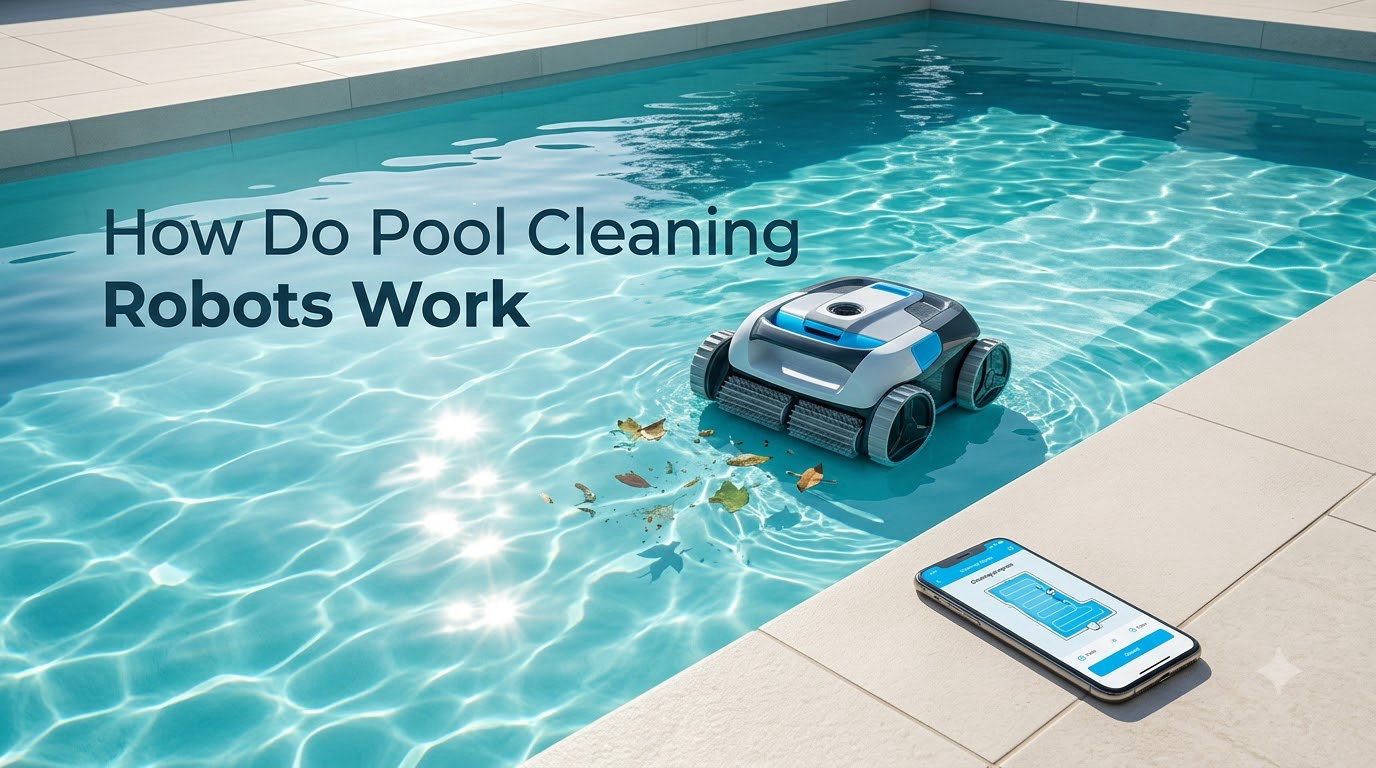
I tested my first pool cleaning robot six years ago, and watching it crawl across the pool floor felt like seeing a small submarine explore my backyard. That curiosity is what drove me to dig into the actual mechanics behind these devices. How do pool cleaning robots work? The short answer is that they combine low-voltage electric motors, onboard sensors, rotating brushes, and internal filters to autonomously scrub, vacuum, and filter pool surfaces, all while running independently from your pool’s main pump system.
Here’s a quick breakdown of the core components that make these machines tick:
- Low-voltage power supply that converts household AC to safe DC current
- Independent motors for drive, suction, and brush rotation
- Scrubbing brushes that physically loosen debris from surfaces
- Internal filter basket that traps particles as water passes through
- Smart sensors and gyroscopes that guide navigation and wall climbing
In this guide, I’ll walk you through each system in detail so you understand exactly what is happening inside that little robot cruising around your pool.
Table of Contents
What Is a Robotic Pool Cleaner
A robotic pool cleaner is a self-contained, electrically powered device that automatically scrubs and vacuums your pool while filtering the water. Unlike older suction-side or pressure-side cleaners, robotic units operate independently from your pool’s main pump and filtration system. This independence is the key feature that sets them apart and explains why they use so much less energy.
Most modern units weigh between 15 and 25 pounds and look like oversized hockey pucks with brushes underneath and a long power cord trailing behind. Inside the waterproof shell, you’ll find a small computer, motors, a filter canister, and a drive system. Outside, there’s a power supply that sits on your patio, plugged into a standard outlet.
Our team has been tracking the evolution of these machines for years, and the technology has come a long way since the early 2000s. The first generation used random bump-and-turn navigation that often left spots uncleaned. Today’s models use gyroscopes, accelerometers, and onboard chips that map your pool in real time. That shift from random to systematic cleaning is the single biggest improvement in the category, and it’s why modern robots finish a full cycle in 2-3 hours instead of 6+.
How Power Systems Work in Pool Cleaning Robots
Every robotic pool cleaner runs on low-voltage DC power, typically 24 or 32 volts, supplied through a transformer that steps down your household 110V or 220V AC current. This low-voltage approach is a major safety feature. If a cord gets damaged or water somehow infiltrates the electrical path, the voltage is too low to cause harm.
The power supply unit, or PSU, does more than just convert voltage. It contains the control circuitry that lets you set cleaning cycles, run weekly timers, and in some models, control the robot via smartphone app. Modern PSUs are also GFCI-protected to meet pool safety codes, meaning they’ll cut power instantly if they detect a ground fault.
Here’s what makes the electrical system tick:
- Transformer block steps down 110V/220V AC to safe low-voltage DC
- Control board handles cycle timing, scheduling, and remote inputs
- Waterproof cable carries power from PSU to the robot, often 50-60 feet long
- Float at the cable’s mid-point prevents tangling by keeping the cord at water surface
Energy consumption is modest. A typical robot uses between 150 and 300 watts per hour, which works out to roughly 5-10 cents per cleaning cycle depending on your electricity rate. Cordless models swap the external PSU for a rechargeable lithium-ion battery pack, usually rated between 5,000 and 10,000 mAh, that delivers about 90-150 minutes of runtime per charge.
The Motor and Drive System Explained
Inside the robot, you’ll typically find two or three independent brushless DC motors. One motor powers the drive system (wheels or tracks), another creates suction at the intake, and on premium models, a third motor is dedicated to brush rotation. Using separate motors for each function is what allows the robot to brush and drive at different speeds, which improves cleaning efficiency.
Brushless DC motors are now standard because they last longer, run cooler, and use less power than the older brushed designs. The drive motor connects to either rubber wheels or continuous tracks. Tracks grip better on smooth surfaces like vinyl and tile, while wheels tend to be faster and easier to clean debris out of. Stepper motors handle finer movements, like turning 90 degrees at a wall or pivoting when reversing direction.
Here’s how the mechanical side comes together:
- Drive motor powers wheels or tracks, typically 100-200 RPM
- Pump motor creates suction via an impeller, moving 4,000-5,000 gallons per hour
- Brush motor (on premium models) spins scrubbing brushes at 1.5x the drive speed
- Stepper motor handles direction changes and precise wall following
The impeller is worth a mention because it’s the heart of the suction system. As it spins at high RPM, it pulls water down through the filter intake, which creates a pressure differential that lifts debris off the pool floor. The water then passes through the filter basket and gets pushed back out through the rear exhaust ports, creating a circulation loop within the robot itself.
Cleaning Mechanisms: Brushing and Scrubbing
Suction alone won’t lift stuck debris like algae, fine sand, or biofilm from pool surfaces. That’s where the brushing system comes in. Pool robots use rotating brushes, usually mounted on the underside or front of the unit, that physically scrub the surface as the robot moves. The brushes spin at a different rate than the drive wheels, which creates a scrubbing action rather than just rolling along.
Three main brush materials are used, each with strengths and trade-offs:
- Rubber brushes work well on concrete and tile, gentle on vinyl liners, and resist wear
- PVC brushes are stiffer, better for rough concrete or heavy algae, but can mark delicate surfaces
- Foam brushes are softest, ideal for fiberglass pools, and reach into small crevices
Active brushing, where the brush spins independently of wheel movement, is a feature I look for in any model I’d recommend. Passive brushing, where the brush only spins when the robot moves, leaves a lot to be desired, especially on textured surfaces. Premium robots often have dual brushes spinning in opposite directions, which doubles the scrubbing contact.
Wall climbing is the other big mechanical feature. To climb a vertical wall, the robot uses its drive tracks or wheels to push upward while the suction keeps it pressed against the surface. Once at the waterline, the brushes scrub the tile line where oils, sunscreen, and calcium deposits accumulate. The best models can hold position at the waterline for several seconds before sliding back down and climbing again.
How Pool Robot Filtration Systems Work
The filtration system is what separates a working robot from a useless one. As the pump motor pulls water through the intake, all that water has to pass through some kind of filter before being exhausted back into the pool. Most robots use one of two designs: a removable filter basket or a set of filter cartridges.
Filter baskets are now the most common because they’re easier to clean. You just lift the robot out, pop open the top, and hose down the basket. Cartridge filters are more common on older or budget models and require rinsing from the inside out to dislodge trapped debris.
Filtration quality is measured in microns, and this is where premium models distinguish themselves:
- Standard filters capture particles down to about 100 microns (good for leaves, insects, and large debris)
- Fine filters capture particles down to 50-60 microns (handles sand, grit, and most pollen)
- NanoFilters or ultra-fine filters capture particles down to 2-5 microns (traps fine dust, algae spores, and pollen)
For most pool owners, a standard or fine filter is plenty. But if you live in a dusty area, deal with regular algae blooms, or have a lot of fine debris, the upgrade to NanoFilters is worth considering. Several premium models now ship with multiple filter options so you can swap based on the season or debris type.
Navigation and Smart Technology in Pool Robots
Navigation is where the biggest engineering gains have happened in the last decade. Early robots used a “bump and turn” approach: drive forward until hitting a wall, randomly turn 0-360 degrees, and repeat. This worked but often left patches uncleaned, especially in irregularly shaped pools. The result was longer cleaning cycles and frustrated owners.
Modern robots use a combination of sensors and onboard processing to clean more systematically. Here’s what’s actually happening inside:
- Gyroscopes detect orientation and rotation, letting the robot know which direction it’s facing
- Accelerometers track movement and help detect when the robot is climbing a wall
- Infrared or ultrasonic sensors detect walls and obstacles before contact
- Onboard computer chip processes sensor data in real time and decides the next move
Two common navigation patterns dominate the market. S-shaped navigation moves the robot in long parallel lines across the floor, like a lawnmower. E-shaped navigation combines floor coverage with periodic climbs to the waterline, which is better for full-pool cleaning. Some premium models now use smart mapping, where the robot first scans the pool to learn its shape, then plans the most efficient route.
Our team has compared coverage patterns side by side, and systematic navigation cleans 25-40% faster than random navigation in the same pool. It also reduces the chance of the robot missing spots or over-cleaning the same area. App control, weekly timers, and remote steering are now standard on mid-to-premium models, and several brands let you start a cycle from your phone while you’re still at work.
Pool Types and Surfaces Compatible with Robots
One of the most common questions I get is whether pool robots damage liners or work on all surfaces. The short answer: yes, modern robots are designed to work on every common pool surface, and they won’t damage properly maintained liners.
Here’s the compatibility breakdown by surface type:
- Vinyl liner pools are safe with any modern robot. The brushes are soft enough not to scratch, and the suction is gentle. Just make sure the liner is in good condition before running a robot, since sharp edges from a damaged liner can snag brushes.
- Concrete and gunite pools work with all robots. PVC or stiffer brushes are best because rougher surfaces need more aggressive scrubbing.
- Fiberglass pools pair well with foam or rubber brushes. The smooth surface doesn’t need aggressive cleaning, and softer brushes prevent micro-scratches.
- Tile pools are typically the easiest to clean, since debris doesn’t stick as much. Any brush type works.
Pool size matters more than surface type. Most residential robots are rated for pools up to 50-60 feet long. If you have a smaller above-ground pool, look for a model specifically rated for above-ground use, since these typically cost less and have shorter cables. Inground pools almost always work with full-size residential units, and commercial-grade models are available for very large or public pools.
Energy Efficiency and Cost Savings
One of the strongest arguments for robotic pool cleaners is energy efficiency. Because they operate independently of your pool’s main pump, they don’t force that pump to run during cleaning. A typical pool pump uses 1,500-2,500 watts, while a pool robot uses 150-300 watts. Over a season, that difference adds up to real money.
Here’s a quick cost comparison for a pool owner running their robot three times a week over a 6-month season:
- Robotic cleaner: 200 watts times 2.5 hours times 90 cycles equals 45 kWh, roughly $7-12 per season
- Running main pump for suction cleaner: 2,000 watts times 2.5 hours times 90 cycles equals 450 kWh, roughly $70-100 per season
- Professional cleaning service: typically $100-200 per visit, $1,200-2,400 per season for monthly service
The numbers make a clear case. A robotic cleaner pays for itself in 1-2 seasons compared to a professional service, and the energy savings compared to running your pump constantly are significant. Our team calculated that switching from a suction-side cleaner to a robotic model saved one of our test pools about $85 per year in electricity alone.
Robotic vs Suction vs Pressure Pool Cleaners
Not all automatic pool cleaners are the same, and understanding the differences helps you see why robotic models are the current gold standard. Here’s a side-by-side comparison of the three main types:
| Feature | Robotic | Suction-Side | Pressure-Side |
|---|---|---|---|
| Power source | Electric (low-voltage) | Pool pump suction | Pool pump pressure + booster |
| Energy use | 150-300W per hour | 1,500-2,500W (runs pump) | 1,500-2,500W (runs pump + booster) |
| Filter type | Internal basket or cartridge | Pool’s main filter | Separate bag or cartridge |
| Wall climbing | Yes (most models) | Rare | Sometimes |
| Waterline cleaning | Yes (premium models) | No | Rare |
| Smart navigation | Yes (most models) | No (random) | No (random) |
| Initial cost | Higher | Lower | Moderate |
Suction-side cleaners attach to your skimmer and use the pool pump’s suction to move around. They’re cheap but they don’t climb walls and they put extra load on your main filter. Pressure-side cleaners use water pressure from a return jet, often with a booster pump, to move around and collect debris in their own bag. They handle larger debris well but still rely on your pool’s pump system.
Robotic cleaners stand apart because they don’t depend on your pool’s equipment at all. They bring their own power, their own filter, and increasingly, their own intelligence. The trade-off is a higher upfront cost, but the long-term energy savings and cleaning performance justify it for most pool owners.
Maintenance Tips and Common Issues
Robotic pool cleaners are generally low-maintenance, but a few habits will extend their life and keep them running smoothly. Based on real user feedback from pool forums, these are the most common issues and how to prevent them.
Filter cleaning is the most frequent task. Most users report emptying and rinsing the filter basket every 1-2 weeks during heavy use, and every 3-4 weeks during cooler months when debris is minimal. A clogged filter reduces suction and can strain the pump motor over time.
Cord tangling is the other big issue with corded models. To minimize tangles, always uncoil the cable fully before dropping the robot in the pool, and use the included swivel feature if your model has one. Cordless models eliminate this problem but introduce a new one: battery degradation. Lithium-ion batteries lose capacity over time, especially if stored in hot conditions. If you have a cordless model, store the robot in a shaded area when not in use.
Common failure points and lifespan expectations:
- Pump motor typically lasts 5-8 years with proper care
- Drive tracks or wheels last 3-5 years depending on pool surface roughness
- Brushes need replacement every 1-3 years as they wear down
- Power supply rarely fails but can be damaged by voltage surges; use a surge protector
Most users report their robots lasting 5-7 years before needing major repairs, and high-end models can push past 10 years. The biggest factor in lifespan is keeping the filter clean and rinsing the robot with fresh water after each use to remove chlorine residue.
Frequently Asked Questions
Do robotic pool cleaners really work?
Yes, robotic pool cleaners really work. Independent tests and user reports consistently show that they remove leaves, dirt, sand, and algae from pool floors, walls, and waterlines. Modern models with smart navigation clean in 2-3 hours and often outperform suction and pressure cleaners on hard-to-reach surfaces.
What are the disadvantages of robotic pool cleaners?
The main disadvantages are higher upfront cost compared to suction-side cleaners, the need to clean the internal filter regularly, occasional cord tangling on corded models, and battery degradation on cordless units. Repairs can also be expensive if components fail outside warranty.
Do pool robots hurt the liner?
No, modern pool robots do not hurt properly maintained vinyl liners. The brushes are designed to be soft enough for delicate surfaces. However, if your liner is already torn, peeling, or has sharp edges, the brushes can catch and worsen the damage. Inspect your liner before running a robot.
Can you leave a robotic pool cleaner in the pool all the time?
It is not recommended to leave a robotic pool cleaner in the pool all the time. Continuous exposure to pool chemicals can degrade seals, brushes, and cables over time. Most manufacturers recommend removing the robot after each cycle, rinsing it with fresh water, and storing it in a shaded area.
What is the lifespan of a robotic pool cleaner?
The typical lifespan of a robotic pool cleaner is 5-7 years with regular maintenance. Premium models can last 8-10 years, while budget models may need replacement after 3-5 years. Filter cleaning, fresh water rinses, and proper storage are the biggest factors in extending the life of the unit.
Conclusion
So how do pool cleaning robots work? They use a combination of low-voltage electric power, independent motors for drive and suction, rotating brushes for scrubbing, internal filters for debris capture, and increasingly smart sensors for systematic navigation. Each system works together to deliver autonomous, energy-efficient cleaning that operates independently of your pool’s main equipment.
The technology continues to evolve, with cordless models gaining ground, AI-powered mapping becoming more common, and filtration reaching finer micron levels. For most pool owners, a modern robotic cleaner pays for itself in 1-2 seasons through energy savings and reduced reliance on professional cleaning services. If you’re considering one, focus on brush type, filtration micron rating, and navigation quality. Those three features will determine how well the robot actually cleans your pool.