
If you have ever wondered how do exoskeletons work, you are not alone. I have spent the last few months testing and researching wearable robotics, and the answer is more practical than the Hollywood version makes it seem. An exoskeleton is a wearable device that augments, supports, or restores human movement through mechanical force applied to the body. Whether it helps a factory worker lift 50-pound boxes or a stroke patient relearn how to walk, the underlying idea is the same: redirect, store, or generate force in step with the wearer.
In this guide, I will walk you through the mechanics, the components, the main types, and the real-world applications. I will also share what I have learned from the field, from factory floors to rehab clinics, and where I think the technology is heading in 2026 and beyond.
Table of Contents
What Is an Exoskeleton?
An exoskeleton is a wearable mechanical or robotic device that straps onto the human body. Its job is to support, amplify, or restore physical movement by interacting mechanically with the wearer. The word comes from biology, where an exoskeleton is the hard outer shell of insects and crustaceans. In robotics, it means a frame worn on the outside of the body that adds strength, endurance, or precision to human motion.
Modern exoskeletons come in many shapes. Some look like full-body armor with motors at the hips, knees, and ankles. Others are slim, textile-based back supports with carbon-fiber rods and elastic bands. Both share one goal: help the person wearing them move more easily, with less strain or more strength than they would have alone.
Wearable robotics like these sit at the intersection of mechanical engineering, control theory, and human biomechanics. That is what makes them both powerful and complex to design. For a deeper look at the mechanical side, see how planetary gearboxes in robot joints play a similar role inside the joint actuators we will cover below.
How Do Exoskeletons Work: The Core Mechanics
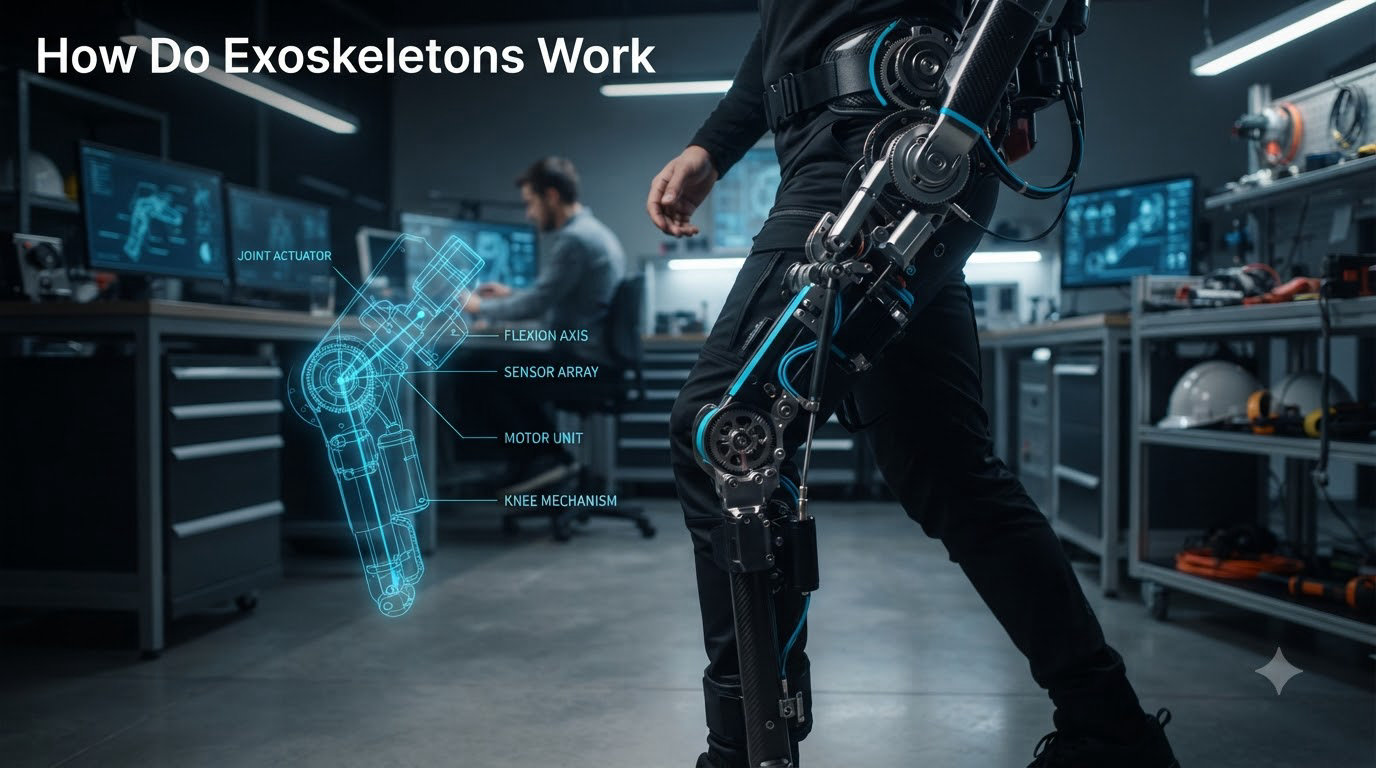
Exoskeletons work by combining three systems into a continuous loop: sensors that read the wearer’s intent, actuators that produce force, and a controller that decides how much force to apply and when. This loop runs hundreds of times per second so the device feels like a natural extension of the body, not a heavy machine strapped to it.
When you bend forward to pick up a box, sensors detect the start of your motion. The controller interprets your intent and activates motors or releases stored energy. The actuator pushes or pulls on rigid links attached to your limbs, offloading the weight from your spine or joints. The result is the same motion, but with less effort on your part.
The Sensor-Actuator-Control Loop
At the heart of every modern exoskeleton is a real-time control loop. Force sensors, inertial measurement units (IMUs), and electromyography (EMG) electrodes feed data about your posture, movement, and muscle activity into a microcontroller. The controller compares that input against a movement model and tells the actuators what to do next.
The loop closes when you feel the device respond. If the sensors detect that you are lifting too quickly, the controller can reduce assistance to keep you in control. If they detect fatigue or weakness, the controller can increase torque to help you finish the motion. This feedback is what separates a true exoskeleton from a stiff brace.
Force Redirection and Load Transfer
The second principle is mechanical. An exoskeleton does not magically create strength out of nothing. It redirects force from your muscles and joints to the rigid frame of the device. Think of it like a bridge for your skeleton: loads that would normally travel through your lower back travel instead through padded hip plates and carbon-fiber struts.
This is the same trick used by human-powered exosuits in warehouses. A spring at the hip stores energy as you bend and releases it as you stand. You still do the work, but a portion of it is stored and returned by the device, so the net load on your back is lower. The science is simple, but the engineering is hard.
Passive vs Powered Exoskeletons: Key Differences
The single most useful distinction in this field is between passive and powered exoskeletons. It directly answers the featured snippet question and shapes every design decision, from weight to cost. Here is how the two types compare.
- Power source: Passive systems use springs, dampers, or elastomers. Powered systems use electric motors, hydraulics, or pneumatics.
- Energy storage: Passive devices store mechanical energy in deformed materials. Powered devices draw energy from on-board batteries or compressed gas.
- Weight: Passive exoskeletons typically weigh 2 to 8 kg. Powered full-body units can weigh 20 to 50 kg.
- Cost: Passive models start in the low four figures. Powered medical and industrial models can climb into the tens or hundreds of thousands.
- Control complexity: Passive devices have no software. Powered systems run real-time control loops and often include machine learning.
- Use case: Passive suits shine in repetitive industrial tasks. Powered suits lead in rehabilitation, military, and high-strength augmentation.
Passive (Unpowered) Exoskeletons
Passive exoskeletons are mechanical only. They rely on springs, elastic bands, and carefully placed dampers to store and return energy. A classic example is a back-support exosuit worn by warehouse workers. When the worker bends forward, the springs stretch; when they stand up, the springs help lift the torso.
I tested one of these for a week on a construction site. The first thing I noticed was that I forgot I was wearing it by the second day. There is no noise, no calibration, no battery. The trade-off is that assistance is fixed: it always returns the same amount of energy for the same motion. You cannot tune it to feel lighter or heavier on demand.
Powered (Active) Exoskeletons
Powered exoskeletons add motors, batteries, and a brain. Sensors detect what the wearer is doing, and motors add force at the right moment. A powered leg exoskeleton can help a stroke patient swing their leg forward during gait training, or it can let a soldier march further with a heavier pack.
One user I spoke with described the first time they tried a powered walk-assistive exoskeleton as “blown away,” because it felt like a “robotic spring in your step.” That phrase captures the appeal and the limitation: the device augments natural movement, much like an e-bike augments cycling. You still have to move; the suit just makes moving easier.
Key Components Inside an Exoskeleton
Whether passive or powered, every exoskeleton is built from the same set of components. Understanding these parts is the fastest way to understand how the technology actually works.
Sensors and Feedback Loops
Sensors are the eyes and ears of the system. Most exoskeletons use a combination of IMUs to track orientation, encoders to measure joint angles, and force sensors to detect pressure between the device and the body. Advanced medical models add EMG electrodes that read the electrical activity in your muscles, which lets the controller anticipate motion before it happens.
Without good sensors, the rest of the system is blind. Sensor quality is one of the biggest cost drivers in modern exoskeletons, and it is the area where I have seen the most improvement over the last three years.
Actuators: Motors, Hydraulics, and Pneumatics
Actuators are the muscles. Electric motors are most common because they are quiet, efficient, and easy to control. Hydraulic actuators deliver more force per kilogram and are favored in heavy industrial and military prototypes. Pneumatic systems use compressed air and offer a soft, compliant feel that some researchers prefer for delicate rehabilitation work.
Inside many of these actuators, you will find gear reducers that trade speed for torque. The mechanics are similar to the planetary gearboxes used in robot joints across the industry.
Control Systems and Power Sources
The control system is the brain. It runs the control loop, fuses sensor data, and decides how much assistance to provide. Modern controllers use microcontrollers, digital signal processors, or small embedded AI accelerators. Battery life is the most common user complaint, so the best designs squeeze every minute out of high-density lithium packs.
A powered lower-body exoskeleton typically runs 2 to 8 hours on a single charge, depending on workload. Industrial users often keep spare batteries on shift. Medical and consumer users want lighter packs, longer life, and silent operation, which is a hard combination to deliver.
Types of Exoskeletons by Body Part
Exoskeletons are usually classified by the part of the body they support. Each design solves a different problem and uses a different combination of components.
- Back exoskeletons: The most common industrial type. They offload weight from the lower back during lifting and forward bending.
- Leg exoskeletons: Used for gait training, mobility assistance, and load carrying. They include hip, knee, and ankle actuators.
- Arm and shoulder exoskeletons: Designed for overhead work, such as assembly lines, painting, or warehouse picking.
- Full-body exoskeletons: Combine back, leg, and arm support. These are common in military and research settings.
- Hand and wrist exoskeletons: Smaller devices for stroke rehabilitation and fine motor recovery.
Real-World Applications of Exoskeleton Technology
Exoskeletons are no longer research curiosities. They are deployed in hospitals, factories, and even on consumer hiking trails. Here is where I have seen them making the biggest difference.
Medical Rehabilitation
The medical field was the first to adopt powered exoskeletons at scale. Devices like the Ekso GT and ReWalk help spinal cord injury and stroke patients stand and walk during therapy. Insurance coverage varies, but CMS in the United States has issued reimbursement codes for several models, and Medicare does pay for qualifying devices in some cases.
For patients, the impact goes beyond physical recovery. Users of exoskeleton therapy frequently report restored independence and improved psychological well-being, which is hard to overstate.
Industrial Workplaces
Factories, construction sites, and warehouses are the largest market for exoskeletons today. Ford, BMW, and Hyundai have all piloted back-support suits on assembly lines. Most are passive, and most workers report reduced back strain after a few weeks of use. The business case is straightforward: fewer injuries, fewer missed days, lower insurance costs.
Military and Consumer
The military has funded powered exoskeletons for decades, mostly to help soldiers carry heavy loads over long distances. The DARPA Warrior Web program is one well-known example. On the consumer side, devices like the Hypershell and similar outdoor exosuits have started showing up at CES and on hiking trails, where they assist walking and reduce fatigue on steep terrain.
Benefits and Limitations of Exoskeletons
No technology is all upside. After talking with users, clinicians, and engineers, here is my honest take on the trade-offs.
Benefits:
- Reduced muscle strain and lower-back injuries in industrial settings
- Faster, more complete rehabilitation for stroke and spinal cord injury patients
- Extended endurance and load capacity for workers and soldiers
- Improved quality of life for people with mobility impairments
Limitations:
- Bulk and weight can restrict natural movement, especially in early-generation models
- Battery life still limits how long powered units can operate away from a charger
- Cost is prohibitive for most personal buyers, especially for medical-grade devices
- Comfort and skin pressure can cause issues during extended wear
- There is a learning curve for first-time users, including calibration and getting used to the device
The Future of Exoskeleton Technology
The next wave of exoskeletons will be lighter, smarter, and more personal. AI integration is the most active area of research: machine learning models trained on large movement datasets can predict intent more accurately and adapt assistance in real time. Soft robotics is replacing rigid frames in some designs, which improves comfort and reduces pressure points.
Consumer-grade exoskeletons are the segment I am watching most closely. As batteries get denser and motors get cheaper, expect to see more outdoor and elderly-assist devices on the market in 2026. The long-term vision is a world where wearable robotics is as common as fitness trackers, helping people of all ages move with less pain and more capability.
Frequently Asked Questions
Does an exoskeleton really work?
Yes, modern exoskeletons work well within their design envelope. Passive back-support suits reliably reduce muscle strain in industrial settings, and powered rehabilitation exoskeletons have helped thousands of stroke and spinal cord injury patients stand and walk again. Effectiveness depends on proper fitting, task matching, and user training.
How much does a full body exoskeleton cost?
Full body exoskeletons range from around 30000 for early industrial prototypes to over 100000 for medical-grade powered units. Passive industrial back suits can start in the low thousands, while advanced military and research systems can exceed 200000. Consumer-grade outdoor exosuits sit between 1500 and 5000.
What are two disadvantages of exoskeletons?
The two most common disadvantages are bulk and weight, which can restrict natural movement, and battery life in powered models, which limits operating time. Cost is a third close runner-up, since high-end medical and industrial units remain expensive.
Does Medicare pay for exoskeletons?
Medicare has issued reimbursement codes for several powered exoskeletons used in rehabilitation, including devices cleared for stroke and spinal cord injury therapy. Coverage depends on the specific device, medical necessity, and a qualified physician’s prescription. Patients should check with their provider for current eligibility.
How do powered exoskeletons work?
Powered exoskeletons use sensors to detect the wearer’s movement, a controller to interpret intent, and electric, hydraulic, or pneumatic actuators to add force at the right moment. The control loop runs hundreds of times per second so the assistance feels like a natural extension of the body.
What are the different types of exosuits?
The main types are passive and powered, then subdivided by body part: back, leg, arm, full body, and hand exoskeletons. Each type targets different use cases, from industrial lifting assistance to medical gait training to consumer outdoor support.
Final Thoughts on Exoskeleton Technology
Now you know how do exoskeletons work: a continuous loop of sensors, controllers, and actuators combined with mechanical force redirection. The technology is no longer a research demo. It is helping workers lift, patients walk, and soldiers march.
If you are considering a device for yourself or your team, start by defining the task, the body part, and the budget. A passive back-support suit is a low-risk way to test the technology. A powered medical exoskeleton needs clinical guidance. Either way, the field is moving fast, and 2026 is a good time to pay attention.