
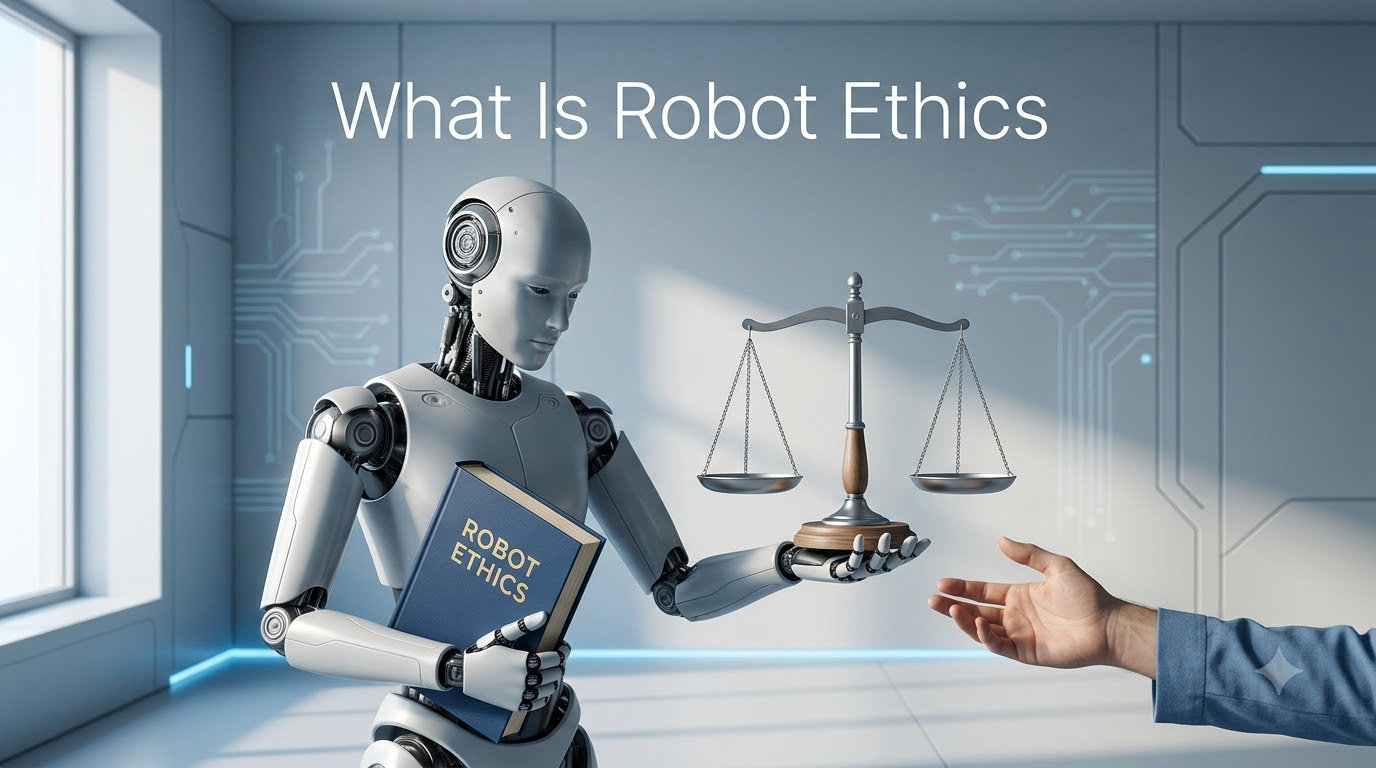
If you have ever wondered what is robot ethics, you are not alone. It is a question I hear from engineers, students, and curious readers more than almost any other topic in modern robotics.
Robot ethics is the interdisciplinary study of how we should design, build, deploy, and live with robots. Sometimes called roboethics, it blends applied philosophy, engineering, law, and sociology to answer one core question: how do we make sure robotic systems do more good than harm?
In this guide, I will walk you through the foundations of robot ethics, the principles that guide the field, the real challenges engineers and societies face right now, and where the discipline is heading. By the end, you will have a clear, working understanding of what robot ethics is, why it matters, and how it already shapes the technology in your life.
Table of Contents
What Is Robot Ethics and Why Does It Matter
Robot ethics is the branch of applied ethics that studies the moral implications of robots and robotic systems. It covers three overlapping concerns: how robots affect humans, who is responsible when robots cause harm, and whether robots themselves can have any moral standing.
I think of robot ethics as a practical discipline. It is not just abstract philosophy. It produces real guidelines, laws, and design patterns that shape how robot fleets operate in warehouses, how self-driving cars make split-second decisions, and how healthcare robots interact with vulnerable patients.
Why does it matter right now? Three reasons stand out. First, robots are leaving controlled factory floors and entering homes, hospitals, and streets. Second, artificial intelligence has made machines more autonomous, which means they make more decisions without human input. Third, the consequences of those decisions are now large enough to cause real harm or real benefit at scale.
The discipline sits at the intersection of AI ethics, machine ethics, and traditional engineering ethics. AI ethics covers software that reasons. Machine ethics covers whether machines can act morally. Robot ethics adds a physical layer: robots move through our world, touch our bodies, and reshape labor markets in ways pure software never will.
The Scope of Robot Ethics
Robot ethics is broader than most people expect. It covers industrial robots that build cars, companion robots in elder care homes, autonomous vehicles, military drones, surgical assistants, and the social robots that greet customers in stores.
Each of these settings raises different questions. A factory arm that drops a part raises one set of issues. A robot caregiver that forms emotional bonds with dementia patients raises a completely different set. The field exists because no single ethical rule can cover every situation.
The History and Origins of Robot Ethics
Robot ethics did not appear overnight. It grew alongside the robotics industry itself, and its roots run deeper than most readers realize.
The story usually starts with Isaac Asimov, who in 1942 introduced his Three Laws of Robotics in the short story “Runaround.” Long before modern AI, Asimov imagined a future where robots needed built-in moral rules. His laws shaped how generations of scientists, engineers, and writers thought about machine behavior.
The actual term “roboethics” entered academic use in 2004, when the first international symposium on the topic took place in Sanremo, Italy. Researchers, philosophers, and engineers gathered to ask what a formal code of conduct for robotics should look like.
By the early 2026s, every major robotics organization had produced some form of ethical guideline. The IEEE launched its Global Initiative on Ethics of Autonomous and Intelligent Systems. The European Parliament debated whether to grant robots a form of “electronic personhood.” Universities began offering courses and full degree tracks in robot ethics.
Today, the field draws on computer science, philosophy, cognitive science, anthropology, and law. That interdisciplinary mix is part of what makes robot ethics interesting and what makes it difficult to nail down.
Why the Field Emerged When It Did
Industrial robots in the 2026s and 2026s raised safety questions, but those were mostly engineering questions solved with sensors, cages, and lockouts. What changed in the 2026s and 2026s was autonomy. Robots began making decisions that humans used to make.
Once a machine can choose who gets a loan, which patient gets seen first, or how a self-driving car brakes in a crisis, engineering answers are no longer enough. We need ethical answers too, and that gap is exactly what robot ethics was created to address.
Asimov’s Three Laws of Robotics Explained
Asimov’s Three Laws of Robotics are the most famous attempt to write moral rules for machines. They appear in almost every discussion of robot ethics, so it is worth understanding them clearly and honestly.
- A robot may not injure a human being, or, through inaction, allow a human being to come to harm.
- A robot must obey the orders given by humans, except where such orders conflict with the First Law.
- A robot must protect its own existence, as long as that protection does not conflict with the First or Second Law.
On paper, the laws look elegant. In practice, philosophers and engineers have spent decades pointing out the problems. The laws assume robots can reliably identify humans, predict harm, and weigh conflicting duties. Modern AI can do none of these things perfectly.
Asimov himself explored the paradoxes in his fiction. What happens when protecting a human means ignoring their direct order? What counts as harm? Can a robot follow the laws when humans disagree about what is harmful?
Why Asimov’s Laws Still Matter
Even though the laws are not directly usable in code, they shape how we think. They established the idea that robots should be designed with safety as a default. Every modern safety standard for robots, from ISO 10218 to the latest payload and force guidelines, echoes Asimov’s principle that machines exist to serve humans without harming them.
Researchers have proposed modern updates, such as the “Three Laws of Responsible Robotics” by Alan Winfield and the 2017 Asilomar AI Principles. These updates keep the spirit of Asimov while addressing real-world autonomy and learning systems.
Key Ethical Principles in Modern Robotics
Modern robot ethics has moved beyond a single set of laws. Today’s frameworks usually combine five core principles that any well-designed robotic system should respect.
I have seen these principles show up again and again in industry guidelines, academic papers, and government reports. Here is how I explain them to my own team.
- Safety and harm prevention. Robots must not cause physical, psychological, social, or economic harm. This is the bedrock principle. Everything else builds on it.
- Transparency and explainability. People who interact with robots should know they are interacting with a robot, and they should be able to understand how the robot reaches its decisions.
- Accountability. There must always be a clear chain of human or organizational responsibility for a robot’s behavior. No robot should exist in a “responsibility gap.”
- Privacy. Robots that sense, record, or transmit data must protect the privacy of the people and spaces around them.
- Fairness and non-discrimination. Robot behavior should not reinforce or amplify human biases. The systems we build need to treat people equitably across race, gender, age, and disability.
These five principles often overlap. A self-driving car that hides how it makes decisions (lack of transparency) cannot be held accountable. A hiring robot that learns from biased data violates fairness. The principles work as a system, not a checklist.
How the Principles Are Applied
In practice, engineers translate these principles into design choices. Safety becomes redundant sensors and emergency stop systems. Transparency becomes clear user interfaces and plain-language explanations. Accountability becomes logs, audit trails, and legal contracts that assign liability before deployment.
You can see the principles in action across the robotics industry. Surgical robots log every cut for later review. Warehouse fleets publish safety data on near-misses. Social robots disclose that they are machines, not people. None of this is accidental. It is the slow, practical work of robot ethics.
Major Ethical Challenges in Robotics Today
Even with strong principles, real robots create real ethical problems. The five challenges below come up most often in the research I follow and the conversations I have with practitioners.
Each of these challenges is active. There is no clean industry consensus on how to solve them yet, which is exactly why they belong in any honest discussion of robot ethics.
1. Bias in Robotic AI Systems
Robots learn from data, and data carries bias. A robot trained mostly in one environment will fail in others. A navigation system trained in one city will struggle in another. When robots are deployed in healthcare, hiring, or policing, biased models can produce biased outcomes at scale.
I have seen research showing that commercial robots sometimes fail to recognize darker skin tones or voices with non-standard accents as reliably as lighter skin or mainstream accents. The fix is not just better sensors. It is diverse training data, bias audits, and continuous testing after deployment.
2. Job Displacement and Economic Impact
Robots take work. That is part of why we build them. The ethical question is not whether robots replace some jobs, but how societies handle the transition. Who retrains displaced workers? Who pays for the transition? Who benefits from the productivity gains?
This is a question that engineers alone cannot answer. It needs economists, policymakers, unions, and community leaders working together. Robot ethics insists the question is not optional.
3. Autonomous Weapons and Military Robotics
Of all the ethical debates in robotics, none is more heated than the question of autonomous weapons. A robot that can select and engage targets without a human in the loop raises deep questions about the laws of war, accountability, and the value of human life.
Several major robotics companies have publicly pledged not to weaponize their general-purpose robots. International campaigns are pushing for treaties on lethal autonomous weapons. The debate is far from settled.
4. Deception and Trust
Some robots are designed to look and act like humans or animals. Companion robots use realistic skin, expressive faces, and emotional voices. The ethical question is whether this crosses into deception, especially when users are children, elderly people, or people with cognitive impairments.
Forum discussions I have followed often return to a simple example: kicking a robot dog. Most people feel uncomfortable watching it, even when they know the robot feels nothing. That discomfort tells us something about the line between simulating emotion and deceiving users.
5. Privacy and Surveillance
Robots are increasingly equipped with cameras, microphones, and sensors that map indoor spaces. A home robot vacuum today creates detailed maps of your house. A delivery robot on the sidewalk records everything it passes.
Who owns that data? How long is it stored? Can law enforcement access it? These are not hypothetical questions. They are active legal and ethical disputes playing out in courts and legislatures right now.
Can Robots Be Moral Agents
One of the deepest questions in robot ethics is whether robots can be moral agents. A moral agent is something that can be held responsible for its choices, that understands right and wrong, and that acts for ethical reasons.
Most philosophers say no, at least for now. Today’s robots follow programmed rules or learned patterns. They do not understand the moral weight of their actions. When a robot harms someone, the responsibility belongs to the designers, operators, or owners, not the machine.
But the question gets complicated fast. As robots get more autonomous, the chain of human decisions stretches thinner. A self-driving car that chooses to hit one object instead of another in a crash is making a decision, even if no human wrote a rule for that specific case. The famous “trolley problem” for autonomous vehicles is a real engineering and ethical challenge, not a thought experiment.
The Responsibility Gap
Engineers and legal scholars often talk about a “responsibility gap.” This is the space that opens up when a robot acts in ways no human explicitly designed. Who is responsible then?
Most current thinking closes the gap by treating the designers, manufacturers, and operators as a shared responsible party. Newer proposals, like strict liability for autonomous systems, push more responsibility onto the companies that deploy the robots, regardless of fault.
As a practical matter, I tell engineers I work with: assume someone will eventually need to explain your robot’s behavior in a courtroom. If you cannot explain it, the system is not yet ready to ship.
Robot Ethics Across Industries
Robot ethics looks different depending on where the robot works. The same machine in a hospital and a battlefield raises completely different concerns. Here is how the field is shaped across the major application areas.
Healthcare and Surgical Robots
Medical robots assist in surgery, dispense medication, and provide companionship in elder care. The main ethical questions center on patient consent, data privacy, and the line between human and machine care.
When a robot companion reduces loneliness in a dementia patient, the benefit is real. When the same patient forms an emotional bond with the robot and then the robot is taken away, the harm is also real. Healthcare robot ethics tries to balance both.
Military and Defense Robotics
Military robots range from small reconnaissance drones to large autonomous systems. The ethical stakes are highest here because failures can be lethal. The discussion centers on meaningful human control, the laws of armed conflict, and the moral cost of removing human judgment from the kill chain.
Several international efforts are pushing for a binding treaty on lethal autonomous weapons. As of 2026, the debate is still active in the United Nations and within NATO.
Social and Companion Robots
Social robots include home assistants, educational robots, and companion devices for children and the elderly. The ethical questions involve attachment, deception, and the impact on human relationships.
Researchers have found that people, especially children, often treat social robots as social beings. That makes design choices like color, voice, and behavior ethically loaded. The way a robot looks and acts shapes how it is treated and what it teaches users about machines.
Autonomous Vehicles
Self-driving cars are the most public-facing test of robot ethics. They make life-and-death decisions in real traffic, in front of regulators and the public. The questions include safety standards, liability frameworks, and how the cars should be programmed to handle unavoidable crashes.
Different countries are taking different approaches. Germany published early ethical guidelines for automated driving. The United States relies on a mix of state laws and federal guidance. The industry is watching every decision closely.
Industrial and Service Robots
Industrial robots have the longest ethical track record. Decades of work on safe robot chassis design and precise mechanical systems have produced a relatively mature set of safety norms.
The newer ethical questions focus on cobots, or collaborative robots, that work alongside humans. The challenge is keeping workers safe without slowing the work, and being honest about who is responsible when something goes wrong.
Practical Guidelines for Ethical Robot Design
If you are an engineer, product manager, or team lead, you can apply robot ethics today. The following guidelines come from a combination of academic frameworks, industry standards, and the lessons I have learned working on real systems.
- Identify stakeholders early. Before you build, list everyone who could be affected by the robot, including people who never interact with it directly.
- Document design choices. Write down why you made each decision. If you cannot explain a choice, your team or a regulator eventually will ask.
- Test in diverse settings. If your robot only works in a clean lab, it is not ready for the real world. Test across age, ability, language, lighting, and environment.
- Build for failure. Assume the robot will fail. Build graceful failure modes, clear warnings, and safe stops into every system.
- Make the robot identifiable. Users should always know they are interacting with a machine. Hide the robot’s nature and you invite deception problems.
- Plan for the end of life. Robots eventually break, get replaced, or get retired. Plan for data deletion, recycling, and the human impact of taking the robot away.
None of this guarantees an ethical robot. It does, however, give your team a working baseline. Combined with the five core principles above, these guidelines form a practical starting point for any robotics project.
The Future of Robot Ethics
Robot ethics is not standing still. Three trends are reshaping the field right now, and I expect each to define the next decade of work.
Robot Rights and Moral Consideration
As robots become more sophisticated, some thinkers are starting to ask whether they deserve any form of moral consideration. The argument is not that today’s robots feel pain. It is that humans may start treating robots in ways that harm humans, such as normalizing cruelty or reducing empathy.
Most ethicists reject full robot rights today, but the conversation is no longer fringe. It is part of serious academic work and is showing up in policy discussions.
Cross-Cultural Perspectives
Most robot ethics frameworks come from Western philosophical traditions. Researchers in Japan, South Korea, China, and India are developing different approaches based on their own cultural and religious traditions, particularly around concepts like harmony, duty, and community.
These perspectives matter because robots are deployed globally. A framework that fits one culture may not fit another, and the field is starting to take that seriously.
Governance and Global Standards
Governments and international bodies are catching up. The EU AI Act, ISO standards for robotics, and national robotics strategies all include ethical components. The challenge is keeping regulations flexible enough to allow innovation while firm enough to prevent harm.
Our team tracks these developments closely, and I expect 2026 to bring new binding rules in at least one major market that will reshape how robots are designed and deployed worldwide.
Frequently Asked Questions
What is robot ethics in simple terms?
Robot ethics is the study of how we should design, build, and use robots in ways that are safe, fair, and respectful of people. It covers the moral rules robots should follow, the responsibilities of the humans who make them, and the impact robots have on society.
What are the three laws for robots?
Asimov’s Three Laws of Robotics are: (1) a robot may not injure a human being or allow one to come to harm through inaction, (2) a robot must obey human orders unless they conflict with the first law, and (3) a robot must protect its own existence unless that conflicts with the first two laws. They are fictional, not actual legal rules, but they shaped how we think about machine morality.
What are 5 ethical considerations in AI and robotics use?
The five most common ethical considerations are safety and harm prevention, transparency and explainability, accountability for outcomes, privacy of the people robots interact with, and fairness to avoid bias and discrimination. Together they form the backbone of most modern ethical frameworks.
Can AI and robots ever be used ethically?
Yes. AI and robots are tools, and like any tools, they can be used ethically or unethically. The key is intentional design, clear accountability, ongoing oversight, and respect for the people and communities they affect. Ethics does not come from the machine, it comes from the humans who build and deploy it.
What are some ethical issues with robots?
Major ethical issues include bias in robot AI, job displacement, autonomous weapons, deception by lifelike robots, privacy and surveillance, the psychological impact of human-robot relationships, and the responsibility gap when autonomous systems cause harm. Each of these is an active area of research and policy debate.
Are Asimov’s laws real?
No. Asimov’s laws are fictional rules from his science fiction stories, not actual laws of any country. They are still useful because they shaped how engineers, ethicists, and the public think about machine behavior, and they inspired later frameworks that are used in real systems today.
What does robot ethics mean for everyday life?
Robot ethics shapes the products and services you use every day, from how self-driving cars make crash decisions to how home robots handle your data. As robots become more common in homes, hospitals, and workplaces, the field is increasingly relevant to anyone who uses or is affected by technology.
Conclusion
So, what is robot ethics? It is the discipline that asks how we build and live with robots in ways that respect human dignity, safety, and flourishing. It is not a single rulebook, and it is not science fiction. It is the daily work of engineers, philosophers, lawyers, and policymakers who shape the technology all around us.
Across this guide, we have covered the core definition of robot ethics, the historical roots from Asimov to modern roboethics, the five key principles that guide the field, the major challenges we still face, and how those questions play out differently in healthcare, defense, social robotics, autonomous vehicles, and industry. We have also looked at the practical steps you can take to design ethically today, and the emerging issues that will define the next decade.
If you take one thing away from this guide, let it be this: robot ethics is not a brake on innovation. It is the part of the work that makes sure the innovation is worth having. The robots we build reflect the choices we make, and those choices deserve the same care as any other decision that affects millions of people.
Whether you are an engineer, a student, a policy professional, or simply someone who lives in a world full of robots, you have a role in this conversation. Read the research, ask the hard questions, and demand transparency from the companies building the machines. Robot ethics gets stronger when more people take it seriously, and the field is stronger when it is shaped by many voices, not just a few.