
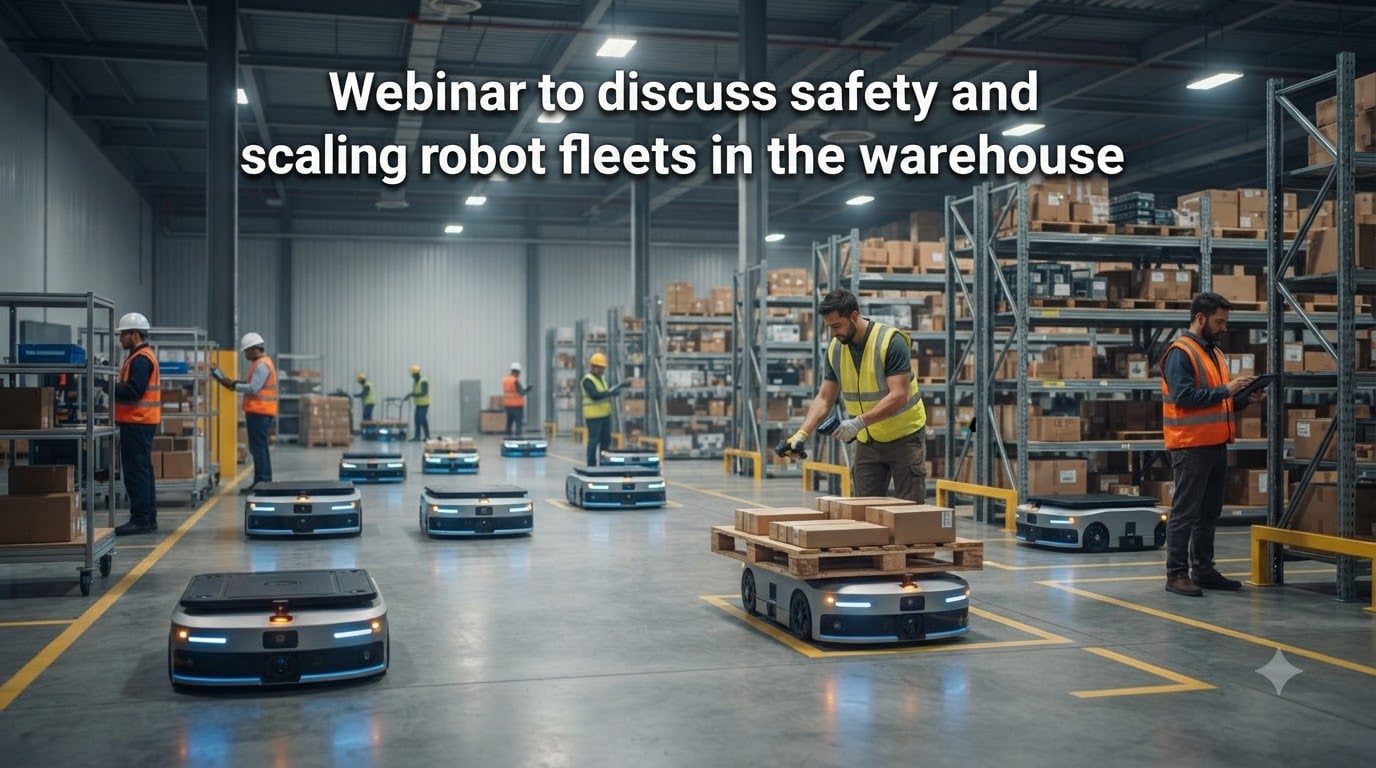
I want to flag an event that matters if you run or scale a warehouse robotics program. On Wednesday, August 26, at 2:00 p.m. ET, a free webinar will pull together industry experts to discuss safety and scaling robot fleets in the warehouse. The session is built for operations leaders who are past pilot mode and now wrestling with real fleet growth.
This particular webinar to discuss safety and scaling robot fleets in the warehouse caught my attention because it brings together voices you rarely see on the same stage. You get a seasoned industry analyst, a vendor-neutral safety expert, and a warehouse operator who has actually scaled autonomous mobile robots from a handful of units to hundreds. Anyone planning a major fleet expansion in 2026 should register.
The goal here is simple. I want to give you a clear preview of what the session covers, why the topics matter right now, and how the lessons apply to your own fleet. I have attended dozens of these webinars over the years, and the ones that pull in real operators tend to be the most useful.
Table of Contents
What the Webinar Covers: Scaling Robot Fleets Safely
The core agenda is built around the practical friction points that show up when warehouse robot fleets grow past pilot scale. Expect four major topic blocks: human-robot collaboration inside active warehouses, structured risk assessments as fleets grow, certified safety architectures, and the productivity trade-offs that come with every safety decision.
One of the strongest points on the agenda is the conversation between safety and throughput. Many fleets that worked well at 10 robots start showing congestion, deadlocks, and near-miss incidents at 60 or 100 units. The speakers will walk through how functional safety certifications like SIL2/PLd, IEC 61508, and ISO 13849-1 actually translate into warehouse behavior.
There is also a dedicated segment on multi-vendor fleet coordination. Most warehouses do not run a single AMR or AGV brand. They run a mix of autonomous mobile robots, automated guided vehicles, and ASRS shuttles, often from competing vendors. Coordinating those fleets without compromising personnel safety is one of the hardest operational problems in warehouse automation today.
Why Safety Is the Biggest Barrier to Scaling Robot Fleets
Safety is the number one reason robot fleet rollouts stall. I have watched deployments that ran beautifully at 20 units suddenly freeze when the operations team tried to scale to 80. The robots themselves did not fail. The safety architecture failed, and the human workforce pushed back.
The first challenge is physical proximity. As fleets grow, AMRs and AGVs share more aisles with pickers, forklifts, and maintenance staff. Collision avoidance that worked with sparse traffic breaks down when dozens of units route through the same bottleneck. Ultra-wideband (UWB) and real-time locating systems (RTLS) become critical, not optional.
The second challenge is regulatory exposure. Once a warehouse robot can cause bodily harm, the operator inherits new OSHA obligations. Risk assessments are no longer a checkbox. They need to be living documents tied to every change in fleet size, route layout, or sensor configuration.
The third challenge is workforce trust. The operators who keep a warehouse running need to believe the robots will not injure them. If workers feel unsafe, productivity collapses long before any incident occurs. Human-robot collaboration only works when both sides of the aisle trust the safety stack.
Best Practices for Human-Robot Collaboration in Warehouses
Effective human-robot collaboration starts with layered safety, not single points of failure. The most reliable deployments combine certified safety scanners, software-defined geofences, and structured traffic rules. The webinar will walk through how each layer contributes to functional safety without strangling throughput.
Here are the best practices I expect the panelists to cover, and that I have seen work in real deployments:
- Define certified safety zones around every robot and review them after every fleet expansion.
- Use collision avoidance sensors with redundant zones, including a warn zone and a stop zone.
- Deploy UWB badges for personnel in mixed-traffic zones so robots can slow or reroute in real time.
- Standardize audible and visual alerts so workers immediately recognize robot intent.
- Train staff on what each robot indicator means, not just on which aisles to avoid.
The speaker lineup is unusually strong. The session includes an analyst from Redpoint, a safety expert from Geek+, and a Toyota representative with hands-on scaling experience. That mix of vendor, analyst, and operator perspective is rare, and it usually produces the most honest answers about what actually works.
Risk Assessment Strategies for Growing Robot Fleets
Risk assessments need to scale with the fleet, not stay frozen at the original deployment. A common mistake I see is treating the initial pilot risk assessment as a permanent document. Once you add 50 new units, change the racking layout, or introduce a new AMR brand, the original assessment is no longer valid.
The webinar will cover a structured methodology for ongoing risk assessments. Expect the speakers to walk through hazard identification, severity scoring, exposure frequency, and the possibility of avoidance. Each new robot added to the fleet should trigger a structured review of nearby workflows.
Real-time monitoring is the second pillar. Modern fleet management platforms log every near-miss, every emergency stop, and every geofence breach. Those logs are not just compliance paperwork. They are the raw data that tells you where the next incident is likely to happen.
Workflow optimization ties everything together. Safety is not the opposite of productivity. The fleets that scale most smoothly are the ones where safety engineers and operations engineers sit at the same table. They design routes that protect workers and still move at the speed the business requires.
Who Should Attend the Warehouse Robot Fleet Webinar
This webinar is built for a specific audience. If you are an operations director, warehouse manager, safety officer, or robotics engineer planning a fleet expansion in 2026, you are the target attendee. Supply chain leaders evaluating automation vendors will also get value from the vendor-neutral framing.
If you are earlier in the journey, just starting to evaluate AMRs or AGVs for a pilot, you will still benefit. The risk assessment and safety frameworks discussed apply as much to a 5-unit pilot as to a 200-unit deployment. In some ways, it is better to learn these patterns before you scale, so your pilot architecture does not have to be rebuilt later.
The event is free and runs for roughly one hour, with time for live audience questions. If you cannot attend live, register anyway and you will get the recording along with the slide deck.
Frequently Asked Questions
Are there any OSHA guidelines for robotic safety?
OSHA does not publish a single robotic safety standard, but it does apply the general duty clause, machine guarding rules, and lockout/tagout requirements to warehouse robots. Most operators also follow ANSI/RIA R15.06 for industrial robot safety and ISO 10218 for collaborative operation. The OSHA NIOSH page on robotics is a practical starting point for warehouse teams.
What are the 5 pillars of fleet management?
The five pillars of fleet management are typically fleet composition, real-time monitoring, preventive maintenance, staff training, and continuous optimization. In a warehouse robotics context, composition means understanding the mix of AMRs, AGVs, and ASRS units. Monitoring covers uptime, near-misses, and traffic flow. Maintenance includes both hardware and software updates. Training keeps workers confident around the robots. Optimization uses the data to refine routes and workflows over time.
What are the safety rules for working with robots?
The core safety rules for working with warehouse robots are: stay out of marked robot zones whenever possible, never enter a geofenced area without logging out the robot first, wear required PPE and UWB badges, follow all audible and visual alerts, report every near-miss to the safety team, and never attempt to override an emergency stop. Workers should also be trained on the specific robot models in their facility, since indicators vary by vendor.
Will warehouse workers be replaced by AI?
Warehouse workers are not being wholesale replaced by AI and robots. The pattern across large deployments is task reassignment, not elimination. Robots handle the repetitive transport and lifting work, while humans move into roles involving exception handling, quality control, robot supervision, and customer-specific tasks. Most operators who have scaled fleets report that their workforce grows in headcount but shifts to higher-value activities.
Final Takeaways on Warehouse Robot Fleet Safety
The big lesson I expect from this warehouse robot fleet safety scaling webinar is that safety and productivity are not opposites. The warehouses that scale fastest are the ones that treat certified safety, ongoing risk assessments, and human-robot collaboration as the foundation of their automation strategy, not as an afterthought.
If you are scaling a fleet in 2026, register for the August 26 session, bring your hardest scaling question, and use the panel to pressure-test your roadmap. The hour is well worth it, and the recording lives in your inbox forever after.