
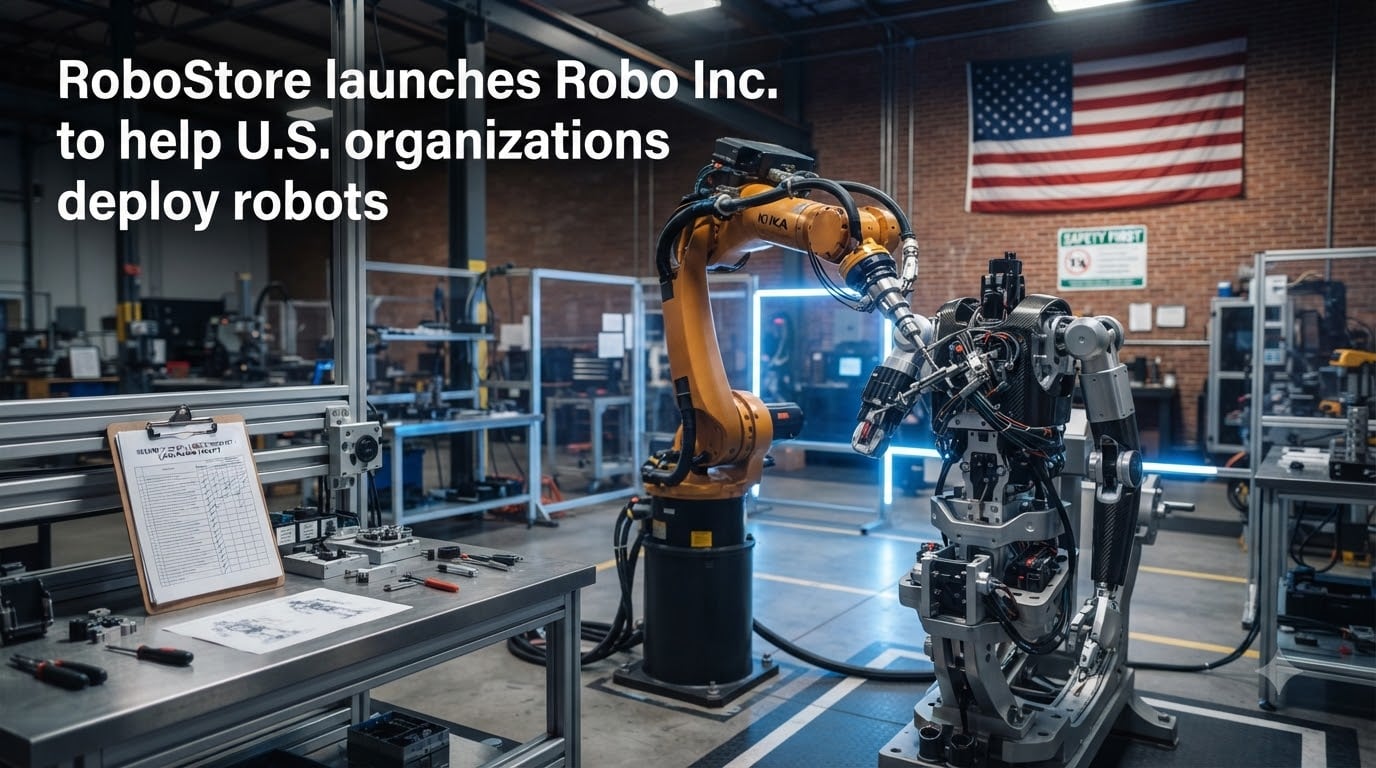
RoboStore, the New York-based distributor of Unitree’s legged and humanoid robots, has launched a new division called Robo Inc. to serve as a U.S.-based manufacturer and systems integrator for American organizations looking to deploy robots. The move comes at a moment when federal restrictions on Chinese-made robotics hardware are forcing companies, universities, and government agencies to rethink how they source and deploy automation.
Robo Inc. operates out of a 66,000-square-foot facility on Long Island, where it performs domestic assembly, security hardening, and compliance review on robotic platforms before they reach U.S. customers. The company positions itself as a hardware-agnostic integrator, meaning it works with robots from multiple global manufacturers rather than locking buyers into a single brand.
In this article, we break down what RoboStore Robo Inc robot deployment actually looks like in practice, why the FCC’s recent ban on certain Chinese robotics hardware created an urgent gap, and what American organizations need to know about the security, compliance, and cost tradeoffs of this new model.
Table of Contents
What Is Robo Inc. and What Does It Do?
Robo Inc. is a U.S.-based robotics manufacturing and systems integration company created by RoboStore to help American organizations deploy robots with domestic assembly, security testing, and compliance documentation. Think of it as the engineering and compliance arm that sits between a global hardware supplier and the end customer.
The distinction from RoboStore matters. RoboStore has operated as a distributor, selling Unitree quadruped and humanoid robots to U.S. buyers since its founding. It built relationships with universities like Harvard and MIT, enterprise customers including Amazon and NVIDIA, and developed a developer community called Roboverse with over 4,000 members. But distribution alone does not solve the integration, security, and compliance problems that come with deploying robots in regulated American environments.
Robo Inc. fills that gap. The 66,000-square-foot Long Island facility handles U.S.-based assembly, localized data infrastructure, firmware review, and safety certification. Rather than shipping a robot straight from a factory in China to a research lab in Boston, Robo Inc. receives the hardware, disassembles and inspects it, applies security hardening, integrates it with the customer’s existing systems, and delivers a deployment-ready package.
This is a shift from selling products to selling solutions. A customer does not just buy a robot. They buy a robot that has been tested for known vulnerabilities, configured for their specific use case, and documented for their compliance team.
The Global-to-Local Model Explained
Robo Inc. describes its approach as a “global-to-local operating model.” The hardware originates from global supply chains, primarily Unitree’s manufacturing in China. But everything that happens after the hardware arrives in the United States, from assembly to security review to software configuration, takes place domestically.
The company has stated it will be hardware-agnostic. That means Robo Inc. is not bound exclusively to Unitree products. If a customer needs a quadruped robot from one manufacturer and a humanoid platform from another, Robo Inc. can integrate both into a unified deployment. This flexibility matters because no single robot manufacturer makes the best platform for every use case.
The integration process includes several security checkpoints. Robo Inc. reviews firmware, evaluates Bluetooth and network communication protocols, examines data flows between the robot and cloud services, and implements network segmentation for enterprise deployments. Safety integration covers physical safeguards, software controls for emergency stopping, and application-specific risk assessments tailored to the deployment environment.
Why the FCC Ban Made This Urgent
On July 28, 2026, the FCC added certain Chinese-made robotics and surveillance equipment to its Covered List, a registry of communications equipment deemed to pose an unacceptable risk to national security. This effectively restricts the purchase and use of specific Chinese robotics platforms in facilities that receive federal funding or operate under federal contracts.
The FCC ban did not appear in a vacuum. Earlier in 2026, security researchers identified CVE-2025-2894, a critical vulnerability in Unitree’s firmware dubbed UniPwn. The exploit allowed remote code execution through Bluetooth and network interfaces on certain quadruped robots. While Unitree released patches, the vulnerability underscored a broader concern about the security posture of Chinese-made robotics hardware in sensitive American environments.
For organizations already deploying these robots, the FCC action created an immediate problem. Universities with active research programs using Unitree quadrupeds needed a compliance pathway. Logistics companies testing humanoid robots in warehouses needed to know whether their investment was now stranded. Defense-adjacent contractors needed documentation proving their robotic systems met federal security standards.
This is the specific and urgent gap Robo Inc. was created to address. By performing U.S.-based assembly and security hardening, Robo Inc. provides a compliance framework that allows organizations to continue deploying advanced robotics while satisfying federal requirements. Whether that framework fully resolves the underlying security concerns is a separate question.
What Security Hardening Can and Cannot Fix
This is where the story gets nuanced. U.S.-based integration and security hardening can address several real problems. Robo Inc. can review firmware for known vulnerabilities like CVE-2025-2894, implement network segmentation to isolate robots from sensitive enterprise systems, audit data flows to ensure robot telemetry is not being sent to overseas servers, and apply Bluetooth security patches. These measures meaningfully reduce the attack surface of a deployed robot.
What domestic integration cannot do is erase the hardware’s country of origin. China’s National Intelligence Law, passed in 2017, requires Chinese companies to cooperate with state intelligence work. This legal framework means that any hardware manufactured by a Chinese company, regardless of where it is assembled or integrated afterward, carries an inherent tension for U.S. national security applications.
The practical implication is that Robo Inc.’s compliance framework works well for commercial enterprises, research institutions, and logistics operations. But for defense contracts, ITAR-regulated environments, and classified facilities, the underlying hardware origin remains a disqualifying factor. Robo Inc. can harden a robot for enterprise IT compliance, but it cannot make a Unitree platform eligible for a defense contract.
RoboStore’s Track Record and Customer Base
RoboStore did not enter this space as an unknown startup. The company has been the official Unitree partner in the United States and has built a substantial customer base across academia and enterprise. Its published customer list includes Harvard, MIT, Amazon, and NVIDIA. These are organizations with rigorous procurement and security standards, and their willingness to work with RoboStore signals a baseline of trust.
The Roboverse developer community, with over 4,000 members, gives Robo Inc. a head start on the software integration side. Developers in this community have already built applications, drivers, and integration tools for Unitree platforms. Robo Inc. can leverage that existing ecosystem rather than starting from scratch with every new customer deployment.
RoboStore has also partnered with OpenMind on university curriculum development. This partnership matters because it addresses the skills gap in robot deployment. Organizations can buy robots, but they also need people who know how to program, maintain, and integrate them. By embedding robotics education into university curricula, RoboStore is building a talent pipeline that supports long-term deployment success.
The Price Gap Problem
One of the most discussed aspects of Chinese versus U.S. robotics is cost. A Unitree R1 humanoid robot has been listed at approximately $5,900, a price point that stunned the market when it was announced. Comparable humanoid platforms from U.S. or European manufacturers can cost tens or hundreds of thousands of dollars per unit.
This price gap is real and it is enormous. On Reddit’s r/Futurology and robotics communities, users have noted that the cost difference makes Chinese robots the default choice for research labs, small companies, and hobbyists with limited budgets. Morgan Stanley research on humanoid robot cost trajectories suggests that closing this gap for U.S.-manufactured platforms will take years, not months.
Robo Inc.’s integration services add cost on top of the base hardware price. Security hardening, compliance documentation, and custom configuration are not free. But for organizations that need to deploy robots in regulated environments, the alternative is either buying a far more expensive U.S.-made platform or abandoning the deployment entirely. Robo Inc. positions itself in the middle: affordable Chinese hardware with enough domestic processing to meet American compliance requirements.
Is This the DJI Drone Ban All Over Again?
The parallels to the DJI drone ban are hard to ignore. DJI dominated the U.S. commercial drone market for years, offering capable hardware at prices no Western manufacturer could match. When federal restrictions began limiting DJI’s use in government and defense contexts, it created a massive gap. Some of that gap was filled by U.S. drone manufacturers like Skydio. Much of it was filled by DJI drones continuing to operate in commercial and consumer spaces where the restrictions did not apply.
The robotics industry may follow a similar pattern. Robo Inc.’s model suggests that Chinese-made robots will not disappear from the U.S. market. Instead, they will be filtered through domestic integration layers that add security review and compliance documentation. Organizations in commercial, academic, and logistics settings will continue using these platforms. Defense and national security applications will remain off-limits.
The key difference from the DJI precedent is that humanoid and quadruped robots are earlier in their adoption curve. Drones were already widely deployed when restrictions hit. Robots are still in the pilot and research phase for most organizations. This means the compliance framework Robo Inc. is building could shape how an entire generation of U.S. robot deployment is structured from the start.
What does Robo Inc. actually do that RoboStore does not?
RoboStore is a distributor that sells Unitree robots to U.S. buyers. Robo Inc. is a U.S.-based manufacturer and systems integrator that performs domestic assembly, security hardening, firmware review, compliance documentation, and custom configuration before delivering robots to customers. RoboStore sells the hardware; Robo Inc. makes it deployment-ready for regulated American environments.
Can you still use Chinese-made robots in American facilities after the FCC ban?
Yes, but with conditions. The FCC’s July 28 Covered List restricts specific Chinese robotics equipment in facilities receiving federal funding or operating under federal contracts. Commercial enterprises, research institutions, and logistics companies can still deploy Chinese-made robots, especially when they go through a U.S.-based integration and security hardening process like the one Robo Inc. offers. Defense and ITAR-regulated environments face stricter limitations.
Does US-based integration actually solve the China national security law problem?
Partially. U.S.-based integration and security hardening can address firmware vulnerabilities, network security, and data flow concerns. However, China’s National Intelligence Law still applies to the hardware’s country of origin. This means Robo Inc.’s compliance framework works for enterprise and academic deployments but does not make Chinese-made robots eligible for defense contracts or classified environments.
How does the price gap between Chinese and US humanoid robots affect the market?
The price gap is significant. Chinese humanoid robots like the Unitree R1 are priced around $5,900, while comparable U.S. or European platforms can cost tens of thousands more. This gap makes Chinese hardware the default for budget-constrained buyers. Robo Inc.’s integration services add cost, but the total remains lower than fully U.S.-manufactured alternatives, creating a middle-ground option for compliant deployments.
What This Means for the Future of U.S. Robot Deployment
Robo Inc. represents a pragmatic response to a real problem. The FCC ban and underlying security concerns are not going away. At the same time, Chinese-made robots offer capabilities and prices that American alternatives cannot currently match. RoboStore Robo Inc robot deployment bridges that divide with domestic integration, security hardening, and compliance documentation.
The Long Island facility and its 66,000 square feet of capacity signal that RoboStore expects substantial demand for this model. With an existing customer base that includes Harvard, MIT, Amazon, and NVIDIA, plus a 4,000-member developer community, the foundation is already in place. Whether Robo Inc. becomes the dominant U.S. robot integrator or simply the first of many will depend on how quickly the compliance landscape evolves and whether American manufacturers can close the price gap.
For organizations evaluating robot deployment in 2026, the takeaway is clear. You can deploy advanced robotics in the United States, but the path from hardware purchase to operational deployment now requires a compliance-aware integration partner. Robo Inc. is betting that partner is them.