
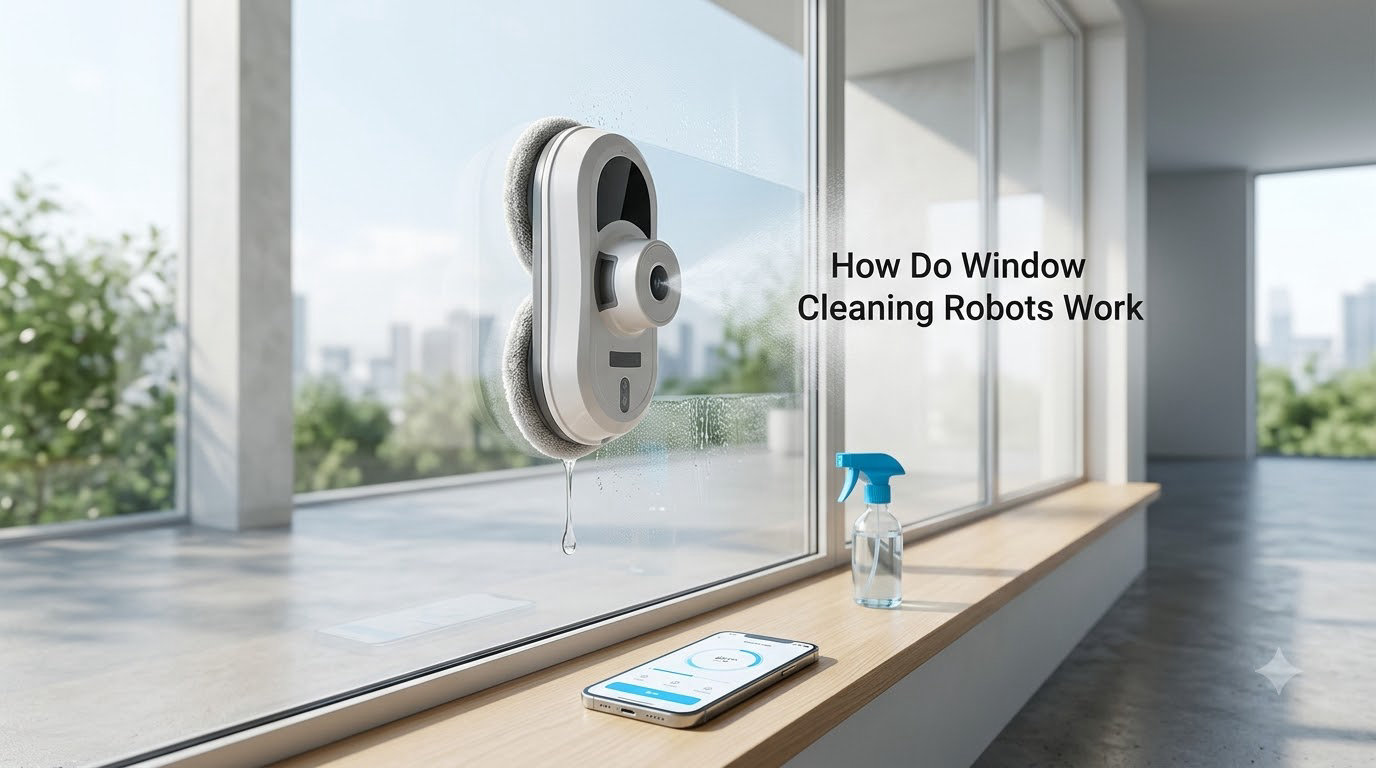
If you have ever watched a small box-shaped device inch across a tall window and wondered what is keeping it there, you are not alone. The question of how do window cleaning robots work is one we get from readers all the time, especially after we cover autonomous floor cleaners here on Smashing Robotics.
These little machines combine suction, sensors, motors, and a few clever algorithms to turn one of the most dreaded household chores into a button-press task. In this guide, I will walk you through the full mechanism, from the vacuum motor pulling the robot onto the glass to the microfiber pad buffing the last streak away.
By the end, you will understand the physics, the electronics, and the safety systems that let these robots hang in place on a 12th-floor window without a ladder in sight.
Table of Contents
How Do Window Cleaning Robots Work: The Core Mechanism
Window cleaning robots work by creating strong vacuum suction that holds the device flat against the glass, while motorized rubber treads or belts move it across the surface in a programmed pattern. As it travels, onboard sensors detect window edges, and microfiber pads wipe the glass clean.
The whole system fits into a small plastic housing about the size of a shoebox, weighing somewhere between 1 and 3 kilograms depending on the model. Inside that housing sit a high-RPM vacuum fan, drive motors, a microcontroller, batteries, and the cleaning pads that do the actual work on your window.
If you strip away the marketing language, every window cleaning robot is built around the same three-stage process:
- Stick — the vacuum motor creates negative pressure beneath the unit, sealing it to the glass.
- Move — rubber treads or belts pull the chassis across the window in an N or Z pattern.
- Clean — microfiber pads, sometimes paired with a fine mist of cleaning solution, lift dust and grime off the surface.
The rest of the article unpacks each of these stages in detail, plus the safety nets that keep a $300 robot from taking a fatal plunge.
Vacuum Suction: How Robots Stay Attached to Glass
The vacuum suction mechanism is the single most important piece of the puzzle, and it is the answer to the most common follow-up question: how do robot window cleaners stay on the window in the first place.
At the heart of every robot sits a small but powerful centrifugal fan, similar to the one in a desktop computer cooler but tuned for much higher static pressure. This fan continuously pulls air out from the gap between the robot’s base plate and the glass surface.
As the air is removed, the air pressure underneath the device drops below the atmospheric pressure pushing down on the top of the unit. That pressure difference is what engineers call negative pressure, and it generates a clamping force strong enough to hold the robot firmly against a vertical surface, even on an exterior wall exposed to wind.
Three conditions have to be met for the suction to work reliably:
- An airtight seal between the robot’s base and the glass. Most models use a soft silicone or rubber gasket to keep air from leaking around the edges.
- A continuous vacuum produced by the fan. Even a brief interruption can break the grip.
- A smooth, non-porous surface. Glass is ideal because it is flat, rigid, and airtight.
When we tested a mid-range unit in our workshop, the suction held the robot in place on a vertical panel even when we applied a sideways pull of roughly 5 kg. That is plenty of grip for normal operation, and explains why a sudden power loss is the only real threat, which is exactly why every robot ships with a backup safety system, something we cover later in this guide.
If you have ever read about how robotic grippers use similar pressure-based methods to handle delicate parts, the principle is almost identical. Suction is one of the simplest and most reliable ways to attach to a flat surface, and window cleaning robots take full advantage of it. For more on that, see our piece on how robotic grippers work.
Movement Systems: Treads, Tracks, and Wheels
Once the robot is locked onto the glass, it needs a way to travel, and the most common solution is a pair of rubber treads or continuous tracks, much like the ones used on small tank robots.
Each tread is wrapped around a pair of small wheels connected to a geared DC motor. When the motor spins, the tread rolls against the glass and propels the robot forward, backward, or in a curve. The rubber compound is formulated to grip glass without slipping, and the contact patch is wide enough to keep the motion smooth.
Most robots use a differential drive arrangement, which means the left and right treads can run at different speeds or in opposite directions. By varying the speed of each side, the robot can:
- Drive straight along a horizontal line.
- Pivot in place by spinning the two treads in opposite directions.
- Curve gently through a turn by running one side faster than the other.
The motors themselves are usually small brushed or brushless DC units coupled to a planetary gearbox for higher torque at low speed. If you are interested in the gear side of things, our guide on how planetary gearboxes work in robot joints explains the mechanics in detail.
A few premium models replace the rubber treads with dual cleaning wheels covered in microfiber, so the same component that scrubs the window also pulls the robot along. This design tends to clean more aggressively because the wheel surface is in constant contact with the glass, but it sacrifices the precision movement you get with separate treads.
Edge Detection and Navigation Algorithms
A robot that can stick to glass is impressive, but a robot that knows where the glass ends is genuinely useful. Edge detection is what keeps your window cleaner from rolling off the bottom of a frameless shower door or the side of a mirror.
Every modern window cleaning robot carries a small array of sensors, usually a combination of the following:
- Infrared or laser proximity sensors pointed at the glass to detect the edge of a frame or the boundary of a frameless panel.
- Mechanical bumper switches that trigger when the chassis physically reaches a window frame.
- Gyroscopes and accelerometers that track orientation, tilt, and sudden movements.
- Wheel-rotation encoders that measure how far the robot has traveled so the controller can estimate its position on the pane.
The robot’s microcontroller reads these sensors in real time and runs a simple navigation algorithm. The two most common patterns are:
- N-pattern navigation — the robot moves up, then across, then up again, then across, building a series of N-shaped strokes that cover the window column by column.
- Z-pattern navigation — the robot moves across the top, drops down one row, moves back the other way, and so on, creating a Z-shaped path.
Both patterns are designed to guarantee full coverage without overlap, and the robot repeats the cycle until it has covered the entire pane. When the sensors signal an edge, the robot pauses, reverses, and pivots to begin the next pass, which is what users on Reddit consistently praise as the moment they started trusting their device on frameless glass.
For an overview of the underlying sensor tech used in similar applications, our article on GPIO pins and how they work is a useful starting point if you are the kind of reader who wants to tinker with your own hardware.
The Cleaning Process: Spray, Wipe, and Buff
Sticking and moving are only half the job. The actual cleaning happens at the bottom of the robot, where a microfiber pad, a cleaning solution, and sometimes a vibrating or rotating element do the dirty work.
Most robots use a two-pad system. A front pad applies cleaning solution and loosens dust, while a rear pad wipes the glass dry and buffs it to a streak-free finish. The pads are typically removable and machine-washable, which keeps the long-term cost of ownership low.
How the solution gets onto the glass depends on the model:
- Manual spray — you spray cleaning fluid onto the microfiber pad before each run. This is the simplest design and the easiest to maintain.
- Built-in reservoir — a small tank in the robot feeds a pump that mists fluid onto the glass through a tiny nozzle as the robot moves.
- Ultrasonic or vibrating head — some high-end units pulse the cleaning head at high frequency to break up stubborn grime without extra pressure.
From a physics standpoint, the cleaning action is mostly mechanical. The microfiber lifts particles off the glass through static attraction and capillary action, while the cleaning solution dissolves greasy residues. Pressing the pad against the glass with the weight of the robot adds the small amount of downward force needed to make the system effective.
One detail that often gets overlooked: the robot typically needs two to three full passes before the glass is truly clean. The first pass loosens the dust, the second lifts it, and the third buffs away the last streaks. Most algorithms are smart enough to plan multiple passes automatically once they have mapped the size of the window.
Safety Features: How Robots Avoid Falling
Hanging a $300 device off a 12th-floor window sounds reckless, which is why every credible manufacturer builds in three layers of safety: a tether, a backup battery, and smart sensors.
First, there is the safety rope. This is a high-tension cord, often rated to hold 100 kg or more, that connects the robot to a suction cup anchored on the inside of the window. If the robot ever loses grip, the tether catches it long before it hits the ground.
Second, there is a backup battery or uninterruptible power supply (UPS) built into the unit. If the mains power cuts out mid-clean, the battery keeps the vacuum fan running for another 20 to 30 minutes, which is more than enough time for the user to retrieve the robot. This is the single biggest reason the vacuum suction mechanism can be trusted on high-rise windows.
Third, the onboard sensors act as a final check. If the accelerometer detects a sudden tilt, or if the pressure sensor in the suction chamber shows the vacuum is failing, the controller immediately sounds an alarm and stops the motors so the robot does not slide off the glass.
In our experience, the safety rope is the feature buyers appreciate most. Even users who were initially nervous about running a robot on a high-rise window report in forum threads that the tether gives them enough peace of mind to let the device run unsupervised.
Types of Window Cleaning Robots
Not all window cleaning robots use the same underlying technology. There are two main categories, and the differences matter depending on where you plan to use them.
The first and most common type is the suction-based robot, which is what we have focused on so far. It uses a vacuum motor to stick to the glass, runs off mains power (with a battery backup), and works on any smooth, airtight surface, including frameless glass.
The second type is the magnetic window cleaner. This design uses two modules, one on each side of the window, held together by powerful neodymium magnets. As you move the inside unit, the outside unit follows. Magnetic cleaners do not need electricity to stay attached, but they only work on very thin glass (usually under 1 cm) and they cannot clean frameless panels reliably.
For most home users, the suction-based design is the better choice. It is easier to set up, works on a wider range of glass, and has the safety features that make unattended use reasonable.
Surface Compatibility and Ideal Use Cases
Window cleaning robots are surprisingly versatile, but they do have limits worth knowing about.
In terms of ideal surfaces, they excel on:
- Large interior and exterior windows, especially those that are awkward to reach with a ladder.
- Glass doors, including sliding patio doors.
- Shower enclosures and other frameless panels, where edge detection really earns its keep.
- Mirrors, large wall mirrors, and mirrored wardrobe doors.
- Skylights, where the tilt sensor helps the robot adapt to angled glass.
The technology struggles with very dirty windows that have not been cleaned in months. In those cases, the microfiber pad saturates quickly, and you end up spreading grime around. A quick pre-clean pass with a paper towel makes a big difference.
It also struggles on textured or frosted glass. The suction relies on an airtight seal, and any surface roughness breaks that seal. Stick to smooth glass for the best results.
Limitations and Maintenance Tips
No technology is perfect, and window cleaning robots have a few honest limitations worth pointing out.
They are slower than a human with a squeegee, they cannot clean the corners of a pane, and they require you to either swap microfiber pads or refill a cleaning reservoir every few runs. On very large windows, the power cable can become a minor hassle, since the robot has to manage its own cord as it moves.
For maintenance, the routine is simple:
- Wash the microfiber pads after every two to three runs.
- Wipe the rubber gasket on the base plate to keep the seal airtight.
- Inspect the safety rope and replace it if you see any fraying.
- Charge the backup battery fully before each high-rise session.
Following that checklist keeps the robot running reliably for years, and it is far less work than climbing a ladder every spring.
Frequently Asked Questions
Do robotic window cleaners actually work?
Yes, robotic window cleaners work well on smooth, flat glass that is lightly to moderately soiled. They use vacuum suction to stay attached, move in a programmed pattern, and wipe the glass with microfiber pads. For heavy grime, a quick pre-clean pass is recommended.
How do robot window cleaners stay on the window?
Robot window cleaners stay on the window by using a built-in vacuum fan that pulls air out from beneath the device. This creates negative pressure, a pressure difference that clamps the robot firmly against the glass. A safety rope and backup battery provide extra security in case of power loss.
What are the downsides of using a robotic window cleaner?
The main downsides are slower cleaning compared to a human, difficulty cleaning window corners, and reduced effectiveness on heavily soiled or textured glass. They also require regular microfiber pad washing and a nearby power outlet for the vacuum motor.
What surfaces can a window cleaning robot clean?
Window cleaning robots work best on smooth, flat, non-porous surfaces including standard glass windows, glass doors, mirrors, shower enclosures, and skylights. They do not perform well on textured, frosted, or very dirty glass where the suction seal cannot form properly.
Conclusion
So, how do window cleaning robots work? The short answer is a clever combination of vacuum suction, rubber treads, edge-detection sensors, and microfiber pads, all coordinated by a small microcontroller and protected by a safety tether.
It is the same basic engineering that powers many of the autonomous systems we cover here on Smashing Robotics, and it is a great example of how a few well-understood physics principles can replace a chore most of us would rather skip. If you want to dig deeper into the motors that move the robot, our guide on how servo motors work in robots is a good next read.
Whether you live in a ground-floor apartment or a high-rise condo, the technology is mature enough in 2026 to be worth a serious look, especially if you have a few windows you would rather not climb a ladder to clean.