
When I first disassembled a servo motor from a defunct robotic arm, I expected to find a simple gear train inside. What I found instead was a beautifully compact arrangement of gears that looked almost like a miniature solar system. That moment pushed me down a rabbit hole of mechanical engineering, and years later, our team at Smashing Robotics still comes back to planetary gearboxes whenever someone asks how to build a powerful, precise robot joint.
In this guide, I will walk you through how planetary gearboxes work in robot joints. You will learn the role of each gear, how torque and speed actually transfer, why these gearboxes dominate modern robotics, and how they compare to alternatives like harmonic and cycloidal drives. By the end, you should be able to pick the right configuration for your own robot project.
Table of Contents
What Is a Planetary Gearbox?
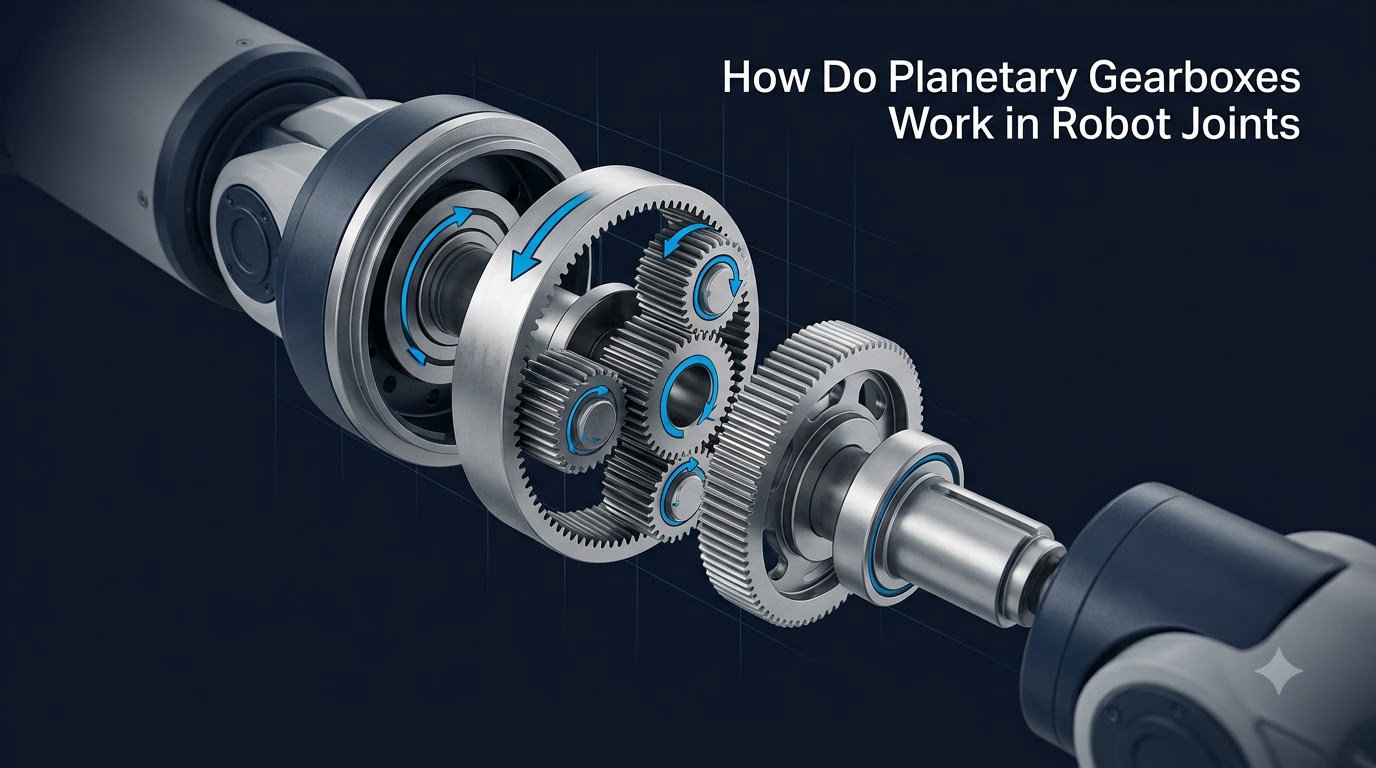
A planetary gearbox is an epicyclic gear train that uses three main components to multiply torque in a compact footprint. The name comes from how the gears move: smaller gears orbit a central gear, much like planets orbit a sun.
Inside every planetary gearbox you will find these parts:
- Sun gear – the central gear that receives input power from the motor.
- Planet gears – typically three to five smaller gears that mesh with the sun gear.
- Ring gear (annulus) – the outer gear with internal teeth that the planets mesh with.
- Carrier – the structural frame that holds the planet gears and transmits the output.
What makes this layout special is the coaxial arrangement. The input and output shafts share the same axis, which is why you often see planetary gearboxes tucked neatly inside robot joints and wrist modules. Engineers love this because it removes the need for bulky right-angle drives.
You may also hear the term epicyclic gear train used interchangeably. Both names describe the same mechanism, where at least one gear axis revolves around another.
How Planetary Gearboxes Work
The working principle of a planetary gearbox is straightforward once you understand which part is held stationary. Power enters at one component, another part stays locked, and the third becomes the output. Let me break it down step by step.
Step 1: Input power enters the sun gear
The motor shaft drives the sun gear at high speed but low torque. Because the planet gears mesh directly with the sun gear, they start to rotate on their own axes.
Step 2: Planet gears mesh with the ring gear
As the planets spin, their outer teeth engage the ring gear. If the ring gear is fixed, the planets are forced to “walk” along its inner surface. This walking motion is captured by the carrier.
Step 3: The carrier delivers the output
The carrier rotates at a slower speed but with much higher torque. This is your output shaft, which connects directly to the robot joint.
Calculating the reduction ratio
The reduction ratio depends on which component is fixed. The most common configuration in robotics is the ring gear fixed and the carrier output. In that case, the ratio follows this formula:
Ratio = 1 + (Number of ring teeth / Number of sun teeth)
For example, if the sun gear has 15 teeth and the ring gear has 60 teeth, the ratio is 1 + (60 / 15) = 5:1. The motor spinning at 5,000 RPM becomes 1,000 RPM at the joint, with five times the torque.
Why backlash matters
Backlash is the small gap between meshing teeth. In a planetary gearbox, backlash is minimized because multiple planet gears share the load and constrain the sun gear. This is a major reason why precision robot arms and CNC machines rely on planetary reducers for repeatability.
Why Planetary Gearboxes Dominate Robot Joints
I have built robots using harmonic drives, cycloidal reducers, and plain planetary gearheads. When I need a balance of torque, size, and cost, the planetary gearbox almost always wins. Here is why.
High torque density
Because load is shared across three or more planet gears, each tooth carries less stress. This lets the gearbox transmit more torque from the same envelope. In humanoid robots like those developed by JSK Lab at the University of Tokyo, this torque density is what allows a compact actuator to lift a full arm.
Compact coaxial design
Planetary gearboxes fit inside the joint itself. The output shaft is the joint axis, and the motor can sit directly behind it. This keeps the robot’s mechanical structure clean and reduces the number of external linkages.
Smooth motion and high efficiency
A well-built planetary stage runs at 95 to 98 percent efficiency per stage. With multiple stages stacked, you still see 85 to 92 percent overall efficiency. Compare that to a harmonic drive at around 80 percent, and you understand why battery-powered robots prefer planetary reducers.
Excellent load sharing
Multiple planet gears contact the sun and ring at the same time. This spreads force evenly, reduces wear, and improves stiffness. For robot joints that experience shock loads – like a quadruped’s knee hitting the ground – this load sharing is critical.
Planetary vs Harmonic vs Cycloidal Gearboxes
If you have shopped for robot joint modules, you have probably seen three names appear again and again: planetary, harmonic, and cycloidal. Each has a place, and choosing the wrong one will hurt your robot’s performance. Here is how I think about the trade-offs.
| Feature | Planetary | Harmonic Drive | Cycloidal |
|---|---|---|---|
| Reduction ratio (single stage) | 3:1 to 10:1 | 30:1 to 100:1 | 10:1 to 100:1 |
| Backlash | Low (5-15 arcmin) | Very low (under 1 arcmin) | Low (1-5 arcmin) |
| Efficiency | High (95%+ per stage) | Moderate (75-85%) | High (85-90%) |
| Torque density | High | Very high | Very high |
| Shock load tolerance | Good | Limited | Excellent |
| Cost | Low to medium | High | Medium to high |
| Common use | Servo joints, robot arms | Surgical robots, space arms | Industrial robots, AGVs |
Planetary gearboxes are the best choice when you need high efficiency, moderate reduction, and reasonable cost. Harmonic drives shine in applications demanding near-zero backlash, like surgical robots and space manipulators. Cycloidal drives handle shock loads beautifully, which is why many heavy industrial robots still use them.
Disadvantages of planetary gearboxes
Nothing is perfect. Planetary gearboxes have a few drawbacks you should know about:
- Limited reduction per stage – you often need two or three stages to reach 100:1.
- Lubrication requirements – grease migration can cause uneven wear.
- Higher complexity than a simple spur gear, which raises build cost for hobbyists.
If your design needs extreme reduction in a single stage or zero backlash for force feedback, look at harmonic or cycloidal alternatives instead.
Real-World Applications in Robotics
I have personally seen planetary gearboxes in everything from a $30 hobby servo to a $50,000 industrial cobot. Here are the most common use cases our team runs into.
Humanoid robots
Modern humanoid actuators, such as those in Unitree’s H1 or Agility Robotics’ Digit, use custom planetary gearboxes designed for high torque in a tight package. The coaxial layout keeps the joint narrow, which mimics human anatomy.
Quadruped robots
Quadrupeds like Spot and ANYmal depend on planetary reducers in their knee and hip joints. The shock load tolerance helps when the robot trots over uneven ground or recovers from a stumble.
Industrial robotic arms
Most 6-axis industrial arms combine planetary gearboxes in the wrist and harmonic drives at the final axis. This hybrid design balances cost and precision.
Exoskeletons and collaborative robots
Wearable robots and cobots need high torque at low speed for safe human interaction. Planetary gearboxes paired with torque sensors deliver smooth, controllable assistance.
QDD and Low-Ratio Transmission Trends
One of the most interesting developments in 2026 is the rise of Quasi-Direct Drive (QDD) actuators. These use a low-ratio planetary gearbox (often 4:1 to 10:1) paired with a high-torque brushless motor.
Traditional robot joints used reduction ratios of 50:1 or higher, which made them stiff but slow to respond. With QDD, the lower ratio preserves back-drivability – meaning external forces push back through the gearbox instead of feeling like a brick wall.
This back-drivability matters for several reasons:
- Force control becomes much easier to implement.
- The robot feels compliant when bumped, which improves safety.
- Dynamic motions like jumping or kicking become possible.
MIT Mini Cheetah, Agility Robotics’ Cassie, and many research humanoids use QDD-style actuators. The trade-off is that the motor itself must produce more torque, which raises power demands. For most mobile robots, the benefits outweigh the cost.
Choosing the Right Gearbox for Your Robot Project
Picking a planetary gearbox is not just about grabbing the highest ratio you can find. Let me share the decision framework I use when our team specs a joint.
Start with your torque and speed targets
Calculate the peak torque the joint must produce. Divide that by the gearbox efficiency to find the motor torque you need. Then choose a reduction ratio that puts the motor into its sweet spot (usually 50 to 80 percent of rated speed).
Match backlash to your precision needs
If your robot arm is for pick-and-place, 10 to 15 arcmin of backlash is fine. For a CNC tool head or surgical tool, you want under 5 arcmin, which pushes you toward precision-ground planetary stages or harmonic drives.
DIY and 3D printing considerations
From the forums I follow on Reddit and Thingiverse, hobbyists regularly 3D print planetary gears using PLA or PETG. Will they hold up? For prototyping and light-duty robots, absolutely. I have a small robot arm in my workshop right now with 3D printed planet gears that has run for hundreds of hours.
For higher loads, print with a stronger filament like nylon or polycarbonate, and always use metal bearings for the planet axes. Hobby servos like the MG996R contain surprisingly capable planetary gear sets for under $10 each.
Budget and availability
Standard off-the-shelf planetary gearboxes from brands like NeveRest, Maxon, or Harmonic Drive are easy to source. If you are building a research platform, plan for $100 to $500 per joint. For hobby projects, you can stay under $30 per joint.
Maintenance and Failure Modes
Most articles on planetary gearboxes skip this part, which I think is a mistake. If you build robots long enough, you will see failures. Knowing what goes wrong helps you prevent it.
Common failure causes
The most common failure I have seen is tooth wear from insufficient lubrication. The second is broken planet gear pins from shock overload. The third is ring gear tooth fracture from misalignment during assembly.
Lubrication and inspection
Check the grease every 6 to 12 months in a working robot joint. Use a high-quality synthetic grease rated for the gear material (many steel gears need moly or lithium-based grease). If the gearbox runs hot or sounds gritty, it is time to service it.
When to replace
If you measure backlash above the manufacturer’s spec, or you see metal flakes in the grease, replace the gearbox. Trying to “run it a little longer” almost always ends with the motor stalling and tripping a controller fault.
FAQ
How do planetary gearboxes work?
A planetary gearbox works by routing input power through three gear elements: a central sun gear, surrounding planet gears, and an outer ring gear. The motor drives the sun gear, the planet gears spin against the stationary ring gear, and the carrier collects the slower, higher-torque rotation as the output. This coaxial arrangement gives high torque density in a small footprint.
How do robot joints move?
Robot joints move through a motor coupled to a gearbox, usually a planetary reducer. The motor spins at high speed with low torque. The gearbox reduces that speed and multiplies the torque. The output shaft of the gearbox is the joint axis, so when it rotates, the connected link pivots. Sensors like encoders and torque cells feed position and force data back to the controller.
What are the disadvantages of planetary gearboxes?
The main disadvantages of planetary gearboxes are limited reduction per stage (usually under 10:1), the need for precise lubrication, and slightly higher manufacturing complexity than simple spur gears. They also cannot match the near-zero backlash of harmonic drives, which matters in surgical and precision machining applications.
What are the different types of gearboxes for robotic arms?
The three most common gearboxes for robotic arms are planetary, harmonic, and cycloidal. Planetary gearboxes offer high efficiency and moderate reduction. Harmonic drives provide very high reduction and near-zero backlash for precision tasks. Cycloidal drives deliver excellent shock tolerance and high torque density for heavy industrial arms.
What reduction ratio should I use for a robot joint?
For typical robotic arms and humanoids, a reduction ratio between 10:1 and 50:1 is common. For high-speed pick-and-place arms, stay closer to 10:1 to 20:1 for back-drivability. For heavy industrial arms lifting kilograms of payload, ratios between 50:1 and 100:1 are standard. Quasi-Direct Drive robots often use only 4:1 to 10:1 to preserve force control.
Are 3D printed planetary gearboxes strong enough?
Yes, for prototyping and light-duty robots. Hobbyists regularly 3D print working planetary gearboxes using PLA, PETG, or stronger filaments like nylon. For higher loads, use metal pins and bearings for the planet axes, and design teeth with at least 1 mm of thickness. For production robots, prefer metal gearboxes for longevity.
Conclusion
Planetary gearboxes work by combining a sun gear, planet gears, ring gear, and carrier into a compact coaxial unit that multiplies torque while reducing speed. That single design principle is what makes them the workhorse of modern robot joints, from hobby servo motors to humanoid research platforms.
If you are designing your own robot, start by calculating the torque you need, choose a reduction ratio that keeps your motor in its efficient range, and decide whether the extra cost of harmonic or cycloidal drives is justified for your precision goals. For most hobby and research projects, planetary gearboxes will give you the best balance of performance, weight, and cost.
I hope this guide helps you build better robot joints. Our team at Smashing Robotics will keep publishing deep dives like this one, so if there is a topic you want us to cover next, let us know.