
If you’ve been told you need surgery and someone mentioned the Da Vinci Surgical System, you’re probably wondering whether a robot is actually going to operate on you. I get that question a lot from readers, and the short answer is no. A highly trained surgeon performs every single move. The robot is the tool, not the operator.
In this guide, I’ll walk you through exactly what the Da Vinci Surgical System is, how the three main components work together, what procedures surgeons use it for, and the real benefits and risks you should know about. I pulled information from peer-reviewed sources, Intuitive Surgical’s official documentation, and surgeon forums where doctors share unfiltered experiences with the platform.
Table of Contents
What Is the Da Vinci Surgical System
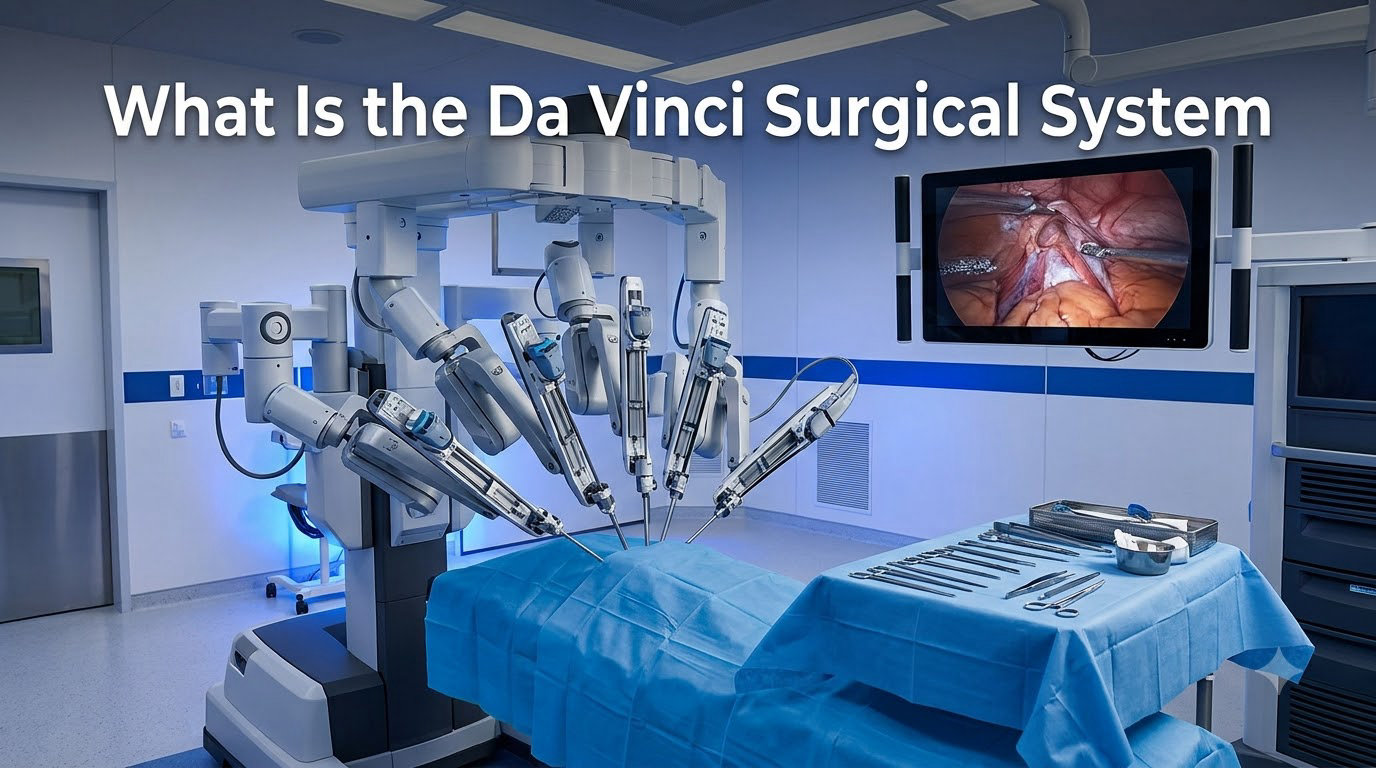
The Da Vinci Surgical System is a robotic-assisted surgical platform made by Intuitive Surgical that allows surgeons to perform minimally invasive procedures through small incisions. It combines 3D high-definition vision, wristed instruments, and motion scaling to translate a surgeon’s hand movements into precise micro-movements inside the patient’s body.
Here’s the part most people miss. The robot does not act on its own. There is no artificial intelligence making clinical decisions during your operation. A surgeon sits at a console a few feet away from the patient, looks into a stereoscopic viewer that shows a magnified 3D image, and uses hand and foot controls to manipulate robotic arms. The system filters out hand tremors and scales down large movements into finer ones, which is why it’s especially useful for procedures requiring work near nerves or delicate tissue.
Intuitive Surgical launched the first commercial Da Vinci system in 2000, and the platform has since been used in more than 12 million procedures worldwide. It is currently installed in over 5,500 hospitals across 67 countries, making it the most widely adopted surgical robot in the world.
How the Da Vinci System Works
Understanding how the system works starts with the three core components. Every Da Vinci system in a hospital operating room today is built from these same three parts, regardless of whether it’s the older Xi or the newer Da Vinci 5.
1. The surgeon console. This is where your surgeon sits during the operation. They look into a 3D viewer that shows a magnified, high-definition image of the surgical field. Hand grips and foot pedals translate their natural hand and finger movements into commands sent to the robotic arms. The console’s software also filters out physiological hand tremor and scales movements – a 1-centimeter hand movement at the console might become a 5-millimeter movement on the instrument tip.
2. The patient cart. This is the part that physically sits over the patient. It holds the robotic arms – usually four – that hold the camera and the surgical instruments. The arms insert through small port incisions (typically 8 to 12 millimeters each) made in the patient’s abdomen or chest. The arms are designed to be repositioned quickly during multi-quadrant surgery.
3. The vision cart. This tower contains the light source, camera processor, and the equipment that powers the 3D imaging system. Modern vision carts also handle the data processing for advanced features like surgical analytics and live AI-assisted overlays on some newer systems.
To learn more about the underlying software that keeps these components synchronized, see our primer on real-time operating systems in robotics.
The Three Main Components Explained
Let me go deeper on the parts you’ll actually see in the operating room. These details matter because they explain why Da Vinci surgery feels different from both open surgery and standard laparoscopy.
EndoWrist instruments. Each robotic arm carries a single-use EndoWrist instrument. These are the tools that actually do the cutting, suturing, grasping, and cauterizing. What makes them special is the wristed tip. Unlike standard laparoscopic instruments (which are essentially chopsticks), EndoWrist instruments have seven degrees of freedom, which actually exceeds the range of motion of a human hand. This lets surgeons suture, tie knots, and reach around structures in ways that would be impossible with rigid laparoscopic tools.
The 3D vision system. Standard laparoscopy shows surgeons a 2D image on a flat monitor, which makes depth perception tricky. The Da Vinci console projects a true stereoscopic 3D image to each eye separately, which restores natural depth perception. The camera also magnifies the image up to 10 times, so surgeons can see anatomical details they would miss in open surgery.
Motion scaling and tremor filtration. When the surgeon moves their hand 1 centimeter at the console, the system can scale that down to 5 millimeters at the instrument tip. This is motion scaling, and it allows for very fine work near critical structures. The system also filters out the natural 50-to-100-micron tremor every human hand has, which is a real problem during microsurgery.
Common Procedures Performed with Da Vinci
Surgeons use the Da Vinci Surgical System across most surgical specialties. The most common procedure categories include urology, gynecology, general surgery, colorectal, thoracic, and head and neck.
By volume, the procedures most frequently performed with the system include:
- Prostatectomy (radical prostate removal for cancer)
- Hysterectomy (uterus removal, with or without ovaries)
- Kidney procedures including partial nephrectomy
- Hernia repair (inguinal, ventral, and umbilical)
- Gallbladder removal (cholecystectomy)
- Colorectal resection for cancer and diverticulitis
- Thoracic procedures including lung lobectomy
- Endometriosis excision
It is not just abdominal surgery. Transoral robotic surgery (TORS) uses a Da Vinci SP to remove tumors from the throat and base of the tongue through the mouth, which used to require splitting the jaw.
Robotic-assisted surgery is also expanding in orthopedics and cardiac surgery. For an example of how a different surgical robot handles feeding tube placement, read our coverage of ENvue Medical’s robotic feeding tube placement system.
Benefits of Da Vinci Robotic Surgery
The benefits break into two groups: what patients experience and what surgeons experience. Both matter because surgeon fatigue and dexterity directly affect patient outcomes.
Patient benefits. Patients typically have smaller incisions (roughly 8 to 12 mm versus 6 to 12 inches for open surgery), which means less pain, lower infection risk, and minimal scarring. Blood loss is usually lower, and many patients go home the same day or after one night instead of staying 3 to 5 days in the hospital. Most people return to normal activities within 2 to 3 weeks, compared with 6 to 8 weeks after open surgery.
Surgeons I’ve spoken with on medical forums consistently report that prostatectomy recovery in particular has dropped dramatically. One urologist described cases where patients were back to light work in 5 days instead of the 6 to 8 weeks common after open radical prostatectomy in the early 2000s.
Surgeon benefits. Sitting at an ergonomic console rather than hunching over an operating table for hours reduces physical strain. Wristed instruments restore the dexterity lost in standard laparoscopy, and the 3D magnified view lets surgeons see critical structures like nerves and blood vessels more clearly. Multiple forum threads describe the platform as “ridiculously intuitive” once surgeons get past the learning curve.
Tremor reduction and motion scaling translate to measurably better precision. In microsurgical tasks, studies have shown instrument tip accuracy improves by 50% or more when compared to freehand laparoscopy.
Risks and Disadvantages of the Da Vinci System
No surgical platform is perfect. Patients should be aware of the real downsides before consenting to a Da Vinci procedure.
Loss of tactile feedback. Surgeons cannot directly feel tissue the way they can in open surgery. They rely on visual cues and instrument behavior to judge how hard they are pulling or how thick tissue is. Newer systems like the Da Vinci 5 are adding force feedback, but the sensation is still not the same as a human hand on tissue.
Conversion to open surgery. Sometimes the surgeon needs to switch to an open procedure mid-operation. This can happen because of bleeding, unexpected scar tissue, anatomical variations, or equipment issues. Conversion rates are low (typically 1% to 5% for most procedures) but they exist.
Cost and access. A single Da Vinci system costs hospitals between $1.5 million and $3.5 million depending on the model and configuration, plus annual service contracts that can exceed $100,000. Those costs eventually show up in the bills patients see, and not every hospital has one.
Surgeon experience matters. Outcomes are strongly tied to how often the surgeon uses the system. Studies show surgeons who perform more than 50 robotic cases a year have lower complication rates than those who only do a few. Ask your surgeon how many procedures they have done with the platform before scheduling.
Mechanical and software issues. Like any complex electromechanical device, the system can have technical problems. Intuitive Surgical has issued field notices over the years for issues like instrument tip fractures and console errors. Hospitals must have backup plans and conversion protocols ready.
On safety and reliability, our guide to watchdog timers in embedded systems explains one of the techniques engineers use to catch system faults before they become patient risks.
Da Vinci System Models: Xi, 5, and SP Compared
Intuitive Surgical has released several generations of the system. Today most hospitals use one of three current models.
Da Vinci Xi (2014). This is the workhorse model and the most widely deployed. It supports multi-quadrant surgery, has a rotating patient cart arm setup, and is the platform most training programs standardize on. If your hospital has “a Da Vinci,” it’s almost certainly an Xi.
Da Vinci 5 (2024). The newest platform. It adds force feedback, a more powerful vision system, and integrated surgical analytics. Intuitive claims the Da Vinci 5 has more than 10,000 times the computing power of the original 2000 system. It is rolling out to high-volume centers first.
Da Vinci SP (2018). A single-port model designed for procedures through one small incision or natural orifice. It is used primarily for transoral surgery, urology, and select gynecologic procedures. The SP has one arm with three instruments and one camera all entering through a 2.5-centimeter port.
Older systems like the Si and X are still in use but are being phased out as hospitals upgrade.
What to Expect: Surgery Day and Recovery
Patients are not awake during Da Vinci surgery. The procedure is performed under general anesthesia, so you will be completely unconscious and pain-free. Most Da Vinci procedures take the same amount of time as the equivalent open or laparoscopic operation, sometimes slightly longer while the team docks the robot.
On the day of surgery, you’ll arrive at the hospital, get prepped, meet the anesthesia team, and go to sleep in the operating room. The surgical team makes the small port incisions, docks the robotic arms, and the surgeon takes their position at the console. After the procedure, the surgeon undocks the robot, closes the small incisions with a few sutures or surgical glue, and you wake up in the recovery room.
Recovery depends on the procedure, but most patients are walking within hours, eating light food the same day, and going home within 24 hours for straightforward cases. Pain is usually manageable with over-the-counter medication after the first day or two. Most people return to desk work within 1 to 2 weeks and physical work within 3 to 4 weeks.
Complications occur in a small percentage of cases. The most common are bleeding, infection at the port sites, and rare injuries to nearby organs. Your surgical team will go over the specific risks for your procedure.
Frequently Asked Questions
How does the da Vinci Surgical System work?
A surgeon sits at a console and views a magnified 3D image of the surgical field. Hand and foot controls translate the surgeon’s movements into precise commands sent to robotic arms docked to the patient. The system scales down movements, filters tremor, and uses wristed instruments that bend like a human hand.
What are the disadvantages of da Vinci surgery?
The main disadvantages are loss of tactile feedback for the surgeon, high equipment cost that affects hospital pricing, the risk of conversion to open surgery mid-procedure, and outcomes that depend heavily on surgeon experience. Mechanical and software issues can also occur, though they are uncommon.
How much does the da Vinci surgery system cost?
Hospitals pay $1.5 million to $3.5 million for a Da Vinci system plus annual service contracts over $100,000. The cost to a patient varies by procedure, hospital, and insurance coverage. Many insurance plans cover robotic-assisted surgery the same as laparoscopic surgery, but patients should confirm coverage with their provider.
Are patients awake during da Vinci surgery?
No. Da Vinci procedures are performed under general anesthesia, so the patient is completely unconscious and feels no pain. Some patients may be aware briefly in the operating room before anesthesia is administered, but during the actual robotic portion of the surgery they are fully asleep.
Is the robot doing the surgery on its own?
No. A trained surgeon controls every movement of the Da Vinci system from start to finish. The robot is a tool that translates the surgeon’s hand and finger motions into precise instrument movements. There is no autonomous action and no AI making clinical decisions during the operation.
Key Takeaways
The Da Vinci Surgical System is the most widely used robotic-assisted surgical platform in the world, and it has changed how surgeons approach prostatectomy, hysterectomy, hernia repair, and dozens of other procedures. The system is not autonomous. A trained surgeon at a console controls every instrument, and the robotic components simply translate, scale, and refine those movements.
Patients benefit from smaller incisions, less pain, shorter hospital stays, and faster recovery. Surgeons benefit from 3D vision, restored wristed dexterity, and better ergonomics. The main downsides are cost, dependence on surgeon experience, and the rare need to convert to open surgery if something unexpected happens.
If your doctor has recommended a Da Vinci procedure for 2026, ask how many cases they have done with the platform, what the recovery timeline looks like for your specific procedure, and whether your insurance covers it. Those three questions will give you a much clearer picture of what to expect.