
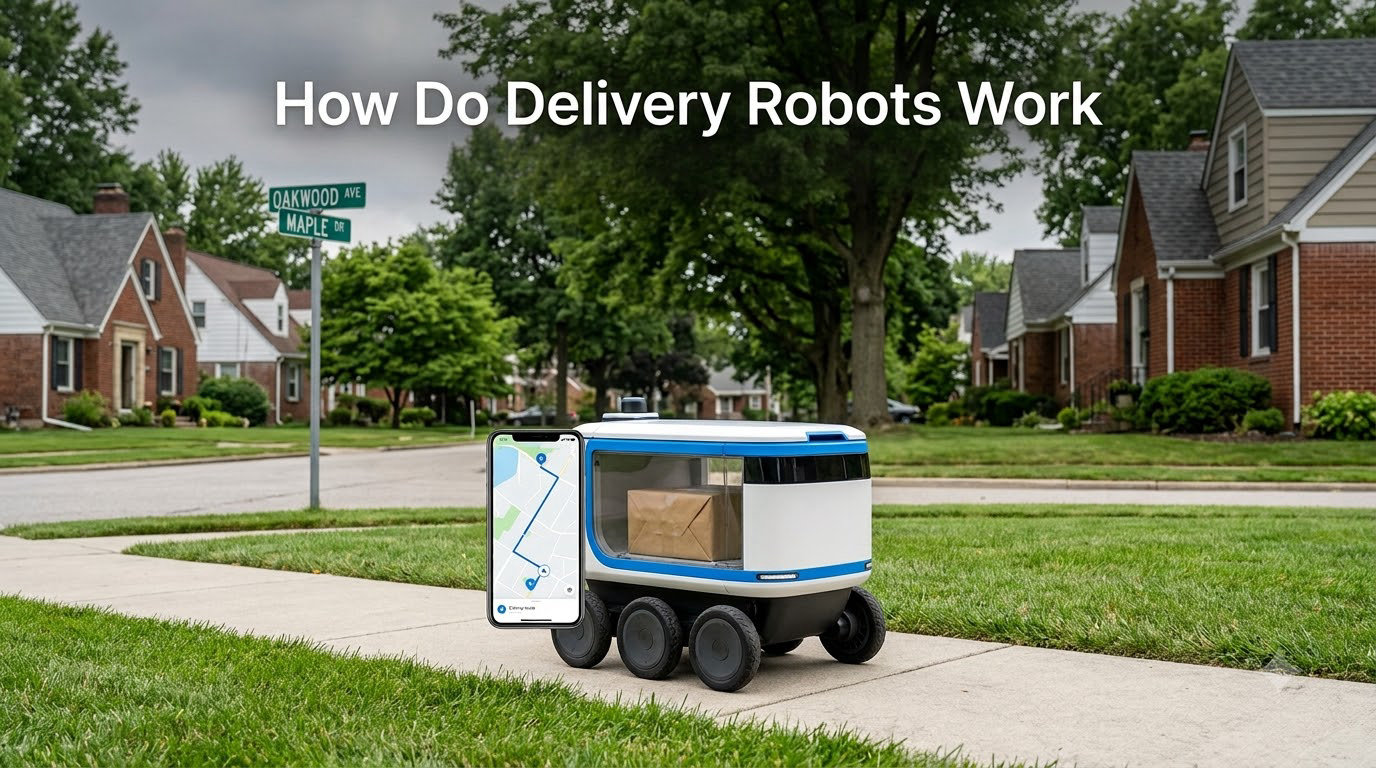
If you’ve spotted a six-wheeled cooler rolling down a sidewalk near you, you’ve probably wondered how delivery robots actually work. I started paying attention to them on my college campus a few years ago, and after watching dozens of trips, I dug into the technology. This guide pulls together everything I learned.
Delivery robots are autonomous vehicles that handle last-mile delivery of food, groceries, and small packages. They combine sensors, cameras, artificial intelligence, and mobile apps to travel along sidewalks and deliver items without a human driver. Below, I’ll walk through the technology, the step-by-step process, and the answers to questions people ask most often.
Our team has tracked the delivery robot industry since the early pilots, and we’ll show you exactly what happens when you tap “order” in an app all the way to the moment the lid pops open at your door.
Table of Contents
What Is a Delivery Robot
A delivery robot is a small, self-driving vehicle designed to carry food, packages, or other goods over short distances, usually the last mile from a local business to a customer. Most sidewalk delivery robots are about the size of a large cooler on wheels, weighing between 50 and 100 pounds when loaded.
The “last mile” part of the delivery is the final leg of a trip, from a local hub to the customer’s door. It is the most expensive part of any delivery because it requires a human driver to handle a single small order. Delivery robots exist to take that human out of the loop and cut the cost of moving a burrito or a bag of groceries a few blocks.
What separates a delivery robot from a self-driving car is the operating environment. Delivery robots travel on sidewalks at walking pace, usually 3 to 6 mph, and they only operate within a geofenced area, a digitally defined zone where they are authorized to drive. This is why you see them clustered around college campuses, downtowns, and a few cities, but not on highways.
Most units are electric, have between four and six wheels, and carry an insulated cargo compartment that can be locked and unlocked through a mobile app. The compartment keeps food warm or cold and protects the order from rain, theft, and curious animals.
How Do Delivery Robots Work Step by Step
Here is the end-to-end process a typical sidewalk delivery robot follows, from the moment you place an order to the moment it rolls back to base. This is the sequence you should picture in your head whenever you see one of these robots out in the wild.
- You place an order in a mobile app. The app shows which nearby restaurants or stores use robot delivery. You tap the items you want, pay, and choose a drop-off spot on a map.
- The restaurant receives the order and prepares your food. Staff place the order in the robot’s cargo compartment when it arrives at the back door.
- The robot is dispatched. A fleet management system assigns the nearest available robot, locks the compartment, and starts the trip.
- The robot plans a route. Using GPS, prior map data, and real-time sensor input, the robot calculates a sidewalk path to your drop-off point.
- The robot drives itself along the sidewalk. It uses cameras, LIDAR, and ultrasonic sensors to detect people, pets, curbs, and obstacles, and it slows or stops as needed.
- The robot crosses streets at crosswalks. It identifies the crosswalk, waits for the walk signal or a safe gap in traffic, and crosses. Some models also ask a remote operator to confirm before crossing.
- The robot arrives at your location. It sends a push notification to your phone saying it has arrived.
- You unlock the lid through the app. The compartment opens only for the customer whose account is tied to that order, usually within a short time window.
- You take your food and close the lid. The robot confirms the compartment is closed and either heads back to base or accepts a new order.
- The robot returns to a charging depot or waits for the next delivery. Operators monitor the entire trip from a remote operations center.
The whole process typically takes 15 to 45 minutes depending on distance, restaurant prep time, and sidewalk traffic. From the customer’s perspective, the most hands-on part is the unlock step at the end.
Navigation Technology: Sensors, AI, and Cameras
Delivery robots use a layered sensor stack, a combination of several different sensors that work together, to build a real-time picture of the world around them. No single sensor is good enough on its own, which is why you will see robots bristling with cameras, laser scanners, and ultrasonic probes. Here is what each piece does.
LIDAR
LIDAR, which stands for Light Detection and Ranging, is a laser scanner that spins on top of the robot and fires millions of laser pulses per second. It measures how long each pulse takes to bounce back, building a 3D point cloud of everything within 30 to 100 meters. This gives the robot a precise map of curbs, parked cars, sign posts, and pedestrians, even in the dark.
Cameras
Most robots carry multiple wide-angle cameras, often six or more, covering the front, sides, and rear. These cameras read traffic lights, recognize crosswalk markings, and use computer vision, a branch of AI that interprets images, to classify objects. The robot can tell the difference between a small child, a dog on a leash, a trash can, and a skateboard, and reacts differently to each.
Ultrasonic Sensors
Ultrasonic sensors send out high-frequency sound waves and listen for the echo. They are cheap, reliable, and work well at very short range, so they handle the last few inches. They are what tells the robot to stop when it is about to bump into a bench leg or a curb.
GPS and IMU
GPS gives the robot a global position, accurate to within a few meters on a good day. An IMU, or inertial measurement unit, tracks acceleration, rotation, and heading so the robot knows which way it is facing and how fast it is moving, even between GPS fixes.
Machine Learning and AI
All the sensor data feeds into machine learning models, computer programs that learn patterns from large amounts of data instead of being given fixed rules, trained on millions of sidewalk miles. The models predict where pedestrians will step, recognize when a child is about to chase the robot, and identify unusual objects like a fallen branch or a lost toy.
Together, this is what people mean by autonomous robot navigation. The robot is constantly fusing sensor data, comparing what it sees to its internal map, and updating its plan ten times every second.
Are Delivery Robots Controlled by People
Yes, and this surprises a lot of people. Most delivery robots are not fully autonomous in the way a sci-fi robot would be. They are highly automated, but humans are still in the loop, and that loop is what makes them safe enough to share sidewalks with kids and dogs.
Each robot reports its status to a remote operations center, often located in a different country from where the robot is driving. When the robot gets confused, gets stuck, or reaches a decision it is not confident about, like crossing a busy intersection, a remote operator takes over. The operator sees through the robot’s cameras and can drive it manually until the situation is resolved.
Reddit threads often point out that some fleets have operators paid per delivery in places with lower labor costs. This is true, and it is actually a sign of a healthy safety culture rather than a weakness. The goal is to combine the tireless patience of a robot with the judgment of a human for the rare cases that need it.
For everything else, the robot drives itself. About 90 to 95 percent of the trip is fully autonomous on the most mature fleets. Human intervention usually only happens at crosswalks, around construction zones, and when the robot gets blocked by something unexpected.
Safety Features and Obstacle Avoidance
Safety is the single biggest engineering priority for any delivery robot, and a lot of effort has gone into making sure these machines fail safely. Here is what a sidewalk robot does to keep pedestrians, pets, and itself out of trouble.
360-degree sensing. The combination of LIDAR, cameras, and ultrasonic sensors means the robot has no real blind spots. It can see a skateboarder approaching from behind just as well as a stroller rolling toward it from the front.
Automatic emergency stop. If any sensor detects an imminent collision, the robot stops within a fraction of a second. The brakes are software-controlled, meaning a software command can stop them instantly, and they hold the robot in place until the obstacle is gone.
Anti-tamper design. The cargo compartment locks automatically, and the robot can only be opened by the customer’s app. Most robots have alarms and GPS trackers in case someone picks one up, and a few even have cameras that live-stream to the operations center.
Bumpers and rounded edges. If a robot ever does touch a pedestrian, the contact surfaces are soft and rounded. The robot is also heavy enough to be stable in wind but light enough that a collision is unlikely to cause injury.
Geofenced operating zones. The robot physically cannot drive outside its approved area. If it is somehow pushed or carried, the next time it powers on, it will refuse to operate outside its map.
After millions of delivered orders, the published safety record is very strong. Starship Technologies, one of the largest operators, has reported completing millions of autonomous deliveries with a very low incident rate, and most of those incidents amount to minor bumps or the robot getting stuck rather than any injury.
How Delivery Robots Cross the Street
Crossing the street is the trickiest part of any sidewalk robot’s trip, and it is one of the things competitors rarely explain well. Here is how it actually works.
First, the robot uses its cameras and prior map data to identify a marked crosswalk. It will not jaywalk, even if the path is clear. Once at the curb, the robot stops and waits. It looks for a walk signal using its cameras, and if there is no signal, it watches for a safe gap in traffic.
Some robots also pause to ask a remote operator to confirm the crossing. The operator can see the intersection through the robot’s cameras and either approves the crossing or takes manual control. This is the moment that sometimes feels awkward to bystanders, since the robot might sit at the curb for a few extra seconds, but it is the safety case working as designed.
If the robot cannot find a crosswalk within a reasonable distance, it will reroute. Most sidewalk networks have been pre-mapped, so the robot already knows where every legal crossing point is before it starts the trip.
Where Do Delivery Robots Go at Night
Delivery robots do not sleep, but they do go home. Each fleet operates out of a depot, a small warehouse or hub, where the robots charge, get cleaned, and wait for their next order.
Depots are usually located in low-rent industrial spaces near the geofenced delivery area, often in the same neighborhood as the restaurants they serve. Robots that finish late-night deliveries return to the depot on their own, plug into a charging dock, and enter a low-power state until morning.
Some fleets pause operations overnight in cold climates because batteries lose capacity below freezing, and a few cities restrict robot hours to daylight or early evening. Most college campuses switch to quieter operating hours after midnight, but the robots are still on standby for any late-night snack orders.
If you happen to see a delivery robot parked under a streetlight at 2 a.m., it is probably recharging between deliveries or waiting for an operator to clear a stuck condition.
Popular Delivery Robot Companies and Where They Operate
Several companies have built large-scale robot delivery fleets, and a few of them have become household names in the cities they serve. Here is who to look out for.
Starship Technologies is the largest sidewalk robot operator, with fleets in more than 100 locations across the US, UK, and Europe. They built the original six-wheeled format that most competitors copied and have completed more than 7 million autonomous deliveries.
Grubhub partners with Starship and other fleets to power robot delivery on more than 250 college campuses in the US. Students order through the Grubhub app and unlock the robot when it arrives at their dorm.
Avride (formerly Yandex Self-Driving Group) operates in college towns and select US cities, with both sidewalk robots and larger autonomous vehicles for street-level delivery.
Kiwibot runs a sidewalk robot fleet focused on college campuses and has completed more than 200,000 deliveries across the US, Latin America, and Europe.
Nuro takes a different approach with a larger, street-legal autonomous vehicle designed for groceries and packages rather than sidewalk food delivery. You will see Nuro vehicles in California, Texas, and Arizona.
Other notable players include Cartken, Coco, and Serve Robotics, each with smaller fleets in specific cities. Together, these companies represent the bulk of commercial robot delivery activity in 2026.
Advantages and Disadvantages of Delivery Robots
Delivery robots are not a perfect solution for every situation, and it helps to look at the tradeoffs honestly. Here is what I see after watching and reading about these robots for years.
Advantages
Lower delivery cost. A robot can do the work of a part-time driver at a fraction of the cost per delivery, which keeps fees low for small orders.
24/7 availability. Robots do not get tired, hungry, or sick, so they can run all night on a busy campus or downtown.
Contactless service. For customers who prefer not to interact with a driver, robot delivery is a clean alternative.
Better data. Every trip is logged, which helps companies optimize routes, predict demand, and respond to incidents quickly.
Reduced emissions. Electric robots replace short car trips, which is meaningful in dense urban areas.
Disadvantages
Limited range. Sidewalk robots cover maybe a 2 to 3 mile radius from a depot, so they are not useful for longer deliveries.
Weather sensitivity. Heavy snow, ice, and severe rain can ground the fleet or force it to operate at much slower speeds.
Sidewalk congestion. Crowded sidewalks, especially during class changes, can slow robots to a crawl, which frustrates pedestrians.
Vandalism and theft. Most incidents are minor, but a determined thief can still pick one up, and a kicked robot is a real cost.
You have to go outside. This is the single biggest complaint from real users. You cannot buzz a robot into your apartment, so you still have to walk down to the curb to retrieve your food.
Regulatory patchwork. Each city sets its own rules, and some have outright banned sidewalk robots, which limits where companies can operate.
The Future of Delivery Robots
Delivery robots are still early in their adoption curve, but the trajectory is clear. Industry analysts expect the global market to grow several times over by 2026, driven by labor costs, e-commerce growth, and improvements in autonomy.
The next wave of robots will handle a wider range of environments, including indoor-to-outdoor handoffs in apartment buildings, larger payloads for grocery runs, and tighter integration with stores that operate their own micro-fulfillment centers.
Expect to see robots paired with drones for hybrid deliveries, where a robot handles the sidewalk and a drone handles the air. Some companies are also testing robots that can climb stairs and ring doorbells, which would solve the “I have to go outside” complaint that holds the industry back today.
For now, the best way to understand the technology is to use it. Order a coffee through a robot on a college campus, watch it navigate a busy sidewalk, and you will get a feel for both what works and what still needs improvement.
Frequently Asked Questions
Are delivery robots controlled by people?
Yes, most delivery robots are monitored by remote operators who can take over when the robot gets stuck, reaches a complex intersection, or needs help with an unusual situation. The remote operators are usually based in a separate operations center and only intervene when the robot’s AI is not confident. For about 90 to 95 percent of a typical trip, the robot drives itself fully autonomously.
Where do the delivery robots go at night?
Delivery robots return to a local depot at the end of their shift. The depot is a small warehouse or charging hub where the robots plug in, get cleaned, and wait for their next dispatch. Some fleets also pause operations overnight in cold climates because batteries lose capacity below freezing, but most remain on standby 24/7 for any late-night orders.
How do you get food from a delivery robot?
When the robot arrives, you get a push notification on your phone through the delivery app. You walk out to the robot, tap the unlock button in the app, and the cargo compartment opens. You take your order, close the lid, and the robot rolls away. Only the customer tied to that order can unlock the compartment, so the food stays secure until you arrive.
What are the disadvantages of delivery robots?
The main disadvantages are limited range, weather sensitivity, and the fact that you still have to go outside to meet the robot. Sidewalk congestion, occasional vandalism, and a patchwork of city regulations also hold back adoption. For longer deliveries or apartment dwellers without easy sidewalk access, a human courier is still the better option.
Conclusion
Delivery robots work by combining sensors, cameras, GPS, and machine learning to drive themselves along sidewalks and deliver small orders. You place an order in an app, the robot plans a route and avoids obstacles, and you unlock the compartment when it arrives. Remote operators help with the hard cases, but most of each trip is fully autonomous.
As the technology improves and regulations catch up, expect to see delivery robots handling a wider range of tasks, from groceries to apartment drop-offs. For now, they are a real, working part of last-mile delivery in hundreds of cities and campuses, and the best way to understand them is to use one yourself.