
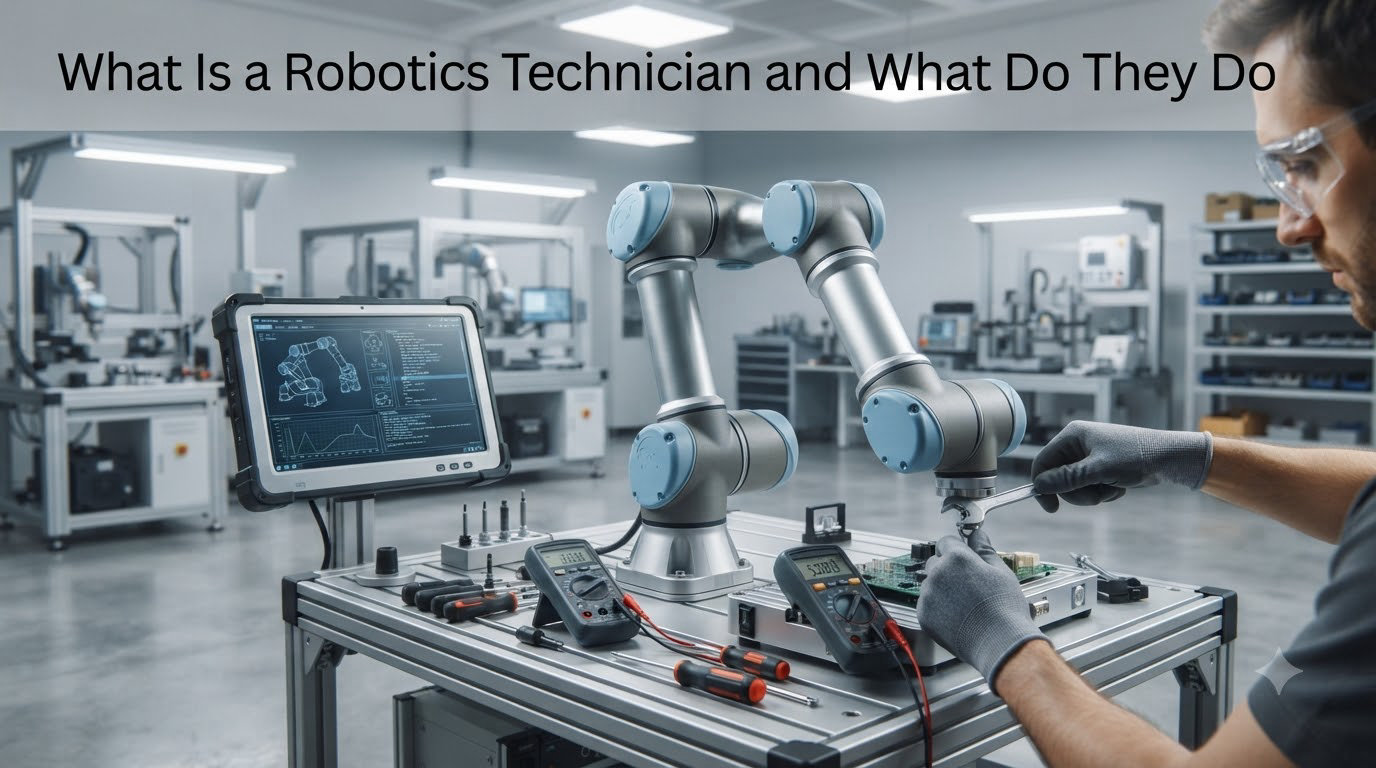
A robotics technician is a professional who maintains, develops, operates, and tests robotic systems and machines, often collaborating with engineers to keep automated production lines running smoothly. I have spent time talking with technicians on factory floors, and the role boils down to one thing: making sure robots do their job without breaking the line.
Robotics is one of the fastest-growing career fields in 2026, and the demand for skilled technicians has never been higher. If you are considering this career path, this guide covers everything you need to know, from daily duties and salary expectations to training options and future job outlook.
Table of Contents
What Is a Robotics Technician?
A robotics technician is a hands-on technical professional who builds, installs, tests, and maintains robotic equipment and automated production systems. The U.S. Bureau of Labor Statistics classifies this role under ONET code 17-3024.01, and the work spans industries from automotive assembly to hospital pharmacies.
Think of the robotics technician as the bridge between the engineer who designs a robot and the production line that depends on it. Engineers create the schematics and high-level programming. Technicians bring those designs to life, fine-tune them on the factory floor, and keep them running day after day.
Robotics technicians differ from robotics engineers in important ways. Engineers focus on design, research, and development. Technicians focus on implementation, maintenance, and repair. Both roles require strong technical knowledge, but the day-to-day work looks very different.
For a deeper look at how robots process information at the component level, our guide to GPIO pins explains the basics of how robots receive and send electrical signals.
Daily Responsibilities and Duties of a Robotics Technician
On any given day, a robotics technician might be installing a new robotic arm, debugging a control system, or training operators on safe use. The job blends mechanical work, electrical troubleshooting, and computer programming in roughly equal measure.
The most common daily duties include:
- Installing robotic systems: Setting up new robots, mounting them in production cells, and connecting them to power, networking, and safety systems.
- Performing preventive maintenance: Following scheduled service intervals to lubricate joints, replace worn parts, and recalibrate sensors before failures occur.
- Troubleshooting breakdowns: Diagnosing why a robot stopped working, often under pressure to get a production line back online quickly.
- Programming and updating controllers: Writing or modifying code on teach pendants, PLCs, and motion controllers to change robot behavior.
- Testing and validating performance: Running test cycles, measuring accuracy, and confirming that safety standards are met.
- Reading schematics and technical documentation: Interpreting electrical diagrams, mechanical drawings, and manufacturer manuals.
- Documenting work: Logging maintenance activities, fault findings, and parts replaced in maintenance management systems.
I have seen technicians spend 70% of their time on planned maintenance and 30% on emergency repairs, though that ratio flips on older equipment. One technician I spoke with described his shift as “boring until 3 p.m., then everything catches fire at once.”
Key Skills Every Robotics Technician Needs
The skill set is hybrid by design. You need to be comfortable with mechanical systems, electrical circuits, and software, often switching between all three within a single shift.
The technical skills employers look for include:
- PLC programming (Allen-Bradley, Siemens)
- Reading electrical schematics and mechanical drawings
- Working with sensors, encoders, servomotors, and controllers
- CAD software basics for reviewing designs
- Knowledge of safety standards like ANSI/RIA R15.06
- Diagnostic equipment use (multimeters, oscilloscopes)
Equally important are the soft skills that separate good technicians from great ones:
- Problem-solving under pressure: When a $50,000 robot stalls on a production line worth millions per hour, guessing is not an option.
- Clear communication: You will explain problems to engineers, operators, and managers who do not all speak the same technical language.
- Adaptability: Robot technology evolves quickly. A technician who learned Fanuc in 2010 now needs to be comfortable with collaborative robots and vision systems.
- Attention to detail: A single misaligned sensor can scrap an entire batch of products.
Reddit users in the r/robotics community often emphasize that strong coding fundamentals matter more than a specific degree. As one technician put it, “if you can read Python and ladder logic, you can pick up the rest on the job.”
Education and Training Requirements
You do not always need a four-year degree to become a robotics technician. The most common path is a two-year associate degree in robotics technology, mechatronics, or industrial automation from a community college or technical school.
Typical coursework covers:
- DC and AC circuits
- Industrial robotics and motion control
- PLC programming
- Hydraulics and pneumatics
- Computer-aided design (CAD)
- Manufacturing processes
Apprenticeships are another strong path. Programs like those offered through the Department of Labor or manufacturers like Fanuc and Yaskawa combine paid work experience with classroom instruction. Reddit users frequently point to the CMU robotics apprenticeship as a model for combining academic rigor with real shop-floor time.
Certifications can boost your resume and starting pay, including:
- Fanuc Certified Robot Operator or Technician
- ABB Robotics Service Certification
- Siemens Mechatronics Systems Certification
- Certified Automation Professional (CAP) from ISA
For those transitioning from another field, military training in electronics or avionics translates well. Many veterans move directly into robotics technician roles with only a short bridge program.
Robotics Technician Salary and Earning Potential
The U.S. Bureau of Labor Statistics reports a median annual wage near $65,000 for electro-mechanical and robotics technicians, with top earners exceeding $100,000 in industries like aerospace and pharmaceuticals. Salaries vary based on location, industry, experience, and certifications.
Typical salary ranges by experience level:
- Entry-level (0-2 years): $45,000 to $55,000
- Mid-career (3-7 years): $60,000 to $80,000
- Senior (8+ years): $80,000 to $100,000+
Industries pay differently. Automotive and food processing tend to sit at the lower end, while pharmaceutical, aerospace, and semiconductor cleanrooms often pay a premium. Field service technicians who travel to client sites can earn significantly more through overtime and per diem pay.
Geographic location matters as well. States with strong manufacturing bases like Michigan, Ohio, and California typically pay above the national median. Remote or rural roles sometimes offer higher base pay to attract talent willing to relocate.
Work Environment and Industries
Most robotics technicians work in manufacturing environments, but the variety is wider than most people expect. I have toured robotics labs in hospitals, semiconductor fabs, and even agricultural facilities, all employing technicians to keep their systems running.
Common industries include:
- Automotive assembly: Welding, painting, and material handling robots on production lines.
- Pharmaceutical and medical device manufacturing: Precision packaging, pill sorting, and sterile handling.
- Food processing: Picking, packing, and palletizing systems in cold or wet environments.
- Aerospace: Drilling, inspection, and composite layup robots.
- Healthcare: Hospital delivery robots, pharmacy automation, and surgical robot support.
- Electronics and semiconductors: Cleanroom robotics for chip production.
Work conditions vary by industry. Factory floors can be noisy, hot, or cold depending on the product. Cleanroom environments require full gowning and strict protocols. Field service technicians split time between a home office and customer sites, often traveling regionally or nationally.
For a look at how robotics is reshaping infrastructure in 2026, our coverage of physical AI infrastructure platforms shows where the field is heading.
A Day in the Life of a Robotics Technician
To make this real, here is what a typical Wednesday looks like for Marcus, a robotics technician at a mid-sized automotive parts supplier in Ohio.
His shift starts at 6 a.m. with a quick review of overnight maintenance logs and any open work orders. The first hour is spent on preventive maintenance, lubricating three robot arms in cell B and checking the air pressure on pneumatic grippers in cell D.
By mid-morning, he is troubleshooting a vision system that has been rejecting good parts at a 4% rate. The issue turns out to be a dirty lens on a 2D camera. He cleans it, recalibrates the inspection parameters, and runs a 30-part validation batch.
After lunch, Marcus spends two hours updating the PLC program for a new safety light curtain. He uses a teach pendant to jog a robot into the new safe positions, runs risk assessments, and documents the change in the maintenance system.
The rest of the afternoon is split between helping an operator understand a new error code, ordering replacement servo drives, and sitting in on a meeting about a planned cobot installation next month. He clocks out at 2:30 p.m. with nothing on fire, which he considers a good day.
Robotics Technician vs Robotics Engineer
People often confuse these two roles, but they are distinct careers with different education requirements, responsibilities, and pay scales. Understanding the difference helps you pick the right path for your goals and temperament.
Robotics Technician:
- Education: Associate degree or apprenticeship (2 years)
- Focus: Hands-on installation, maintenance, and repair
- Typical salary: $45,000 to $100,000
- Works mostly on the factory floor or in the field
Robotics Engineer:
- Education: Bachelor’s or master’s degree in robotics, mechanical, or electrical engineering (4-6 years)
- Focus: Design, programming, and research
- Typical salary: $80,000 to $150,000+
- Works mostly in offices and labs
Technicians often report higher job satisfaction from immediate, tangible results, fixing something and seeing production restart. Engineers tend to report satisfaction from creative problem-solving and longer project cycles. Neither is better; they are different jobs for different personalities.
Many technicians later pursue engineering degrees, and engineers sometimes step into technician roles early in their careers to better understand the systems they design.
Career Outlook and Future Demand
The job outlook for robotics technicians is strong. The U.S. Bureau of Labor Statistics projects faster-than-average growth for electro-mechanical technicians through 2026, driven by expanding automation across nearly every industry.
Three trends are shaping demand in 2026:
- Manufacturing reshoring: New U.S. factories are being built with automation as a baseline, creating thousands of technician openings.
- Collaborative robots: Cobots work alongside humans in small businesses, expanding robotics into industries that historically could not afford it.
- AI and edge computing: Modern robots use on-device AI for vision and decision-making, creating demand for technicians who understand both traditional controls and machine learning fundamentals. Our guide to edge AI in robotics explains this shift in more detail.
Concerns about automation eliminating technician jobs are common on Reddit, but the consensus among working technicians is that AI is changing their job rather than replacing it. The technician of 2030 will spend less time on routine maintenance and more time on system integration, AI training, and advanced troubleshooting.
How to Become a Robotics Technician
If this career sounds like a fit, here is a practical path to get started in 2026.
- Get foundational training. Enroll in an associate degree program in robotics, mechatronics, or industrial automation. Many community colleges offer flexible evening and online options.
- Learn one robot platform deeply. Pick a major brand like Fanuc, ABB, or Universal Robots and get comfortable with its programming environment.
- Earn an entry-level certification. Manufacturer certifications like Fanuc’s Robot Operator prove baseline competence to employers.
- Land an internship or apprenticeship. Real production line experience is worth more than any textbook. Look for programs that combine classroom time with paid shop work.
- Build a portfolio. Document personal projects, school labs, or repair jobs you have done. Hiring managers love seeing actual work.
- Apply strategically. Target industries that match your interests, whether that is automotive, pharmaceuticals, or healthcare, and pursue roles at system integrators that service multiple clients.
The fastest path into the field is often an apprenticeship or technician role at a system integrator, where you see many different robot brands and applications within your first year.
Frequently Asked Questions
Is it hard to become a robotics technician?
Becoming a robotics technician is moderately challenging but very achievable. Most people complete a two-year associate degree or apprenticeship, and the hands-on curriculum focuses on practical skills rather than heavy theory. Strong aptitude for electronics, mechanics, and basic programming helps, but you do not need to be a math whiz. Many technicians break in from military electronics, automotive repair, or industrial maintenance backgrounds.
What is the average salary for a robotics technician in the US?
The average salary for a robotics technician in the US is around $65,000 per year, with a typical range of $45,000 to $100,000 depending on experience, industry, and location. Entry-level positions start near $45,000 to $55,000, while senior technicians in pharmaceutical, aerospace, or field service roles can earn over $100,000. Certifications from Fanuc, ABB, or Siemens typically boost pay by 5-10%.
Do I need a degree to be a robotics technician?
A degree is not strictly required to be a robotics technician, but most employers prefer at least an associate degree in robotics, mechatronics, or industrial automation. Apprenticeships, military training, and manufacturer certifications can substitute for formal education in many cases. A four-year bachelor’s degree is usually unnecessary unless you plan to move into engineering or management roles.
What is the highest paid job in robotics?
The highest paid jobs in robotics are typically senior robotics engineers, robotics research scientists, and AI-focused robotics architects, with salaries ranging from $130,000 to $250,000 or more. On the technician side, the highest paying roles are field service engineers specializing in pharmaceutical, semiconductor, or aerospace automation, where senior technicians can earn over $100,000 with overtime and travel premium pay.
Is robotics technician a good career?
Yes, robotics technician is a good career for people who enjoy hands-on technical work and want strong job security. The role offers above-average pay, low unemployment, varied daily tasks, and clear paths for advancement into engineering or management. The main downsides are occasional production-line pressure, the need to keep learning as technology evolves, and physical demands of factory work in some industries.
Are robotics technicians in demand?
Yes, robotics technicians are in demand. The US Bureau of Labor Statistics projects faster-than-average growth for electro-mechanical and robotics technicians through the end of the decade. Reshoring of manufacturing, expansion of collaborative robots, and growth in pharmaceutical and food automation are all driving steady job creation. Most graduates with relevant certifications report job offers within three months of completing their program.
Conclusion
A robotics technician is the professional who keeps our automated world running, installing, programming, troubleshooting, and maintaining the systems that modern industry depends on. The career offers strong pay, real job security, and the kind of hands-on variety that desk jobs rarely provide.
If you are ready to explore becoming a robotics technician, start by researching associate degree and apprenticeship programs at community colleges near you. The sooner you get on a real shop floor, the sooner you will know whether this career is the right fit for 2026 and beyond.