
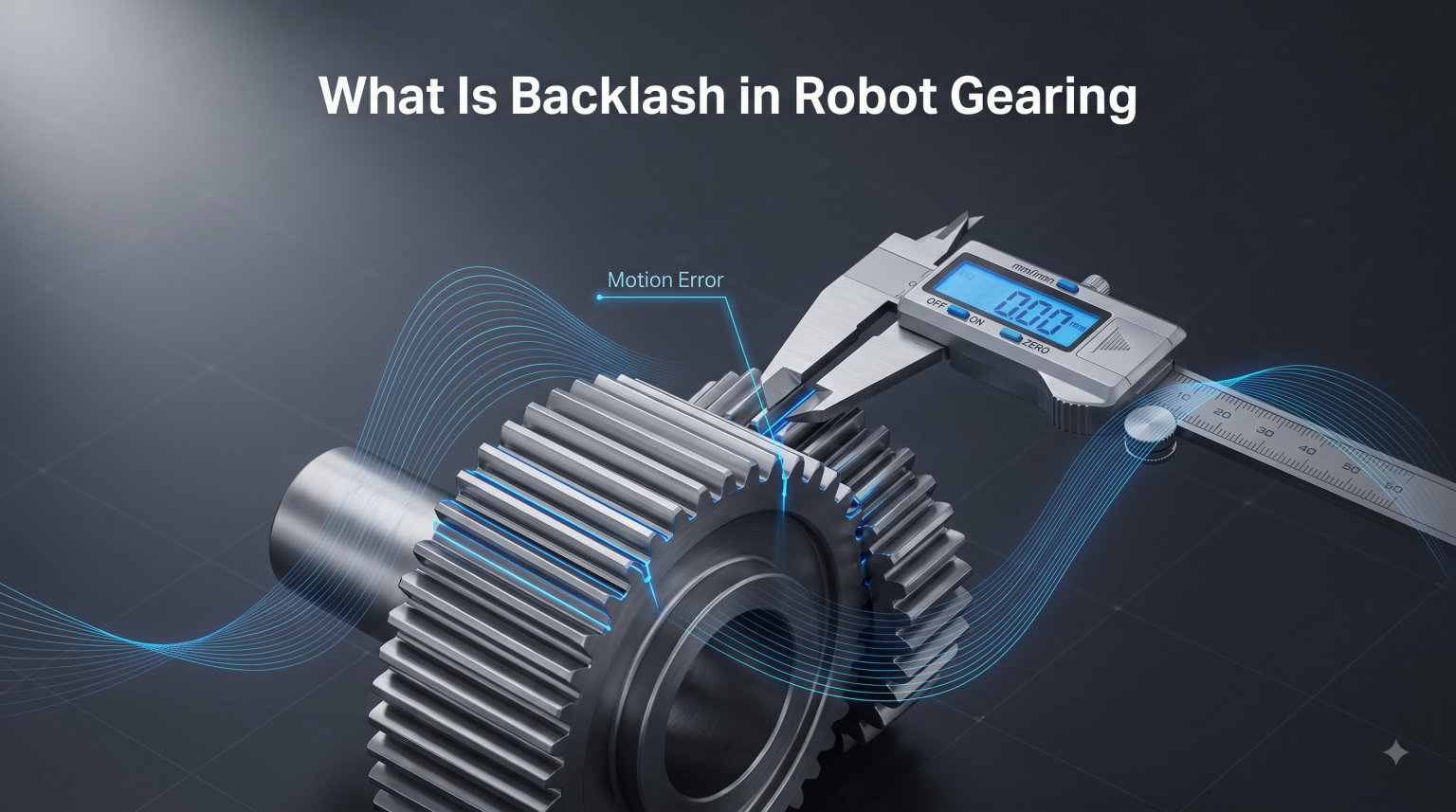
Backlash in robot gearing is one of those quiet problems that decides whether your arm picks up a screw or flings it across the workbench. I learned this the hard way on my first 6-DOF arm, when the gripper overshot every target by 2-3 degrees and I blamed the software for two solid weeks.
The real culprit was backlash. Specifically, the small clearance between meshing gear teeth that allows free play before the next tooth takes a bite. In this guide, I will walk you through what backlash in robot gearing actually is, where it comes from, and how engineers and hobbyists like us deal with it. Whether you build industrial robot arms, humanoid robots, or weekend CNC contraptions, this affects you.
We will cover the physics, the measurement methods, and the real-world fixes that work without breaking the bank. By the end, you will know why harmonic drives dominate precision robotics, when a planetary gearbox is enough, and how to spot backlash problems before they ruin your next build.
Table of Contents
What Is Backlash in Robot Gearing?
Backlash is the small clearance or play between the teeth of two meshing gears that causes a delay in torque transmission when the direction of motion reverses. When you flip the rotation direction on a motor, the driving gear has to rotate through that gap before its teeth make contact with the driven gear.
Think of it like meshing two gears by hand. There is always a tiny gap between the teeth where neither gear is pushing the other. That gap is backlash. In a robot joint, this gap shows up as lost motion. You command the motor to turn 10 degrees, but the output shaft only moves 9.6 degrees because the first 0.4 degrees was just slack being taken up.
This lost motion is measured in arc minutes or micrometers, and even a few arc minutes can wreck precision tasks like CNC milling or pick-and-place assembly. The smaller the backlash, the tighter your positioning accuracy. The larger the backlash, the more your robot drifts, vibrates, and wears out.
What Causes Backlash in Robotic Gear Systems?
Backlash is not a manufacturing flaw. It is a deliberate design choice with unavoidable side effects. Every gear needs a little clearance to mesh without jamming, and that clearance is the source of backlash in robot gearing.
Manufacturing Tolerances
Gears are cut to tolerances, not exact dimensions. A standard spur gear might be accurate to plus or minus 0.05 mm, and when you stack two gears with that tolerance, the gap adds up. High-precision gear grinders push tolerances down to a few micrometers, but cost scales fast.
Our team has tested budget planetary gearboxes from hobby suppliers that show 1-2 degrees of backlash right out of the box. Industrial gearboxes from Harmonic Drive or Wittenstein sit closer to a few arc minutes. The difference is mostly tolerance, materials, and assembly precision.
Thermal Expansion
Metal expands when it heats up. A gearbox running at full torque can warm up by 30-40 degrees Celsius, and that thermal growth changes the center distance between gears. Designers account for this with a thermal expansion tolerance, but it eats into your backlash budget.
You will see this in long CNC runs where the machine drifts as the spindle warms up. Robotic arms in continuous production lines face the same issue. What was acceptable backlash at room temperature becomes a positioning error at operating temperature.
Wear and Fatigue
Gear teeth wear down over millions of cycles. The contact surfaces flatten, the gaps widen, and backlash grows. This is why older robots drift more than new ones, and why used industrial gearboxes come with backlash spec sheets that nobody trusts.
A FTC team I mentored last year had this exact problem. Their arm worked fine in week one, but by week eight of the build season, the shoulder joint had noticeable play. The fix was a new gearbox, but the lesson was that backlash is not a fixed number. It grows with use.
Design Choices
Tooth profile, pressure angle, and center distance all influence backlash. Helical gears mesh more smoothly than spur gears but introduce axial thrust. Bevel gears handle direction changes but are harder to keep tight. Every gear geometry choice trades backlash against something else, usually strength, efficiency, or cost.
How Backlash Affects Robot Performance
Backlash in robot gearing does not just hurt accuracy. It ripples through nearly every part of a robotic system. Here is what I have seen in real builds and what the spec sheets confirm.
Positioning Accuracy and Repeatability
The most direct hit. Each backlash gap adds dead zone to your motion. Command 5 degrees, get 4.7. Command minus 5 degrees, get minus 4.6. Repeat that error across six joints and your end-effector lands centimeters off target.
Repeatability suffers even worse. A robot might return to within 0.1 mm of a position when moving in one direction, but drift by 0.5 mm when approaching from the opposite direction. That is backlash, and it kills tasks like PCB assembly or precision welding.
Vibrations and Noise
Gaps between gear teeth let components rattle under load. When a motor reverses direction, the slack takes up with a small jolt, and that jolt shows up as vibration. Collaborative robots and humanoid robots feel this more than industrial arms because their structures are lighter.
You can hear backlash too. Loose gears make a clacking sound when the drive reverses. Tight gears make a smooth hum. If your robot sounds like a maraca, backlash is probably involved.
Efficiency Loss
Every gap is wasted motion. Energy that should reach the output shaft gets absorbed by the gear slack instead. This shows up as heat, lower torque transmission, and higher current draw on your motors.
Tests on budget robot gearboxes have shown efficiency drops of 10-15% purely from backlash losses. Premium gearboxes with proper preloading hold efficiency above 90% even under reversing loads.
Wear and Premature Failure
Backlash increases with wear, and wear increases with backlash. The impact loads from direction reversals hammer the tooth surfaces, accelerating fatigue. Over time, this turns a precision joint into a sloppy one.
Safety in Collaborative Robots
Backdrivability matters for collaborative robots that work alongside humans. If a person pushes against the arm, the gears need to spin freely in response. Excessive backlash means the arm feels mushy and unpredictable, which breaks the safety model.
Gear Types and Their Backlash Characteristics
Not all gear systems are equal when it comes to backlash in robot gearing. The four common types you will encounter each have their own personality.
Spur Gears
The simplest and cheapest. Spur gears have straight teeth that mesh along a single axis. They are easy to manufacture and great for high-ratio reductions, but backlash is typically the highest of any option. Expect 1-3 degrees in hobby-grade spur gearboxes.
You will find spur gears in educational kits, VEX robotics, and entry-level robot arms. For learning and prototyping, they are fine. For precision tasks, they fall short fast.
Planetary Gearboxes
Planetary gearboxes use a sun gear, planet gears, and a ring gear to distribute load across multiple contact points. They offer higher torque density and better efficiency than spur gears, with backlash in the 5-15 arc minute range for quality units.
This is the workhorse of mid-range robotics. Industrial servo motors ship with planetary gearboxes for a reason. They balance cost, size, and precision well enough for most automation tasks.
Harmonic Drives (Strain Wave Gearing)
Harmonic drives are the gold standard for low-backlash precision. They use a wave generator, flexspline, and circular spline to achieve zero or near-zero backlash. A harmonic drive can deliver less than 1 arc minute of lost motion.
This is why you see harmonic drives in robot arms from FANUC, KUKA, and ABB. It is also why humanoid robots from Tesla and Figure use them. The trade-off is cost. A quality harmonic drive runs 5-10x the price of a planetary gearbox.
Cycloidal Drives
Cycloidal drives use an eccentric cam and disc arrangement to achieve very low backlash with high shock tolerance. They are common in heavy industrial robots and some collaborative robots. Backlash is similar to harmonic drives, but the mechanism is different and more tolerant of impact loads.
| Gear Type | Typical Backlash | Relative Cost | Best For |
|---|---|---|---|
| Spur Gears | 1-3 degrees | Low | Educational, hobby |
| Planetary | 5-15 arc min | Medium | Servo-driven industrial |
| Harmonic Drive | Under 1 arc min | High | Precision robot joints |
| Cycloidal | 1-5 arc min | High | Heavy-duty cobots |
How to Measure Gear Backlash
Measuring backlash in robot gearing is more accessible than most people think. You do not need a metrology lab. You need a dial indicator, a way to lock one shaft, and a way to rotate the other.
The Dial Indicator Method
Mount a dial indicator against the output shaft of your gearbox. Lock the input shaft so it cannot rotate. Now rotate the output shaft by hand in one direction until the gears bottom out, then in the opposite direction until they bottom out the other way.
The total travel on the dial indicator is your backlash. Divide by the gear ratio if you want the input-side equivalent. Most hobby dial indicators read in 0.01 mm increments, which works for gearboxes down to about 10 arc minutes.
Backlash in Arc Minutes
Gear manufacturers spec backlash in arc minutes, where 1 arc minute equals 1/60th of a degree. A robot joint with 5 arc minutes of backlash has 0.083 degrees of lost motion. That sounds tiny, but at a 1-meter arm length, it translates to 1.45 mm of endpoint drift.
For reference, the AR4 robot arm has a J2 axis with about 25 arc minutes of backlash listed in its specs. Users on Reddit and the Annin Robotics forum have asked if this is too much. The answer depends on the task. For light pick-and-place, fine. For precision machining, not even close.
Practical Tips for Hobbyists
If you do not have a dial indicator, you can measure backlash with a protractor and a pointer. Lock the output, rotate the input by hand until you feel resistance, mark the angle, then rotate the other direction and mark again. The difference is your backlash in degrees.
Convert degrees to arc minutes by multiplying by 60. So 0.5 degrees equals 30 arc minutes. It is not as accurate as a dial indicator, but it gives you a ballpark number for under 10 dollars in parts.
How to Reduce or Eliminate Backlash in Robot Gears
You cannot remove backlash entirely without changing the gear type. But you can reduce it dramatically with the right approach.
Use a Harmonic Drive or Cycloidal Gearbox
The most direct fix. If your robot needs sub-arc-minute precision, you need a strain wave gearbox. There is no software trick that matches the mechanical reality of zero-backlash gearing.
Preload the Gears
Preloading applies a constant force that pushes the gears into contact, eliminating the free play. You see this in precision planetary gearboxes where the manufacturer tensions the bearings to remove axial play and the sun gear to remove radial play.
For hobbyists, preload is harder to implement. Some anti-backlash gears use a split gear with a spring that pushes the two halves in opposite directions, taking up the gap. They work but add friction and complexity.
Software Compensation
If backlash is consistent, you can compensate in code. Measure the backlash, then add a small correction offset whenever the motor reverses direction. This is how many CNC controllers handle backlash on cheap leadscrews.
The downside is that backlash changes with load, temperature, and wear. A compensation table calibrated at the start of the day may not match reality by lunchtime. Still, it is a free fix that can halve your effective backlash in software.
Anti-Backlash Gear Designs
Split gears with spring tension are common in servo applications. You can also find duplex gears where two gears are mounted slightly offset and locked together. Both approaches reduce backlash mechanically without going to a harmonic drive.
For FTC and VEX teams, anti-backlash gears are often the difference between a robot that scores and one that does not. Green Loctite on set screws is another cheap fix for shaft slop that contributes to perceived backlash.
Reduce the Load and Speed
Backlash gets worse with shock loads and high reversing speeds. If your robot arm is slamming into hard stops, you are hammering the gears and growing the backlash over time. Smooth motion profiles with acceleration limits help preserve precision.
I run trapezoidal velocity profiles with bounded jerk on every robot I build now. The reduction in shock loads extended gearbox life on my test rig from roughly 800 hours to over 2000 hours before measurable backlash growth appeared.
Choosing the Right Backlash for Your Application
Not every robot needs zero backlash. A robot arm sorting boxes in a warehouse can tolerate a few arc minutes of play without anyone noticing. A CNC spindle needs under 5 arc minutes to hold tight tolerances. A surgical robot needs sub-arc-minute precision to avoid damaging tissue.
Match your backlash budget to the task. Over-specifying drives up cost and adds weight. Under-specifying creates quality problems and safety risks. When in doubt, start with a mid-range planetary gearbox and add software compensation to see if you can hit your accuracy targets before upgrading to a harmonic drive.
| Robot Type | Backlash Budget | Reason |
|---|---|---|
| Educational / Hobby | 1-3 degrees | Cost-conscious, accuracy not critical |
| Industrial Pick-and-Place | 5-15 arc min | Repeatable positioning at moderate speeds |
| Collaborative Robot | 1-5 arc min | Backdrivability and safety requirements |
| Humanoid Robot Joint | Under 5 arc min | Smooth motion and force control |
| CNC Machine | Under 5 arc min | Tight tolerance machining |
| Surgical Robot | Under 1 arc min | Patient safety and precision |
FAQ
What is backlash in robotics?
Backlash in robotics is the small clearance between meshing gear teeth that allows free motion before the teeth re-engage when the drive reverses direction. It causes lost motion in robot joints and reduces positioning accuracy.
How much backlash is acceptable in a robot gear?
For industrial robot arms and CNC machines, backlash under 5 arc minutes is acceptable. For hobby robots and educational kits, 30-60 arc minutes (0.5-1 degree) is often acceptable. Precision applications like PCB assembly or surgery robots need under 1 arc minute.
What does gear backlash mean?
Gear backlash means the gap or play between two gear teeth that must close before torque transfers from the driving gear to the driven gear. It is measured in arc minutes or micrometers and shows up as lost motion in the output shaft.
Is backlash good or bad?
Backlash is necessary for gears to mesh without jamming, so a small amount is good. Excessive backlash is bad because it causes positioning errors, vibrations, efficiency loss, and premature wear in robot gearing.
What is the problem with gear backlash?
The main problems with gear backlash are reduced positioning accuracy, inconsistent repeatability, vibrations and noise, efficiency loss, increased wear, and safety concerns in collaborative robots where backdrivability matters.
Final Thoughts on Backlash in Robot Gearing
Backlash is not a bug. It is a feature that got out of hand. A little clearance keeps gears from jamming, but too much backlash in robot gearing wrecks precision, causes vibrations, and shortens component life.
For most hobbyists, the right fix is a quality planetary gearbox with preload or a harmonic drive if the budget allows. For industrial users, harmonic drives and cycloidal gearboxes are non-negotiable on precision joints. Measure your backlash, track it over time, and design your control system to compensate for what remains. The robots that work well are the ones where the engineer understood their backlash and built around it.