
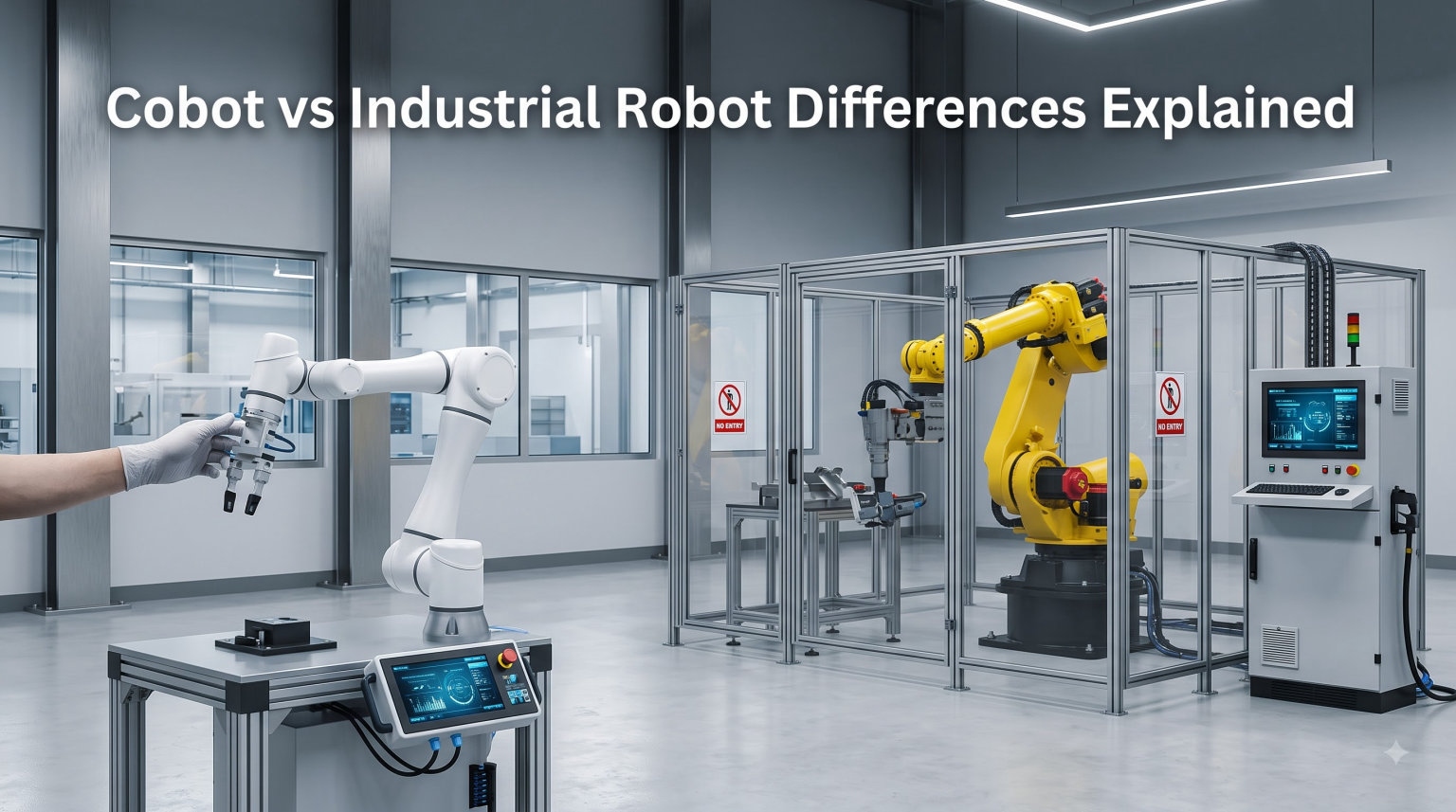
A cobot works alongside humans in a shared workspace, while an industrial robot operates independently inside a safety cage, replacing human labor on dedicated tasks. That single sentence captures the entire cobot vs industrial robot debate, and it is the starting point most buyers and engineers need before they get lost in spec sheets.
I have spent time on shop floors watching both kinds of robots run, talked to integrators who deploy them, and pulled apart the marketing claims that surround each category. This guide is the result: an honest, practical breakdown of how collaborative robots and industrial robots differ in safety, speed, cost, programming, and real-world return on investment. If you are choosing automation for a small batch shop or scaling a high-volume line, you will find a clear answer here.
By the end you will know exactly which type fits your production volume, your floor space, your workforce skill level, and your budget. We will also cover the four disadvantages of cobot welding that most vendors gloss over, plus the cost and ROI numbers manufacturers actually report in 2026.
Table of Contents
What Is a Cobot?
A cobot, short for collaborative robot, is a robot specifically designed to share a workspace with human workers without the need for safety cages or fences. Cobots use force-limiting joints, rounded edges, and built-in sensors to detect contact and stop or reverse motion immediately when a person enters their work envelope.
The first cobots appeared in 1996 as research projects by J. Edward Colgate and Michael Peshkin at Northwestern University. Commercial cobots from Universal Robots, FANUC, and Techman hit the market in the late 2000s, and today the category includes more than a dozen manufacturers worldwide.
Most cobots share a few common traits. They typically weigh between 10 and 70 kilograms, carry payloads from 3 to 35 kilograms, and reach distances of 500 to 1,300 millimeters. They run at slower joint speeds than industrial robots, capped by safety standards like ISO/TS 15066, and they can usually be programmed through a teach pendant or a graphical drag-and-drop interface without writing code.
Typical cobot use cases include machine tending on small CNC runs, light pick and place operations, screwdriving, lab automation, and quality inspection. If you want a deeper look at how perception is changing what these robots can do, our team recently wrote about why perception is the key to scaling industrial autonomy.
What Is an Industrial Robot?
An industrial robot is an autonomous, programmable, multi-axis manipulator designed to perform repetitive tasks at high speed inside a defined work cell. Industrial robots almost always operate behind physical barriers, light curtains, or safety scanners that prevent human contact during motion.
The category has existed since the 1960s, with the first Unimate robot installed at a General Motors plant in 1961. The four traditional types are articulated arms, SCARA robots, Cartesian gantry systems, and delta robots. Articulated six-axis arms dominate heavy manufacturing, while SCARAs lead in electronics assembly and delta robots dominate high-speed packaging.
Industrial robots cover a much wider performance envelope than cobots. They can lift payloads from 5 kilograms up to more than 2,000 kilograms, reach distances beyond 4 meters, and run cycle times under 0.3 seconds on dedicated pick and place lines. Their repeatability is often 0.02 millimeters or better, which makes them suitable for precision welding, machining, and semiconductor handling.
These robots require professional programming, structured work cells, and dedicated safety infrastructure. The trade-off is throughput: a single industrial robot can replace several human workers on a high-volume line. The mechanical heart of these machines relies on precision gearboxes, and you can read our breakdown of how planetary gearboxes work in robot joints for the engineering details.
Cobot vs Industrial Robot: Key Differences at a Glance
The fastest way to compare a cobot vs industrial robot is to lay their specs side by side. The table below summarizes the categories that matter most when you are sizing automation for a real production environment.
| Specification | Cobot | Industrial Robot |
|---|---|---|
| Workspace | Shared with humans, no cage | Caged work cell, restricted access |
| Payload | 3 to 35 kg typical | 5 to 2,000+ kg |
| Reach | 500 to 1,300 mm | 700 mm to 4 m+ |
| Speed | Limited by ISO/TS 15066, slower | High speed, cycle times under 0.3 s |
| Repeatability | 0.05 to 0.1 mm | 0.02 to 0.05 mm |
| Programming | Graphical, teach pendant, low-code | Text-based, professional programmer |
| Footprint | Small, mobile bases common | Large, fixed installation |
| Unit price (arm only) | Often under $50k | $25k to $400k+ |
| Total system cost | Lower integration burden | Higher integration and safety spend |
| Best fit | Low to mid volume, mixed SKUs | High volume, dedicated lines |
These are typical ranges. Real prices depend on reach, payload, end-of-arm tooling, and integration scope. A fully integrated cobot cell can still cross $100k once you add fixturing, conveyors, and vision, while a bare industrial robot arm may look cheap until you price the cell around it.
Safety: How Cobots and Industrial Robots Protect Workers Differently
Safety is the single biggest differentiator in the cobot vs industrial robot decision. The two robot classes take fundamentally different approaches to keeping humans out of harm’s way.
Industrial robots rely on exclusion. Physical cages, interlocked doors, area scanners, and light curtains create a hard boundary between the robot work envelope and human operators. Once a door opens, the robot either stops immediately (category 1 stop) or completes the cycle and then stops (category 2 stop). This is well-established, highly reliable, and governed by standards like ANSI/RIA R15.06 and ISO 10218.
Cobots rely on inclusion. Built-in force-torque sensors at each joint, compliant surfaces, and software-defined speed and separation limits let a cobot detect contact and react. ISO/TS 15066 sets specific force and pressure limits for collaborative operation. A cobot can run at full collaborative speed when no one is nearby, slow down as a person approaches, and stop on contact within milliseconds.
Our team has watched several cobot safety demonstrations in person. The robots stop fast, but they do not prevent injury on their own. A cobot still needs a proper risk assessment, sometimes a partial barrier, and clear operating procedures. The phrase “collaborative” means the robot is designed for shared work, not that it is harmless.
For high-risk tasks like heavy welding, palletizing, or any operation involving sharp tools or hot parts, an industrial robot inside a properly rated cell is often the safer choice. For light assembly, inspection, or machine tending where workers need to interact with the part, a cobot usually wins. Picking the wrong class for the application is one of the most common safety mistakes we see on shop floors.
Speed, Payload, and Performance Trade-Offs
Industrial robots are faster, period. A caged six-axis arm from FANUC, ABB, or KUKA can run 200 picks per minute in a sorting cell, while a cobot on the same line typically tops out around 15 to 30 picks per minute. The gap comes from safety-mandated speed limits, lower joint torque, and softer servo control.
If your line runs the same part 24/7, that speed difference translates directly into throughput. A single industrial robot can replace three or four cobots in a high-volume pick and place application, which is why dedicated high-volume lines still use caged robots almost exclusively.
Payload is another gap. Most cobots cap at 16 kilograms, and even the heavy-duty UR20 and FANUC CR-35iB top out around 35 kilograms. Industrial robots scale from light SCARAs to monster arms that handle entire car bodies.
Where cobots catch up is in flexibility. A cobot cell can switch from assembling product A to product B in minutes, while a dedicated industrial robot line can take days to retool. For high-mix, low-volume work, that flexibility often matters more than raw speed. If you are scaling robot fleets across multiple sites, our coverage of warehouse robot fleet safety scaling covers the operational side.
The honest answer: choose the industrial robot when throughput is king, and choose the cobot when changeover and flexibility are king.
Programming Complexity and Deployment Time
Cobots are dramatically easier to program than industrial robots. A line worker with no robotics background can usually learn a Universal Robots or Techman cobot in a day. Hand-guiding, drag-and-drop block programming, and pre-built skill libraries mean a basic pick and place can be live in hours.
Industrial robots still require professional programmers. Languages like ABB RAPID, KUKA KRL, or FANUC Karel demand a real learning curve. A skilled integrator can program a complex welding path in a week, while a non-expert would need months.
This difference has real consequences for small and mid-sized manufacturers. A cobot lets a shop with no in-house automation engineer get started, while an industrial robot often requires a system integrator or a full-time robot programmer on staff.
That said, the simplicity has a ceiling. Once a cobot task becomes complex, multi-robot coordination kicks in, or tight integration with a PLC is required, programming effort looks more like an industrial robot project. The edge cases are where most cobot deployments stall.
For motion planning and kinematics fundamentals that apply to both, our primer on forward kinematics vs inverse kinematics is worth a read.
Cost Comparison and ROI Timelines
Cost is where the cobot vs industrial robot comparison gets interesting. A cobot arm often costs less than a single caged industrial robot when you factor in safety infrastructure.
Typical price ranges in 2026:
- Entry-level cobot arm: $20,000 to $35,000
- Mid-range cobot cell (arm, gripper, vision, basic fixturing): $50,000 to $100,000
- Heavy-duty cobot arm (UR20, FANUC CR-35iB): $50,000 to $80,000
- Industrial robot arm (articulated, 6-axis): $25,000 to $150,000
- Full industrial robot cell (arm, safety cage, conveyors, integration): $100,000 to $500,000+
Payback periods depend heavily on the application. Cobots deployed on a single shift for simple machine tending routinely pay back in 8 to 14 months. Industrial robot lines on three-shift high-volume production can pay back in 6 to 18 months purely on labor savings, but the upfront capital is much higher.
Hidden costs catch many buyers off guard. End-of-arm tooling, fixturing, conveyors, vision systems, and integration labor can easily double the price of the arm itself. For industrial robots, safety infrastructure, custom guarding, and a dedicated PLC cabinet can add another 30% to 60% on top.
One Reddit integrator I spoke with put it well: “the cheapest robot is the one that fits the application, because the wrong robot always costs more in the end.” That applies to both classes.
Space, Footprint, and Integration Requirements
Cobots win on space. A typical cobot cell fits inside a 2 by 2 meter area, and mobile bases let you roll the same cobot between machines. Industrial robots need larger dedicated work cells, often 3 by 3 meters minimum, plus clearance for safety zones and operator access.
This matters more than it sounds. Many small and mid-sized manufacturers simply do not have the floor space to dedicate a full caged cell to a single application. A cobot mounted on a mobile cart and wheeled between three CNC machines is often the only realistic way to automate in a tight shop.
For greenfield sites with room to design a line from scratch, industrial robots usually make more sense. You can design the cell layout around the robot, integrate conveyors and vision from day one, and squeeze out maximum throughput. A recent piece on igus energy chain rotation for industrial robots shows how modern cable management is pushing industrial robot reach and reliability even further.
When to Choose a Cobot vs an Industrial Robot
Choosing between a cobot and an industrial robot comes down to a few honest questions about your production environment. I walk integrators through the same five every time.
First, what is your production volume? If you run the same part more than 100,000 times per year, an industrial robot usually wins on throughput. If your volumes are lower or your SKU mix changes weekly, a cobot’s flexibility is worth more.
Second, do humans need to work in the same space as the robot? If yes, a cobot is the safer and cheaper option. If the robot can live in a dedicated cell, an industrial robot often runs faster and costs less per cycle.
Third, what is your payload and reach? Anything over 35 kilograms or 1.3 meters usually pushes you toward an industrial robot. Cobots in that range exist but the cost climbs fast.
Fourth, do you have in-house programming expertise? If not, a cobot lets you start sooner with less risk. If you have a controls engineer or an integrator on contract, an industrial robot project is more reasonable.
Fifth, what is your budget profile? If capital is tight and payback in 12 months matters, a cobot usually fits. If you can invest $250,000 today for a 5-year return, an industrial robot line is often the better long-term play.
Frequently Asked Questions
What are the key differences between industrial robots and cobots?
Industrial robots operate inside safety cages at high speed with high payloads, while cobots share workspace with humans at limited speed and lower payloads using force-limiting sensors. The biggest practical differences are in safety approach, throughput, programming complexity, and total cost of integration.
What are the four types of industrial robots?
The four traditional types are articulated robots, SCARA robots, Cartesian or gantry robots, and delta robots. Articulated arms handle welding and heavy assembly, SCARAs dominate electronics assembly, Cartesian systems cover pick and place and dispensing, and delta robots lead in high-speed packaging and sorting.
What are the disadvantages of cobot welding?
Cobot welding has four main disadvantages: lower welding speed compared to dedicated welding cells, limited torch payload that restricts thick material work, sensitivity to fit-up variations, and the need for careful safety assessment because arc flash and heat are still hazards even in collaborative mode. For high-volume thick-plate welding, a caged industrial welding cell is still the better choice.
What are the big 4 of robotics?
The big 4 industrial robot manufacturers are FANUC, ABB, Yaskawa, and KUKA. Together they account for the majority of industrial robot installations worldwide. Universal Robots is often called the leader in cobots, followed by Techman, FANUC CR series, and Doosan Robotics.
Can cobots work safely alongside humans?
Yes, when properly risk-assessed under ISO/TS 15066. Cobots use force-torque sensors and speed-and-separation monitoring to detect human presence and stop on contact. They are not risk-free, and high-energy applications still need additional guarding, but for light assembly, inspection, and machine tending they are the safest practical option.
How much does a cobot cost compared to an industrial robot?
A cobot arm typically costs $20,000 to $80,000, while a comparable industrial robot arm costs $25,000 to $150,000. Total system costs tell a different story: a cobot cell usually lands at $50,000 to $100,000, while a fully integrated industrial robot cell runs $100,000 to $500,000 once safety infrastructure, conveyors, and integration labor are included.
Conclusion
The cobot vs industrial robot decision is not about which technology is better. It is about which technology fits your production volume, your floor space, your safety needs, and your team’s skill set. Cobots win on flexibility, ease of programming, and shared workspace. Industrial robots win on speed, payload, and total throughput on dedicated lines.
If you are a small or mid-sized manufacturer running mixed SKUs, start with a cobot. Pilot it on a single machine tending or assembly cell, learn the workflow, and expand from there. If you are running high-volume dedicated production, an industrial robot line will pay for itself faster than you think, even with the higher upfront cost.
Either way, do the risk assessment, price the full cell, and talk to integrators who have deployed both. The right answer for your shop floor in 2026 is the one that matches the parts you actually run and the people who actually run them.