
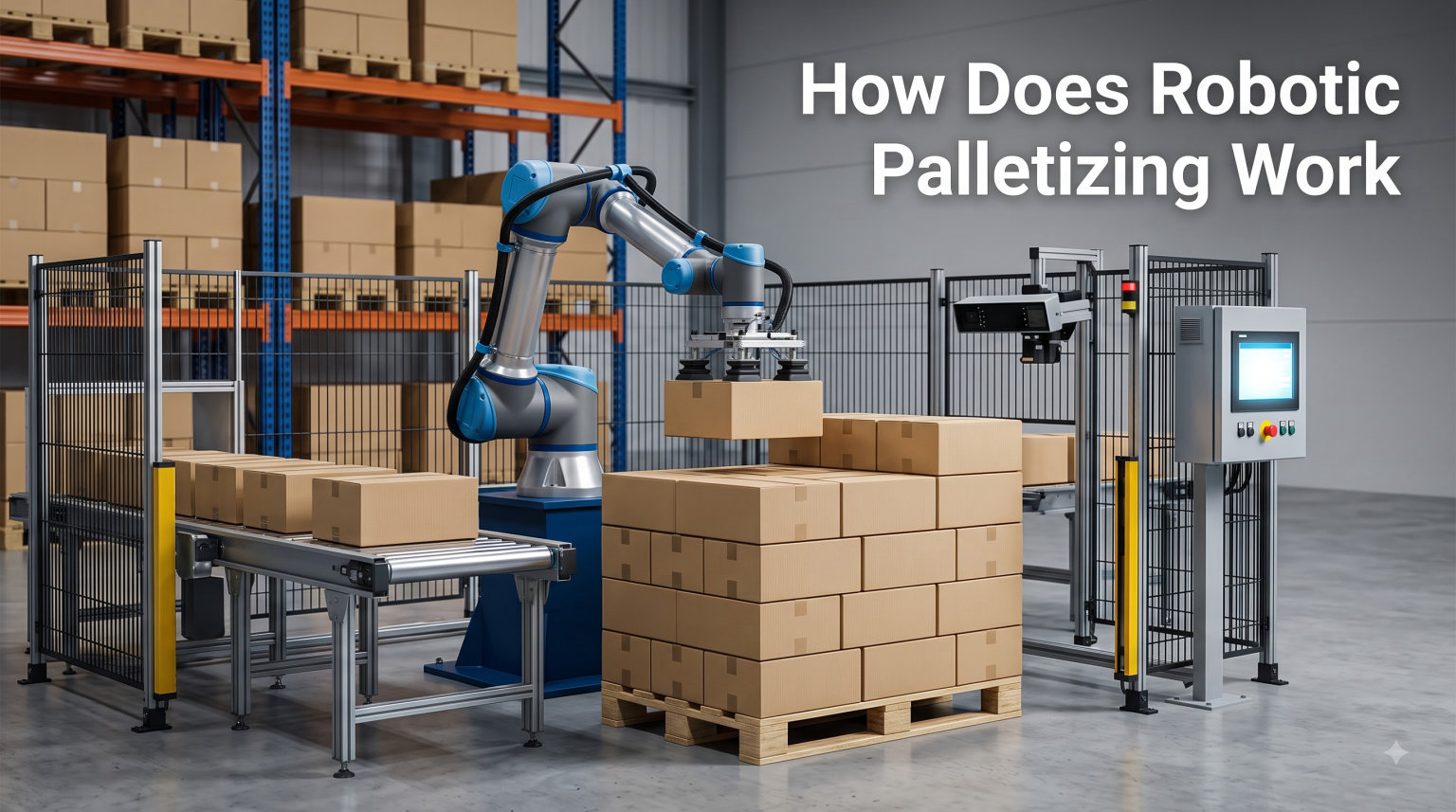
Robotic palletizing uses a robotic arm fitted with an end effector to pick, orient, and stack products onto pallets in a programmed pattern. It replaces the manual lifting, twisting, and stacking that workers do at the end of a production line, and it runs the same cycle thousands of times per shift without tiring.
I have spent the last decade watching palletizing cells go from rare curiosities to standard equipment in mid-sized plants. In this guide I will walk you through the exact mechanism, the parts inside the cell, the different flavors of robotic palletizer, and the real numbers that decide whether the investment pays off. You will finish with a clear picture of how robotic palletizing actually works and whether it fits your operation.
Table of Contents
What Is Robotic Palletizing
Robotic palletizing is the use of a programmable robotic arm and a specialized gripper to stack packaged goods onto a pallet in a defined pattern. The system receives products on a conveyor, identifies their position, picks them up, and places them in the correct slot on the pallet until the load is complete.
The word “palletizing” simply means arranging goods on a pallet. “Robotic” describes the actor doing the work. So robotic palletizing equals robot plus palletizing. The robot is usually a 4-axis or 6-axis industrial arm, but collaborative robots (cobots) are now common in lower-throughput cells.
The broader category is automated palletizing, which also includes layer palletizers that build full layers of product and drop them on a slip sheet. Robotic palletizing is the most flexible form because the same arm can run new patterns by changing only the program, not the hardware.
How Does Robotic Palletizing Work Step by Step
Robotic palletizing works through a repeating six-step cycle that the robot performs thousands of times per shift. Here is the exact sequence inside a typical cell.
Step 1: Products Arrive on the Infeed
Cases, bags, or totes leave the packaging line and ride a conveyor into the robot’s working envelope. A sensor or vision camera at the infeed detects each unit and signals the controller that a new product is ready to pick.
Step 2: The Vision System Locates the Product
If products arrive in random positions, a 2D or 3D vision camera captures the location and orientation. The controller translates that image into X, Y, and rotation coordinates the arm can follow. In fixed-position cells, the pickup point is hard-coded and no vision is needed.
Step 3: The Robot Picks the Product
The arm moves to the pickup coordinates and the end effector activates. For a vacuum gripper, a vacuum pump pulls air through suction cups and the product clings to the cups. For a clamp gripper, mechanical fingers close around the product. For a bag gripper, padded plates slide under and lift the load.
Step 4: The Arm Moves to the Pallet
Using a programmed motion path, the arm lifts the product, rotates to the correct face of the pallet, and travels to the placement point. The motion controller interpolates smooth arcs between waypoints so the product does not swing or collide with anything in the cell.
Step 5: The End Effector Releases the Product
At the target slot, the gripper opens or the vacuum vents, and the product settles onto the stack. Force sensors can confirm a clean release, and a slip sheet or tier sheet dispenser may fire between layers to stabilize the load.
Step 6: The Cycle Repeats
The arm returns to the infeed and waits for the next trigger. Modern palletizing robots complete a full pick-and-place in 4 to 12 seconds, depending on payload, reach, and pattern complexity. That is the core mechanism: trigger, pick, move, place, return, repeat.
Key Components of a Robotic Palletizing System
A working robotic palletizing cell is a stack of hardware and software that has to agree with the factory around it. Here are the parts you will see in almost every installation.
The Robotic Arm
The arm is the most visible piece. Most palletizing arms are 4-axis designs (FANUC M-410, ABB IRB 660) because pallet stacks only need up-down, in-out, rotate, and a small tilt. 6-axis arms (FANUC M-2000, KUKA KR 1000) are reserved for heavy payloads, odd shapes, or depalletizing tasks where the arm has to reach around existing product.
The End Effector
The end effector is the tool at the wrist of the arm. It is the part that actually touches the product. For a deeper look at how these tools are designed and selected, see our guide to end effectors (grippers and vacuum systems). Common types include vacuum grippers with foam or suction-cup arrays, mechanical clamp grippers, bag grippers with finger plates, and hybrid tools that combine vacuum and clamping for unstable loads.
Conveyors and Pallet Dispensers
The infeed conveyor delivers products to the pickup point, and a separate pallet dispenser stacks empty pallets and feeds one into place at the start of each cycle. Some cells add a slip-sheet or top-sheet dispenser that drops a sheet of corrugated or plastic between every few layers to stabilize the load.
Sensors and Vision
Photo eyes, proximity switches, and load sensors confirm that a product is in place and that the pallet is empty. Vision cameras add the ability to handle random or skewed products without manual reorientation. Force-torque sensors at the wrist can detect collisions and trigger a safe stop.
Safety Enclosure
Most industrial palletizing cells are surrounded by fencing with interlocked gates. Light curtains, safety mats, and area scanners create virtual perimeters. The robot is hard-wired to enter a slow or stopped state the moment anything crosses the line.
Controller and PLC
The robot controller executes the motion program and talks to the plant PLC. The PLC hands off I/O signals: product ready, pallet in place, cycle complete, fault. This handshaking is the part that integrators spend the most time on, and it is where many first-time projects run into delays.
Types of Robotic Palletizers
Not all robotic palletizing systems look the same. Three designs cover the vast majority of real installations.
Industrial Articulated-Arm Palletizers
These are the workhorses. A 4-axis arm with a 100 to 500 kg payload sits on a pedestal and services one or two pallet positions. They handle the highest throughputs, run three shifts without a break, and dominate in beverage, food, and paper. The trade-off is floor space and a full safety enclosure.
Cobot Palletizers
Collaborative robots from Universal Robots, FANUC, and Yaskawa bring the same idea to smaller operations. Payloads are usually 8 to 30 kg, cycle times are slower, and the cobot can work next to people without fencing after a risk assessment. Cobot palletizers are common in contract packaging, small e-commerce, and short-run operations that change patterns often.
Layer Palletizers with a Robot Interface
Some high-volume lines use a layer-forming table to build a complete layer of product, then hand it off to a robot that places the layer on the pallet. This hybrid gives you the speed of a layer system and the flexibility of a robot. It is overkill for most lines but useful when throughput exceeds 30 cases per minute.
Benefits and Advantages of Robotic Palletizing
The reasons plants keep buying robotic palletizers are practical, not theoretical.
Consistent Stack Quality
A robotic arm places each case in the same X, Y, and rotation every cycle. Stack patterns are tighter, glue migration is reduced, and stretch-wrapper performance improves because the load is square.
Throughput That Holds Across Shifts
Robots do not slow down at minute 30, hour 4, or shift 2. A cell rated at 20 cycles per minute will still hit 20 cycles per minute at 2 a.m. on a Friday, which is something manual teams almost never match.
Lower Long-Term Labor Cost
A single robotic cell replaces two to four palletizing operators per shift, depending on the line. Across three shifts and loaded benefits, that adds up fast. Most payback calculations I have seen land in the 18 to 36 month range for a two-shift operation.
Reduced Injury Exposure
Palletizing is one of the top five causes of back and shoulder injuries in manufacturing. Removing the repetitive lift-twist-stack motion cuts recordable incidents dramatically, which also lowers workers’ comp costs.
Pattern Flexibility
Switching a pattern is a program change, not a retooling. A cell can run an 8-case pinwheel pattern in the morning, a 6-case column stack in the afternoon, and a mixed-SKU display in the evening without anyone touching the hardware.
Industries and Applications
Robotic palletizing shows up wherever pallets leave the building in volume.
Food and Beverage
Bottles, cans, cases of cereal, and bags of flour are the bread and butter of the industry. Wet, dusty, or cold environments favor stainless hardware and wash-down-rated grippers.
Pharmaceutical and Personal Care
Strict pattern control and traceability matter here. Robots deliver both, and the same cell often handles multiple SKUs with different end effectors auto-changed at the wrist.
E-commerce and Logistics
Distribution centers use robotic palletizing to build mixed-SKU pallets for store delivery. Vision-guided cells pick random cartons from a conveyor and build stable loads without pre-sorting.
Automotive and Heavy Manufacturing
Tier suppliers palletize drums of oil, totes of fasteners, and cases of components. Higher payloads and 6-axis arms are common when individual cases exceed 50 kg.
Agriculture and Building Materials
Bags of seed, fertilizer, and concrete are notoriously hard to grip because the bags stretch and shift. Bag-style grippers with penetration fingers and clamp plates are the standard answer.
Common Failure Modes and Maintenance
Robotic palletizers are reliable, but they are not magic. Here is what actually breaks in real plants.
Vacuum Gripper Failures
Suction cups wear out, filters clog, and vacuum pumps lose seal over time. Plan a quarterly inspection of cups and lines, and keep a spare vacuum pump on the shelf. This is the single most common service call I hear about from integrators.
Gripper Mechanical Wear
Clamp pads, springs, and finger pins take a beating. Replacement intervals vary by duty cycle, but most plants keep a spare set of pads and pins and swap them during planned downtime rather than waiting for a fault.
PLC Handshake Errors
When a robot suddenly stops with a waiting-for-permissive fault, the cause is almost always a signal from the plant PLC that never came. The cure is a clear I/O map and a handshake test that runs every shift start.
Unpredictable Package Behavior
Paper bags, soft cases, and shrink-wrapped trays can deform in transit. Vision systems and force sensors help, but a regular check that incoming product matches the spec the cell was programmed for is essential. If the supplier changes case dimensions by 5 mm, the cell may miss picks.
Preventive Maintenance Schedule
For a two-shift operation, the realistic PM cadence is: weekly visual checks, monthly lubrication of axis gearboxes per OEM spec, quarterly gripper inspection, and annual controller backup and battery check. Robots in palletizing duty commonly run 50,000 to 80,000 hours before a major overhaul.
Integration Requirements and ROI
Most robotic palletizing projects succeed or fail in the integration phase, not the equipment selection phase. Knowing what to plan for keeps the project on schedule.
Payload and Reach Sizing
Size the arm for the heaviest case plus a 25% margin, and the reach for the tallest stack plus the pallet change clearance. Our payload capacity guide walks through the math, including the moment arm effects that catch people off guard.
PLC and Conveyor Handshaking
Plan at least 40 hours of integrator time for I/O mapping, fault handling, and a simulated dry run before product hits the cell. Use a clearly labeled I/O list as the contract between the robot vendor and the plant controls team.
Footprint and Utilities
Typical cells need 80 to 200 square feet including conveyors and pallet dispensers, a 480 V three-phase power drop, and 80 to 100 psi compressed air for vacuum and pneumatics. Add space for a control cabinet and a maintenance access aisle.
Simple ROI Math
Take the loaded hourly cost of the operators you are replacing, multiply by hours saved per year, and subtract the fully loaded annual cost of the cell (depreciation, power, maintenance, consumables). For most two-shift cells in 2026, that ratio lands between 1.5x and 3x annual savings versus installed cost, which is a 2 to 4 year payback.
Safety Considerations and Standards
Safety is not optional in a palletizing cell. In North America, ANSI/RIA R15.06 governs industrial robot safety, and ISO 10218 is the international equivalent. For cobots, ISO/TS 15066 defines the force and speed limits that allow human-robot collaboration after a formal risk assessment.
Practical steps in every cell I have audited: a documented risk assessment, fenced perimeter or approved collaborative workspace, clearly marked restricted zones, lockable disconnects at the cell boundary, and a written rescue plan if a worker becomes trapped against equipment. The cell should also be designed so that the robot’s stopping time plus the safety distance keeps hands and limbs out of the pinch zones during a stop.
Frequently Asked Questions
What is palletizing in robotics?
Palletizing in robotics is the use of a programmable robotic arm with a gripper or vacuum end effector to pick up packaged products and stack them onto a pallet in a defined pattern. The robot repeats the same pick, move, and place cycle hundreds or thousands of times per shift, replacing the manual lifting and stacking that would otherwise be done by workers at the end of a production line.
How much does a palletizing robot cost?
A complete robotic palletizing cell in 2026 typically costs between 150,000 and 400,000 installed for a cobot or mid-payload industrial arm, and 400,000 to 800,000+ for a high-payload system with conveyors, pallet dispensers, and full safety enclosure. Software, integration, and training add another 20 to 40 percent on top of the equipment. Most buyers recover the cost through labor savings in 2 to 4 years on a two-shift operation.
What kills a robot in a palletizing cell?
The most common causes of robot failure in palletizing are vacuum gripper leaks and worn suction cups, mechanical wear on clamp pads and finger pins, PLC handshake errors that leave the robot waiting for a permissive signal, and collisions with misaligned or oversize product. Poor preventive maintenance and sudden changes in incoming case dimensions are the leading triggers behind these failures.
What are 5 disadvantages of robotic palletizing?
Five disadvantages of robotic palletizing are: 1) high upfront capital cost compared to manual labor, 2) integration complexity with existing PLCs and conveyors, 3) sensitivity to changes in package size, weight, or surface, 4) need for a safety enclosure and trained maintenance staff, and 5) limited ability to handle highly variable or one-off loads that a human palletizer can adapt to on the fly. Most of these are manageable with the right integrator and a realistic maintenance plan.
Conclusion
How does robotic palletizing work? A sensor or vision system sees an incoming product, the robot arm picks it up with an end effector, moves it to the pallet, and places it in a programmed slot. That six-step cycle repeats as long as product is flowing, which is the whole point: consistent, fast, tireless stacking that a manual team cannot match across three shifts.
If you are sizing a cell for your own line, start with the heaviest case, the tallest pallet, and the required cycles per minute, then validate the integration scope with your plant controls team before signing anything. A clear I/O map and a realistic preventive maintenance plan are the two factors that separate smooth installations from frustrating ones.