
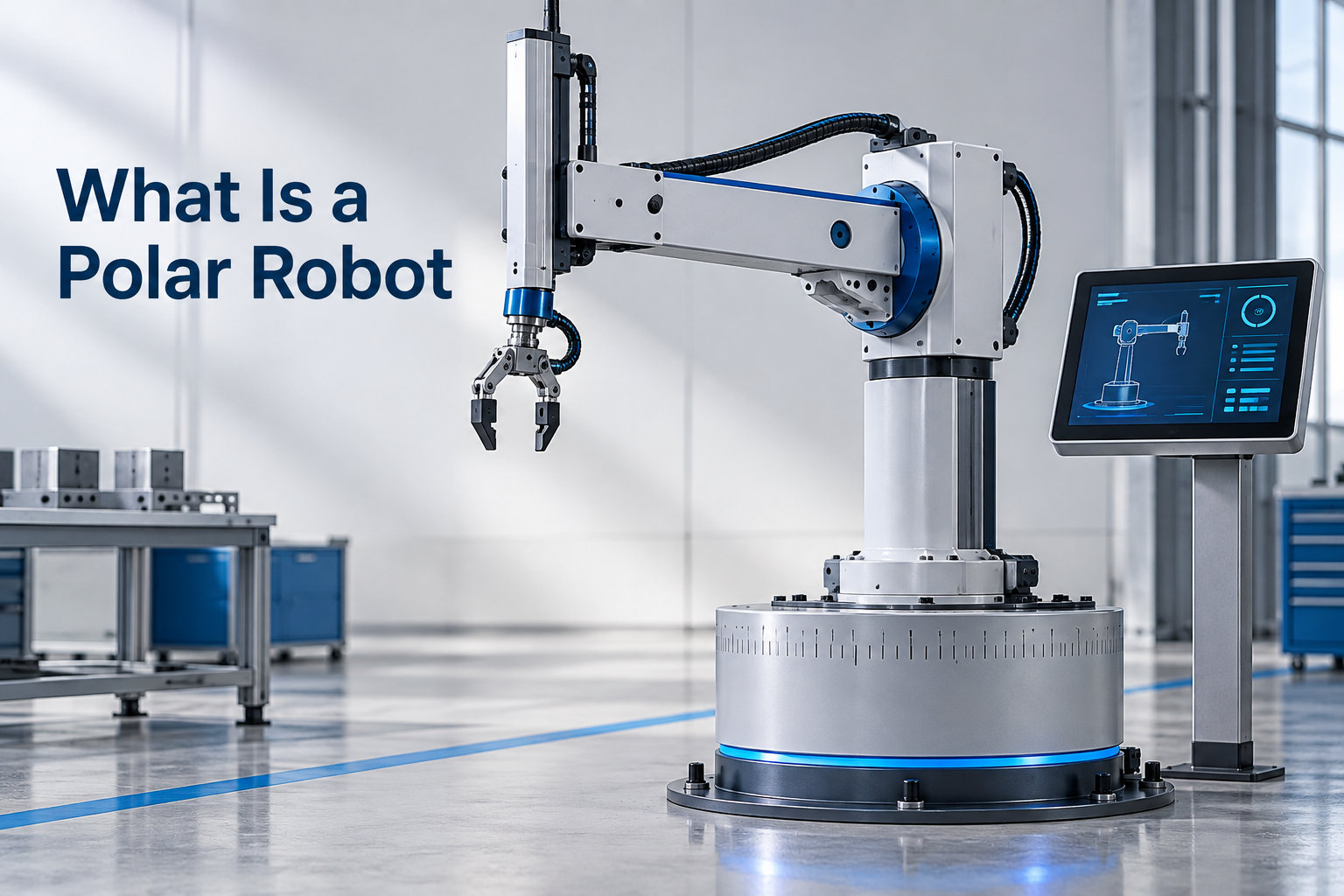
A polar robot (also called a spherical robot) is an industrial robot arm with two rotary joints and one prismatic joint, whose axes form a polar coordinate system. That joint mix creates a spherical work envelope, which is why you will see these machines called either polar or spherical robots depending on the manufacturer.
I’ve spent years writing about industrial automation, and polar robots keep coming up in one specific niche: high-reach tasks in tight factory footprints. This guide breaks down what a polar robot is, how the joints work together, where these robots actually shine, and when you should pick a different configuration instead.
By the end, you’ll understand the mechanics, the applications, and the tradeoffs that engineers weigh when choosing between polar, SCARA, articulated, and cylindrical robots.
Table of Contents
What Is a Polar Robot and How Does It Work
A polar robot is a type of industrial robot whose arm moves through a polar coordinate system, which is the same coordinate system used to describe points by distance from a center and angles around it. The result is a workspace shaped like a partial sphere, hence the alternate name “spherical robot.”
The arm moves using a combination of rotational and linear motion. The base rotates around a vertical axis, an “elbow” joint rotates around a horizontal axis, and a prismatic joint extends or retracts the arm linearly. These three motions work together to position the end effector anywhere within the spherical work envelope.
In plain terms, a polar robot is the robotic equivalent of a tank turret: it can spin, raise, lower, and extend its barrel. That design gives it both reach and flexibility from a compact base, which is a combination few other robot types can match.
The Three Joints in Detail
Every polar robot has exactly three primary axes of motion, often referred to as 3 degrees of freedom (3 DOF) before adding a wrist. The joints are:
- Twisting joint at the base — rotates the entire arm horizontally around a vertical axis
- Rotary (revolute) joint at the shoulder — raises and lowers the arm in a vertical plane
- Prismatic (linear) joint — extends or retracts the arm in and out from the base
Some polar robots add a two- or three-axis wrist at the end of the arm for orientation control. That brings the total to 5 or 6 DOF, matching the dexterity of more common articulated robots. Without the wrist, the polar robot can position its tool in space but cannot aim it freely.
Polar Robot Joint Configuration Explained
The defining trait of a polar robot configuration is the 2 rotary + 1 prismatic joint arrangement. This is the only industrial robot type that uses this specific combination, and it’s the reason for the spherical workspace shape.
Rotary vs Prismatic Joints: What’s the Difference
A rotary joint (also called a revolute joint) provides rotation around an axis, similar to how your elbow bends. A prismatic joint provides linear sliding motion along an axis, like a drawer opening and closing. Industrial robots use these two joint types in different combinations to produce different workspace shapes.
For a polar robot, the two rotary joints handle angular positioning while the single prismatic joint handles reach. That division of labor is what produces the polar coordinate system the robot is named after.
Why This Configuration Matters
Most industrial robot types have signature joint combinations:
- Cartesian robots use three prismatic joints for a rectangular workspace
- Cylindrical robots use one rotary and two prismatic joints for a cylindrical workspace
- SCARA robots use two rotary and one prismatic joint, but arranged for a cylindrical workspace with selective compliance
- Articulated robots use three or more rotary joints for a near-spherical workspace
- Polar robots use two rotary and one prismatic joint for a true spherical workspace
Only polar robots deliver a genuinely spherical work envelope with a compact base, which is the practical advantage engineers exploit in specific applications.
Understanding the Spherical Work Envelope
The work envelope (also called the work volume) is the three-dimensional space a robot’s end effector can reach. For a polar robot, this envelope takes the shape of a partial sphere or a spherical sector, depending on how the joints are configured and limited.
Shape and Size
Imagine a hollow ball cut in half. The flat side sits on the factory floor, with the polar robot’s base at the center. The arm can reach any point on the inside of the dome. The radius of that dome equals the maximum extension of the prismatic joint, and the height equals the maximum reach of the shoulder rotation.
This shape is bigger than the robot’s actual physical footprint, which is a key benefit. A polar robot with a base only a meter wide can reach points three or more meters away. Few Cartesian or cylindrical robots can match that reach from a similar base size.
Why It Matters in Practice
The spherical work envelope is particularly useful for tasks that require reaching over, under, or around obstacles. For example, a polar robot tending an injection molding machine can reach into the mold area from above, around safety gates, and back out without repositioning the base.
Compare that to a Cartesian robot, which would need a much longer linear rail to achieve the same reach, or an articulated robot, which would need a longer arm. The polar configuration is more space-efficient for certain layouts.
Polar Robot Applications and Industries
Polar robots are most common in heavy industrial settings where reach, flexibility, and the ability to handle hot or hazardous parts matter. Here are the primary applications.
Die Casting
Die casting is the most cited application for polar robots, and it’s the one most textbooks mention first. A polar robot can reach into a die casting machine, extract the hot part, and dip it into a quench tank, all in a single smooth motion. The spherical envelope is ideal for this sequence because the robot needs to approach the die from above, withdraw at an angle, and then move laterally to the quench station.
Polar robots used in die casting are often built with heat shielding and special coatings to survive the high temperatures. Their compact base also allows them to fit between cells in a die casting shop where floor space is at a premium.
Injection Molding Automation
Injection molding is another classic polar robot application. The robot extracts molded parts from the press, orients them, and places them on a conveyor or in a packing station. Like die casting, this requires reaching into a confined space and coming back out at an angle.
Polar robots in injection molding are valued for their ability to service presses from above, which keeps the floor clear for operator access and material delivery. They can also handle inserts, runners, and rejected parts in a single cycle.
Welding
Both spot welding and arc welding are common polar robot applications, especially in older automotive plants. The spherical work envelope lets the robot position a welding torch at almost any angle relative to the workpiece, which is critical for consistent weld quality.
Modern welding has largely shifted to articulated robots with 6 axes, but polar robots still appear in niche welding cells where their compact base or specific reach profile is a better fit.
Material Handling and Machine Tending
Material handling covers any task that moves parts between stations, including loading and unloading CNC machines, press brakes, and forging hammers. Machine tending is a subset of material handling focused specifically on keeping production machines fed with raw stock and removing finished parts.
Polar robots are well suited to these jobs because they can service a large area from a fixed position. A single polar robot can often tend multiple machines arranged in a circle, which reduces the number of robots needed and cuts the total system cost.
Other Applications
You will also find polar robots in:
- Glass handling and laminating
- Forging and heat treatment parts transfer
- Painting and coating (less common today, but still in use)
- Assembly of large components
- Pick and place operations in clean factory layouts
Polar robots are not as widespread as articulated or SCARA robots in modern factories. You will mostly see them in legacy installations, heavy industry, and a few specialized niches where their specific geometry is a genuine advantage.
Polar Robot vs Other Industrial Robot Types
Choosing the right robot type is about matching the workspace shape, reach, payload, and precision to your application. Here is how polar robots compare to the four other main industrial robot types.
Comparison With the Five Main Industrial Robot Types
The five main types of industrial robots are Cartesian, cylindrical, polar (spherical), SCARA, and articulated. Each has a distinct joint configuration and workspace shape that makes it better suited to certain tasks.
- Polar robots — 2 rotary + 1 prismatic joints, spherical workspace, compact base, good reach
- Articulated robots — 3+ rotary joints, near-spherical workspace, maximum flexibility, dominant in modern industry
- SCARA robots — 2 rotary + 1 prismatic joints, cylindrical workspace with vertical stiffness, ideal for high-speed assembly
- Cylindrical robots — 1 rotary + 2 prismatic joints, cylindrical workspace, good for pick and place in front of the robot
- Cartesian robots — 3 prismatic joints, rectangular workspace, simple, precise, used in gantry systems
Polar vs Articulated Robots
Polar robots and articulated robots both produce roughly spherical workspaces, but they reach those workspaces differently. A polar robot uses one linear extension and two rotations. An articulated robot uses only rotations, with no prismatic joint at all.
Articulated robots dominate modern manufacturing because they can have 6 or even 7 axes, giving them unmatched flexibility. Polar robots are simpler mechanically, which can mean lower cost and easier maintenance, but they are limited in their dexterity compared to 6-axis articulated arms.
Polar vs SCARA Robots
SCARA robots share the same joint count as polar robots (2 rotary + 1 prismatic), but they are configured for a different workspace. SCARA stands for Selective Compliance Assembly Robot Arm, and its design favors fast, precise vertical insertion tasks.
If your application is high-speed pick and place or small parts assembly, a SCARA is almost always a better fit. If your application requires reaching around obstacles or operating above and below a fixture, a polar robot’s geometry is more appropriate.
Polar vs Cylindrical Robots
Cylindrical robots have one rotary joint and two prismatic joints, producing a cylindrical workspace. The prismatic joints in a cylindrical robot can extend in straight lines, which gives them strong rigidity for heavy loads at full extension.
Polar robots win on compactness and reach. Cylindrical robots win on structural rigidity and are easier to control because the kinematics are simpler. For modern factories, cylindrical robots are less common than they once were.
Advantages and Limitations of Polar Robots
No robot type is universally better than the others. Polar robots have real strengths, but they also come with tradeoffs that you should weigh carefully before specifying one for a new cell.
Key Advantages
The biggest advantages of polar robots come from their geometry and mechanical simplicity.
- Large work envelope from a compact base — reach three or more meters while the base fits in a small footprint
- Good reach around obstacles — spherical shape lets the arm access hard-to-reach points
- Fewer mechanical parts than some alternatives — simpler kinematic chain can mean lower cost and easier service
- Strong fit for die casting and injection molding — proven design for these specific applications
- Can service multiple machines from one position — circular arrangement of machines lets one polar robot tend several
Key Limitations
Polar robots also have drawbacks that have reduced their popularity in newer installations.
- Lower popularity means fewer modern options — most robot OEMs have shifted R&D to articulated arms
- Prismatic joint limits dexterity at full extension — the linear joint can be harder to control precisely than a rotary joint
- Spherical workspace has dead zones — points directly below the base and at extreme angles are harder to reach
- Calibration is more complex — combining rotary and linear motion in one kinematic chain requires careful setup
- Replaced by articulated robots in many applications — newer 6-axis arms often match or exceed polar reach with better flexibility
If you are designing a new automation cell in 2026, a polar robot is rarely the default choice. It is the right choice when its specific geometry matches a specific problem, such as tending a die cast cell from a tight corner of the shop floor.
History and Evolution of Polar Robots
Polar robots are among the oldest industrial robot configurations in commercial use. Understanding where they came from helps explain why they still exist in factories today.
Early Development
The first industrial robots appeared in the late 1950s and early 1960s. The Unimate, created by George Devol and Joseph Engelberger in 1961, was essentially a polar configuration robot. It had a rotating base, an extending arm, and a tilting column, all of which fit the 2 rotary + 1 prismatic pattern.
These early Unimates were used for die casting and welding in General Motors plants, and they set the template for industrial robotics for the next two decades. Many of the polar robots you see in older factories trace their lineage back to these first machines.
Why Polar Robots Dominated the 1960s and 1970s
In the early decades of industrial robotics, the polar configuration made sense. Hydraulic actuators were strong and cheap, the spherical workspace was well suited to the dominant applications of the day, and control systems could handle the simpler kinematics more easily than more complex configurations.
Articulated robots existed in research labs, but they required more sophisticated servo control, more expensive components, and more careful mechanical design. For a factory in 1970, a polar robot was the practical, affordable choice.
The Shift to Articulated Robots
By the 1980s and 1990s, several factors pushed the industry toward articulated robots. Electric servo motors became cheaper and more powerful, microcontrollers enabled complex multi-axis coordination, and the rise of automotive spot welding and arc welding demanded the dexterity that 6-axis articulated arms provide.
As articulated robots dropped in price, their flexibility advantage overwhelmed the polar robot’s compactness advantage. ABB, KUKA, FANUC, and Yaskawa all built their modern product lines around articulated arms, and polar robots became a smaller niche category.
Polar Robots Today
In 2026, polar robots are still in production, but they are a small share of new industrial robot sales. You will mostly encounter them in:
- Legacy die casting and injection molding cells
- Specialty applications where their geometry is genuinely the best fit
- Research and academic settings where their simpler kinematics aid teaching
- Modern rebuilds of older polar cells with updated controllers
Most robot manufacturers still offer a polar or spherical model in their catalog, but it is rarely the headline product. The trend toward modular 6-axis articulated arms with collaborative features continues to pull new investment away from polar designs.
When to Choose a Polar Robot for Your Application
Choosing between robot types is a practical engineering decision, not a brand preference. Here is how I think through whether a polar robot is the right fit for a given application.
Step 1: Map the Required Workspace
Start by sketching the points the robot must reach. If those points form a sphere or partial sphere around a single mounting location, a polar robot is a strong candidate. If the points form a long rectangle or line, a Cartesian robot is better. If the points form a near-sphere but require complex tool orientation, an articulated robot is the safer bet.
Step 2: Check Reach Against Floor Space
Polar robots excel when you need long reach from a small base. If the factory floor forces you into a corner and you still need to service a 4-meter-wide work area, a polar robot’s geometry solves that problem elegantly. If you have plenty of floor space, an articulated robot with a longer arm may be simpler to integrate.
Step 3: Match the Application Profile
Polar robots are proven in die casting, injection molding, forging, and some welding tasks. If your application falls in one of these categories and your factory has the right footprint, a polar robot is worth considering. If your application is high-speed assembly, modern arc welding, or collaborative human-robot work, an articulated or SCARA robot is the better default.
Step 4: Evaluate Vendor Support
Because polar robots are a smaller market segment, vendor support and spare parts availability matter more than they would for a more common robot type. Before committing to a polar robot in 2026, confirm that the manufacturer has a local service network, stocked spares, and active software support. A robot is only as good as the team that keeps it running.
Step 5: Calculate Total Cost of Ownership
Initial purchase price is only part of the cost. Include installation, integration, training, maintenance, energy, and expected service life. A polar robot may be cheaper to buy but more expensive to integrate if your team is not familiar with the configuration. Run the numbers for a 10-year horizon before deciding.
Frequently Asked Questions
What is a polar robot?
A polar robot (also called a spherical robot) is an industrial robot with two rotary joints and one prismatic joint. The axes of those joints form a polar coordinate system, which gives the robot a spherical work envelope.
What is a polar robot used for?
Polar robots are most commonly used for die casting, injection molding, welding, forging, and material handling. Their spherical workspace and compact base make them well suited to reaching into presses, dies, and machine tools.
What is the difference between a polar robot and a spherical robot?
There is no difference. Polar robot and spherical robot are two names for the same configuration. The name polar comes from the polar coordinate system the joints produce, and spherical comes from the shape of the work envelope.
How does a polar robot work?
A polar robot works by combining base rotation, shoulder rotation, and a linear prismatic joint. The two rotary joints handle angular positioning, and the prismatic joint extends or retracts the arm to reach any point within the spherical workspace.
What are the 5 main types of industrial robots?
The five main types of industrial robots are Cartesian, cylindrical, polar (spherical), SCARA, and articulated. Each type uses a different joint configuration to produce a different workspace shape, and each is best suited to a different set of applications.
Final Thoughts on Polar Robots
A polar robot is a specific tool for specific jobs. Its 2 rotary + 1 prismatic joint configuration creates a spherical workspace that few other robot types can match from a small base, and that geometry has made it a fixture in die casting, injection molding, and material handling for decades.
If you are evaluating polar robots in 2026, focus on whether the spherical workspace matches your real application, not just whether the robot is available. For most modern automation cells, an articulated 6-axis arm will be the more flexible default. For legacy niches and a few specialty applications, the polar robot is still the right answer.