
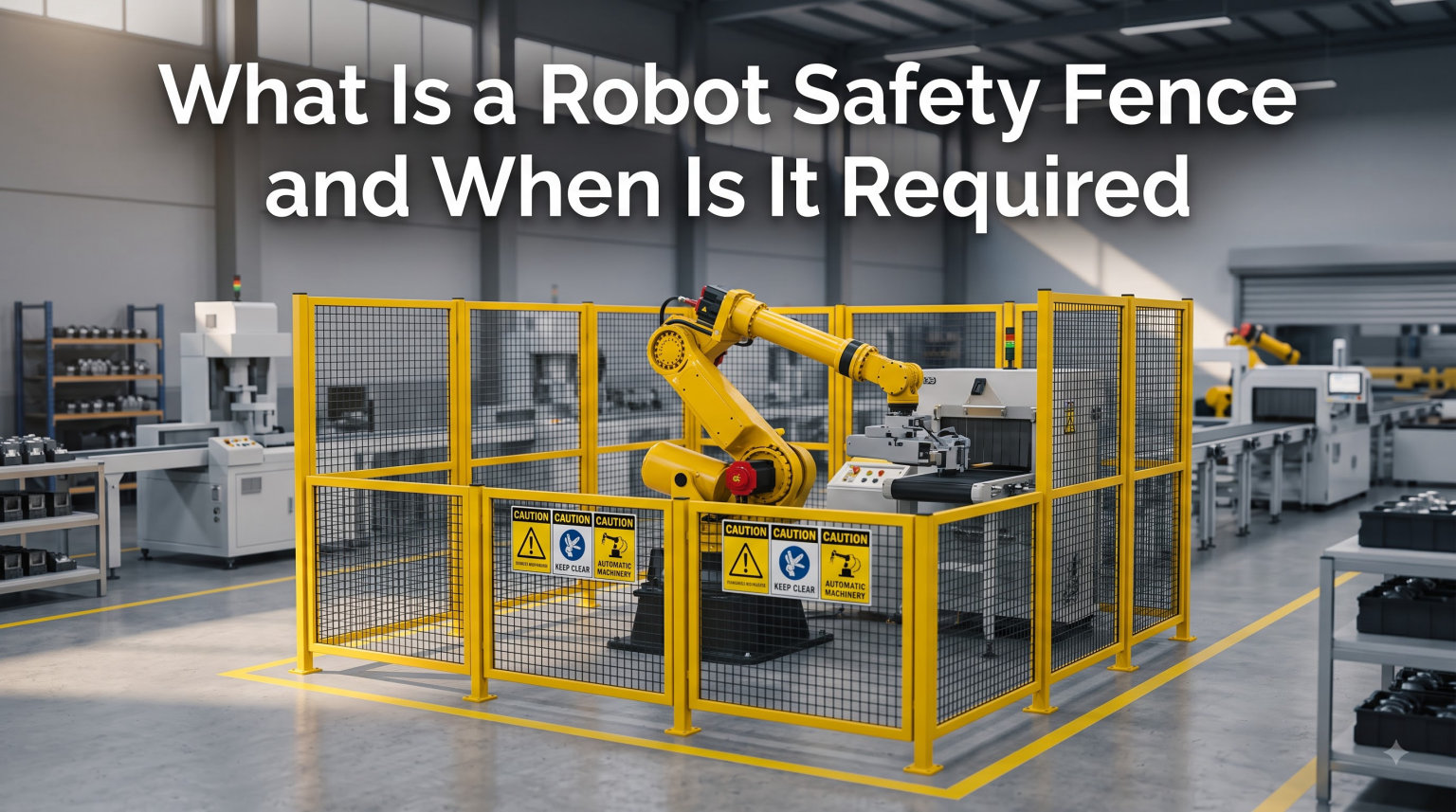
A robot safety fence is a physical barrier system that prevents workers from entering hazardous zones around industrial robots. It is required by OSHA, ANSI/RIA R15.06, and ISO 10218 whenever a robotic work cell, automated assembly line, or material handling station could expose personnel to crush, pinch, or impact injuries. In 2026, these barriers remain the most common safeguarding method deployed across automotive, welding, and material handling facilities.
I have spent the last decade working with integrators, safety engineers, and OSHA inspectors, and I can tell you that misunderstanding when a robot safety fence is required is the single most common reason facilities get cited. This guide walks you through the definition, the exact standards, and the trigger conditions that determine whether your facility needs one.
Table of Contents
What Is a Robot Safety Fence
A robot safety fence is a fixed or interlocked barrier that separates human workers from the operational and reach envelope of an industrial robot. Its purpose is to keep people out of the zone where the robot moves at high speed and significant force, which could cause severe injury or death on contact.
These fences are built from welded wire mesh, sheet metal, polycarbonate panels, or aluminum framing, and they surround the entire robot cell. The minimum height is 60 inches (1524 mm) measured from the walking surface, and the gap between the bottom rail and floor must not exceed 6 inches (152 mm). This prevents a worker from reaching under the fence into the active work area.
Core Components of a Robot Safety Fence
- Vertical panels or mesh: Form the continuous barrier that blocks reach into the hazard zone.
- Floor-mounted posts: Anchor the fence to the concrete pad to resist impact loads.
- Access gates: Allow authorized entry for setup, maintenance, and material loading.
- Safety interlocks: Cut robot motion when a gate opens, treated as a safety-rated input.
- Visibility elements: Yellow framing, signal lighting, or transparent panels to make the barrier obvious.
Primary Purpose of a Robot Safety Fence
The primary purpose is twofold: prevent accidental entry during automatic operation, and provide a physical boundary for the robot’s safeguarded space. When properly designed, a robot safety fence reduces the risk of the four main types of robot accidents: crushing or trapping, impact or collision, entanglement with cabling or tooling, and mechanical failure projection.
I want to be clear about something I have seen trip up new safety managers. The fence is not the safeguard itself. The fence is the physical host for the safeguarding system. The actual safety function is the interlock switch on the gate, the safety relay, and the stop circuit that halts the robot when someone enters. Treat the fence, gate, interlock, and controller logic as one system, not four separate parts.
When Is a Robot Safety Fence Required
A robot safety fence is required any time an industrial robot can move while a worker is within its reach envelope, or when the operation creates hazards at the point of operation such as welding spatter, material ejection, or clamping forces. The trigger is not the size of the robot. The trigger is the presence of a hazard that a worker could reach.
Under OSHA 29 CFR 1910.212 and ANSI/RIA R15.06, the requirement applies to all industrial robots as defined in the standard, including articulated arms, SCARA, delta, Cartesian gantries, and collaborative robots operating in power-and-force-limited mode with restricted space. Even collaborative robots that stop on contact are subject to risk assessment and may require perimeter fencing in many installations.
Common Scenarios That Require a Robot Safety Fence
- Robotic welding cells where arc flash, spatter, and electrode motion are present
- Material handling cells with palletizers, depalletizers, and conveyors feeding the robot
- Automated assembly lines with presses, fasteners, or insertion tools
- Machine tending operations where the robot loads and unloads CNC or injection molding equipment
- Painting and coating cells with flammable or pressurized fluids
- Any installation where the robot reach extends beyond a clearly defined workstation
When a Fence May Be Reduced or Replaced
There are limited cases where a fence is not the primary safeguard. Safety-rated soft axis and space limiting, presence-sensing devices like safety light curtains or safety mats, and verified safe stop functions can replace part of the perimeter. However, when I look at facilities that have had serious incidents, almost every one of them skipped a perimeter barrier in the name of operator access, then later added it back after a near-miss. For most production environments, the fence is the baseline and the electronic devices are additions, not replacements.
OSHA Requirements for Robot Safety Fencing
OSHA regulates robot safeguarding under 29 CFR 1910.212, which is the general requirement for all machine guarding, and under 29 CFR 1910.147 for lockout/tagout during maintenance. The 1910.212 standard requires one or more methods of guarding to protect operators from point-of-operation hazards, and it applies to industrial robots as machines.
There is no robot-specific OSHA standard. Instead, OSHA uses the general duty clause (Section 5(a)(1) of the OSH Act) and the 1910.212 framework to cite facilities for inadequate robot guarding. The agency also cites ANSI/RIA R15.06 as the recognized industry consensus standard, which means compliance with R15.06 is effectively the path to OSHA compliance.
OSHA Citation Hot Spots for Robot Cells
- No perimeter barrier separating operators from the robot’s safeguarded space
- Gate interlocks that are not safety-rated, or that are bypassed during production
- Inadequate safety distance allowing reach over or under the fence
- Lack of lockout/tagout procedures for maintenance inside the cell
- Missing or non-functional emergency stop devices
- No documented risk assessment for the cell
Practical OSHA Compliance Checklist
When I walk a facility with a maintenance lead, I always start with the same six items. First, verify the fence is at least 60 inches tall with no gaps larger than 6 inches at the floor. Second, confirm that every access gate has a safety-rated interlock that is hardwired to a safety relay or safety PLC. Third, check that the safety distance calculation is documented and that the fence line is set at or beyond that distance. Fourth, test every emergency stop and confirm it is wired to a safety input, not a standard digital input. Fifth, confirm lockout/tagout procedures exist for any entry into the cell. Sixth, confirm the risk assessment is on file and has been reviewed within the last three years.
ANSI/RIA R15.06 Standards Overview
ANSI/RIA R15.06 is the US national robot safety standard, and it is the document OSHA inspectors most often reference during robot cell inspections. The current version is R15.06-2012, which harmonizes with ISO 10218-1 and ISO 10218-2. The standard defines the requirements for the design, integration, installation, and safeguarding of industrial robot systems.
R15.06 requires a risk assessment for every robot cell, performed by a competent person using methods such as the Task-Based Risk Assessment outlined in the RIA TR R15.306 technical report. The assessment identifies hazards, estimates severity and probability, and prescribes the safeguarding measures needed to reduce risk to an acceptable level.
Key Safeguarding Requirements in R15.06
- Perimeter safeguarding with a minimum height of 1.5 m (59 inches) for awareness barriers, with 1.8 m (71 inches) preferred for restricted space
- Hardwired or safety-bus interlock on every access door, rated to PLa or PLd per ISO 13849-1
- Safety-rated soft axis and space limiting where the robot’s work envelope is intentionally restricted
- Three-position enabling device for reduced-speed manual operation inside the cell
- Verified safe stop functions, with stop categories 0 or 1 depending on the application
If you want one resource to anchor your safety program, R15.06 is it. Pair it with the RIA TR R15.306 task-based risk assessment methodology, and you have the framework OSHA inspectors expect to see. The RIA also offers a free download of the risk assessment template to members, and it is worth every minute you spend on it.
ISO 10218 and ISO 13857 Specifications
ISO 10218 is the international standard for industrial robot safety, split into two parts. Part 1 covers robot manufacturers and the inherent safety design of the robot itself. Part 2 covers robot system integrators and the cell-level integration. ISO 13857 complements 10218 by defining the safety distances to prevent reach over, under, or around protective structures.
For facilities shipping products globally, compliance with ISO 10218 is essential. The standard uses the same Performance Level (PL) and Safety Integrity Level (SIL) framework found in ISO 13849-1 and IEC 62061, and the EU Machinery Directive 2006/42/EC cites it as a harmonized standard. If you build a robot cell to ISO 10218, you are effectively compliant with CE marking requirements in the EU and most of the rest of the world.
Safety Distance Formula from ISO 13857
The safety distance S is calculated as S = K x T + C, where K is the approach speed (typically 1600 mm/s for hand approach), T is the total stop time of the system including the safety function, and C is the intrusion distance based on the opening geometry. For a fence with no openings below 120 mm, C is 850 mm for hand-arm reach. The calculated S becomes the minimum distance from the hazard to the fence line.
Comparing OSHA, ANSI/RIA, and ISO
| Requirement | OSHA 29 CFR 1910.212 | ANSI/RIA R15.06 | ISO 10218 / 13857 |
|---|---|---|---|
| Minimum fence height | Not specified | 1.5 m awareness, 1.8 m restricted | 1.4 m minimum, calculate by reach |
| Floor clearance | Not specified | Less than 6 inches (152 mm) | Less than 180 mm preferred |
| Risk assessment | Implied by general duty | Required, task-based | Required, iterative process |
| Interlock performance | Not specified | PLd minimum, PLa in some cases | PLd minimum, PLe for high hazard |
| Safety distance formula | Not provided | References ISO 13857 | S = K x T + C |
You will notice that OSHA itself does not specify a height. That is why facilities look to R15.06 and ISO 13857. In practice, a fence of 60 inches (1524 mm) with no more than 6 inches (152 mm) of floor clearance satisfies all three frameworks for typical applications.
Minimum Height and Safety Distance Requirements
The minimum height for a robot safety fence in most US installations is 60 inches (1524 mm), with the floor clearance not exceeding 6 inches (152 mm). These values are derived from the anthropometric data in ISO 13857 and the reach calculations in ANSI/RIA R15.06, both of which assume an adult operator of average height and arm length.
For installations with elevated work platforms, mezzanines, or unusual reach conditions, the height must be calculated based on the specific reach envelope. The fence must be tall enough that an operator cannot reach over the top into the active work envelope, accounting for the distance the fence is set back from the hazard.
Safety Distance Calculation Example
Let us work a real example I have used in training. Suppose your robot stop time T is 250 ms, your safety function adds 50 ms, and the door interlock response is 30 ms, for a total T of 330 ms or 0.33 s. With K at 1600 mm/s, K x T equals 528 mm. Adding C of 850 mm for a hand-arm reach gives a safety distance of 1378 mm. That means your fence must be at least 1378 mm (54 inches) away from the closest reach point, even if the fence itself is 60 inches tall. Many facilities miscalculate this and set the fence too close, creating a reach hazard that the height alone cannot solve.
Common Clearance Errors
- Setting the fence line 1 m from the robot base when the calculated safety distance is 2 m
- Leaving more than 6 inches under the bottom rail, allowing reach access
- Mounting the fence on a raised curb that itself becomes a step-up, increasing reach height
- Failing to account for tooling extension that increases the effective reach envelope
Types of Robot Safety Fencing Systems
Two main categories of robot safety fence are used in modern facilities. Fixed guarding is a permanent barrier that requires tools to remove, used where access to the cell is infrequent. Interlocked guarding includes access gates wired to the safety circuit, used where operators need to enter the cell for setup, loading, or maintenance.
The choice between fixed and interlocked depends on the frequency of entry, the training of personnel, and the type of work performed inside the cell. Most production cells use a hybrid approach with fixed panels for the bulk of the perimeter and one or two interlocked gates for required access points.
Fixed Guarding Characteristics
- Welded wire mesh or sheet metal panels bolted to floor posts
- No access during operation, only during shutdowns
- Lower cost, simpler integration, no safety wiring on panels
- Best for cells with no operator interaction during production
Interlocked Guarding Characteristics
- Gate with safety-rated interlock switch, often with a guard locking device
- Stops robot motion when gate opens, using a safety relay or safety PLC
- Higher cost, requires safety wiring and verification
- Best for cells with frequent operator loading or tooling changes
One thing I have learned is that the interlock switch is the most likely point of failure. Choose a switch with a mechanical actuator that positively opens when the gate swings, and wire it to a safety input that latches in a fault state. Spring-loaded switches and magnetic-only switches have a higher rate of failure over years of use, and they tend to be the cause of post-incident findings.
Frequently Asked Questions
What is the purpose of a robot safety fence?
A robot safety fence creates a physical barrier that prevents workers from entering the operational and reach envelope of an industrial robot. Its purpose is to keep personnel out of the zone where the robot moves at high speed and significant force, reducing the risk of crushing, impact, and entanglement injuries during automatic operation.
Are there any OSHA guidelines for robotic safety?
OSHA regulates robot safety under 29 CFR 1910.212, the general machine guarding standard, and the general duty clause of the OSH Act Section 5(a)(1). While there is no robot-specific OSHA rule, the agency cites ANSI/RIA R15.06 as the recognized industry consensus standard, making compliance with R15.06 effectively the path to OSHA compliance.
What is the minimum height for a robot safety fence?
The minimum height for a robot safety fence in typical US installations is 60 inches (1524 mm) above the walking surface, with no more than 6 inches (152 mm) of gap between the bottom rail and the floor. ANSI/RIA R15.06 allows 1.5 m for awareness barriers and recommends 1.8 m for restricted space, while ISO 13857 requires height calculated from the reach envelope.
What are the four main types of robot accidents?
The four main types of robot accidents are crushing or trapping injuries from robot motion, impact or collision injuries from unexpected movement, entanglement with cabling, hoses, or rotating tooling, and mechanical failure projection where parts or material eject from the cell. A properly designed robot safety fence addresses all four by keeping personnel outside the hazard zone.
Conclusion
A robot safety fence is required whenever an industrial robot can move while a worker is within reach, and it must be designed to satisfy OSHA 29 CFR 1910.212, ANSI/RIA R15.06, and ISO 10218 / 13857. The minimum 60-inch height, 6-inch floor clearance, and calculated safety distance are the three specifications I recommend every safety engineer verify before signing off on a new cell.
If you are building a new robotic work cell, start with a documented task-based risk assessment using RIA TR R15.306, calculate the safety distance S = K x T + C from ISO 13857, and select a fence that meets or exceeds both the height and distance requirements. Pair the perimeter with safety-rated interlocks on every gate, a verified safe stop function, and a lockout/tagout procedure, and you will have a robot safety fence program that satisfies inspectors and, more importantly, protects the people on your floor.
To go deeper on related topics, our team has also covered how planetary gearboxes work in robot joints and how a robot chassis works, both of which feed into the same integrated safety story. If you are scaling a fleet across a warehouse, the warehouse robot fleet safety scaling webinar is a useful next step.