
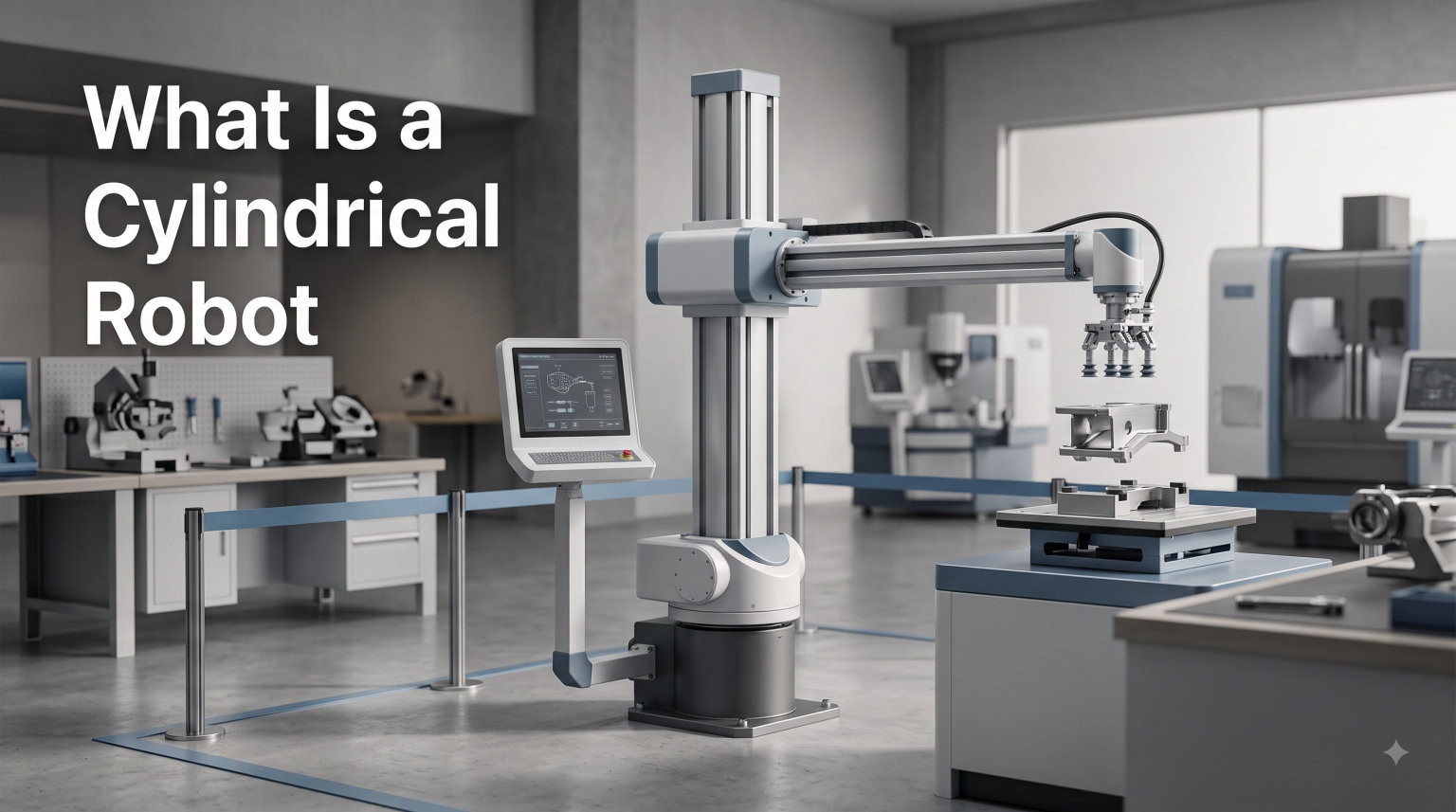
If you have ever watched an assembly line pick up a part, rotate it into position, and place it with the same precision hundreds of times per hour, you have likely seen a cylindrical robot at work. These machines have been quietly powering factories since the 1970s, and they remain one of the most cost-effective automation solutions in 2026.
In this guide, I will walk you through exactly what a cylindrical robot is, how the mechanical structure works, where these robots earn their keep on the factory floor, and how they compare to other industrial robot types. Our team has spent time on manufacturing floors studying these systems, and the answers below come from that hands-on research plus the latest industry data.
Table of Contents
What Is a Cylindrical Robot
A cylindrical robot is an industrial robot whose axes form a cylindrical coordinate system, with one rotary axis at the base for rotation and two linear axes for vertical movement and arm extension. The combination of these three axes creates a working space shaped like a hollow cylinder, and the robot’s end effector can reach any point inside that volume.
This simple definition matters because it explains the robot’s name, its motion pattern, and its core strength in a single sentence. When engineers say a cylindrical robot works in a cylindrical coordinate system, they mean the arm sweeps through space the same way a point moves in cylindrical math notation: by combining an angle, a height, and a radius from a central post.
Cylindrical robots belong to the broader family of industrial robot arms, alongside Cartesian, SCARA, articulated, and polar configurations. Each configuration has a signature shape to its work envelope, and the cylindrical robot’s signature is exactly what the name suggests.
How Cylindrical Robots Work
Every cylindrical robot is built around three primary axes, and understanding those axes is the fastest way to understand the whole machine.
The Three-Axis Configuration
The first axis is a revolute joint, often called a rotary base, that spins the entire arm around a vertical column. This gives the robot 360 degrees of horizontal rotation, just like a turntable. The second axis is a prismatic joint, a linear slide, that raises and lowers the arm along that vertical column. The third axis is another prismatic joint that extends the arm outward and pulls it back in, like a telescope.
Together, these three movements describe a point in three-dimensional space using angle, height, and radius. That is the cylindrical coordinate system, and it is also the reason the work envelope takes the shape of a hollow cylinder when you map it out.
Joints, Actuators, and Reach
Most cylindrical robots use servo motors paired with gear reducers to drive each axis. The rotary base typically uses a heavy-duty servo with a high gear ratio to handle the entire arm’s mass as it pivots. The vertical and radial linear axes often use ball screws or rack-and-pinion drives, which keep motion smooth and repeatable to within a few thousandths of an inch.
Payload capacity for cylindrical robots usually runs from a few kilograms up to about 50 kilograms for heavier material handling models. Reach commonly extends to 1.5 or 2 meters vertically and a similar distance radially, though industrial units can go further. The mechanical simplicity is one of the defining features, and it translates directly into lower cost, easier maintenance, and reliable long-term performance.
The Workspace Envelope
The work envelope is the entire region of space the robot’s end effector can reach. For a cylindrical robot, this envelope is a hollow cylindrical shell, sometimes called a tube of reach. There is a hollow core right around the central column where the arm cannot reach, and there is a maximum outer radius where the arm runs out of extension. Anything inside that tube-shaped region is fair game for the robot’s tooling.
Cylindrical Robot vs Other Robot Types
Choosing the right robot configuration is one of the most common pain points I hear from automation engineers, especially on forums like Reddit’s r/robotics and Robot Forum. The simplest way to compare options is to look at the shape of their work envelopes side by side.
Quick Comparison Table
Here is how the four most common industrial robot configurations stack up against each other.
- Cartesian robot: Three linear axes (X, Y, Z) form a rectangular work envelope. Excellent precision and easy programming, but the mechanics get bulky at long reaches.
- Cylindrical robot: One rotary axis plus two linear axes form a cylindrical work envelope. Compact, fast, and cost-effective for round work zones.
- SCARA robot: Two rotary axes plus a vertical linear axis, giving a horizontal disk-shaped work envelope. Very fast and stiff for top-down assembly.
- Articulated robot: Three or more rotary axes form a roughly spherical work envelope. Maximum flexibility and reach, but higher cost and complexity.
Cylindrical robots sit in a useful middle ground. They are simpler and cheaper than articulated arms, and they have a more natural reach for round or rotational tasks than Cartesian systems. SCARA robots outperform them for high-speed top-down assembly, while articulated arms win when you need maximum flexibility around obstacles.
For operations where the work zone is naturally cylindrical, such as loading a lathe, dipping parts into a die casting station, or rotating around a vertical post, a cylindrical robot is often the smartest match.
Common Applications of Cylindrical Robots
Cylindrical robots have carved out a long list of reliable roles in manufacturing. The five applications below are the ones I see most often when touring plants.
Assembly Operations
Light assembly, especially of small to mid-sized parts, is a classic cylindrical robot task. The arm picks a component, rotates to the next station, lowers it into place, and retracts. The motion is fast, repeatable, and easy to program.
Machine Tending
Cylindrical robots excel at loading and unloading CNC machines, lathes, and presses. The combination of vertical reach and horizontal rotation makes it easy to swing a part out of a chuck, clear the machine, and present it to the next operation.
Die Casting and Foundry Work
High heat, heavy castings, and the need for repeatable placement make die casting a perfect fit. The robust structure of a cylindrical robot handles hot parts, and the rotary base allows it to dip and withdraw from molds cleanly.
Spot Welding and Material Handling
Historically, cylindrical robots have been used in spot welding cells, particularly in automotive body shops. They also handle palletizing, packaging, and pick-and-place operations where the cylindrical envelope matches the work zone naturally.
Coating, Dispensing, and Inspection
When you need to apply sealant around a cylindrical part, dispense adhesive, or rotate a part under a vision camera, the rotating base of a cylindrical robot is genuinely useful. Engineers on Robot Forum have specifically called out this strength for dispensing tasks on round parts.
Advantages and Limitations
No robot type is right for every job, and cylindrical robots are no exception. Here is the honest breakdown of where they shine and where they fall short.
Key Advantages
Mechanical simplicity is the headline benefit. Fewer moving parts mean lower cost, easier maintenance, and a longer mean time between failures. Cylindrical robots also tend to be very fast on their linear axes, since the prismatic joints can be optimized for rapid straight-line motion. Their reach into a round work zone is highly efficient, with no wasted mechanical structure outside the cylindrical envelope. For high-volume, repetitive tasks, they are exceptionally reliable.
Notable Limitations
The hollow core around the central column is a permanent blind spot. If your process requires reaching straight down inside that core, a Cartesian or articulated arm will do better. Cylindrical robots are also less flexible than articulated arms when the work environment is cluttered with obstacles. Finally, modern 6-axis articulated robots have eaten into the cylindrical robot’s market share for many traditional applications, leaving cylindrical systems more common in legacy lines and specific niches.
Choosing the Right Cylindrical Robot for Your Application
Selection comes down to a handful of practical questions. Start by mapping the work zone. If your part naturally moves through a cylindrical space, the choice is easy. Then check payload, including the weight of the gripper and any fixtures. Add a safety margin of 20 to 30 percent above the actual part weight to keep the robot in its optimal performance range.
Repeatability is another key spec. For assembly and dispensing, look for repeatability under 0.05 millimeters. For rougher material handling, repeatability around 0.1 millimeters is often enough. Reach should cover the maximum vertical and horizontal distances with a small buffer.
Integration matters too. Many automation teams I have spoken with run PLC-based control systems, so check the robot controller’s compatibility with your existing stack. Brands like FANUC, Yaskawa, ABB, and KUKA have all produced cylindrical configurations, and there are also many refurbished legacy units still in service.
Finally, consider total cost of ownership. A new cylindrical robot is generally less expensive than a comparable articulated arm, and lower maintenance costs keep lifetime expenses down. If you are replacing a legacy unit, be aware that some older models, like the Zymark XP series that engineers still mention in forums, may be more cost-effective to refurbish than to replace outright.
For more on the mechanical guts that make these robots tick, our piece on how planetary gearboxes work in robot joints is a useful deep dive.
Frequently Asked Questions
What is a cylindrical robot?
A cylindrical robot is an industrial robot whose axes form a cylindrical coordinate system. It has one rotary axis at the base for rotation and two linear axes for vertical movement and arm extension, creating a cylindrical work envelope.
What are cylindrical robots used for?
Cylindrical robots are used for assembly operations, machine tending, die casting, spot welding, material handling, packaging, palletization, and dispensing tasks where the work zone naturally fits a cylindrical shape.
What are the axes of a cylindrical robot?
A standard cylindrical robot has three primary axes: a revolute joint that rotates the base, a prismatic joint that raises and lowers the arm vertically, and a second prismatic joint that extends and retracts the arm radially.
What is the difference between a cylindrical robot and a SCARA robot?
A cylindrical robot uses one rotary axis and two linear axes to create a cylindrical work envelope, while a SCARA robot uses two rotary axes and one vertical linear axis to create a horizontal disk-shaped work envelope. SCARAs are typically faster for top-down assembly, while cylindrical robots handle taller, rounder work zones more naturally.
What are the four main types of industrial robots?
The four main types of industrial robots are Cartesian (linear axes forming a rectangular envelope), cylindrical (one rotary and two linear axes forming a cylindrical envelope), SCARA (two rotary and one linear axis forming a disk-shaped envelope), and articulated (multiple rotary axes forming a roughly spherical envelope).
Conclusion
A cylindrical robot is one of the simplest and most reliable configurations in industrial automation, and its cylindrical coordinate system is both the source of its name and the key to understanding its strengths. If your application has a naturally round work zone and you need a fast, cost-effective, easy-to-maintain solution, the cylindrical robot is still a strong choice in 2026.
For deeper dives into the broader robotics landscape, including humanoid platforms and the AI systems driving them, keep exploring our robotics coverage at Smashing Robotics.