
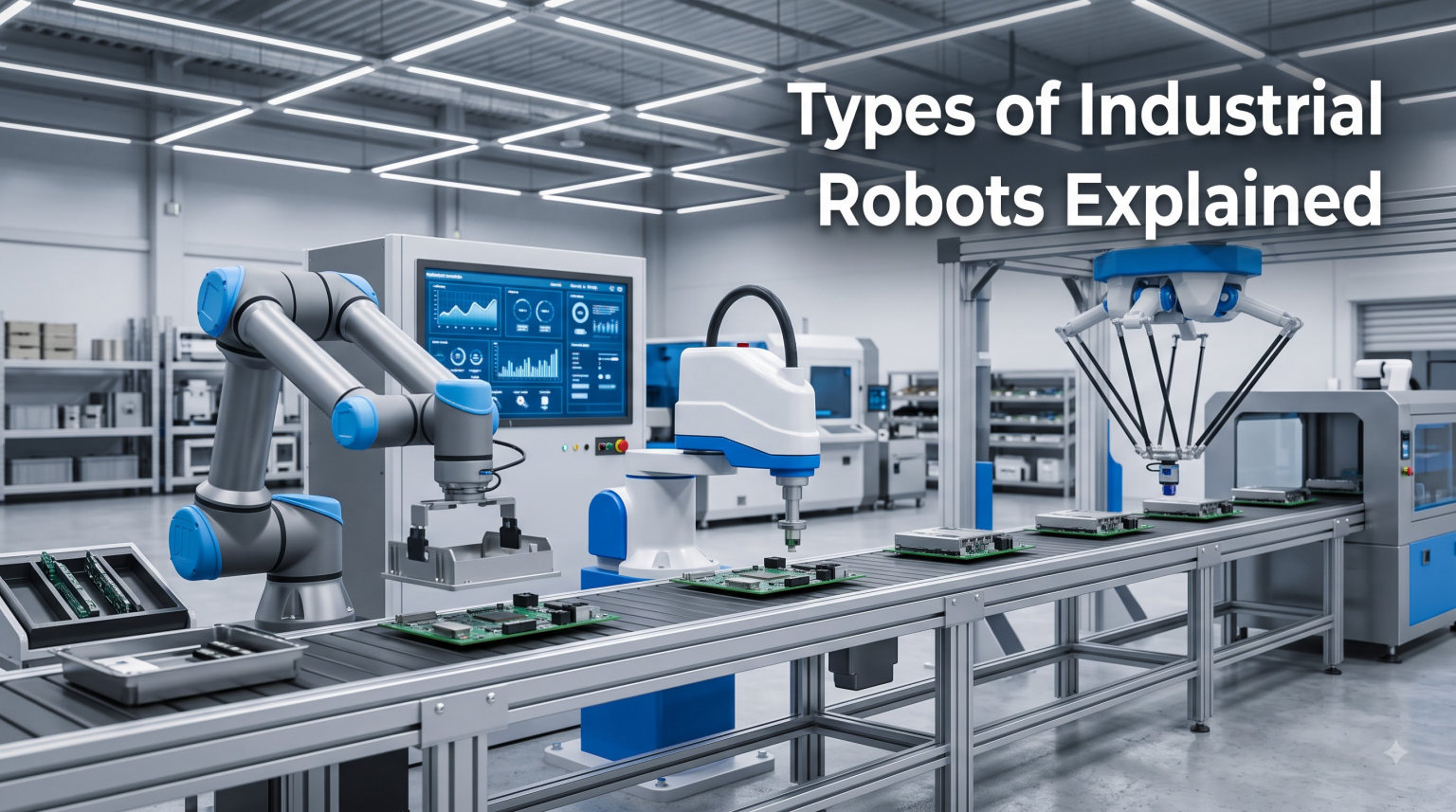
Industrial robots are the backbone of modern manufacturing. From welding car frames to packing blister packs of pills, these programmable machines run millions of production lines worldwide. If you are evaluating automation for a factory, a research lab, or a startup product, the first decision is the most fundamental one: which type of industrial robot fits the job?
I have spent the last decade writing about and visiting robotics labs, and the same question comes up every time. So in this guide, I will walk you through the six core types of industrial robots, plus the increasingly important seventh category, collaborative robots. By the end, you will know what each robot type is, how it works, where it excels, and how to choose between them.
Table of Contents
What Are Industrial Robots? A Working Definition
An industrial robot is a programmable, multi-axis manipulator used in manufacturing and automation. According to the International Federation of Robotics, an industrial robot is an “automatically controlled, reprogrammable, multipurpose manipulator programmable in three or more axes.” That single sentence defines the field.
Three defining features separate industrial robots from other factory machines:
- Programmable. You can change its task without rewiring hardware. Teach a robot to weld today, repaint tomorrow.
- Multi-axis. At least three degrees of freedom, often four to six, so the arm can reach around obstacles.
- Reprogrammable and versatile. The same robot can move from spot welding to machine tending with a new program and a different end effector.
Key Components
Every industrial robot shares a common anatomy. The mechanical arm has links and joints driven by servo motors, which is why we have written a separate deep dive on how servo motors work in robots. A controller executes the program, and an end effector (gripper, welder, paint sprayer, vacuum cup) does the actual work. The combined reach of all joints forms the work envelope, the three-dimensional space the end effector can touch.
Two specifications describe what the robot can handle: payload capacity (how much weight the arm can carry at full reach) and reach (the maximum distance from the base to the tool center point).
The 6 Main Types of Industrial Robots at a Glance
Most textbooks and reference sites group industrial robots into six main categories, based on the coordinate system or kinematic structure of the arm. Here is the list, in the order I find most useful when teaching newcomers.
- Cartesian Robots (Gantry). Three linear axes (X, Y, Z) arranged at right angles. Simple, rigid, and easy to program. Common in CNC machines, 3D printers, and pick-and-place tables.
- SCARA Robots. Two parallel rotary joints plus a linear vertical axis. Fast and stiff in the horizontal plane. The dominant pick-and-place robot in electronics assembly.
- Articulated Robots (6-Axis). Six rotary joints that mimic a human arm. The most flexible and the most common robot type in automotive and heavy industry.
- Cylindrical Robots. One rotary axis at the base, one linear axis, and one prismatic axis. Reach around obstacles in a cylindrical work envelope. Often seen in machine tending.
- Delta Robots (Parallel). Three arms connected to a common base, moving a small platform in parallel. The fastest robot type, used in food, pharma, and packaging.
- Polar Robots (Spherical). One linear and two rotary axes forming a spherical work envelope. Older design, still used in some forging and die-cast applications.
To that list, add a seventh modern category: collaborative robots (cobots). Cobots are built with the same kinematic structures (most are jointed arms) but designed to share a workspace with humans. I cover them in their own section below because the selection criteria differ.
Cartesian Robots: The Linear Workhorse
Cartesian robots, also called gantry robots, move along three perpendicular linear axes. The X, Y, and Z slides are usually belt-driven or rack-and-pinion, stacked on a gantry frame. This makes them the simplest industrial robot type in both mechanics and control.
How Cartesian Robots Work
Each axis moves independently along a straight line, so the controller only has to command positions, not angles. Payloads range from a few hundred grams up to several tons for very large gantries. Reach is set by the length of each axis, so work envelopes are rectangular and predictable.
Typical Applications
Cartesian robots dominate any application that needs straight-line motion over a flat surface. Common uses include CNC machining, 3D printing, automated cutting, large-format assembly, and pick-and-place on conveyor lines. Their rigidity also makes them a popular choice for laser welding and dispensing.
Strengths and Limits
Cartesian robots are the easiest to program and maintain, which is why the r/PLC and r/robotics communities consistently recommend them for first-time automation projects. They are highly accurate, affordable, and easy to scale. The downsides are footprint (they need a full rectangular envelope) and limited ability to reach around obstacles.
SCARA Robots: Speed for Pick-and-Place
SCARA stands for Selective Compliance Assembly Robot Arm. The design has two parallel rotary joints that move in the horizontal plane, plus a linear vertical axis for up-and-down motion. The selective compliance, or flex, is along the vertical axis only, so the arm is rigid horizontally and springy vertically.
How SCARA Robots Work
Two horizontal arms rotate around a vertical column, and a quill moves up and down on the third axis. The configuration is fast, repeatable, and excellent at vertical insertion tasks. Cycle times under one second are common for small parts.
Typical Applications
SCARA robots are the workhorses of electronics assembly. You will find them inserting components onto PCBs, picking chips from trays, and placing small parts in packaging lines. They are also widely used in screw-driving, dispensing, and small-parts testing.
Strengths and Limits
SCARA robots offer an outstanding ratio of speed to payload for assembly work under about 2 kg. Their work envelope is roughly cylindrical, and they can fit into compact cells. They are not suited for large parts, complex 3D paths, or applications that require reaching around obstructions, which is where 6-axis arms pull ahead.
Articulated Robots: The 6-Axis Powerhouse
Articulated robots are the most common industrial robot type. They look and move like a human arm, with rotary joints at the base, shoulder, elbow, and wrist. The most popular configuration, the 6-axis articulated robot, has six rotary degrees of freedom and can position the end effector at any point within its work envelope, at any orientation.
How Articulated Robots Work
Each of the six joints is driven by a servo motor through a harmonic drive or RV reducer. The controller solves inverse kinematics to convert a desired tool position into joint angles, in real time, hundreds of times per second. If you want the engineering detail, our servo motor explainer covers the drive side in depth. The way the cables and hoses are routed through the arm matters too, and that is why igus’s new energy chain with 600-degree rotation is a meaningful upgrade for articulated robots.
Typical Applications
Articulated robots dominate the automotive industry: spot welding, arc welding, paint spraying, and material handling. Outside the car plant, you see them in machine tending, foundry work, palletizing, and large-part assembly. They are the default choice when the work envelope is complex or the part is heavy.
Strengths and Limits
With six degrees of freedom, articulated robots can reach around fixtures, weld in tight seams, and orient the end effector freely in 3D space. Payloads range from 6 kg up to over 1,000 kg for heavy-duty models. They cost more than Cartesian or SCARA robots, require more programming expertise, and need a larger footprint.
Cylindrical Robots: Reach Around the Work Cell
Cylindrical robots have a rotary base, a vertical linear axis, and a horizontal prismatic (sliding) arm. The combined motion traces a cylindrical work envelope, which is why they are sometimes called cylindrical-coordinate robots.
How Cylindrical Robots Work
The base rotates around a vertical column, a vertical slide moves up and down, and a horizontal arm extends and retracts. The end effector can reach around obstacles in the radial direction without needing multiple rotary joints.
Typical Applications
Cylindrical robots are common in machine tending for lathes and milling machines, where the arm has to reach through a door into the work area. They are also used in coating, simple pick-and-place, and assembly of round or tubular parts.
Strengths and Limits
They are simpler than 6-axis articulated robots and can handle heavier payloads than SCARAs of similar size. They are rigid and well-suited to confined cells. The downside is the cylindrical work envelope, which leaves dead zones in the corners of a rectangular workspace.
Delta Robots: The Parallel Speed Champions
Delta robots, also called parallel link robots, use three arms connected in parallel between the base and a small moving platform. The arms are usually belt-driven or actuated by motors mounted above the work envelope, so the platform itself stays very light.
How Delta Robots Work
Three or four motors at the top of the cell drive linkages that move the platform in three translational degrees of freedom (X, Y, Z). Because the moving mass is small and the structure is stiff, delta robots accelerate in milliseconds and can complete 100+ picks per minute.
Typical Applications
Delta robots are the first choice for high-speed pick-and-place in food packaging, pharmaceutical blister packs, cosmetics, and small electronics. You will also see them in 3D printing and some high-speed assembly applications where cycle time is the bottleneck.
Strengths and Limits
Delta robots are the fastest industrial robot type, and they handle food and pharma well because the stainless variants are washdown-rated. The trade-off is a small work envelope (typically under 1.5 m diameter) and a much higher unit cost than Cartesian or SCARA robots. Integration also requires more expertise, which the r/robotics community flags often.
Polar Robots: Spherical Work Envelopes
Polar robots, sometimes called spherical robots, have one linear axis and two rotary axes that combine to form a spherical work envelope. The base rotates, an arm tilts up and down, and a prismatic joint extends the arm outward.
How Polar Robots Work
The coordinate system is polar: an angle, a tilt, and a reach. The work envelope is a section of a sphere, which is efficient when the robot needs to cover a wide range of angles from a central point.
Typical Applications
Polar robots are an older design, but they still show up in die casting, forging, glass handling, and some heavy-payload machine tending. Their ability to reach high and tilt the tool downward makes them useful for press tending and injection molding.
Strengths and Limits
Polar robots offer good reach and payload relative to their size, and they can reach high vertical positions. They are less common in new installations because 6-axis articulated robots have become more affordable, and programming a 6-axis arm is now easier than programming a polar robot. Most modern buyers will only encounter polar robots in legacy cells.
Collaborative Robots (Cobots): Working Alongside Humans
Collaborative robots, or cobots, are not a separate kinematic family. Most cobots are articulated arms (4-axis, 6-axis, or 7-axis). What makes them collaborative is a set of design features that allow them to share a workspace with human operators safely, under the conditions defined by ISO/TS 15066.
What Makes a Robot Collaborative
Cobots use a combination of force sensing, rounded geometry, low inertia, and software-monitored speed and force limits. Where a traditional industrial robot moves at 2 m/s or faster, cobots are typically limited to 250 mm/s during collaboration, which is a real bottleneck the r/robotics community flags often. They also support power- and force-limited operation, where the robot stops on contact.
Cobot vs Traditional Industrial Robot
Cobots trade raw speed and payload for ease of use. You can teach a cobot a new task by physically guiding its arm or via a simple drag-and-drop interface, instead of writing ladder logic or KAREL code. The trade-offs are well documented in user forums: cobots are slower, carry less payload (usually 3-35 kg), and have a smaller reach than a comparable industrial arm. For high-volume production, traditional robots still win on throughput.
Typical Applications
Cobots shine in low-volume, high-mix environments: small-batch assembly, machine tending for short runs, screw-driving, glue dispensing, quality inspection, and palletizing mixed-SKU orders. They are popular in small and mid-sized manufacturers, which is why we cover them alongside the broader trend in autonomous mobile robots.
How to Choose the Right Industrial Robot Type
Choosing a robot is a five-step process. Walk through these in order and you will arrive at a defensible answer.
Step 1: Define the Task
Write down what the robot has to do in plain language. Welding a seam, picking from a tray, palletizing boxes, dispensing glue, or tending a CNC mill. Each task points to a kinematic family. Welding and painting almost always go to articulated arms. Pick-and-place in a tight cell usually points to SCARA or delta. Machine tending in a rectangular envelope points to Cartesian.
Step 2: Match Axes to Motion Needs
Count the number of independent motions the task requires. A pick from a flat tray is fine with 4 axes. A weld seam on a curved part needs 6 axes. A palletizing cell might be fine with 4 but uses 6 for flexibility. Add axes only when the task needs them, since more axes mean more programming and more cost.
Step 3: Check Payload and Reach
Total payload is the weight of the part plus the end effector plus any cabling. Add a 20-30% safety margin. Reach is the distance from the robot base to the farthest point the tool must touch, again with margin. For articulated arms, payload drops as reach extends, so check the payload-reach curve, not just the headline number.
Step 4: Evaluate Speed, Repeatability, and Footprint
Speed is measured in degrees per second, mm/s, or cycles per minute. Match it to your takt time. Repeatability, the ability to return to a taught position, is typically ±0.02 mm for SCARA and articulated arms, ±0.1 mm for Cartesian, and ±0.05 mm for delta. Footprint matters when floor space is limited; SCARA and delta fit in smaller cells than articulated arms.
Step 5: Consider Integration, Safety, and TCO
Think about how the robot will be programmed (hand-guidance, teach pendant, offline), how it will talk to the rest of the line (fieldbus, OPC UA, MQTT for Industry 4.0), and how updates will be deployed. The trend toward OTA software updates for robots is changing how fleets are maintained. Finally, model total cost of ownership: the robot cost is usually only 30-40% of the lifetime cost. The rest is integration, end-of-arm tooling, training, and maintenance.
Comparison Table: All Industrial Robot Types
| Type | Axes | Payload | Reach | Speed | Typical Application |
|---|---|---|---|---|---|
| Cartesian | 3 (linear) | 1 kg to 1,000+ kg | Customizable | Medium | CNC, 3D printing, pick-and-place |
| SCARA | 4 (2 rotary + 1 linear + 1 Z) | 0.5 to 20 kg | 200 to 1,000 mm | High | Electronics assembly, dispensing |
| Articulated (6-axis) | 6 (rotary) | 6 to 1,000+ kg | 500 to 3,500+ mm | Medium-High | Welding, painting, machine tending |
| Cylindrical | 3 to 4 (1 rotary + 1 linear + 1 prismatic) | 5 to 500 kg | 500 to 2,000 mm | Medium | Machine tending, coating |
| Delta (parallel) | 3 to 4 (translational) | 0.1 to 12 kg | 300 to 1,500 mm diameter | Very high | Food, pharma, packaging |
| Polar (spherical) | 3 (1 linear + 2 rotary) | 5 to 1,000 kg | 500 to 3,000 mm | Medium | Die casting, forging, press tending |
| Collaborative (cobot) | 4 to 7 | 3 to 35 kg | 500 to 1,800 mm | Low (capped at 250 mm/s) | Small-batch assembly, inspection |
Frequently Asked Questions
What are the six main types of industrial robots?
The six main types are Cartesian (linear gantry), SCARA, articulated (typically 6-axis), cylindrical, delta (parallel), and polar (spherical). Each is defined by its kinematic structure and the shape of its work envelope.
What is the most common industrial robot type?
The 6-axis articulated robot is the most common industrial robot type. It dominates automotive welding, painting, and material handling because it can reach any point inside its work envelope at any orientation.
What is the difference between a SCARA and an articulated robot?
A SCARA robot has two parallel rotary joints and a vertical linear axis, giving it a roughly cylindrical work envelope and very fast horizontal motion. An articulated robot has three to six rotary joints, which lets it reach around obstacles and orient the tool freely in 3D space.
What is a delta robot used for?
Delta robots are used for high-speed pick-and-place in food packaging, pharmaceutical blister packs, cosmetics, and small electronics assembly. They are the fastest industrial robot type and can complete over 100 picks per minute in some applications.
How is a cobot different from a traditional industrial robot?
A cobot is designed to share a workspace with humans. It runs at lower speeds (typically capped at 250 mm/s during collaboration), uses force sensing to stop on contact, and is easier to program via hand-guidance. A traditional industrial robot is faster, carries more payload, and operates inside a safety cage.
How do I choose the right industrial robot type for my application?
Start by defining the task and the workspace, then match the number of axes, payload, reach, speed, and repeatability to that task. Finally, weigh integration cost, programming complexity, safety requirements, and total cost of ownership. For high-volume production, traditional articulated or delta robots win on throughput. For low-volume, high-mix work, cobots usually win on flexibility.
Conclusion: Picking the Right Robot for Your Cell
There is no single best type of industrial robot, only the right tool for the task. Articulated 6-axis arms cover most heavy-industry work, SCARAs dominate small-parts assembly, delta robots own high-speed packaging, Cartesian gantries handle linear jobs, cylindrical and polar robots fit legacy cells, and cobots open automation to low-volume, high-mix environments. If you want to see how all of this is changing under Industry 4.0, look at the rise of robots that learn on the job. The kinematics stay the same; the intelligence is what is shifting.