
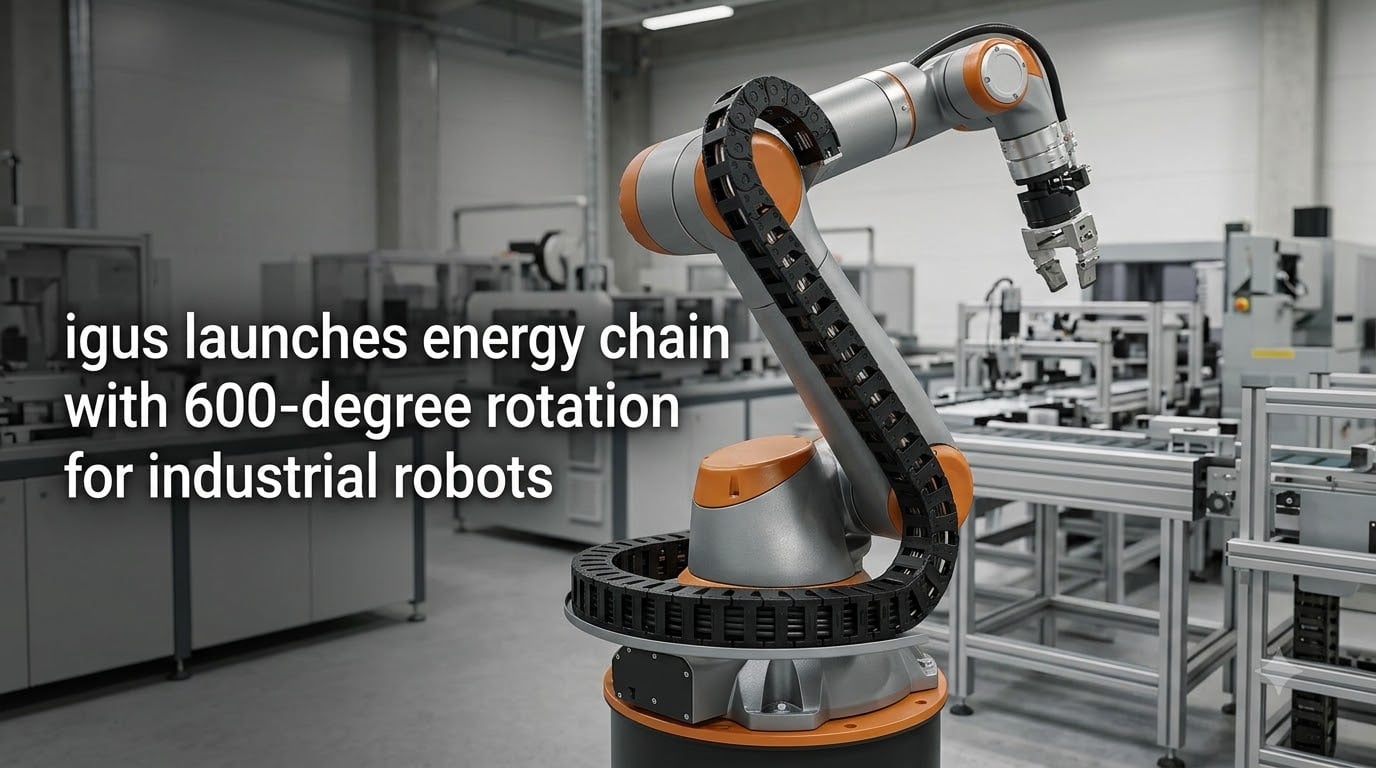
On August 3, 2026, igus introduced a new self-supporting energy chain designed to handle rotation angles exceeding 600 degrees on industrial robots. The product, called the twisterchain, tackles two long-standing challenges in robotic cable management: keeping cables organized through continuous rotation and eliminating the need for bulky guide troughs that eat up valuable floor space.
An igus energy chain is a cable carrier system made from motion plastics that guides power, data, and media cables safely through moving parts on industrial robots. The new twisterchain variant extends this concept to applications where a robot arm rotates well beyond a single full turn, which has been a pain point for automation engineers working with compact robot designs.
Our team has been tracking developments in robot dress pack technology, and this launch stands out because no competing solution currently offers self-supporting rotation past 600 degrees in such a compact footprint. The igus energy chain 600 degree rotation industrial robots solution fills a gap that palletizing and assembly robot integrators have struggled with for years.
Table of Contents
What Is the igus twisterchain Energy Chain?
The igus twisterchain is a specialized energy chain engineered for rotary movements on industrial robots. Unlike standard cable carriers that move in linear gliding or hanging applications, the twisterchain is built to wrap around a robot base or axis and flex through continuous rotation cycles.
What sets this chain apart is its self-supporting design. The chain holds its own weight in a suspended arc without needing a guide trough or external track to keep it aligned. That means the chain literally supports itself as it swings through each rotation cycle, lifting and settling in a controlled manner.
igus constructs the twisterchain from its proprietary tribo-polymers, a family of motion plastics developed in-house over decades of wear testing. These materials are engineered to minimize friction between the chain links during repeated bending cycles, which directly extends service life compared to standard industrial plastics.
The chain’s geometry is also purpose-built for rotational motion. Rather than articulating in a single plane like a conventional e-chain, the twisterchain’s links twist along their vertical axis, allowing the entire assembly to follow a curved path around the robot’s rotational axis.
How the 600-Degree Rotation System Works
The 600-degree rotation capability comes from a two-connection-point design. One end of the twisterchain mounts to the fixed robot base, while the other end attaches to the rotating element. As the robot rotates, the chain forms a sag that sits around the base and lifts step by step instead of wrapping continuously.
This step-by-step lifting motion is the key innovation. As rotation increases past 360 degrees, traditional chains would collide with themselves or the connector plate. The twisterchain avoids this by stacking its sag in a controlled arc that lifts cleanly with each degree of rotation, reaching past 600 degrees without mechanical interference.
Because the chain is self-supporting, no guide trough is required. Traditional energy chain systems on rotating robot axes often need a machined trough or track bolted to the robot base to guide the chain through its travel. Eliminating that trough simplifies installation and reduces the overall footprint of the cable management system.
The design also incorporates adjustable pretension. Engineers can fine-tune how tightly the chain holds its arc, which lets the twisterchain accommodate different robot sizes, rotation speeds, and cable payloads without requiring custom chain geometry for each application.
Key Features of the igus twisterchain
The twisterchain brings several engineering features that address real-world cable management problems on industrial robots:
Inner radius opening: The chain opens on its inner radius, giving technicians direct access to cables at the point where they experience the most stress during rotation. This makes inspection and replacement significantly faster than with chains that only open from the outside.
Removable shelves: Interior separation shelves can be pulled out individually, so cables can be inserted or serviced without threading them through the entire chain length from one end. This is a major time-saver during commissioning and maintenance.
Flexible interior separation: The chain supports adjustable interior separators that keep power, data, and pneumatic lines from rubbing against each other during rotation. Cross-cable friction is one of the leading causes of premature cable failure in robot dress packs.
Adjustable pretension: The chain’s arc tension can be tuned to match the specific robot application, ensuring stable motion whether the robot rotates slowly for palletizing or rapidly for pick-and-place tasks.
Target Applications for Industrial Robots
igus designed the twisterchain primarily for two categories of robots that have historically lacked reliable energy supply solutions for fast-rotating axes.
Compact industrial robots are the first target. These smaller robots often have tight mounting envelopes where a traditional guide trough simply will not fit. The twisterchain’s self-supporting design means it can be installed on compact robot bases without adding structural steel or machining custom guide tracks.
Palletizing robots represent the second major application. These robots typically rotate through large angles as they move between conveyor infeed and stacking positions, and cable management on the primary rotational axis has been a persistent failure point. The 600-degree rotation capacity covers the full working envelope of most palletizing robots without requiring slack loops or cable wraps.
Beyond these two primary categories, the twisterchain suits several specific automation tasks:
Screwing and gluing applications where the robot end effector rotates continuously during fastening or dispensing cycles. Assembly automation stations that require the robot to reach multiple fixtures around its base. Pick-and-place robots that sweep through wide arcs between loading and unloading positions.
The chain can be mounted on axis 1 at the robot base for primary rotation, or on axis 5 near the end effector for wrist rotation, depending on which axis demands the higher rotation angle in the specific application.
twisterchain vs Traditional Cable Management
Traditional cable management on rotating robot axes typically falls into one of three approaches, each with well-documented drawbacks that the twisterchain addresses directly.
Guide trough systems are the most common solution for high-angle rotation. A metal or plastic trough is bolted to the robot base, and a standard energy chain rides inside it. The trough adds weight, takes up space, and requires precision alignment during installation. The twisterchain eliminates the trough entirely, which reduces both engineering time and mechanical complexity.
Loose cable wraps involve bundling cables and letting them hang freely through the rotation axis. This approach is cheap initially but leads to cable tangling, abrasion, and premature failure. Forum discussions among robotics engineers consistently highlight cable tangling during 360-degree rotation as a top frustration. The twisterchain guides cables through a protected channel, eliminating the tangling problem.
Slip ring assemblies transmit power and signals through rotating contacts, which works for continuous spin but adds cost, complexity, and a wear surface that eventually fails. Slip rings also have limitations on the number and type of cables they can handle. The twisterchain carries standard cables without modification, so no special wiring or signal conditioning is needed.
From a maintenance standpoint, the twisterchain’s removable shelves and inner radius opening mean that a damaged cable can be replaced in minutes rather than hours. With a guide trough system, the entire chain often needs to be removed from the trough to access interior cables.
Servicing and Sustainability
igus built serviceability into the twisterchain from the ground up. The inner radius opening and removable shelves let maintenance technicians access individual cables without disassembling the full chain or disconnecting both endpoints. In production environments where robot downtime costs thousands per hour, this design choice has real financial impact.
The chain is made from recyclable tribo-polymers, consistent with igus’s broader sustainability initiatives. The company operates a recycling program for spent energy chains and has been expanding its use of regranulated materials across its product lines.
igus also offers an online service life calculation tool that predicts chain lifespan based on application parameters like rotation angle, speed, cable payload, and environmental conditions. Engineers can input their specific robot data and receive an estimated service life before committing to the twisterchain, which takes the guesswork out of maintenance planning.
The twisterchain is available from stock, meaning it is not a fully custom-engineered solution with lead times measured in months. Standard sizes ship quickly, and igus offers customization for non-standard applications through its engineering team.
igus has also integrated the twisterchain into its RBTX platform, an online marketplace for Lean Robotics components that helps automation engineers match compatible parts across manufacturers. This means the chain can be paired with igus chainflex continuous-flex cables, plain bearings, and linear guides as part of a complete energy supply system.
What is an igus energy chain?
An igus energy chain is a cable carrier system made from motion plastics that guides power, data, and media cables safely through moving parts on industrial robots and automation equipment. The twisterchain variant is designed specifically for rotary movements exceeding 600 degrees.
How does the twisterchain achieve 600-degree rotation?
The twisterchain uses a two-connection-point design where the chain forms a controlled sag around the robot base. As the robot rotates, the chain lifts step by step rather than wrapping continuously, allowing it to reach past 600 degrees without colliding with itself or the connector plate.
Which robots benefit most from the igus twisterchain?
Compact industrial robots and palletizing robots benefit most from the twisterchain, as both require high-angle rotation on their primary axes. It also works well for screwing, gluing, assembly, and pick-and-place applications where the robot sweeps through wide arcs.
Does the twisterchain require a guide trough?
No, the twisterchain is self-supporting and does not require a guide trough. This eliminates the need to machine and install an external track on the robot base, simplifying installation and reducing the overall system footprint.
How long does an igus energy chain last?
Service life depends on the application parameters including rotation angle, speed, cable payload, and environmental conditions. igus provides an online service life calculation tool where engineers can input their specific robot data to receive an estimated lifespan before installation.
What This Launch Means for Robotics in 2026
The igus twisterchain solves a specific engineering problem that has limited compact and palletizing robot designs for years. By enabling 600-degree rotation in a self-supporting package that needs no guide trough, igus gives automation engineers a simpler path to reliable cable management on high-rotation axes.
For the broader robotics industry, this launch signals that motion plastics technology has matured to the point where complex rotational cable management can be handled by standardized, stock-available components rather than fully custom-engineered solutions. That shift reduces lead times, simplifies spare parts management, and makes advanced robot configurations accessible to smaller integration teams.
The igus energy chain 600 degree rotation industrial robots solution is available now through igus and its distribution network, with standard sizes in stock and custom configurations available on request.