
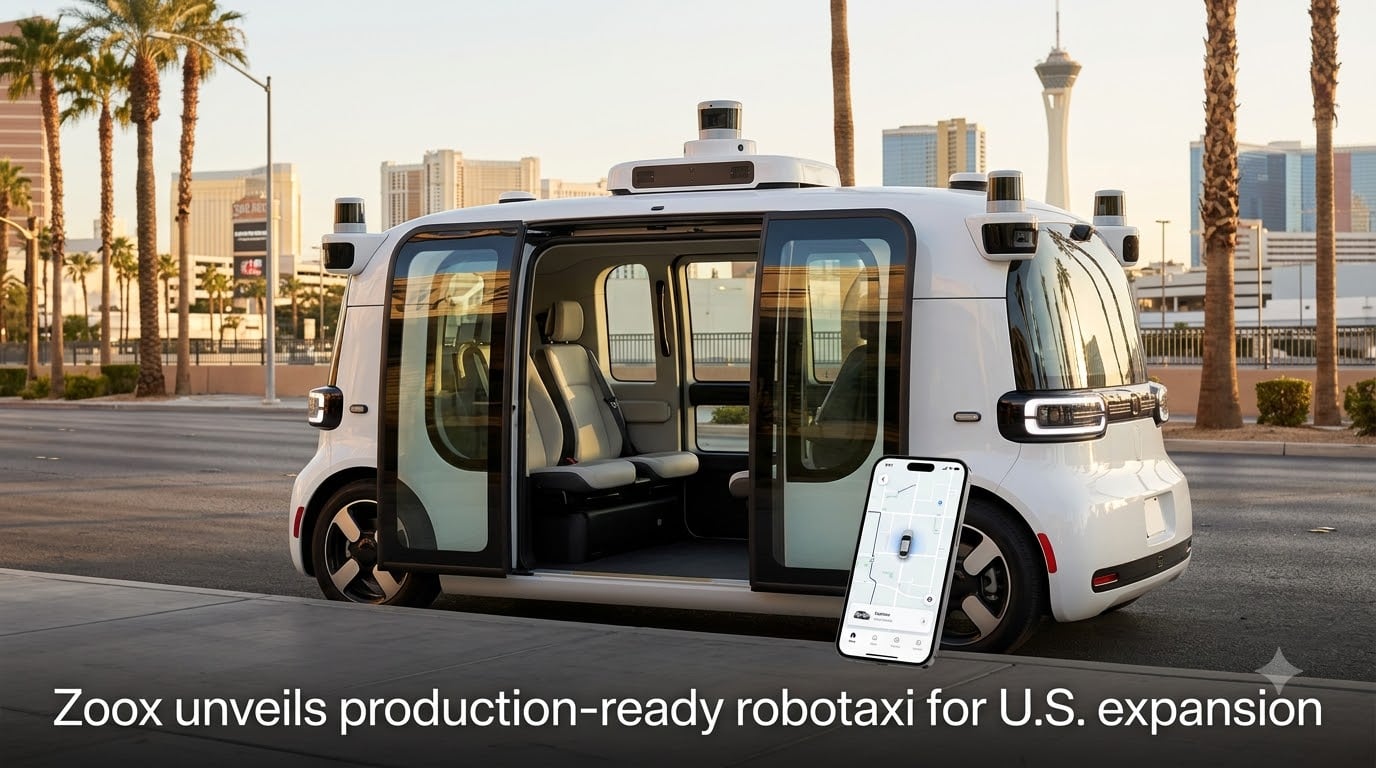
Amazon’s Zoox has pulled the wraps off a production-ready version of its toaster-shaped robotaxi, setting the stage for a multi-city U.S. expansion in 2026. The unveiling, combined with a landmark federal safety exemption, gives Zoox the legal clearance to charge passengers for driverless rides through a vehicle that has no steering wheel and no pedals.
I have been tracking Zoox since the company first showed off its bidirectional concept years ago, and this announcement feels different. This is not another demo video or a waitlist page. Zoox is now a commercial robotaxi service, and the production-ready vehicle is the version that will actually scale across U.S. cities.
Table of Contents
What Zoox Announced With the Production-Ready Robotaxi
On September 2026, Zoox publicly revealed the production-intent version of its purpose-built robotaxi, the first U.S.-approved vehicle designed from the ground up for autonomous ride-hailing without any human controls.
The biggest news wrapped inside this announcement is regulatory. The National Highway Traffic Safety Administration (NHTSA) granted Zoox a temporary exemption covering eight federal motor vehicle safety standards. The exemption allows Zoox to deploy up to 2,500 vehicles annually for two years, which is the first U.S. approval for paid robotaxis that operate without steering wheels or pedals.
For Amazon, the parent company that acquired Zoox in 2020, this is the moment their autonomous vehicle bet starts paying off in real rides, not just pilot programs. Aicha Evans, Zoox’s CEO, has framed the approval as the company stepping into a new phase of commercial deployment.
Key Features and Upgrades of the New Zoox Robotaxi
The redesigned Zoox robotaxi is not a refresh of the prototype. It is a vehicle built for serial production, with comfort and durability upgrades that come straight from real rider feedback. Here is what changed from the early prototypes:
- Comfortable seats with proper headrests for all four passengers, addressing one of the most consistent complaints from earlier test riders.
- Higher-quality touch screens at each seat for riders to control music, climate, and ride destinations.
- Bidirectional reflectors since the vehicle has no traditional front or rear, lighting has to work in both directions.
- Bluetooth audio pairing so multiple riders can connect their devices at once.
- ZooxCast and Find My Zoox features in the app for live tracking and entertainment.
- Pre-booking capabilities for hotels, the Las Vegas Convention Center, and other high-traffic destinations.
The vehicle’s bidirectional wheels and symmetrical design are not gimmicks. They let the robotaxi pull into a space, drop off riders, and leave in the opposite direction without awkward three-point turns. That is a real advantage in dense urban cores where U-turns are often illegal.
U.S. Expansion Cities and Timeline
Zoox is no longer a one-city story. The current footprint includes Las Vegas and San Francisco, with both cities getting meaningful service upgrades heading into 2026.
Las Vegas is now running a wider service area, including a partnership with the Las Vegas Convention Center that helps move thousands of visitors per day. San Francisco has roughly quadrupled its operating area compared to the early Zoox Explorers program, which is how the robotaxi service started.
The bigger headlines are the two new launch markets: Austin and Miami. Both are expected to come online in 2026, giving Zoox a four-city launch footprint to start the year. The company has logged over 2 million autonomous miles and carried more than 350,000 passengers, which is a meaningful real-world dataset for regulators and partners evaluating safety.
On the production side, Zoox’s serial production facility in Hayward, California is being scaled up to support a target output of roughly 10,000 vehicles per year. That is the same scale Waymo has been targeting with its retrofitted Jaguar I-PACE fleet, but Zoox is doing it with a purpose-built vehicle rather than a converted SUV.
Zoox vs Waymo: How the Robotaxi Race Stacks Up
Any honest coverage of Zoox has to address Waymo, since Waymo is the only other U.S. company running a paid driverless service at scale. Waymo currently runs around 500,000 paid rides per week across Phoenix, San Francisco, Los Angeles, and Austin, which is a massive operational lead.
Where Zoox argues it has a differentiator is the vehicle itself. Waymo’s service runs on retrofitted Jaguars that still have steering wheels and pedals, even if no human uses them. Zoox’s robotaxi was designed from scratch for autonomous ride-hailing, which the company claims gives it more interior space, a lower entry step, and a cleaner cabin experience.
That said, Reddit users who have ridden both services point out real trade-offs. Some Zoox riders describe the cabin as feeling small and budget compared to a Waymo Jaguar, and the vehicle is currently capped at 45 MPH. Zoox has also had issues navigating heavy smoke conditions in California wildfire periods. None of these are deal-breakers, but they are worth knowing if you plan to ride.
The Tesla Cybercab, which Elon Musk has been teasing for 2026, is a third competitor to watch. As of this writing, it has not yet launched a paid commercial service, leaving Zoox and Waymo as the two real players in paid U.S. robotaxi service today.
What This Means for the Future of Autonomous Transportation
The Zoox robotaxi matters well beyond one company. It is the first commercial proof point that a vehicle without a steering wheel or pedals can be legally sold and operated for paid rides in the United States. That precedent opens the door for other purpose-built designs from competitors, suppliers, and startups.
For Amazon, the Zoox robotaxi is also a long-term play in urban logistics and transportation. Whether Zoox eventually integrates with Prime, Whole Foods, or AWS-powered fleet management has not been announced, but the strategic fit is obvious. In 2026, expect more city launches, more pressure on NHTSA to make the temporary exemption permanent, and more competition for Waymo’s ridership numbers.
Is Zoox owned by Amazon?
Yes. Zoox is a wholly-owned subsidiary of Amazon. Amazon acquired the autonomous vehicle company in 2020, and Zoox continues to operate as an independent unit focused on purpose-built robotaxi service for urban ride-hailing.
How long will Zoox be free?
Zoox has been offering free rides to early users through its Zoox Explorers waitlist program in Las Vegas and San Francisco. The free period is ending as the company transitions to a paid service in 2026, now that NHTSA has cleared its exemption for commercial operations.
Is Zoox cheaper than Uber?
Pricing for the paid Zoox robotaxi service has not been publicly confirmed in detail, but early reports suggest Zoox is positioning itself competitively with Uber and Lyft rather than as a premium alternative. Final pricing will roll out alongside the paid launch in 2026.
What is the latest news on Zoox?
As of September 2026, the latest news is the unveiling of Zoox’s production-ready robotaxi and NHTSA’s temporary exemption allowing up to 2,500 vehicles per year to operate as paid driverless robotaxis. Zoox is also expanding to Austin and Miami.
What are the latest updates to the Amazon Zoox robotaxi?
The newest updates to the Amazon Zoox robotaxi include comfortable seats with headrests, higher-quality touch screens, bidirectional reflectors, Bluetooth audio, Find My Zoox tracking, ZooxCast entertainment, and pre-booking for hotels and the Las Vegas Convention Center.
Conclusion
The Zoox production-ready robotaxi marks the first real commercial test of a steering-wheel-free, pedal-free vehicle in the United States. With NHTSA approval secured, four launch cities lined up for 2026, and a serial production facility scaling toward 10,000 vehicles per year, Zoox has moved from a curiosity to a genuine competitor to Waymo in the U.S. robotaxi market.
Watch for the paid launch in Austin and Miami over the next few months, the first pricing data, and any safety reports from the rollout. The Zoox robotaxi story is no longer about whether the technology works. It is about whether the business model scales.