
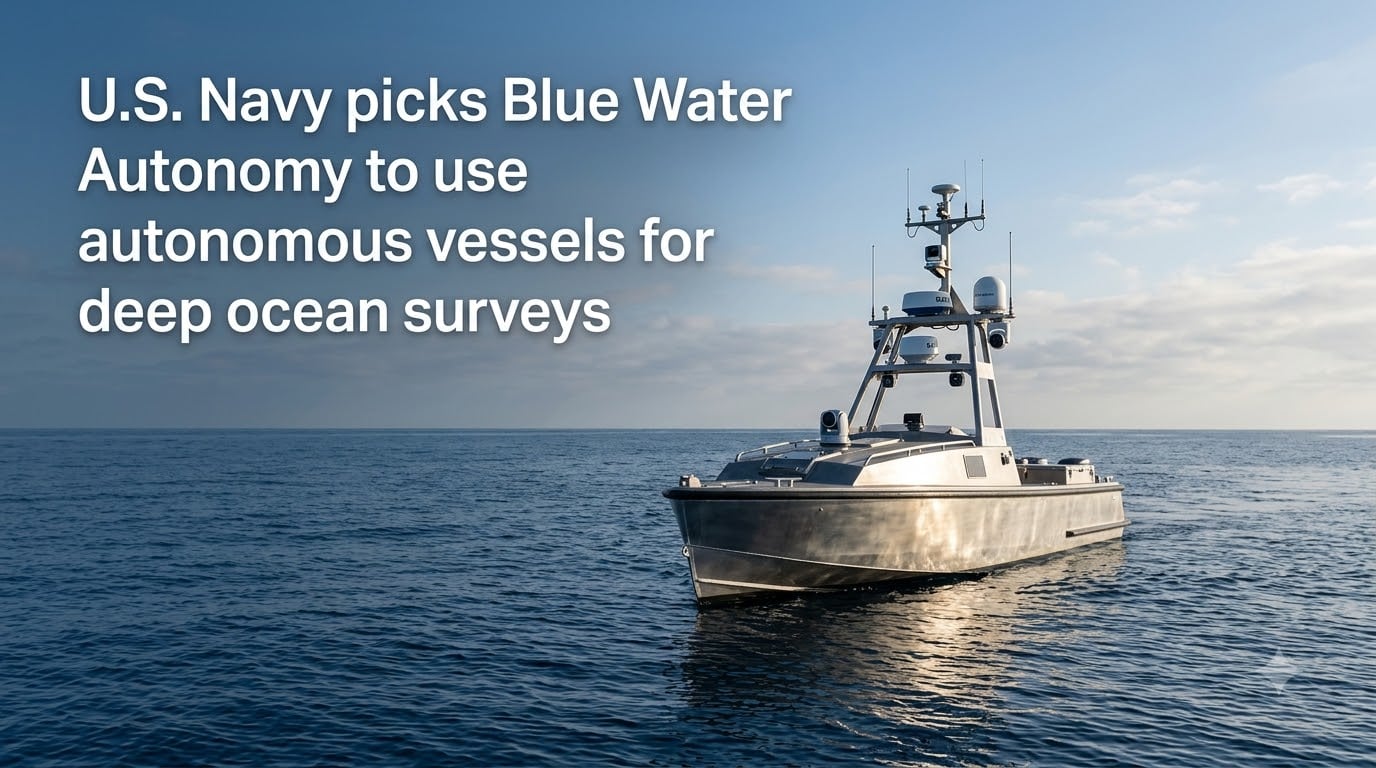
The U.S. Navy has selected Blue Water Autonomy to use autonomous vessels for deep ocean surveys, naming the Boston-based startup as an awardee on a Naval Oceanographic Office (NAVOCEANO) contract to map the seafloor with uncrewed surface vessels. The selection places Blue Water Autonomy among a small group of companies competing for task orders under a shared $40 million ceiling over a two-year period. This move signals the Navy’s accelerating push to replace crewed survey ships with long-endurance autonomous platforms across the Indian and Pacific Oceans.
For readers tracking defense technology and autonomous maritime systems, this contract award matters because it validates a company that did not exist two years ago. Blue Water Autonomy, founded in 2024, has gone from concept to Navy contract awardee in record time, proving that the demand for uncrewed ocean survey capabilities has outpaced traditional shipbuilding timelines.
Table of Contents
Navy Selects Blue Water Autonomy for Autonomous Vessels Deep Ocean Surveys
The U.S. Navy Blue Water Autonomy autonomous vessels deep ocean surveys contract is structured as an Indefinite Delivery, Indefinite Quantity (IDIQ) agreement. This means the Navy does not commit to a fixed number of vessels or missions upfront. Instead, Blue Water Autonomy holds one of six seats on the contract and competes for individual task orders as survey needs arise.
The contract carries a shared $40 million ceiling across all awardees over a two-year base period. The Naval Oceanographic Office, headquartered at NASA’s Stennis Space Center in Mississippi, will issue task orders for specific deep ocean survey missions. These missions focus on collecting high-resolution bathymetric data and characterizing ocean conditions across vast stretches of the Indian and Pacific Oceans.
Ocean floor mapping is foundational to Navy operations. Accurate seafloor terrain data informs submarine navigation, undersea cable routing, mine detection, and amphibious mission planning. Traditionally, this work required large crewed survey ships that cost tens of thousands of dollars per day to operate. Autonomous vessels slash that cost dramatically while removing personnel from remote, potentially hazardous environments.
What Blue Water Autonomy Brings to Navy Operations
Blue Water Autonomy’s autonomous ship design fully integrates hardware, software, and AI into a single platform. Rather than bolting an autonomy kit onto an existing hull, the company builds its vessels from the keel up as software-defined ships. Every system, from propulsion to sensor payload, is designed to operate without a crew for extended periods.
The company’s autonomy stack handles navigation, collision avoidance, and mission execution on the open ocean. Vessels can deploy for months-long missions spanning thousands of nautical miles without human intervention. When a task order comes in, the ship transits to the survey area, collects data continuously, and returns autonomously.
For the Navy’s deep ocean survey mission, this means continuous data collection without the logistical burden of crew rotations, provisioning, or crew rest requirements. A single autonomous vessel can match or exceed the annual at-sea days of a traditional survey ship simply because it never needs to pull into port for human reasons.
The Liberty Class Vessel: Specs and Capabilities
The centerpiece of Blue Water Autonomy’s offering is the Liberty Class vessel, a 190-foot steel-hulled autonomous ship built for open ocean endurance. The hull design prioritizes seaworthiness and fuel efficiency over speed, allowing the vessel to operate in rough conditions that would ground smaller uncrewed platforms.
The Liberty Class boasts a range of 10,000 nautical miles on a single deployment and carries up to 150 metric tons of payload. That payload capacity is critical for survey missions, which require multibeam echo sounders, sub-bottom profilers, acoustic sensors, and the power systems to run them continuously. The vessel can also carry additional sensor packages tailored to specific task orders.
Months-long deployments are the design goal rather than a stretch target. The ship’s systems are built for autonomous fault detection and redundancy, so a single component failure does not abort a multi-week mission. This reliability standard is what makes the Liberty Class viable for Navy survey work, where data continuity across a survey grid matters more than top speed.
Company Background: Blue Water Autonomy’s Rapid Rise
Blue Water Autonomy is headquartered in Boston, Massachusetts, and was founded in 2024. The company has raised approximately $64 million in total funding, including a Series A round led by GV (formerly Google Ventures). That capital has funded both the autonomy software stack and the physical shipbuilding program.
The company’s CEO, Rylan Hamilton, brings a rare combination of Navy operational experience and commercial robotics expertise. Hamilton served as a Navy officer before co-founding 6 River Systems, a warehouse robotics company that scaled to hundreds of deployments. Co-founder Austin Gray contributed experience in unmanned systems development, including drone work in Ukraine. This founding team bridges the gap between military requirements and commercial-grade engineering velocity.
Going from founding to a Navy IDIQ seat in roughly two years is unusual in defense procurement. Traditional shipbuilders operate on decades-long timelines. Blue Water Autonomy’s speed reflects both the maturity of autonomous navigation technology and the Navy’s willingness to fast-track uncrewed platforms that address urgent survey shortfalls.
Why Autonomous Vessels Matter for the Navy
The Navy’s broader strategy leans heavily on uncrewed surface vessels (USVs) to extend operational reach without growing the manned fleet. Deep ocean survey is an ideal first mission for autonomous ships because it is data-intensive but low-risk. No weapons are involved, and the mission profile, transit, map, return, repeats predictably enough for AI-driven execution.
Crewed survey ships like the T-AGS class cost hundreds of millions of dollars to build and require crews of 25 to 50 personnel. Keeping those ships at sea means managing rotations, training pipelines, and maintenance schedules tied to human availability. An autonomous fleet sidesteps all of that. One shore-based operator can monitor multiple vessels simultaneously, multiplying survey coverage per dollar spent.
The Navy faces a well-documented backlog of unmapped ocean floor. Estimates suggest that large portions of the deep ocean remain uncharted at high resolution. Autonomous vessels offer the only realistic path to closing that gap within a decade, given the cost and pace of crewed survey operations. The Blue Water Autonomy contract is one piece of a much larger shift toward scalable, uncrewed maritime data collection.
What is Blue Water Autonomy?
Blue Water Autonomy is a Boston-based technology and shipbuilding company founded in 2024 that designs and builds autonomous unmanned ships capable of operating on the open ocean for months at a time. The company integrates hardware, software, and AI into vessels built from the keel up for uncrewed missions.
Who owns Blue Water Autonomy?
Blue Water Autonomy was co-founded by CEO Rylan Hamilton, a former Navy officer and co-founder of warehouse robotics company 6 River Systems, and Austin Gray, who has experience in unmanned systems including drone work in Ukraine. The company has raised approximately $64 million in funding, including a Series A round led by GV.
Where is Blue Water Autonomy located?
Blue Water Autonomy is headquartered in Boston, Massachusetts, where it develops its autonomy software stack and builds its Liberty Class autonomous vessels.
What is the Liberty Class vessel?
The Liberty Class is Blue Water Autonomy’s flagship autonomous ship, a 190-foot steel-hulled uncrewed surface vessel with a range of 10,000 nautical miles and a payload capacity of 150 metric tons, designed for months-long deployments on the open ocean.
How do autonomous ships map the ocean floor?
Autonomous survey vessels use multibeam echo sounders, sub-bottom profilers, and acoustic sensors to collect high-resolution bathymetric data as they transit survey grids. The onboard autonomy stack handles navigation and collision avoidance while sensors continuously capture seafloor terrain data without any crew on board.
What This Means for Autonomous Maritime Systems in 2026
The U.S. Navy selecting Blue Water Autonomy for autonomous vessels deep ocean surveys marks a turning point for uncrewed maritime technology. A two-year-old company now competes alongside established defense contractors for real operational task orders, and the Navy has committed real funding through the $40 million IDIQ ceiling. This is not a research grant or a prototype demonstration, it is a procurement vehicle for actual survey work.
Expect more contracts like this in 2026 and beyond. The Navy’s survey backlog is massive, crewed ships are expensive, and autonomous navigation has matured to the point where months-long uncrewed deployments are feasible. Blue Water Autonomy’s Liberty Class vessel and its software-defined approach to shipbuilding represent one blueprint for how the maritime industry adapts to that reality. For anyone following autonomous vessels, deep ocean surveys, and the future of Navy operations, this contract is a story worth watching closely.