
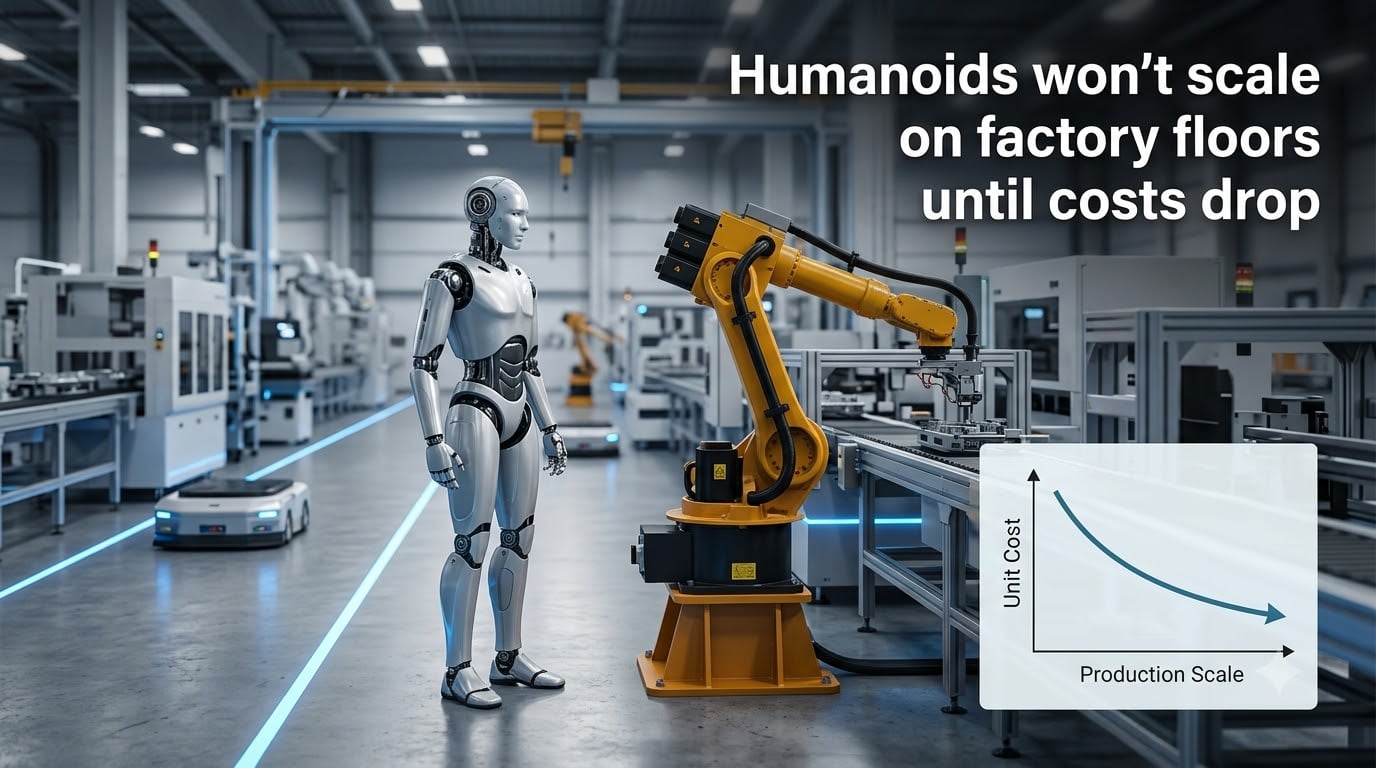
Every few months, a new video goes viral showing a humanoid robot folding laundry, carrying boxes, or tightening a bolt on an assembly line. The implication is clear: our factories are about to be staffed by metal workers who never take breaks. But when you look past the demo videos and dig into the numbers, a different picture emerges. The technology is getting close, but humanoid robots factory floor costs are nowhere near where they need to be for real deployment at scale.
The tech industry loves to talk about AI as the main barrier holding humanoid robots back from factory floors. That narrative misses the point. The real bottleneck is not intelligence or dexterity or battery life. It is unit economics. A robot that costs $50,000 to $250,000 per unit, needs constant supervision, and requires maintenance every few hundred hours simply cannot compete with a $35,000-per-year human worker or a $25,000 specialized industrial arm that runs for 50,000 hours between service intervals.
Our team has been tracking humanoid robotics economics for over two years, analyzing data from Goldman Sachs, Morgan Stanley, and conversations with manufacturing engineers who actually deploy automation on production lines. The picture is clear: humanoids are coming, but not on the timeline the hype machine suggests. Let us break down exactly why the numbers do not work yet and what needs to change before they do.
Table of Contents
The Technology Is Closer Than You Think
Here is the surprising part: the AI and hardware capabilities powering today’s humanoid robots are genuinely impressive. Foundation models from companies like Google DeepMind have reached a point where robots can understand natural language commands, navigate unfamiliar environments, and perform multi-step manipulation tasks. AI-powered humanoid control systems like Gemini Robotics 2 now enable whole-body coordination that was science fiction just three years ago.
Computer vision systems can identify and grasp objects they have never seen before. Tactile sensors in robotic hands can detect slip and adjust grip force in real time. Motion planning algorithms handle complex movements like reaching into cluttered shelves without collisions. The pieces are falling into place on the technology side.
Figure AI’s humanoid demonstrated autonomous task execution at a BMW manufacturing facility. Boston Dynamics showed Atlas performing complex parkour and manipulation sequences. Apptronik’s Apollo robot is being tested by Mercedes-Benz for material delivery on factory floors. These are not CGI renders. They are real robots doing real work in real factories.
So if the technology works, what is the holdup? The answer is not in the code. It is in the bill of materials, the maintenance schedule, and the ROI spreadsheet. Technology readiness has outpaced economic viability by a wide margin.
Why Humanoid Robot Costs Are the Real Barrier
Goldman Sachs estimated that humanoid manufacturing costs ranged from $30,000 to $150,000 per unit in early 2024. That represents a 40% year-on-year decline, which sounds encouraging until you realize what that price range actually means for a factory operator running the numbers.
At $150,000 per unit, a humanoid robot needs to replace roughly four to five years of human labor to pay for itself. That assumes the robot works 24 hours a day, seven days a week, with zero downtime. In reality, today’s humanoids operate autonomously for limited stretches, need frequent charging, and require human intervention when they encounter edge cases. The effective working hours per day are far lower than the marketing suggests.
Forbes reported that current humanoid costs sit around $50,000 per unit, with industry analysts suggesting that prices need to drop to between $5,000 and $10,000 before we see a sector-wide shift. That is a five-to-tenfold reduction from where we are today. No manufacturing industry has ever achieved that kind of cost reduction without massive economies of scale, and those economies require demand that does not exist yet because the economics do not work.
This is the chicken-and-egg problem at the heart of humanoid scaling. Costs will not drop until production volumes increase. Production volumes will not increase until customers place large orders. Customers will not place large orders until costs drop enough to justify the investment. Breaking this cycle requires either a technological breakthrough that slashes component costs or a patient capital provider willing to subsidize early production at a loss.
The Actuator Problem: Where the Money Goes
If you want to understand why humanoid robots are expensive, look at the actuators. These are the electric motors and gear systems that move every joint in a robot’s body. A humanoid typically has 28 to 40 degrees of freedom, meaning 28 to 40 individual actuated joints that each need precise, powerful, and compact actuation.
Community discussions on robotics forums consistently identify actuators as the single biggest cost driver. Depending on the design, actuators account for 40% to 60% of the total bill of materials. A high-quality rotary actuator with the torque density needed for a humanoid hip or shoulder joint can cost $500 to $2,000 per unit. Multiply that across dozens of joints and the numbers add up fast.
For context, understanding robot degrees of freedom and actuator requirements helps explain why humanoids are inherently more expensive than fixed industrial arms. A six-axis industrial robot arm needs six actuators. A humanoid needs six to eight times that many, plus the control systems, power distribution, and thermal management to keep them all running simultaneously.
The dexterous hands are another major cost center. A humanoid hand with enough tactile sensitivity and grip strength to handle varied objects can cost $10,000 to $30,000 on its own. Some manufacturers are experimenting with simpler underactuated designs that reduce per-hand costs to $2,000 to $5,000, but the tradeoff is reduced manipulation capability.
Until someone figures out how to manufacture high-performance actuators at a fraction of today’s cost, humanoid robot prices will stay elevated. This is fundamentally a manufacturing and materials problem, not an AI problem.
Specialized Robots Still Outperform Humanoids
This is where the economics get really painful for humanoid advocates. For almost every factory task, a purpose-built robot already exists that does the job faster, more reliably, and at a lower cost than any humanoid on the drawing board.
A pick-and-place operation that a humanoid performs at moderate speed can be handled by a delta robot running at 120 picks per minute for $15,000. A welding task that requires humanoid precision can be done by a six-axis industrial arm with sub-millimeter accuracy for $25,000. Material transport across a factory floor is handled by AGVs and AMRs that cost $20,000 to $40,000 and run nearly continuously.
Companies like KUKA have built entire industrial automation platforms for automotive manufacturing that coordinate hundreds of specialized robots. These systems are proven, reliable, and integrated into existing production lines. Humanoids would need to displace not just one robot but an entire ecosystem of mature, optimized automation.
The reliability gap is even more stark. Industrial robot arms typically run 50,000 to 100,000 hours between major maintenance intervals. Forum data and engineering reports indicate that current humanoid robots need maintenance every 200 to 500 hours of operation. That is a 100x difference in uptime. A factory cannot schedule production around robots that need servicing every few weeks.
The counterargument is that humanoids offer flexibility. You can redeploy a humanoid to a different task by changing its software, while a welding robot is permanently a welding robot. That flexibility has real value, but only if the humanoid’s per-task productivity is close enough to the specialized alternative that the flexibility premium is worth paying. Right now, it is not close.
The Human Oversight Problem Nobody Talks About
Here is something the demo videos do not show: every humanoid robot currently deployed in a factory has a human watching it. Sometimes that human is directly teleoperating the robot for difficult tasks. Other times they are supervising multiple robots, ready to step in when the automation fails. This is the human-in-the-loop model, and it fundamentally undermines the economic case for humanoids.
Teleoperation means one human controls one robot. That is not automation. That is remote work with extra steps. If you need a human operator for every robot, you have not reduced your labor costs. You have added a $50,000 to $250,000 capital expense on top of them.
The supervised autonomy model, where one human oversees several robots, is better but still does not scale. A supervisor who can manage four robots has multiplied human productivity by a factor of four. That helps, but it does not justify humanoid deployment when the same human could manage a fleet of simpler AGVs doing more predictable tasks.
Some companies are working on human-in-the-loop robot training systems where human operators correct robot behavior over time, gradually building toward full autonomy. This is a promising path, but it requires thousands of hours of training data per task type, and the transition from supervised to fully autonomous operation has proven harder than expected.
The core issue is that current humanoid robots are not truly autonomous for extended periods. They handle routine operations fine but fail on edge cases, unexpected obstacles, or slight variations in their environment. Every failure requires human intervention, and in a factory setting, those failures happen frequently enough to keep humans permanently in the loop.
The ROI Equation: When Do Humanoids Pay for Themselves?
Let us run the numbers. A factory worker in the United States costs approximately $35 to $45 per hour including wages, benefits, and overhead. That works out to roughly $70,000 to $90,000 per year for a single-shift position. A humanoid robot that costs $50,000 and operates three shifts per day, 365 days per year, would need to achieve labor-equivalent productivity at a cost of about $2 per operating hour.
At first glance, that looks favorable. The problem is that no current humanoid operates three full shifts autonomously. Between charging time, maintenance intervals, supervision requirements, and task-completion failure rates, the effective productive hours per day for a humanoid are likely 8 to 12, not 24. That changes the cost per productive hour to $5 to $8, which is still cheaper than human labor but not dramatically so when you factor in supervision costs.
Add a human supervisor at $45 per hour overseeing four robots, and the effective cost per robot per hour jumps by about $11. Now your humanoid costs $16 to $19 per productive hour. That is barely competitive with human labor, and it ignores the $50,000 upfront capital cost, maintenance expenses, and the risk of technological obsolescence within a few years.
The economics start working when robot costs drop below $20,000 and autonomous operation stretches to 16+ hours per day without supervision. At that point, the cost per productive hour falls below $5, and the ROI becomes compelling even for tasks where specialized alternatives exist, because the humanoid’s flexibility adds value that specialized robots cannot match.
This is why forum consensus in the robotics community has converged on sub-$50,000 as the entry point for viable humanoid deployment, and sub-$20,000 as the threshold for mass adoption. We are approaching the first threshold. We are nowhere near the second.
Cost Reduction Trajectory: The Path to Viability
Despite these challenges, the cost trajectory is genuinely encouraging. Goldman Sachs projects that humanoid costs will continue declining 30% to 40% annually as production scales. If that rate holds, a $50,000 robot today could cost $20,000 by 2028 or 2029. Morgan Stanley estimates the humanoid market could reach $5 trillion by 2050, though projections that far out are speculative at best.
Tesla has a unique advantage here. The company already operates some of the most advanced manufacturing facilities on the planet and has deep expertise in vertical integration, battery production, and electric motor manufacturing. Many of the component technologies in Tesla’s vehicles, from motors to power electronics, share fundamental engineering with humanoid actuators. Tesla’s Optimus program is betting that automotive-scale manufacturing can drive humanoid costs down faster than competitors who lack that production infrastructure.
Chinese manufacturers like Unitree are pricing their humanoid platforms aggressively, with some models targeting the $16,000 range. However, FCC import regulations affecting humanoid robot costs could limit availability of Chinese-made humanoids in the U.S. market, potentially keeping prices elevated for American manufacturers regardless of global cost trends.
The path from today’s costs to viable economics runs through three milestones. First, actuator costs need to drop by at least 50%, likely through new manufacturing techniques or redesigned actuator topologies. Second, production volumes need to reach tens of thousands of units per year to unlock component-level economies of scale. Third, physical AI infrastructure for robotics scaling needs to mature enough to support genuinely autonomous operation without constant human oversight.
Each milestone is achievable. None of them will happen overnight. Realistic timelines put economically viable humanoid deployment in factory settings at 2028 to 2032, with mass adoption following in the mid-2030s if the cost curve holds.
What Needs to Happen Before Humanoids Scale
Manufacturing executives do not need to wait for humanoids to solve their labor challenges. There are roughly 600,000 unfilled manufacturing jobs in the United States alone, and that gap is widening as older workers retire. The solution for most factories today is not waiting for humanoid robots but deploying proven automation technologies that already deliver strong ROI.
Cobots, AGVs, vision-guided pickers, and automated inspection systems can address many of the tasks that humanoids are being designed for, at a fraction of the cost and with years of proven reliability. Factory operators should focus on identifying the specific tasks that cause labor bottlenecks and matching them with specialized automation that pays for itself in 12 to 24 months.
Humanoid robots will eventually find their place on factory floors. That place is likely in high-mix, low-volume manufacturing environments where the ability to quickly reprogram a robot for a new task outweighs the per-task efficiency advantage of specialized automation. But that future is five to ten years away, and it depends on cost reductions that have not happened yet.
How much do humanoid robots cost to manufacture?
As of 2026, humanoid robot manufacturing costs range from $30,000 to $150,000 per unit according to Goldman Sachs estimates. Some Chinese manufacturers like Unitree are targeting lower price points around $16,000, while premium platforms from companies like Boston Dynamics cost significantly more. Industry analysts believe costs need to drop below $20,000 for mass factory adoption.
Why are humanoid robots so expensive compared to industrial robot arms?
Humanoid robots require 28 to 40 actuated joints compared to 6 on a typical industrial arm, dramatically increasing actuator and control system costs. Actuators alone account for 40% to 60% of the total bill of materials. Additionally, dexterous hands, onboard computing, battery systems, and balance control sensors add costs that fixed industrial robots do not need.
What is the ROI of humanoid robots in factories?
Current humanoid robots struggle to deliver positive ROI in most factory applications. At $50,000 per unit, a humanoid needs to replace multiple years of human labor across multiple shifts to break even. However, current robots only operate autonomously for limited hours, require human supervision, and need maintenance every 200 to 500 hours. Positive ROI typically requires costs below $20,000 and 16+ hours of autonomous operation per day.
When will humanoid robots be economically viable for manufacturing?
Based on current cost trajectories of 30% to 40% annual reduction, humanoid robots could reach economic viability for specific factory applications between 2028 and 2032. Mass adoption depends on actuator costs dropping by at least 50%, production volumes reaching tens of thousands of units per year, and autonomous operation extending beyond 16 hours per day without constant human supervision.
Can specialized robots do factory tasks better than humanoids?
Yes, for most factory tasks. Specialized robots like delta pickers, six-axis welding arms, and AGVs are faster, more reliable, and significantly cheaper than humanoids for their specific tasks. Industrial robot arms run 50,000 to 100,000 hours between maintenance versus 200 to 500 hours for current humanoids. Humanoids only win when flexibility and task-switching capability outweigh per-task efficiency.
Conclusion
Humanoid robots are one of the most exciting technology categories in 2026, and the progress in AI, manipulation, and mobility is genuinely remarkable. But excitement does not pay factory bills. Until humanoid robot factory floor costs drop below $20,000 per unit and autonomous operation extends to full production shifts without supervision, specialized automation will remain the better investment for most manufacturers.
The economics will eventually align. Actuator costs will fall, production volumes will scale, and AI systems will mature enough to handle factory environments without constant human intervention. When that happens, humanoids will earn their place on the factory floor. Until then, the smart money is on proven automation that delivers measurable ROI today, not promises of what might be possible tomorrow.