
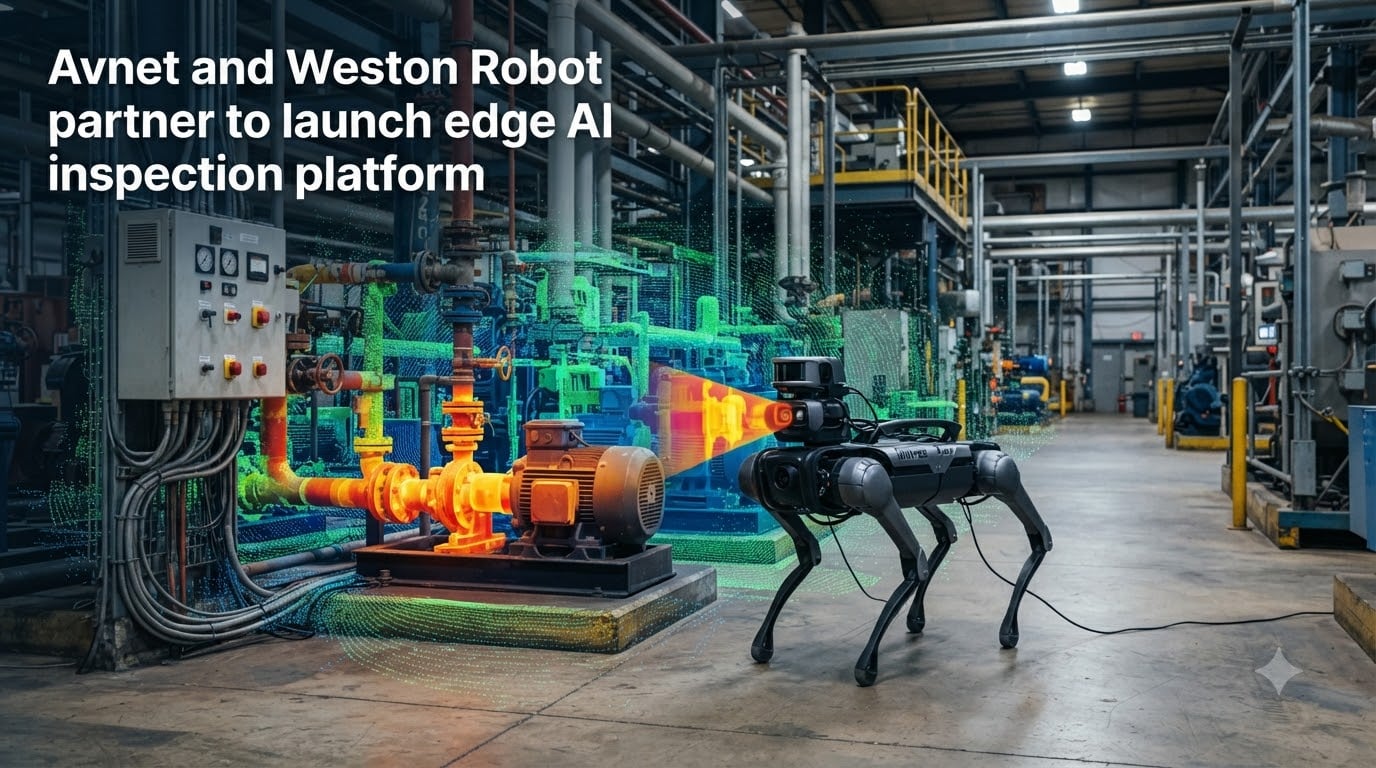
Avnet and Weston Robot have announced a partnership to bring edge AI inspection technology to the factory floor, combining autonomous quadruped robots with AMD-powered computing for real-time industrial monitoring. The collaboration, announced in August 2026, targets organizations looking to automate inspection workflows using Physical AI, a model where machines perceive, reason, and act autonomously without cloud connectivity.
The Avnet Weston Robot edge AI inspection platform pairs a Unitree quadruped robot body with AMD Ryzen AI Embedded processors, delivering up to 50 TOPS of AI performance directly on the device. That means the robot processes sensor data locally rather than sending it to a remote server for analysis.
For industrial operators, that translates into faster decisions, lower latency, and the ability to run inspections in GPS-denied environments where traditional cloud pipelines break down. Our team has been tracking the Physical AI infrastructure platforms reshaping robotics in 2026, and this partnership sits squarely in that conversation.
Table of Contents
What the Avnet and Weston Robot Partnership Means for Industrial Inspection
The partnership brings together two very different skill sets. Avnet, a global technology distributor with deep supply chain and embedded computing expertise, provides the hardware backbone and distribution muscle. Weston Robot, a robotics integrator specializing in autonomous inspection solutions, contributes the robot platform and deployment know-how.
Together, they are positioning the edge AI inspection platform as a turnkey solution for factory operators, facility managers, and critical infrastructure teams. Rather than building a robot from scratch, customers get a pre-integrated system that combines the quadruped robot, the AMD compute module, and fleet management software in one package.
The model also leans into robots-as-a-service, or RaaS, which lets organizations deploy inspection robots without owning the hardware outright. That approach lowers the barrier to entry for mid-sized facilities that cannot justify a large capital expenditure on robotics infrastructure.
Executives from both companies framed the announcement around practical outcomes. The goal is to let organizations detect operational issues earlier, reduce the cost and risk of manual inspections, and keep production lines running without interruption. One executive noted that combining edge AI with intelligent perception gives the platform the ability to make decisions in real time, even in complex industrial environments.
Inside the Platform: AMD Ryzen AI and 50 TOPS of Edge Performance
At the hardware level, the platform runs on AMD Ryzen AI Embedded processors. These chips are designed for edge computing workloads, meaning they handle AI inference locally on the robot rather than offloading it to a data center. AMD has been pushing its Ryzen AI line into embedded and industrial markets, and this partnership is a concrete example of that strategy landing in a real product.
The headline specification is 50 TOPS of AI performance. For context, TOPS stands for Tera Operations Per Second and measures how many trillion operations a processor can execute each second. At 50 TOPS, the platform has enough compute headroom to run multiple AI models simultaneously, processing camera feeds, thermal data, and lidar scans in parallel.
That compute budget matters because industrial inspection is computationally expensive. A quadruped robot walking through a facility generates a constant stream of sensor data. Without local processing, that data has to travel to the cloud, get analyzed, and come back as instructions, introducing latency and depending on network availability.
Edge AI eliminates that round trip. The robot perceives its environment, runs inference on the spot, and acts. For patrolling and inspection tasks where seconds matter, like detecting a overheating machine or a leaking pipe, low-latency AI inference is the difference between catching a problem early and discovering it after damage occurs.
Our research found that no competitor has provided a deep technical analysis of the AMD architecture behind this platform. The Ryzen AI Embedded family combines CPU cores, a GPU, and a dedicated AI engine on a single chip, which is what makes the 50 TOPS figure possible in a power envelope suitable for a mobile robot.
Key Capabilities: From 3D Lidar Mapping to Autonomous Navigation
The Avnet Weston Robot edge AI inspection platform bundles several sensor and navigation technologies into one system. Here is what stands out from the announcement and technical specifications.
3D Lidar Mapping: The robot uses lidar to build detailed three-dimensional maps of its surroundings. This lets it navigate autonomously through cluttered industrial spaces, avoiding obstacles and adjusting its path in real time without human intervention.
GPS-Denied Operation: Many industrial facilities, indoor factories, underground tunnels, and dense plant environments, have no reliable GPS signal. The platform is designed to operate in these GPS-denied environments by relying on lidar-based localization and onboard mapping instead.
Thermal Analytics: A thermal camera allows the robot to detect temperature anomalies that a standard visual camera would miss. That is useful for spotting overheating electrical panels, friction in rotating equipment, or insulation failures before they cause downtime.
Visual Analytics: Standard visual cameras feed AI models that can identify leaks, corrosion, missing safety equipment, and other visible defects. The combination of thermal and visual analytics gives operators two complementary inspection lenses in a single pass.
Fleet Management Software: For facilities running multiple robots, the platform includes fleet management integration. Operators can schedule patrols, monitor robot status, and review inspection reports from a central dashboard rather than managing each robot individually.
Where the Platform Fits: Industrial Use Cases and Applications
The announcement highlights several target applications, and they all share a common thread, repetitive, time-consuming inspection tasks that are currently done manually or not at all.
Factory Floor Inspections: Robots can patrol production lines on a schedule, checking equipment status, looking for spills or debris, and flagging machines that need attention. This frees human workers to focus on higher-value tasks.
Facility Management: Large facilities like warehouses and distribution centers need constant monitoring. The platform supports patrolling for security, safety compliance checks, and environmental monitoring. For readers interested in broader applications, our coverage of AI in warehousing explores how similar technology is reshaping logistics operations.
Critical Infrastructure Monitoring: Power plants, substations, and oil and gas facilities require regular inspection of hard-to-reach or hazardous areas. A quadruped robot can access spaces that wheeled robots cannot, making it suitable for stairs, grated platforms, and uneven terrain.
Patrolling and Security: Beyond inspection, the platform can serve an autonomous security role, monitoring facility perimeters, detecting intrusions, and providing a continuous visual record of facility conditions over time.
Edge AI transforms automated visual inspection by removing the dependency on cloud infrastructure. Instead of streaming video to a remote server for analysis, the robot identifies issues on the spot and sends only the relevant alerts back to operators. That reduces bandwidth costs, improves response times, and makes the system viable in facilities with limited connectivity.
Physical AI Explained: Why Edge Computing Changes the Equation
Physical AI is the term both companies use to describe what this platform does. At its core, Physical AI refers to AI systems that perceive, reason, and act autonomously in the physical world. Unlike a chatbot that processes text, a Physical AI system processes real-world sensor data and takes physical actions based on what it learns.
Three definitions help frame the concept. Physical AI is AI that operates in and interacts with the real world. Edge AI is AI processing performed locally on the device, not in the cloud. TOPS measures how many trillion operations per second a processor can handle.
The combination of these three ideas is what makes this platform different from earlier inspection robots. The robot is not just a mobile camera streaming footage to a server. It is a self-contained AI system that can make decisions on its own, adapt to its environment, and complete inspection tasks without a persistent network connection.
Frequently Asked Questions
What is the Avnet Weston Robot edge AI inspection platform?
The platform combines a Unitree quadruped robot with AMD Ryzen AI Embedded processors to perform autonomous industrial inspections. It processes sensor data locally at the edge using up to 50 TOPS of AI performance, enabling real-time inspection without cloud connectivity.
What is the AI software for autonomous inspection robots?
The platform runs AI models for visual analytics, thermal analytics, 3D lidar mapping, and autonomous navigation directly on the robot using AMD Ryzen AI Embedded processors. It integrates with fleet management software so operators can schedule patrols, monitor robots, and review inspection reports from a central dashboard.
How is edge AI transforming automated visual inspection?
Edge AI lets inspection robots process camera and sensor data locally instead of sending it to the cloud. This reduces latency, cuts bandwidth costs, and enables operation in GPS-denied or low-connectivity environments. Robots can detect defects, temperature anomalies, and safety issues in real time and send only relevant alerts to operators.
What is Physical AI in industrial operations?
Physical AI describes AI systems that perceive, reason, and act autonomously in the physical world. In industrial settings, this means robots that can navigate facilities, interpret sensor data, make inspection decisions, and take action without human intervention or cloud dependency.
What This Partnership Signals for the Future of Industrial Inspection
The Avnet and Weston Robot edge AI inspection platform represents a shift from cloud-dependent robotics toward self-contained Physical AI systems. By pairing 50 TOPS of AMD-powered edge computing with a quadruped robot body and fleet management software, the partnership gives industrial operators a practical path to autonomous inspection.
For facilities dealing with GPS-denied environments, hazardous areas, or repetitive patrol schedules, this platform offers a way to detect problems earlier and reduce reliance on manual inspections. As Physical AI continues to mature in 2026, expect more partnerships of this shape, distributors pairing embedded computing expertise with robotics integration to ship turnkey solutions.