
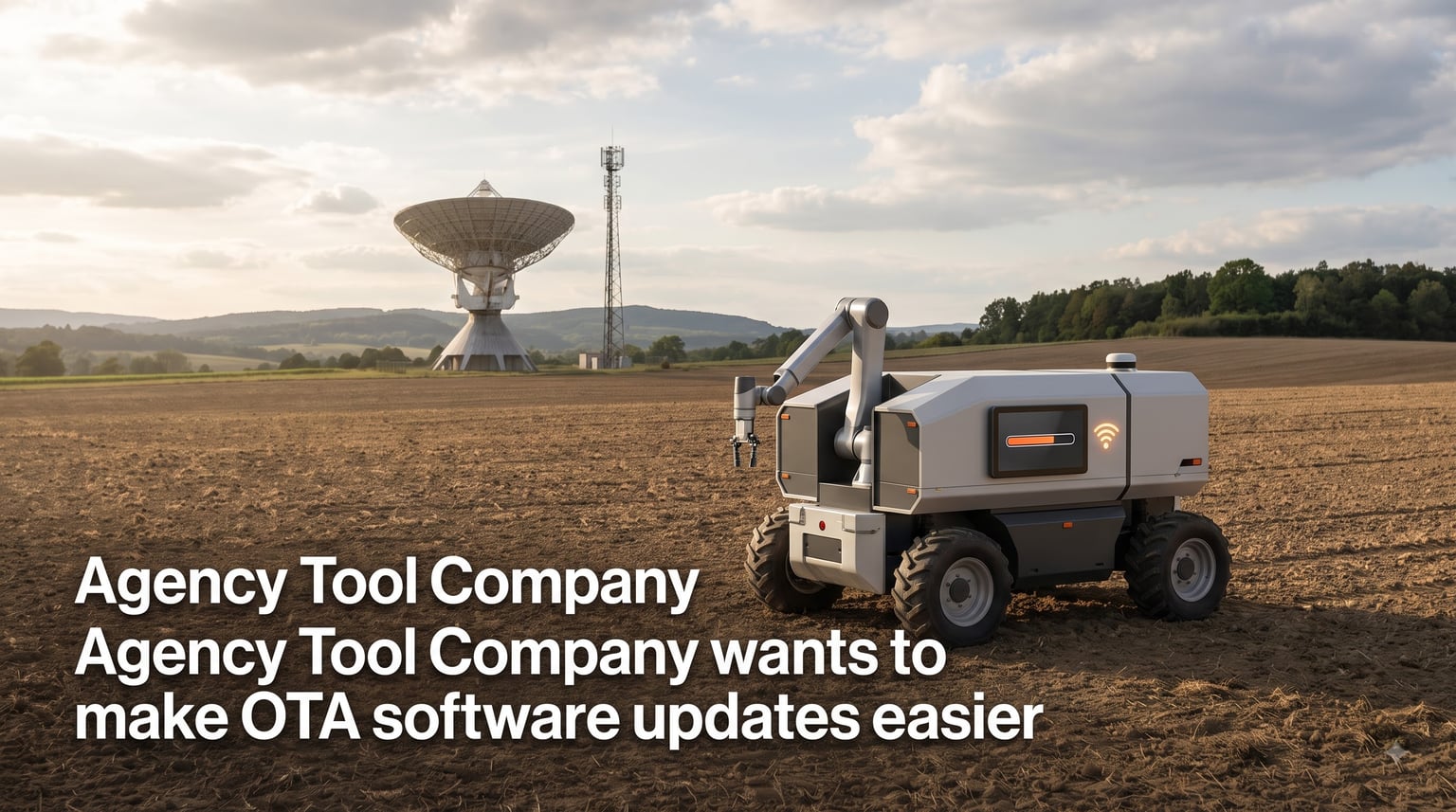
Updating software on a robot sounds simple until you try doing it across 500 machines scattered through farm fields, warehouses, and distribution centers with spotty LTE connections. That gap between expectation and reality is exactly what Agency Tool Company wants to close. The startup emerged in 2026 with a product called ATC Deploy, built specifically to make OTA software updates easier for robotics developers.
OTA software updates in robotics remain a surprisingly hard problem. The robot OTA update platforms market was valued at roughly $2.8 billion and is projected to reach $9.7 billion by 2034, growing at a CAGR of around 21%. Despite that growth, many robotics companies still rely on manual scripts, USB drives, or fragile custom pipelines to push code to their fleets. Agency Tool Company believes it can do better.
In this article, we break down what OTA updates mean for robotics, why they are so difficult, and how ATC Deploy approaches the problem differently from generic IoT or automotive solutions.
Table of Contents
What Is Agency Tool Company?
Agency Tool Company is a robotics infrastructure startup focused on the tools that robotics developers use every day but rarely want to build themselves. The company was founded by engineers who spent eight years at Scythe Robotics, a commercial mower manufacturer known for its autonomous electric robots.
That background matters. The founders lived through the pain of deploying software to robots operating in unpredictable outdoor environments. They dealt with machines that lost connectivity mid-update, firmware that got corrupted during transfer, and fleets that needed different software versions across different regions. Instead of accepting those problems as normal, they decided to build the infrastructure they always wished existed.
The company’s first product, ATC Deploy, launched with support from real robotics companies already running it in production. Rather than building a theoretical platform, the team shipped something that solves a problem their launch partners were actively experiencing.
Why OTA Updates Are Still a Hurdle for Robotics
Most people assume OTA updates are a solved problem. After all, your phone updates itself overnight. Your laptop downloads patches in the background. But installing software on a robot is nothing like updating an iPhone or Chrome, as robotics engineers on Reddit frequently point out.
The challenges stack up quickly. Robots often operate in environments with limited or unreliable connectivity. A fleet of agricultural robots might be connected over LTE in remote fields, or even satellite links, where bandwidth is low and connections drop without warning. Warehouse drones might deal with signal interference from metal shelving and concrete walls.
Then there is the power problem. Unlike a server or a phone, a robot can turn off at random times. Its battery might die mid-update. Someone might switch it off manually. If an update was only partially written when the machine lost power, the robot could be left in a broken state, unable to boot.
Validation adds another layer of difficulty. Even if the software transfers successfully, you need to confirm it was not corrupted. You need to verify the robot is running the correct version. And if something goes wrong after deployment, you need a way to roll back to the previous working state without sending a technician to the field.
Scaling makes all of this worse. A process that works for ten robots in a lab can fall apart across hundreds of machines spread across multiple locations. Managing which version runs on which robot, scheduling updates to avoid downtime, and coordinating staged rollouts becomes a full-time job that pulls engineers away from building actual robot features.
What Is ATC Deploy?
ATC Deploy is Agency Tool Company’s solution for shipping software to robots. It is designed to work with the software architectures that robotics companies already use rather than forcing them to rebuild their stacks from scratch.
The platform supports standard container formats, including OCI images and Docker containers, which means companies running ROS applications or other containerized robot software can integrate ATC Deploy without a full migration. This is a deliberate design choice. The founders learned at Scythe that adoption friction kills infrastructure tools, so they prioritized compatibility over proprietary formats.
At its core, ATC Deploy handles the full deployment lifecycle. It manages version control across fleets, pushes updates to individual robots or groups, and provides a monitoring dashboard so developers can see which machines received which updates. The system tracks deployment status in real time, which addresses one of the biggest pain points that forum users describe: not knowing whether an update actually landed.
How ATC Deploy Handles Flaky Connections
Connection reliability is where most generic OTA solutions fail for robotics. ATC Deploy was built with the assumption that connections will be flaky. Whether a robot is on LTE, 3G, satellite, or some other constrained network, the platform is designed to resume interrupted transfers rather than starting over from scratch.
This matters because large software updates over low-bandwidth links can take significant time. If a 200 MB container image takes 30 minutes to transfer over a weak cellular connection and the connection drops at minute 28, a naive system would restart the entire download. ATC Deploy’s approach avoids that wasted time and bandwidth.
The platform also handles the scenario where a robot goes offline entirely during an update. When the machine comes back online, the deployment picks up where it left off. This is critical for agricultural and field robots that may only have connectivity windows of a few minutes per day.
Launch Partners and Real-World Testing
Agency Tool Company did not launch ATC Deploy in a vacuum. The product went live with three robotics companies already using it: Burro, Tempo, and Gather AI.
Burro builds agricultural robots designed to help farm workers with carrying and transportation tasks. Their robots operate outdoors in unpredictable conditions, which makes them an ideal test case for OTA updates over unreliable connections. Tempo focuses on autonomous solutions in industrial environments. Gather AI develops autonomous drone systems for warehouse inventory management, where GPS signals are unreliable and network conditions vary.
Having launch partners across agriculture, industrial, and warehouse logistics gives Agency Tool Company validation across the environments where OTA challenges are most acute. These are not companies running robots in a clean lab. They are deploying machines in the messy real world where updates actually break.
The Road Ahead: ATC Build and Beyond
ATC Deploy is only the first product in Agency Tool Company’s roadmap. The company has signaled that future tools will address the broader software development lifecycle for robotics, including a product called ATC Build focused on continuous integration and validation.
Validation is a natural next step. Once you can reliably ship software to robots, the next question is whether that software is safe to ship in the first place. ATC Build would likely tackle the CI pipeline side, helping robotics teams test and validate updates before pushing them to production fleets.
The long-term vision appears to be a full platform for robot software lifecycle management. If ATC Deploy handles delivery and ATC Build handles validation, the company would cover the two biggest gaps that robotics developers face today.
What are OTA updates in robotics?
OTA (Over-The-Air) updates in robotics enable remote deployment of firmware, software, and security patches to robots without requiring physical access to each machine. This allows companies to push new features, fix bugs, and apply security updates across entire fleets from a central platform.
Why are OTA updates difficult for robots?
OTA updates are difficult for robots because robots often operate in environments with unreliable connectivity (LTE, satellite, 3G), can lose power mid-update, require file integrity validation, and need rollback capabilities. Scaling updates across hundreds of machines in different locations adds complexity that generic IoT and mobile update solutions do not handle well.
What is ATC Deploy?
ATC Deploy is a product from Agency Tool Company that ships software to robots. It supports standard container formats like OCI images and Docker, manages version control across fleets, handles interrupted transfers over flaky connections, and provides monitoring dashboards for tracking deployment status.
Are OTA updates necessary for robotics?
Yes. OTA updates reduce maintenance costs by eliminating the need for technicians to physically access each robot. They enable faster feature deployment, allow security patches to reach fleets quickly, and make it possible to manage robots at scale. Without OTA, companies must rely on manual updates that do not scale beyond small fleets.
What benefits do over-the-air OTA software updates provide?
OTA updates provide several benefits: reduced maintenance costs through remote patching, faster deployment of new features and bug fixes, improved security through timely patches, fleet-wide version control, staged rollout capabilities, rollback options when updates fail, and the ability to manage robots across multiple locations without physical site visits.
Conclusion
OTA software updates in robotics have lagged behind every other technology sector for too long. Phones, cars, and laptops all update themselves smoothly, but robots still require teams of engineers to manage deployment scripts and pray their machines stay online long enough to receive new code.
Agency Tool Company’s ATC Deploy takes a practical swing at that problem by working with existing architectures, handling flaky connections gracefully, and drawing on real deployment experience from founders who lived through these challenges at Scythe Robotics. With launch partners like Burro, Tempo, and Gather AI already on board, the product has moved past theory into production use.
As the robotics industry continues to grow and fleets scale from dozens to thousands of machines, reliable OTA software updates will shift from a nice-to-have feature to a baseline requirement. Tools like ATC Deploy are arriving at the right time to meet that need.