
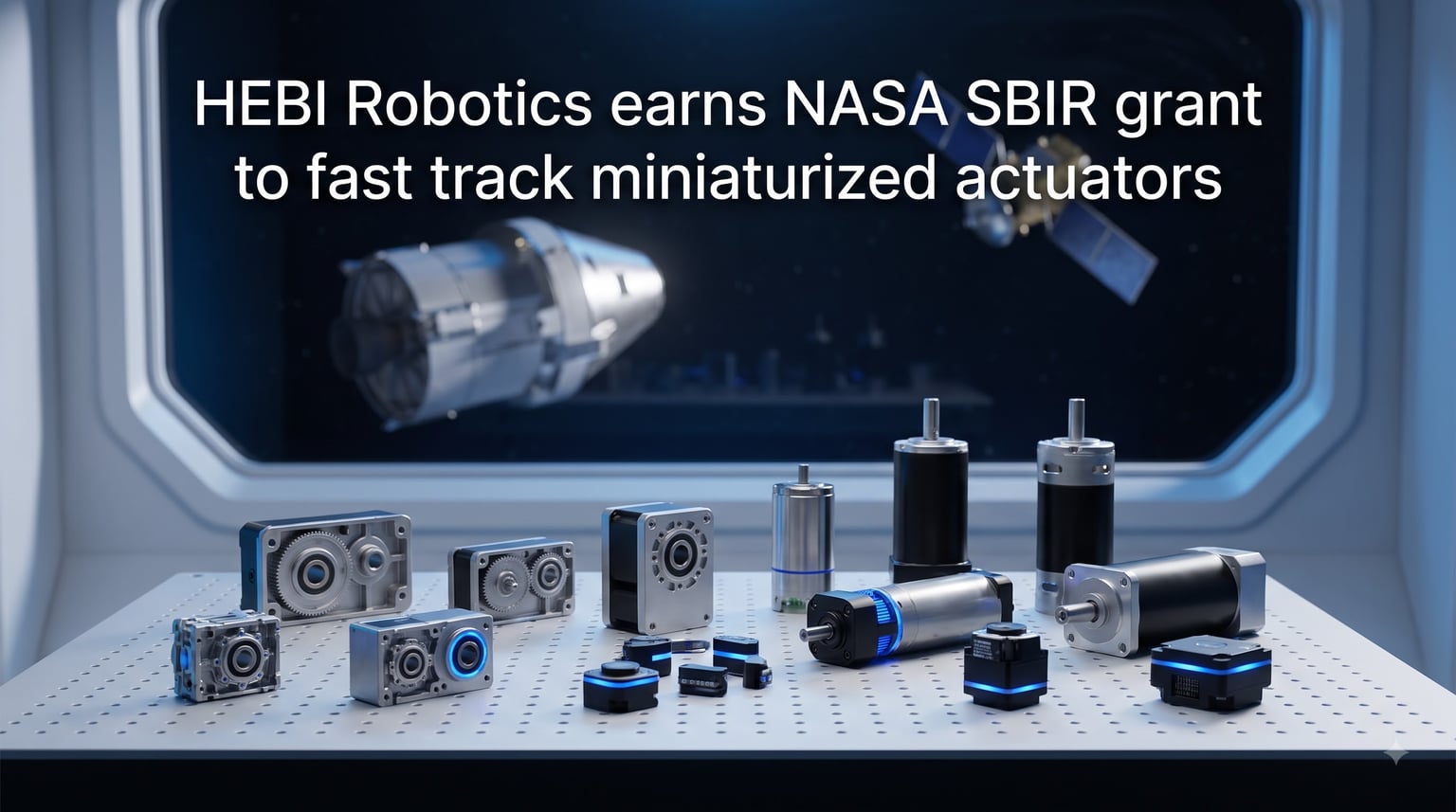
NASA has selected Pittsburgh-based HEBI Robotics for back-to-back Small Business Innovation Research awards aimed at developing miniaturized, space-rated actuators that could reshape how robotic systems are built for orbit and beyond. The HEBI Robotics NASA SBIR grant for miniaturized actuators represents a targeted push to shrink the modular building blocks that already power professional terrestrial robots and harden them for the punishing environment of space.
The progression from a $150,000 Phase I feasibility grant in September 2025 to an $850,000 Phase II development contract in February 2026 signals that NASA sees real promise in HEBI’s approach. Rather than designing one-off, mission-specific hardware for every spacecraft, HEBI wants to create a library of flight-qualified actuation modules that engineers can snap together like servo actuators in robotic grippers on Earth, only rated for vacuum and radiation.
Our team has been tracking HEBI’s technology for years, and this SBIR award connects several dots the robotics community has been discussing. The same modular philosophy that made HEBI a favorite in university research labs and nuclear inspection deployments is now being adapted for satellite servicing, lunar infrastructure, and deep-space missions. This article breaks down what the grant covers, why miniaturized actuators matter so much for space, and what the development timeline looks like.
Table of Contents
What HEBI Robotics’ NASA SBIR Grant Covers
The funding story unfolds in two stages that follow the standard SBIR trajectory. NASA awarded HEBI a Phase I grant of $150,000 in September 2025 to prove that the company’s modular actuation technology could be adapted for space environments. That feasibility study apparently delivered convincing results, because NASA followed up with a Phase II contract worth $850,000 in February 2026, extending the project for two additional years of prototype development and testing.
Phase II is where the real engineering work happens. HEBI’s goal during this phase is to take the modular building block concept that works in terrestrial labs and push it through the qualification process needed for flight hardware. That means addressing actuator torque specifications under extreme conditions, qualifying control electronics for radiation exposure, and proving that sealed gear trains will not outgas in vacuum.
The $850,000 figure places this firmly in the typical SBIR Phase II range. NASA’s SBIR Phase II contracts generally run between $750,000 and $1,250,000, so HEBI’s award sits at the entry level, which makes sense for a focused hardware development effort rather than a full spacecraft subsystem program. The two-year timeline gives HEBI enough runway to build, test, and iterate on engineering units that NASA centers can evaluate for future missions.
What makes this particular grant stand out is the miniaturization focus. NASA has funded plenty of space actuator development over the decades, but HEBI’s approach starts from a different baseline. Instead of scaling up a precision gearbox or repurposing an industrial motor, HEBI is working to shrink its already compact Series Elastic Actuators into modules small enough for distributed robotic architectures like walking rovers, articulated booms, and reconfigurable manipulators.
The Push for Miniaturized Space-Rated Actuators
Miniaturization is not a buzzword in space robotics. Every gram that leaves Earth costs money to launch, and every cubic centimeter of volume competes with payload instruments, propellant, and power systems. Smaller actuators mean lighter robotic arms, more joints packed into a given envelope, and more capabilities squeezed onto small spacecraft buses. The HEBI Robotics NASA SBIR grant for miniaturized actuators targets this constraint directly.
HEBI’s terrestrial product line already demonstrates the modular philosophy. Their actuators function as self-contained modules with integrated motors, gearboxes, controllers, and sensors, all packaged in rugged housings. Researchers describe them as LEGO-style building blocks for professional robotics, and that analogy carries over to the space application. If you can build a six-degree-of-freedom arm by bolting together six smart modules, you can also reconfigure that arm for a different mission by swapping out two of them.
The miniaturization challenge involves more than just shrinking each component. Planetary gearboxes in space actuators need to maintain torque density even as their footprint shrinks, which puts enormous demands on gear materials and lubrication. Control electronics have to fit into tighter spaces while still meeting radiation tolerance requirements. And thermal management becomes harder when there is less surface area to dissipate heat.
Series Elastic Actuator technology gives HEBI an advantage here. By placing a compliant spring element between the gearbox output and the load, SEAs provide inherent force sensing, impact tolerance, and safe interaction with delicate objects. These properties are extremely valuable for satellite servicing, where a robot arm must gently grasp a multi-million-dollar spacecraft without damaging solar panels or antenna arrays. The spring element also absorbs shock loads, which helps hardware survive launch vibrations.
HEBI’s miniaturized modules aim to preserve these SEA benefits in a smaller, lighter package. If successful, the technology could enable distributed actuation architectures where dozens of small, smart modules work together in walking robots, tensegrity structures, or large deployable manipulators. NASA’s interest in this direction is evident from related projects like the ARMADAS architecture and the SUPERball tensegrity rover concept.
Space Environment Challenges for Robotic Hardware
Designing actuators for space is fundamentally different from designing them for Earth. Four environmental factors dominate the engineering conversation, and each one directly shapes the work HEBI is doing under this SBIR grant.
Ionizing Radiation
Earth’s atmosphere shields surface hardware from the charged particles that flood near-Earth space. In low Earth orbit, the Van Allen belts trap high-energy protons and electrons. In geosynchronous orbit, galactic cosmic rays and solar particle events add to the bombardment. This radiation can flip bits in memory, cause latch-up in power electronics, and gradually degrade semiconductor performance.
Radiation-hardened components cost significantly more than their commercial equivalents and often lag several generations behind in performance. HEBI’s challenge is finding a balance between using enough rad-hardened parts to survive the expected total ionizing dose and keeping costs and size manageable. Shielding helps, but adding shielding mass fights directly against the miniaturization goal.
Vacuum and Outgassing
In vacuum, many materials release volatile compounds through a process called outgassing. These vapors can condense on nearby optical surfaces, solar cells, and sensors, degrading their performance over time. NASA sets strict limits on total mass loss and collected volatile condensable materials for anything flying near sensitive equipment.
Actuators are particularly vulnerable because they contain lubricants, polymers, and potting compounds. Traditional space actuators often use dry lubricants like molybdenum disulfide or specialized vacuum-rated greases. HEBI needs to verify that every material inside its miniaturized modules meets outgassing limits while still providing the mechanical performance the actuators need for precise force control.
Thermal Extremes
Spacecraft experience temperature swings that no terrestrial robot ever faces. A satellite in LEO cycles between roughly minus 150 and plus 150 degrees Celsius every 90 minutes as it moves between sunlight and Earth’s shadow. Thermal expansion and contraction can change gear clearances, affect sensor calibration, and stress solder joints.
Miniaturized actuators have less thermal mass, which means they heat up faster under load and cool down faster when idle. HEBI must design thermal management into these small packages without adding the heavy heat pipes or radiators that traditional space hardware uses. Conduction paths through the module housing, careful placement of heat-generating components, and derating of motors all play into this.
Vibration and Shock During Launch
Getting to space is often harder on hardware than being there. Rocket launches subject payloads to intense acoustic vibration, pyrotechnic shocks from stage separations, and sustained acceleration. Actuator modules need mechanical designs that can survive this abuse without bearings brinelling, magnets demagnetizing, or electronics cracking.
HEBI’s ruggedized terrestrial housings already handle industrial-level vibration and shock, which gives the company a head start. But launch qualification adds specific requirements like random vibration testing across defined frequency spectra and shock testing that simulates explosive bolt separation events. The Phase II contract gives HEBI time to run these tests and iterate on the design.
How HEBI’s Modular Approach Differs from Traditional Space Hardware
Traditional space actuator development follows a model that aerospace engineers know all too well. Each mission designs custom hardware from scratch, qualifies it through an exhaustive test campaign, and flies a unique unit that will never be used again. This approach maximizes reliability for critical missions but drives costs sky-high and stretches development timelines over many years.
HEBI’s modular approach flips this model. Instead of building one actuator for one mission, HEBI wants to qualify a family of actuator modules that can be mixed and matched across many missions. The SBIR Phase II funding supports the qualification work needed to turn terrestrial modules into flight-qualified ones. Once a module family is qualified, subsequent missions can reuse it with far less testing.
This philosophy aligns with broader trends in the space industry. Companies like SpaceX and Blue Origin have demonstrated that reusable, modular architectures can dramatically lower costs compared to the traditional one-off approach. HEBI is applying the same logic at the component level, treating actuators as building blocks rather than bespoke creations.
The rapid prototyping advantage is significant. In our conversations with robotics researchers, HEBI users consistently highlight how quickly they can assemble and test new robot configurations using the modular platform. A six-degree-of-freedom arm can go from concept to working prototype in days, not months. If that same speed transfers to space-rated hardware, NASA mission architects could iterate on robotic system designs much faster than the current paradigm allows.
The lab-to-space deployment pipeline that HEBI envisions would let engineers prototype a robot on the bench using standard HEBI modules, validate the control software and kinematics, and then swap in flight-qualified versions of the same modules. Because the control interfaces and mechanical mounting remain consistent, the transition from prototype to flight hardware becomes far smoother.
Applications: From Satellite Servicing to Lunar Infrastructure
The potential applications for miniaturized space-rated actuators span the full spectrum of NASA’s robotic ambitions. The HEBI Robotics NASA SBIR grant for miniaturized actuators explicitly targets In-Space Servicing, Assembly, and Manufacturing, a category of missions that NASA has identified as transformational for the future of space operations.
Satellite servicing represents the most near-term application. Hundreds of active satellites in GEO could benefit from refueling, repair, or component replacement, but doing that work requires robotic arms with precise force control and the ability to interact safely with delicate spacecraft surfaces. HEBI’s Series Elastic Actuators are well suited for this because their compliant behavior prevents the kind of rigid, forceful contact that could damage a client satellite.
In LEO, the same technology could support satellite deployment, solar panel unfolding assistance, and debris capture. The reduced mass of miniaturized actuators means a servicing spacecraft can carry more tools and propellant, extending its operational life and the number of satellites it can service during a single mission.
Lunar infrastructure is another target. NASA’s plans for sustained lunar presence under the Artemis program call for robotic systems that can construct landing pads, deploy power systems, and assemble habitats before crews arrive. Walking robots, reconfigurable manipulators, and deployable structures all need compact, reliable actuators that can operate in the temperature extremes and abrasive dust of the lunar surface.
Mars mission hardware is the long-term horizon. Autonomous systems operating on Mars face communication delays of up to 20 minutes each way, which means robots need to perform complex manipulation tasks without real-time human control. Modular actuation architectures that can be reconfigured for different tasks would give mission planners flexibility in designing surface operations.
The applications extend beyond government space programs. Commercial satellite operators, space logistics companies, and emerging players in the cis-lunar economy all need affordable, qualified actuation hardware. If HEBI’s modular approach works, it could open the market to a much broader range of robotic spacecraft than the current custom-built paradigm allows.
HEBI Robotics: From CMU Biorobotics Lab to NASA Partner
HEBI Robotics traces its roots to the Biorobotics Lab at Carnegie Mellon University, where researchers were developing snake robots and other articulated systems that required compact, modular actuation. The challenge of building these robots with conventional components led the team to design their own smart actuator modules, and that internal solution eventually became a commercial product line.
The CMU pedigree shows in HEBI’s design philosophy. Academic robotics researchers need hardware that is flexible enough to support wildly different experiments, intuitive enough for graduate students to use quickly, and robust enough to survive years of handling. HEBI’s modular platform grew directly from these requirements, which explains why university labs were among the company’s earliest and most enthusiastic customers.
NASA is not HEBI’s first government partner. The company has worked on NASA projects before, including the SUPERball tensegrity rover concept and the ARMADAS automated assembly architecture. These prior collaborations gave both sides confidence that HEBI’s modular approach could scale to space applications, which likely helped the SBIR proposals succeed in competitive merit reviews.
HEBI is also an example of Pittsburgh’s growing robotics cluster. The city has built a reputation as a hub for autonomous systems, manipulation research, and robotics startups, with CMU serving as the intellectual engine. Federal funding through programs like SBIR plays an important role in helping these companies bridge the gap between research-stage technology and deployable products.
The terrestrial applications of HEBI’s technology remain an important part of the business. Nuclear inspection robots that operate in radioactive environments face challenges similar to space hardware, including radiation exposure and the need for remote operation in areas where humans cannot go. The SBIR-funded space work feeds back into these terrestrial products, creating a cycle where space and Earth applications benefit each other.
Understanding the NASA SBIR Program
The Small Business Innovation Research program is a competitive funding mechanism that federal agencies with large research and development budgets must participate in. NASA, along with the Department of Defense, the National Institutes of Health, and other agencies, sets aside a percentage of its extramural R&D budget specifically for small businesses.
The program follows a three-phase structure. Phase I provides up to $150,000 for a feasibility study lasting about six months, which is what HEBI received in September 2025. Phase II awards up to $850,000 or more for a two-year development effort to build and test a prototype, which is the contract HEBI landed in February 2026. Phase III is where the commercialized technology gets purchased by government or private customers, but Phase III does not use SBIR funding.
What makes SBIR valuable for small companies is the intellectual property provision. Grantees retain the rights to technologies they develop under the program, which means HEBI owns the space-rated actuator innovations it creates with NASA funding. This arrangement lets small businesses build commercial product lines from government-funded R&D, which is exactly the dual-use outcome the program was designed to produce.
The merit-based review process is rigorous. NASA technical experts evaluate proposals on the strength of the innovation, the qualifications of the team, and the potential for commercialization. HEBI’s success in winning both Phase I and Phase II awards indicates that reviewers found the company’s technology and approach compelling enough to invest in twice.
Frequently Asked Questions
What is the NASA SBIR grant program?
The NASA SBIR (Small Business Innovation Research) program is a competitive award system that funds small businesses to develop innovative technologies. It follows a three-phase structure: Phase I provides up to $150,000 for feasibility studies, Phase II provides up to $850,000 or more for prototype development, and Phase III focuses on commercialization without SBIR funding.
How much funding did HEBI Robotics receive from NASA?
HEBI Robotics received a $150,000 SBIR Phase I grant in September 2025 followed by an $850,000 SBIR Phase II contract in February 2026. The Phase II contract funds a two-year development effort to create miniaturized, space-rated actuator modules.
Why are miniaturized actuators important for space missions?
Miniaturized actuators reduce the mass and volume of robotic systems, which directly lowers launch costs and allows more capabilities to fit on smaller spacecraft. Smaller actuators also enable distributed architectures with many joints, such as walking rovers and reconfigurable manipulators, that would be too heavy with conventional space hardware.
What challenges do robotic actuators face in space?
Space-rated actuators must survive ionizing radiation that can damage electronics, vacuum environments that cause material outgassing, extreme temperature swings from roughly minus 150 to plus 150 degrees Celsius, and intense vibration and shock during launch. Each of these factors requires specific design and material choices that terrestrial actuators do not need.
What is ISAM and how does HEBI’s technology support it?
ISAM stands for In-Space Servicing, Assembly, and Manufacturing. It refers to NASA missions that service, repair, refuel, or assemble spacecraft and structures in orbit rather than on the ground. HEBI’s modular actuators with Series Elastic technology provide the precise force control needed for robotic arms to safely interact with delicate spacecraft during servicing operations.
What is radiation hardening for space hardware?
Radiation hardening is the process of designing electronic and mechanical components to withstand ionizing radiation in space. It involves using specialized semiconductor manufacturing processes, shielding sensitive parts, adding redundancy to critical circuits, and selecting materials that resist radiation-induced degradation. HEBI must address radiation hardening in its miniaturized actuator control electronics.
What This Means for the Future of Space Robotics
The HEBI Robotics NASA SBIR grant for miniaturized actuators represents more than a single company winning a single contract. It signals NASA’s growing interest in modular, reusable hardware architectures that can serve multiple missions without the cost and timeline penalties of traditional one-off development.
If HEBI succeeds in qualifying its miniaturized actuator family for space, the ripple effects could extend across the industry. Commercial satellite operators get affordable actuation hardware for servicing vehicles. NASA mission architects get a library of pre-qualified modules that shorten development cycles. And the broader robotics community benefits from technology improvements that flow back into terrestrial products.
The two-year Phase II window gives HEBI through approximately 2028 to deliver engineering units that NASA can evaluate. From there, Phase III commercialization would see the technology integrated into actual mission hardware. Whether that first flight is a satellite servicing demonstration, a lunar construction robot, or something else entirely remains to be seen, but the building blocks are being put in place.
For now, the robotics community will be watching HEBI’s progress closely. The combination of CMU research pedigree, proven terrestrial products, and NASA validation creates a compelling story, and the miniaturized actuator work funded by this SBIR grant could be the bridge that connects modular terrestrial robotics to the next generation of space systems.