
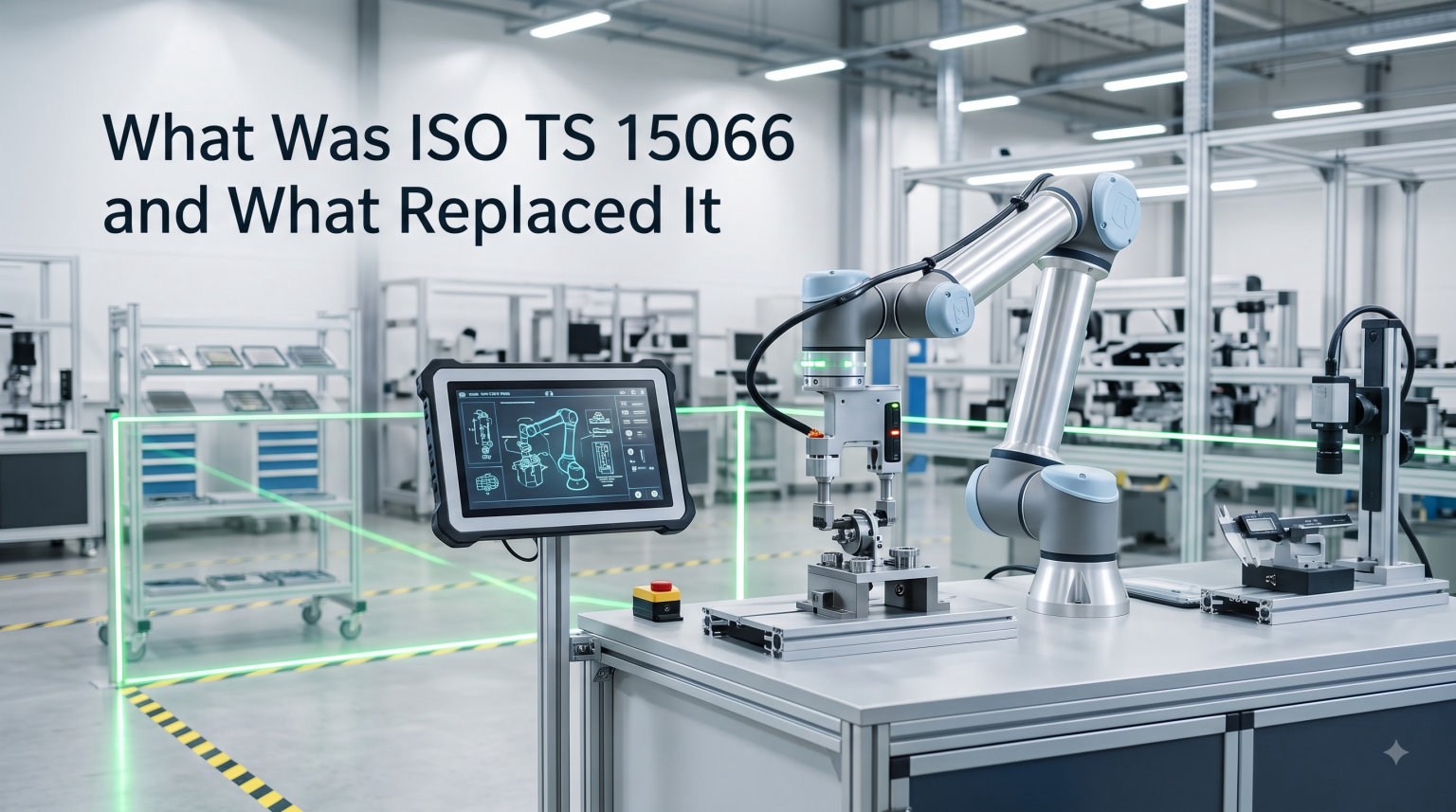
ISO/TS 15066 was a Technical Specification published in 2016 that defined the safety requirements for collaborative industrial robot systems and their work environments. For nearly a decade, this document served as the global reference for engineers, integrators, and safety professionals who needed to deploy robots that share workspace with human operators.
If you searched for what replaced ISO/TS 15066, the short answer is that the updated ISO 10218-1:2025 and ISO 10218-2:2025 standards absorbed and expanded its collaborative robot requirements. I have spent weeks reading the original specification, the new ISO 10218:2025 documents, and dozens of integrator reports to bring you a clear, complete picture of this transition. By the end of this guide, you will understand what the old standard covered, why it was retired, what replaced it, and how to think about compliance going forward.
Table of Contents
What Is ISO/TS 15066
ISO/TS 15066 is a Technical Specification issued by the International Organization for Standardization under the full title “Robots and robotic devices – Collaborative robots.” The “TS” in its name signals that it was not a full International Standard but a Technical Specification, which ISO uses when there is a need for guidance but the industry does not yet have enough consensus for a binding standard.
The document provided a detailed framework for safe human-robot collaboration (HRC) in industrial settings. Before its release, robot safety standards like ISO 10218-1 and ISO 10218-2 (originally published in 2011) assumed robots operated inside cages or fenced cells, separated from people. ISO/TS 15066 broke that assumption by giving engineers a way to design, validate, and operate collaborative robot systems, also called cobots, where humans and robots share a workspace.
At its core, ISO/TS 15066 defined four collaborative operating methods, biomechanical injury thresholds, and a structured risk assessment process. Manufacturers, system integrators, and end users relied on it to deploy cobots in applications like pick-and-place, machine tending, assembly, and palletizing without traditional safety fencing.
When Was ISO/TS 15066 Published and Why It Mattered
ISO/TS 15066 was first published in February 2016. It arrived at a moment when collaborative robots were transitioning from research labs into real factory floors. Universal Robots had launched the UR5 cobot earlier in 2008, and by 2015 several major manufacturers, including FANUC, KUKA, ABB, and Yaskawa, were selling their own cobot models. The industry needed a shared safety vocabulary, and ISO/TS 15066 delivered it.
Before 2016, integrators who wanted to deploy fenceless cobot cells had to cobble together guidance from ISO 10218, ANSI/RIA R15.06, and manufacturer white papers. ISO/TS 15066 centralized that knowledge. It gave the industry a common reference for the four collaborative methods, the maximum allowable quasi-static and transient contact forces, and the risk assessment steps required to validate a collaborative application.
The standard quickly became the de facto reference for cobot safety worldwide. It was adopted in Europe, cited in North American risk assessments, and used in academic research on human-robot interaction. By 2026, the document had shaped nearly every commercial cobot installation of the past decade.
Key Safety Requirements Covered by ISO/TS 15066
ISO/TS 15066 organized its safety requirements around four collaborative operating methods. Each method is a different way of ensuring that any contact between a human and a robot remains below biomechanical injury thresholds. Let me walk through each one.
Safety-Rated Monitored Stop
When a human enters the collaborative workspace, the robot stops and remains stationary. The stop is safety-rated, meaning it is monitored and reliably held until the operator leaves the area. This method allows full robot speed when the operator is absent and zero motion when the operator is present.
Hand Guiding
The operator physically guides the robot end-effector by hand, often using a special handle. The robot only moves while the operator applies force, and the system limits speed, force, and direction. Hand guiding is common in teach-by-demonstration tasks and heavy-payload assembly.
Speed and Separation Monitoring
The robot and human can move simultaneously as long as a protective separation distance is maintained. Sensors and software continuously calculate the minimum distance based on the robot’s speed, the human’s speed, the robot’s stopping time, and the system’s intrusion distance. If the distance shrinks below the threshold, the robot slows or stops.
Power and Force Limiting
The robot is designed so that any contact, whether intentional or accidental, cannot exceed biomechanical limits. The specification set maximum allowable values for quasi-static contact (clamping or crushing) and transient contact (brief impacts) across different body regions. For example, the maximum allowable transient force on the hand is 140 N, while the same force on the chest is significantly lower.
Beyond these four methods, ISO/TS 15066 also introduced the now-famous biomechanical limit table. It lists 29 body regions with specific thresholds for maximum permissible pressure and force, based on pain thresholds rather than injury thresholds. The values were derived from research studies on human volunteers, which made the document uniquely practical for real-world risk assessments.
What Replaced ISO/TS 15066
ISO/TS 15066 was replaced by the updated ISO 10218-1:2025 and ISO 10218-2:2025 standards, which were published in 2025 and consolidated the collaborative robot requirements directly into the main robot safety standards. Instead of referencing a separate Technical Specification, the new ISO 10218 documents now contain the four collaborative methods, biomechanical guidance, and risk assessment requirements that used to live in ISO/TS 15066.
ISO 10218-1 covers the robot itself, including its design, manufacturing, and integrated safety functions. ISO 10218-2 covers the robot system, cell, and integration, including installation, application design, and risk assessment. Together, the 2025 revisions form a single, unified framework for industrial robot safety, whether the robot operates in a fenced cell or in a collaborative workspace.
For engineers and integrators, the practical change is that you no longer have to combine ISO 10218 (2011) with ISO/TS 15066 (2016) when evaluating a cobot application. The new ISO 10218:2025 documents bring everything together. If you want to dig into how these robot control systems handle signals, our primer on what an ADC does explains the sensing side of those safety functions.
The transition reflects how the standards community responded to ten years of cobot deployment experience. The new revisions are clearer, more aligned with ANSI/RIA R15.06-2012 and its 2024 update, and easier to apply to modern cobot designs that include integrated force-torque sensors, vision systems, and software-configurable safety zones.
Why the Transition From ISO/TS 15066 to ISO 10218:2025 Occurred
Three forces drove the retirement of ISO/TS 15066. First, the cobot market matured. In 2016, collaborative robots were still a niche. By 2024, the International Federation of Robotics reported more than 50,000 new collaborative robot installations per year. The Technical Specification format, intended for emerging consensus, no longer matched an industry that had converged on common practices.
Second, the cobot itself evolved. Early cobots were simple position-controlled arms. Modern cobots include torque sensing at every joint, AI-driven path planning, and cloud-connected diagnostics. The 2016 specification did not address how to assess risks in systems with machine learning, mobile manipulators, or human-robot handover tasks. The 2025 standards explicitly cover these cases.
Third, global harmonization mattered. ANSI/RIA R15.06-2012 had already adopted ISO 10218 as its U.S. equivalent, and the 2024 update to R15.06 lined up with the new ISO revisions. Having collaborative robot guidance in the main ISO 10218 documents simplifies compliance for multinational manufacturers and integrators. It also reduces the risk of conflicting requirements between regions.
Finally, ISO only issues a Technical Specification for a limited time. ISO/TS 15066 was due for either conversion to a full International Standard or withdrawal. The 2025 revision of ISO 10218 made that conversion unnecessary, because the collaborative content is now part of the primary standard itself.
Comparing ISO/TS 15066 vs ISO 10218:2025 Requirements
To help you understand what changed, I have summarized the main differences between ISO/TS 15066 and the new ISO 10218-1:2025 and ISO 10218-2:2025 standards. The table below shows the key areas where the 2025 revisions updated, clarified, or expanded on the 2016 specification.
| Area | ISO/TS 15066 (2016) | ISO 10218-1:2025 & ISO 10218-2:2025 |
|---|---|---|
| Document type | Technical Specification (separate document) | Full International Standard (integrated into ISO 10218-1 and 10218-2) |
| Collaborative methods | Four methods: SRMS, hand guiding, SSM, PFL | Same four methods, with refined definitions and new application examples |
| Biomechanical limits | 29 body regions with quasi-static and transient thresholds | Updated limit table with new body regions and clarified contact types |
| Risk assessment | Detailed process in the TS itself | Process moved into ISO 10218-2, expanded with modern risk methods |
| Mobile robots | Not covered | New content for mobile manipulators and AGV-style cobots |
| AI and ML integration | Not addressed | Guidance on assessing risk in systems with adaptive behavior |
| Workspace sharing | Focused on shared workspace between human and robot arm | Adds guidance for multi-robot cells and human-robot handover tasks |
Notice that the core engineering values, like the four collaborative methods and the biomechanical thresholds, did not change dramatically. What changed is the structure, the context, and the additional coverage of new technologies. The 2025 standards also added more worked examples, which I expect will be a relief to integrators who found the 2016 specification dense.
Compliance Guidance for Existing Installations
If your facility already runs cobots validated under ISO/TS 15066, you do not need to panic. The 2016 specification is not suddenly invalid. Risk assessments and installations performed under ISO/TS 15066 remain valid documentation, and most national regulatory bodies continue to accept them. What changes is how you should think about future work.
For new installations, integrate the ISO 10218:2025 requirements from the start. That means your risk assessment, safety function validation, and operational procedures should reference the new standards. If you are upgrading an existing cobot cell, treat it as a good moment to review your risk assessment against the 2025 revisions and add any missing elements, especially around mobile manipulators or AI-driven behavior if those apply to your cell.
If your cobot’s drivetrain or motion planning system is going through a redesign, plan for the new force and speed validation procedures. The 2025 standards give clearer guidance on how to measure transient contact forces, which may require updated test fixtures. For broader context on mechanical design tradeoffs, our guide to gear ratio in robotics explains how drivetrain choices affect stopping distance, a key parameter in speed and separation monitoring.
Finally, work with a certified functional safety engineer or a TUV-trained integrator. The new standards are not radically different, but the harmonization with ANSI/RIA R15.06 and the new content around AI integration mean that a quick review by an expert is worth the cost.
Frequently Asked Questions
What is the ISO standard for collaborative robots?
The current ISO standard for collaborative robots is ISO 10218-1:2025 and ISO 10218-2:2025. These documents incorporate the four collaborative operating methods, biomechanical limits, and risk assessment requirements that used to live in ISO/TS 15066. Before 2025, ISO/TS 15066 was the dedicated reference for collaborative robot safety.
What replaced ISO/TS 15066?
ISO/TS 15066 was effectively replaced by the 2025 revisions of ISO 10218-1 and ISO 10218-2. The collaborative robot safety content that was in the Technical Specification was merged into these two main robot safety standards. Existing installations validated under ISO/TS 15066 remain valid, but new installations should follow the ISO 10218:2025 requirements.
When was ISO/TS 15066 published?
ISO/TS 15066 was first published in February 2016. It was issued as a Technical Specification rather than a full International Standard because the collaborative robot industry was still developing consensus on safety practices at the time.
What is ANSI/RIA R15.06?
ANSI/RIA R15.06 is the U.S. national standard for industrial robot safety. It is technically equivalent to ISO 10218 and is maintained by the Robotic Industries Association. The 2012 version of R15.06 was harmonized with ISO 10218:2011, and the 2024 update aligns with the ISO 10218:2025 revisions.
Conclusion
ISO/TS 15066 served as the foundation of collaborative robot safety from 2016 until the 2025 revision of ISO 10218. It defined the four collaborative methods, the biomechanical thresholds, and the risk assessment process that made fenceless cobot cells possible. If you are researching what ISO/TS 15066 was and what replaced it, the answer is that its content now lives inside ISO 10218-1:2025 and ISO 10218-2:2025, which form a single, harmonized framework for industrial robot safety.
For your next steps, audit any existing cobot installations against the new standards, update your risk assessment templates to reference ISO 10218:2025, and consult a certified functional safety engineer for new cells. If you are curious about how the physical hardware supports these safety functions, our article on Power over Ethernet in robotics shows how modern cobot controllers get the reliable power they need for safety-rated monitored stops. The transition from ISO/TS 15066 to ISO 10218:2025 is a practical upgrade, not a disruption, and adopting it will keep your collaborative automation safe, productive, and audit-ready.