
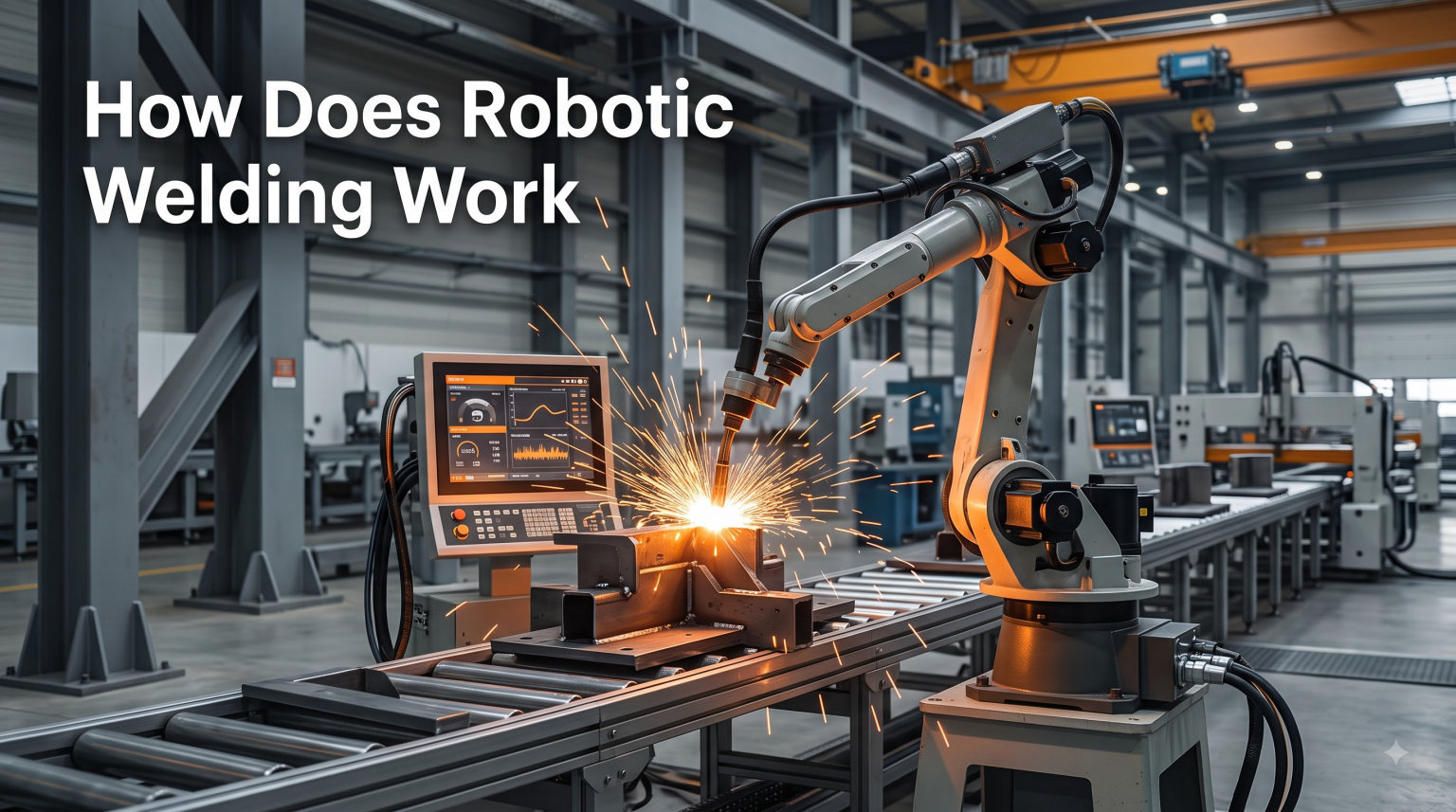
If you’ve ever wondered how does robotic welding work, here’s the short answer: a programmable robot arm moves a welding torch along a precise path to fuse metal parts together, while a controller monitors arc voltage, wire feed, and travel speed in real time. The system repeats the same motion thousands of times with millimeter accuracy, and modern setups use sensors and machine learning to self-correct mid-weld.
I’ve spent the last several months touring fabrication shops and talking to automation engineers, and I want to walk you through what I learned. In this guide, our team breaks down the process, the components, the welding types, and the real-world trade-offs. Whether you’re evaluating automation for your shop or just curious about the technology, you’ll find clear answers below.
Table of Contents
What Is Robotic Welding
Robotic welding is an automated manufacturing process that uses programmable industrial robots to perform welds on metal workpieces. Instead of a human holding a torch, a robotic arm with a welding end effector follows a pre-programmed path, while the controller synchronizes power output, wire feed, and travel speed.
The technology emerged in the 1960s and exploded in the 1980s when automakers adopted it for body assembly. Today, robotic welding handles the majority of mass-production welds in automotive plants, and it has spread into aerospace, heavy equipment, and even small job shops through collaborative robots.
At its core, robotic welding addresses three problems: skilled welder shortages, weld inconsistency, and the economics of 24/7 production. A properly programmed cell can deposit the same bead thousands of times without fatigue, drift, or variation, which is something even the most skilled human welders cannot match over a full shift.
How Does Robotic Welding Work Step by Step
The robotic welding process follows four repeatable stages. Once you understand these stages, every robotic welding cell in any industry makes sense.
- Programming the robot path. An engineer or technician defines the weld path using a teach pendant or offline programming software, setting coordinates, travel speed, torch angle, and welding parameters.
- Preparing and clamping the workpiece. The metal parts are positioned in a fixture or jig, and clamps hold them with consistent geometry so the robot can find the joint every cycle.
- Executing the weld. The robot arm moves the torch along the joint while the power source delivers current and the wire feeder pushes filler metal. Sensors monitor arc length, voltage, and current in real time.
- Inspecting the joint. After the weld cools, automated inspection (or in some setups, in-process monitoring) checks bead width, penetration, and defects to confirm quality.
What surprised me on my shop visits is how much of the work happens before the arc ever strikes. Fixture design, joint preparation, and parameter tuning eat up most of the engineering time. Once a cell is dialed in, though, it can run hundreds of identical parts per shift with minimal supervision.
Key Components of a Robotic Welding System
Every robotic welding cell is a stack of specialized subsystems working together. Here’s what each piece does.
The Robot Arm
The robot arm is typically a 6-axis articulated machine, and 6 degrees of freedom is standard for robotic welding arms because complex weld seams require the torch to approach from multiple angles. Servo motors at each joint provide the precision and repeatability (usually ±0.05 mm or better) that robotic welding demands.
The Controller
The controller is the brain of the system. It stores the program, coordinates motion, and talks to the power source. Most modern controllers also handle safety interlocks and integrate with factory MES systems for production tracking.
The Welding Torch and Power Source
The torch is the end effector, and it’s connected to a power source that delivers the arc. For MIG welding, the torch also routes shielding gas and filler wire. For TIG, it holds a non-consumable tungsten electrode. For spot welding, the torch itself is a pair of copper electrodes that clamp and pulse current through the joint.
Positioners and Fixtures
Positioners rotate or tilt the workpiece so the torch can always weld in the optimal orientation (usually flat or horizontal). Fixtures clamp parts in a fixed location so the robot can find the joint consistently, even on high-mix production.
Sensors and Vision Systems
Arc sensors, laser seam trackers, and 2D/3D cameras feed real-time data back to the controller. They compensate for part variation, detect joint offsets, and trigger adaptive welding responses when conditions drift outside tolerance.
Types of Robotic Welding Explained
Different welding processes suit different materials, thicknesses, and production needs. The four most common types in robotic welding are MIG, TIG, spot, and laser.
MIG Welding (GMAW)
MIG, or gas metal arc welding, is the most common robotic welding process. A continuously fed wire acts as both electrode and filler, and shielding gas protects the weld pool. It’s fast, forgiving, and works well on steel and stainless in automotive and fabrication applications.
TIG Welding (GTAW)
TIG, or gas tungsten arc welding, uses a non-consumable tungsten electrode and a separate filler rod. Robotic TIG delivers exceptionally clean, precise welds on aluminum, stainless, and exotic alloys. It’s slower than MIG but produces higher cosmetic and structural quality.
Spot Welding
Spot welding is resistance welding: two copper electrodes clamp the metal sheets and pass a high current for a fraction of a second, fusing the layers through heat and pressure. It’s the dominant process in automotive body assembly, where a single car body can require 4,000 to 5,000 spot welds.
Laser Welding
Laser beam welding focuses a high-power laser on the joint, creating a narrow, deep weld with minimal heat input. Robotic laser welding is growing fast in battery manufacturing, electronics, and precision components where speed and low distortion matter.
Applications and Industries That Use Robotic Welding
Robotic welding shows up wherever high-volume, repeatable welds are needed. Automotive assembly remains the largest user, with most body-in-white and chassis welds performed by robots.
Aerospace manufacturers use robotic TIG and laser welding for engine components, fuel lines, and structural airframe parts where traceability and defect-free welds are non-negotiable. Heavy equipment fabricators deploy robotic MIG cells for frames, booms, and buckets that would be too large or too repetitive for hand welding.
Beyond the big three, you’ll find robotic welding in shipbuilding, agricultural machinery, consumer appliances, and even small job shops running cobots on low-volume custom work. If you’re interested in building robots like these for your own projects, check out our robot building resources and guides. The technology is no longer reserved for mega-plants.
Advantages of Robotic Welding Over Manual Welding
The case for robotic welding comes down to consistency, throughput, and economics. Here are the advantages that come up again and again in industry data.
Consistent quality. A robot welds the same bead the same way every cycle, with no fatigue, distraction, or shift-to-shift variation. Weld quality is one of the biggest reasons shops invest.
Higher throughput. Robotic welding cells typically run 3 to 5 times faster than manual welding on high-volume parts, and they can run 24/7 with lights-out operation.
Lower long-term cost. Once a cell is paid off, labor costs per part drop sharply. Most fabricators see ROI inside 18 to 36 months on high-volume work.
Better working conditions. Robots take the heat, fumes, and UV exposure, so human welders move into higher-value programming, quality, and supervisory roles.
Tight integration with Industry 4.0. Modern cells feed weld data directly into factory analytics, which supports traceability and continuous improvement initiatives.
Limitations and Downsides of Robotic Welding
Robotic welding is not the right answer for every job. Here are the trade-offs I hear from automation engineers and shop owners.
High upfront cost. A complete robotic welding cell runs from the low six figures into the millions depending on size, fixtures, and integration. For very small shops, that capital barrier is real.
Setup and programming time. Programming a new part takes hours to days, so robotic welding works best on parts that run in batches of at least dozens or hundreds.
Limited flexibility. Robots excel at repetition. Highly variable work, one-off prototypes, or complex 3D paths with frequent repositioning still favor skilled manual welders.
Maintenance and support. Robots need regular preventive maintenance, calibration, and skilled technicians. Downtime on a robotic cell is expensive.
Fixture sensitivity. Robotic welding demands tight fixture tolerances. Part variation that a human welder could compensate for can break a robot cell’s repeatability.
Cobots vs Industrial Robots in Welding
Collaborative robots, or cobots, are a newer category designed to work safely alongside humans. The trade-off compared to traditional industrial welding robots is worth understanding.
Industrial robots are fast, payload-heavy, and caged for safety. They dominate high-volume automotive and heavy industry. Cobots are slower, lower-payload, and equipped with force-sensing collision detection that lets them operate without cages in many applications.
For small and mid-sized shops, cobots open the door to automation because they can be redeployed between jobs, programmed by non-specialists, and installed without expensive safety infrastructure. For high-throughput mass production, industrial robots still win on speed and payload.
Programming Methods for Robotic Welding
Programming a welding robot has come a long way from the early days of hand-coding every coordinate. Three methods dominate today’s cells.
Teach pendant programming. An operator physically guides the robot through the path using a handheld controller, recording waypoints. It’s intuitive for small batches and complex 3D paths.
Offline programming (OLP). Software like RoboDK or manufacturer-specific tools lets engineers simulate and program the cell on a PC while production continues. OLP is essential for high-mix shops and for cells with long changeover windows.
AI-assisted and vision-guided programming. The newest trend uses cameras and machine learning to auto-generate weld paths from CAD data or scanned parts. This is the frontier of robotic welding programming in 2026.
AI and Machine Learning in Robotic Welding
Artificial intelligence is reshaping what robotic welding can do. Adaptive welding systems use real-time arc sensing to adjust voltage and wire feed on the fly, compensating for joint gaps, warping, or material variation that would have caused defects in older systems.
Machine learning models trained on thousands of welds can predict defects before they occur, flagging parameters that drift out of the proven process window. Computer vision inspects completed welds for porosity, undercut, and bead geometry without slowing the line.
For shops evaluating automation in 2026, AI integration is no longer experimental. It’s a competitive advantage that reduces scrap, cuts inspection labor, and pushes robotic welding into applications that were impossible just a few years ago.
Frequently Asked Questions
Can you explain how robotic welding works?
Robotic welding works by programming a robot arm to move a welding torch along a precise path while a controller manages power, wire feed, and travel speed. The system repeats the same motion cycle after cycle, and sensors monitor arc conditions in real time to maintain weld quality.
What are the downsides of robotic welding?
The main downsides of robotic welding are high upfront cost, programming complexity, long setup times for new parts, sensitivity to fixture variation, and the need for ongoing maintenance. It is also less flexible than manual welding for one-off prototypes or highly variable work.
How much faster is a robotic welder than a human welder?
A robotic welder is typically 3 to 5 times faster than a manual welder on high-volume production parts, and it can run continuously without breaks, fatigue, or shift changes. Real-world speed gains depend on part complexity, fixture design, and the specific welding process used.
What types of welding can robots do?
Robots can perform MIG (GMAW), TIG (GTAW), spot welding, laser welding, plasma welding, and stud welding. MIG and spot welding are the most common in automotive production, while TIG and laser are used where precision and low heat input are critical.
How much do robotic welder operators get paid?
Robotic welding operators and programmers in the United States typically earn between 45,000 and 85,000 dollars per year depending on experience, region, and industry. Advanced programmers and integration specialists can earn six figures, especially in automotive and aerospace manufacturing.
Final Thoughts on How Robotic Welding Works
Robotic welding is no longer a black box. Once you understand the four-step process, the key components, and the trade-offs between MIG, TIG, spot, and laser, the technology becomes a practical tool you can evaluate for your own shop or career path.
If you’re considering automation, start by mapping your highest-volume weld, calculating the labor hours spent on it, and talking to integrators about cycle time and ROI. If you’re curious about a career in robotic welding, focus on programming, sensors, and offline simulation. These are the skills that will define the field in 2026 and beyond.