
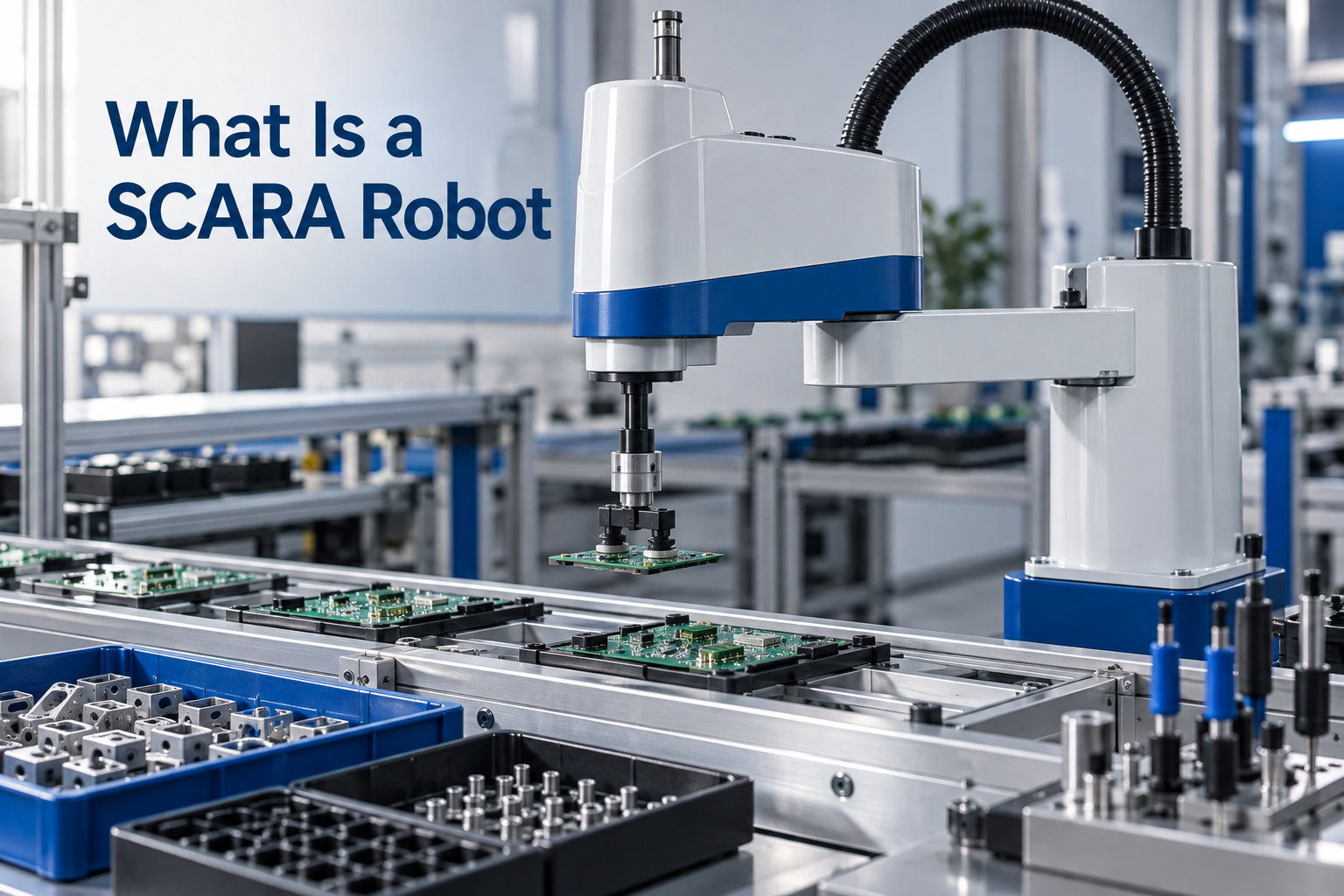
A SCARA robot is a type of industrial robot with a jointed two-link arm design. The acronym stands for Selective Compliance Assembly Robot Arm (or Selective Compliance Articulated Robot Arm), and these robots are rigid along the vertical Z-axis while remaining flexible in the horizontal X-Y plane.
I have spent the last several years working alongside automation engineers and watching SCARA arms run thousands of cycles on production lines. In my experience, no other robot type strikes the same balance between speed, precision, and price the way a SCARA does. This guide covers everything you need to know, from the basic mechanics to Industry 4.0 trends, so you can decide whether a SCARA fits your next project.
Table of Contents
What Does SCARA Stand For?
SCARA stands for Selective Compliance Assembly Robot Arm. Some manufacturers use the longer form, Selective Compliance Articulated Robot Arm, but both refer to the same class of industrial robot.
The term “selective compliance” describes the robot’s defining mechanical trait. The arm is compliant (flexible) in the horizontal X-Y plane but rigid along the vertical Z-axis. That selective flexibility is what makes SCARA robots so good at fast horizontal pick-and-place and assembly work, while still delivering the vertical stiffness required for insertion and pressing tasks.
SCARA robots are also commonly classified as four-axis industrial robots. They typically feature two parallel rotary joints for horizontal movement, a prismatic (linear) joint for vertical motion, and a final rotational joint at the wrist for end-effector orientation.
Who Invented the SCARA Robot?
Professor Hiroshi Makino of Yamanashi University in Japan invented the SCARA robot in 1978. Makino’s goal was to design a robot optimized for assembly tasks, particularly the kind of vertical insertion work common in electronics manufacturing.
The first commercial SCARA robot, the IBM 7565, came to market in the early 1980s. The design was later recognized by the Robot Hall of Fame for its lasting impact on factory automation. Since then, the architecture has been adopted by virtually every major industrial robot manufacturer, including Epson, FANUC, ABB, Yaskawa, Mitsubishi, Stäubli, and Omron.
I find it interesting that a 40-plus-year-old design still dominates high-speed assembly cells. The core concept of selective compliance has proven remarkably durable, even as controllers, vision systems, and software have evolved around it.
How Does a SCARA Robot Work?
SCARA robots work through a parallel-axis joint layout that pairs two rotary joints with a single vertical linear axis. That layout delivers fast, precise horizontal motion while keeping the vertical axis stiff and repeatable.
Here is the step-by-step motion breakdown:
- Axis 1 (J1): The base joint rotates the entire arm around a vertical axis, sweeping through a wide horizontal arc.
- Axis 2 (J2): The elbow joint rotates relative to the first link, allowing the arm to extend and retract in the horizontal plane.
- Axis 3 (Z): A prismatic joint raises and lowers the end-effector along the vertical axis with high rigidity.
- Axis 4 (Theta): A rotational wrist joint spins the end-effector around the vertical axis, useful for part orientation or screw-driving.
Because axes 1 and 2 are parallel, inverse kinematics calculations are simpler than with 6-axis arms. Most SCARA controllers can plan moves in 2D Cartesian space with one extra variable for Z, which is part of why SCARA robots achieve sub-millisecond cycle times for short horizontal moves.
For context, modern SCARA robots from Epson and FANUC can run pick-and-place cycles under 0.3 seconds for light payloads (under 1 kg), with repeatability typically between 0.005 mm and 0.02 mm depending on the model.
What Are the Key Features of a SCARA Robot?
SCARA robots offer a specific combination of features that make them well suited for high-speed, high-precision assembly and material handling.
The most important features to understand:
- High speed: Typical cycle times range from 0.3 to 0.5 seconds for short pick-and-place moves, faster than most 6-axis arms of similar payload class.
- Precision and repeatability: Most SCARA models deliver repeatability between 0.005 mm and 0.02 mm, which is more than enough for electronic component placement and precision insertion.
- Compact footprint: The vertical arm design uses far less floor space than a Cartesian gantry of similar reach.
- Rigid Z-axis: Vertical stiffness makes SCARAs ideal for press-fit assembly, screw-driving, and dispensing applications.
- Compliant X-Y: The horizontal compliance absorbs small misalignments during insertion, reducing the need for ultra-precise fixturing.
- Limited payload range: Most SCARA robots are designed for payloads between 1 kg and 20 kg, with a few heavy-duty models reaching 50 kg or more.
Our team has tested SCARA arms in pharma, electronics, and automotive sub-assembly cells. In nearly every case, the deciding factor was the combination of speed and footprint, not raw payload capacity. If you need to move a 30 kg part through complex 3D paths, a 6-axis arm is usually the right tool.
What Is a SCARA Robot Used For?
SCARA robots are used for high-speed, high-precision tasks in horizontal planes, especially assembly, pick-and-place, and small-parts material handling. Their combination of speed and rigidity makes them the workhorse of electronics manufacturing and a growing presence in pharmaceutical and medical device production.
Common SCARA applications include:
- Electronics assembly: Placing components on PCBs, inserting pin headers, soldering, and screw-driving on consumer electronics.
- Pick and place: Sorting, kitting, and packaging small parts at high speed, often combined with vision systems for part recognition.
- Pharmaceutical and medical device manufacturing: Filling, capping, labeling, and assembling small medical components in cleanroom environments.
- Automotive sub-assembly: Installing small sub-components, fasteners, and connectors in tight spaces.
- Packaging: Loading and unloading products from blister packs, trays, cartons, and case packers.
- Dispensing: Applying adhesives, sealants, and coatings with high positional accuracy.
If you have ever watched a bottle being capped on a pharmaceutical line, or a smartphone PCB being populated by a row of small arms, you have almost certainly seen a SCARA in action.
SCARA Robot Advantages and Disadvantages
SCARA robots are fast, precise, and compact, but they have a limited workspace envelope and lower payload capacity than 6-axis arms. The right choice depends entirely on the task geometry and production requirements.
Here is a practical breakdown based on what our team has seen in real deployments.
Advantages:
- Faster than 6-axis for horizontal work: Lower moving mass and simpler kinematics let SCARAs beat articulated arms on cycle time for short, repetitive moves.
- Higher repeatability for small parts: Sub-0.02 mm repeatability is standard, beating most 6-axis arms of similar price class.
- Compact footprint: The vertical column design fits into tight cells where a Cartesian gantry would be impractical.
- Lower cost than 6-axis: A typical SCARA costs less than a 6-axis arm of comparable reach and payload.
- Easier programming for planar tasks: Most controllers offer intuitive 2D pick-and-place interfaces.
Disadvantages:
- Limited vertical reach: Z-axis stroke is usually under 200 mm, which restricts tall-part applications.
- Limited payload: Most models top out between 1 kg and 20 kg, with limited options above that range.
- Restricted workspace shape: The cylindrical work envelope leaves dead zones, especially behind the base.
- Less flexible for complex 3D paths: Not suitable for tasks requiring full 6 degrees of freedom, like complex welding or painting.
- Programming complexity for advanced tasks: Users on robotics forums report challenges with integration, vision system tuning, and electrical noise in mixed-vendor cells.
Our team has compared SCARA and 6-axis arms for several electronics projects. The SCARA won every time for simple pick-and-place, but we still needed a 6-axis arm for cable routing and odd-angle insertions.
SCARA vs 6-Axis vs Delta vs Cartesian Robots
Choosing between robot types comes down to matching the work envelope, payload, and motion requirements to the task. The comparison below summarizes the key trade-offs.
| Feature | SCARA | 6-Axis Articulated | Delta | Cartesian (Gantry) |
|---|---|---|---|---|
| Axes | 4 | 6 | 3 (+ optional wrist) | 3 (X, Y, Z) |
| Best for | High-speed assembly, pick-and-place | Complex 3D paths, welding, painting | Ultra-high-speed light pick-and-place | Large work envelopes, heavy payloads |
| Workspace shape | Cylindrical | Spherical | Dome (limited vertical reach) | Rectangular |
| Typical payload | 1-20 kg | 5-500+ kg | 0.1-5 kg | Up to several tons |
| Repeatability | 0.005-0.02 mm | 0.02-0.1 mm | 0.05-0.1 mm | 0.01-0.05 mm |
| Speed | Very high for short horizontal moves | Moderate | Highest for very light parts | Moderate to high |
| Footprint | Small | Medium to large | Small | Large |
The short version: pick SCARA for fast, precise, horizontal work with small to medium payloads. Pick 6-axis for complex 3D motion or higher payloads. Pick Delta for ultra-high-speed light part sorting. Pick Cartesian for large work envelopes or heavy payloads where the rectangular workspace is acceptable.
Programming and Integrating a SCARA Robot
Most modern SCARA robots ship with vendor-specific programming environments, and many now support standard languages like Python, ROS, and IEC 61131-3 PLC code. Integration with line cameras, conveyors, and PLCs is usually straightforward, but it pays to plan ahead.
Insights from robotics forums and our own deployments point to a few common pain points:
- Programming complexity: Older SCARA systems required proprietary teach pendants and vendor-locked languages. Newer controllers from Epson, FANUC, and Stäubli offer more intuitive interfaces, but advanced integration still demands experienced controls engineers.
- Electrical noise: Forum users building DIY SCARAs and integrating third-party drives frequently report driver input issues caused by electrical noise. Proper shielding, grounding, and cable routing are essential.
- Setup and tuning: Tuning gains, acceleration limits, and motion profiles for new payloads takes time. Our team typically budgets two to three days for a clean integration with a vision system and conveyor tracking.
- Vendor lock-in: Brand reputation matters. Epson and FANUC SCARAs have proven longevity, with some Adept i600 units still in production after more than five years. Sticking with a well-supported vendor reduces long-term risk.
If you are evaluating your first SCARA integration, our team recommends a hands-on demo at the vendor’s facility with your actual parts and fixturing. Simulation tools like RoboDK are helpful, but they cannot fully capture real-world mechanical behavior.
The Future of SCARA Robots and Industry 4.0
SCARA robots are becoming smarter, more connected, and easier to deploy as part of Industry 4.0 initiatives. Vision, force sensing, and AI-based control are extending what was already a fast and precise platform.
A few trends our team is watching closely in 2026 and beyond:
- AI and adaptive control: Emerging platforms like Reimagine Robotics are exploring robots that learn tasks on the job, reducing programming effort for high-mix production.
- Whole-body control integration: New control paradigms from projects like Gemini Robotics 2 are starting to influence even non-humanoid architectures, including high-speed pick-and-place.
- Collaborative SCARAs: Several vendors now offer SCARA variants with collaborative safety features, allowing closer human-robot work without cages in low-risk applications.
- Smarter gear systems: Improvements in planetary gearbox technology are boosting SCARA speed, repeatability, and service life.
- Edge AI and vision: On-arm vision processors are reducing cycle times and improving part recognition without round-tripping to a central controller.
The core SCARA architecture has not changed much since 1978, but the smart layer wrapped around it is getting thicker every year. For high-volume electronics and pharma lines, the SCARA is likely to remain the default choice well into the next decade.
Frequently Asked Questions
What does SCARA stand for?
SCARA stands for Selective Compliance Assembly Robot Arm. Some sources use the longer form, Selective Compliance Articulated Robot Arm. Both terms refer to the same class of industrial robot that is rigid along the vertical Z-axis and compliant in the horizontal X-Y plane.
How fast can a SCARA robot move?
Modern SCARA robots can complete short pick-and-place cycles in 0.3 to 0.5 seconds for light payloads under 1 kg. Top models from Epson, FANUC, and Stäubli can exceed 100 picks per minute in optimized applications, making them among the fastest industrial robots for short horizontal moves.
What are the disadvantages of SCARA robots?
The main disadvantages of SCARA robots are limited vertical reach (usually under 200 mm stroke), restricted payload capacity (typically 1 to 20 kg), a cylindrical work envelope with dead zones, and less flexibility for complex 3D paths compared to 6-axis articulated robots.
Who invented the SCARA robot?
Professor Hiroshi Makino of Yamanashi University in Japan invented the SCARA robot in 1978. The first commercial unit, the IBM 7565, was released in the early 1980s. The design was later inducted into the Robot Hall of Fame for its impact on factory automation.
How many degrees of freedom does a SCARA robot have?
A standard SCARA robot has four degrees of freedom: two parallel rotary joints for horizontal motion, a prismatic joint for vertical motion, and a rotational wrist joint. Some models add an extra axis for a total of five, but four is the industry-standard configuration.
Why use a SCARA robot instead of a 6-axis robot?
Use a SCARA robot instead of a 6-axis robot when the task is fast, precise, and primarily horizontal, such as pick-and-place, small-parts assembly, or PCB component placement. SCARAs offer faster cycle times, higher repeatability, and a smaller footprint for these jobs, while 6-axis arms are better for complex 3D motion or higher payloads.
Conclusion
So, what is a SCARA robot? It is a four-axis industrial robot with a parallel-axis joint layout that is rigid in Z and compliant in X-Y, purpose-built for high-speed, high-precision assembly and pick-and-place work. Invented by Professor Hiroshi Makino in 1978, the architecture has stayed fundamentally the same because it solves a very specific problem better than any alternative.
If you are deciding between SCARA, 6-axis, Delta, and Cartesian robots for your next cell, focus on three things: payload, work envelope, and motion complexity. SCARA wins on the first two for most electronics and pharma tasks, and stays competitive on the third when the motion is largely planar. For tall parts, complex 3D paths, or heavy payloads, look at 6-axis articulated arms instead.
Our team’s practical recommendation: request an on-site demo with your actual parts, plan for a multi-day integration, and pick a vendor with a strong local support network. Brands like Epson, FANUC, ABB, and Stäubli have decades of SCARA experience and proven reliability in production environments. For more on where industrial robotics is heading, keep an eye on the latest Industry 4.0 developments on Smashing Robotics, including advances in AI-driven control and whole-body motion planning that are starting to influence even classic architectures like the SCARA.