
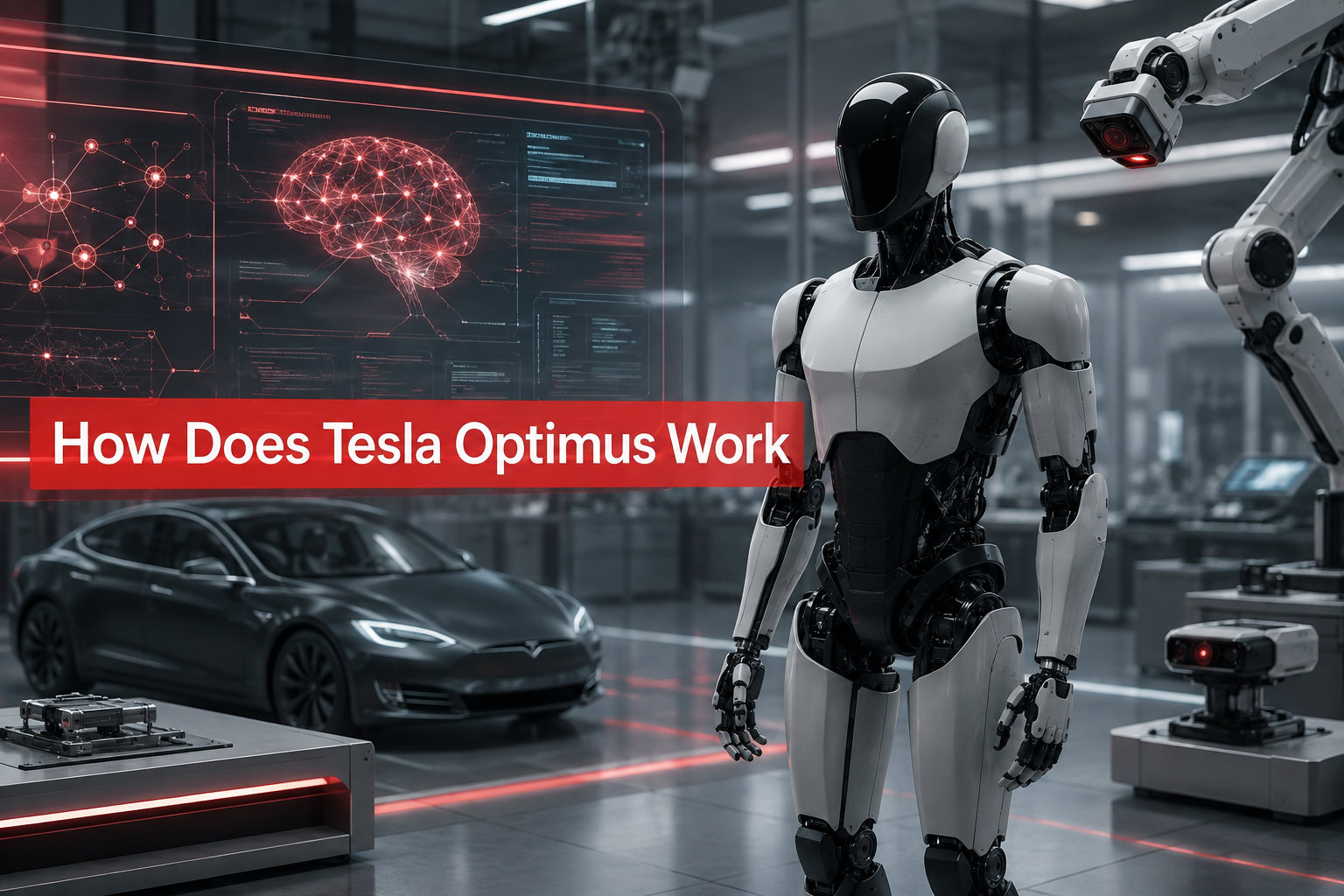
If you have been asking how does Tesla Optimus work, you are not alone. The Tesla Optimus humanoid robot combines end-to-end neural networks borrowed from Tesla’s Full Self-Driving software with a fully custom mechanical body. It uses onboard cameras, joint-level actuators, and imitation learning to walk, lift, sort objects, and perform repetitive tasks. In this guide I will walk you through the brain, the body, the eyes, and the training loop that turn a pile of metal and motors into a useful humanoid.
Our team has tracked every Optimus reveal since AI Day 2021, and the robot has changed a lot since then. The short answer is this: Optimus works because Tesla treated a humanoid robot like a self-driving car with legs. The same neural network stack that drives a Model Y down a highway now drives a bipedal robot through a factory floor.
Table of Contents
What Is Tesla Optimus
Tesla Optimus, also marketed as the Tesla Bot, is a general-purpose bipedal humanoid robot under development by Tesla, Inc. Elon Musk first announced it at Tesla’s AI Day in August 2021, and a costumed human walked across the stage. By 2022, a working prototype walked unsupported on stage. The goal is a mass-produced humanoid that can take over unsafe, repetitive, or boring tasks in factories and, eventually, homes.
At roughly 5’8″ tall and around 125 pounds, Optimus is designed to operate in human spaces. It can use tools, climb stairs, and navigate doorways. Unlike most research humanoids, it is being designed for high-volume manufacturing, which is why Tesla reuses automotive-grade components whenever it can. If you have read our guide on how a robot chassis works, you already know the skeleton is half the battle. For Optimus, the chassis is purpose-built.
How Does Tesla Optimus Work: The Core AI and Brain
Optimus works by running Tesla’s Full Self-Driving (FSD) neural networks on a compact onboard computer housed in its torso. The same end-to-end neural networks that process camera footage from a moving car have been retrained on robot footage, giving Optimus the ability to perceive its world, plan movements, and act in real time. There is no pre-programmed script for each task. The robot generalizes from data.
End-to-End Neural Networks
An end-to-end neural network takes raw sensor input and directly outputs motor commands. Instead of a stack of separate modules for perception, planning, and control, one large model does it all. Tesla uses this approach in FSD, and Optimus applies the same philosophy. The robot’s cameras stream video into the model, and the model returns joint torques, balances, and gripper actions.
This matters because humanoid robots live in unstructured environments. A pre-written rule like “pick up the red block” breaks the moment a block changes color or position. A neural network trained on millions of demonstrations adapts. Tesla has already collected billions of miles of driving footage. The company is now collecting similar volumes of robot footage to push the same scaling laws into physical labor.
Shared Autonomy With Tesla FSD
Tesla’s unique advantage is shared autonomy between cars and robots. The vision encoder, occupancy networks, and path planners from FSD port directly to Optimus. When a Tesla navigates a parking lot, the same neural subnets can help Optimus navigate a warehouse aisle. This shared stack is the single biggest reason Optimus can ship with a competent AI so quickly, and it is an angle most humanoid competitors cannot match. To see how vision pipelines power other autonomous systems, see our explainer on how Wi-Fi control works on a robot.
How Does Tesla Optimus Walk and Move: Mechanical Design
Optimus moves through a network of custom rotary actuators placed at every major joint. Tesla designed these actuators in-house to balance torque, weight, and efficiency. Each leg has six actuators, each arm has several, and the torso houses the central compute and the 2.3 kWh battery pack that powers the entire system for a full day of light work.
Custom Actuators and Joint Motors
The actuators are integrated motor-gearbox assemblies that combine a brushless motor, a precision harmonic or planetary reducer, a torque sensor, and a controller in one unit. Tesla reportedly uses a mix of three actuator sizes: large for hips and knees, medium for ankles and shoulders, and small for wrists and fingers. The result is human-like range of motion with enough torque to squat, lift boxes, and recover from pushes.
Two of the most discussed Optimus specs are walk speed and payload. The Gen 2 prototype walks at around 5 mph, slower than a human jog, and lifts roughly 30 pounds with one arm. The 28 structural actuators are placed to mimic human anatomy as closely as possible, which keeps the learning problem simple. A robot that walks like a person can be trained on human motion capture data almost directly.
Tendon-Driven Hands and Dexterity
The most surprising mechanical detail is the tendon-driven hand. Each hand has 11 degrees of freedom and uses thin, tough cables (the “tendons”) routed through the forearm to actuate the fingers, much like a human’s tendons run through the wrist. Six actuators per hand pull these cables to bend the fingers, while position and force sensors in the fingertips give the robot a sense of touch.
This is fundamentally different from the rigid claw grippers used on factory robots. Tendon-driven hands let Optimus grasp delicate, oddly shaped, or slippery objects: an egg, a plastic cup, a screw, a piece of fabric. Without this design, the laundry-folding and grocery-sorting demos shown at AI Day 2022 would not be possible. If you have ever wondered how a robot hand “knows” how hard it is squeezing, this is the answer.
Sensors and Vision Systems
Optimus sees the world through a sensor suite lifted almost directly from Tesla vehicles. The head houses a set of cameras similar to the ones around a Model Y, providing 360-degree vision. Inertial measurement units (IMUs) in the torso and feet track orientation, acceleration, and balance. Force-torque sensors at the ankles, wrists, and joints give the robot a sense of contact and load. Each fingertip carries a tactile sensor for grip feedback.
There is no LiDAR. Tesla has bet heavily on vision-only perception in its cars, and the same philosophy carries into Optimus. The robot builds a 3D understanding of its surroundings purely from camera frames, the same way the FSD stack does. This keeps the bill of materials low, the robot lighter, and the software stack shared with the auto business. It is also one of the reasons Optimus can be produced at automotive scale rather than research-lab scale.
Onboard processing happens on a custom Tesla-designed computer using DOJO-trained neural networks. The robot does not depend on a wireless link to a data center; everything runs locally with sub-100 ms latency. That latency budget is what allows Optimus to catch itself when shoved or to adjust a grip mid-task without freezing up.
How Tesla Trains Optimus to Learn
Tesla trains Optimus using imitation learning, motion capture, and VR teleoperation. Instead of hand-coding every behavior, engineers demonstrate tasks and the robot learns by watching. This is the same paradigm that powered large language models, applied to physical control. Show the robot a thousand humans folding shirts, and it can fold shirts.
Imitation Learning and Motion Capture
Human operators wear motion capture suits covered in sensors while performing tasks like picking up boxes, sorting batteries, or folding laundry. The captured trajectories become training data for neural networks that map observation to action. Tesla has also shown teleoperation using VR headsets, where an operator sees through Optimus’s cameras and controls its arms and hands to perform a task remotely. Those teleop sessions double as training data, because every recorded demonstration teaches the model one more way to solve the problem.
This is also how Optimus learns to walk. Walking is a hard control problem in classical robotics. In imitation learning, it becomes a pattern-matching problem. Watch enough humans walk on different surfaces, and the network learns the underlying balance strategy without anyone writing a single line of inverse kinematics. As one Tesla engineer put it during an AI Day demo, “we do not program the walk, we teach it.”
VR Teleoperation
When imitation alone is not enough, operators put on a VR headset, hold motion-tracked controllers, and steer the robot through a difficult task in real time. The robot copies the operator’s arm and hand movements while its onboard AI handles balance and obstacle avoidance. This lets Tesla collect first-person manipulation data at scale, including failure cases that are hard to script. It also serves as a low-bandwidth remote control option for early deployments, which is why some skeptics say the demos look “remote-controlled.” In practice, it is both: teleop for data collection, autonomy for execution.
Tesla Optimus Generations: Gen 1 vs Gen 2 vs Gen 3
Each generation of Optimus has brought measurable improvements. The first prototype, called Bumblebee and shown in 2022, walked slowly and had no hands. Gen 2, revealed in December 2023, added custom hands, faster walking, and a slimmer body. Gen 3, shown in 2026, is the first version designed for mass production, with simplified wiring, fewer parts, and a much more human-like gait.
- Gen 1 (Bumblebee, 2026): first public walk, no articulated hands, slow and cautious gait.
- Gen 2 (2026): tendon-driven hands, 10 percent faster walking, 30 percent lighter neck, full-body control demo.
- Gen 3 (2026): redesigned actuators, factory-ready wiring, improved tactile sensing, longer battery life.
The Gen 3 update is the version Tesla intends to deploy in its own factories first. Internal targets include producing “thousands” of units per month at scale, with prices that Musk has suggested could fall below $30,000 once volumes ramp. None of this is guaranteed, but it is the engineering direction the team has telegraphed.
What Can Tesla Optimus Actually Do
In public demos and factory trials, Optimus has walked on flat ground, climbed stairs, picked up eggs without crushing them, sorted colored blocks, folded a t-shirt, and carried boxes across a room. Tesla has shown the robot watering plants, fetching parts from bins, and walking on uneven outdoor surfaces. None of these are research stunts; they are the targeted use cases for the first wave of factory deployments.
The honest answer to “what can Tesla Optimus actually do” is more measured than the keynote videos suggest. The robot can perform short, repetitive, pick-and-place tasks reliably. Long-horizon household chores like cooking a full meal or cleaning a house end-to-end are not yet demonstrated. Optimus is a useful factory assistant today and a promising home robot over the next several years. As one Reddit user summarized, “it can do laundry in a controlled demo, but it cannot yet clean your house.” That gap between demo and deployment is the single biggest open question for the program.
Frequently Asked Questions
What can Tesla Optimus actually do?
In current demonstrations, Tesla Optimus can walk, climb stairs, pick up and sort objects, fold simple clothing, carry boxes, and water plants. Inside Tesla factories it performs short pick-and-place tasks. Long, multi-step household chores like full meal prep are not yet reliable.
How much will Tesla Optimus cost?
Elon Musk has repeatedly suggested a target price under $30,000, with some statements hinting at long-term prices closer to $20,000. As of 2026 there is no official consumer price, because the robot is not yet sold to the public.
Can Optimus clean your house?
Not yet. Optimus can fold laundry and tidy small items in controlled demos, but full autonomous house cleaning is a long-horizon task that combines mobility, perception, and dexterous manipulation. Tesla is targeting factory work first and home use later.
How many Optimus robots has Tesla built?
Tesla has built a small fleet of Optimus prototypes for internal testing, with a goal of producing several thousand Gen 3 units per month once the production line is fully ramped. Exact unit counts are not publicly disclosed.
Is Tesla Optimus autonomous?
Optimus is designed to be fully autonomous and runs Tesla’s end-to-end neural networks onboard. Some public demos have also used VR teleoperation for data collection and difficult tasks, which is why online videos sometimes appear remote-controlled.
How does Tesla train Optimus to learn new tasks?
Tesla uses imitation learning, motion capture suits, and VR teleoperation. Human operators perform tasks while wearing sensors, and those demonstrations become training data for the neural networks that control the robot. The same networks that learn from humans are fine-tuned on Optimus’s own experience.
The Future of Optimus
How does Tesla Optimus work in the long run? The answer is increasingly less about clever engineering and more about scale. Every Optimus that rolls off the line collects data. Every hour of teleoperation adds to the training set. Every new task broadens what the network can do. That compounding loop is what makes Optimus different from a research robot, and it is the bet Tesla is making.
If the program succeeds, you will eventually see Optimus units working alongside humans in warehouses, hospitals, and homes, performing the tasks that none of us want to do. If it does not, the technical foundations will still feed back into Tesla’s cars. Either way, when you next ask how does Tesla Optimus work, the short answer is: shared AI, custom hardware, and a lot of demonstration data. For a deeper look at the embedded controllers that orchestrate it all, our beginner’s guide to Arduino shows how smaller robots make similar control decisions at hobbyist scale.