
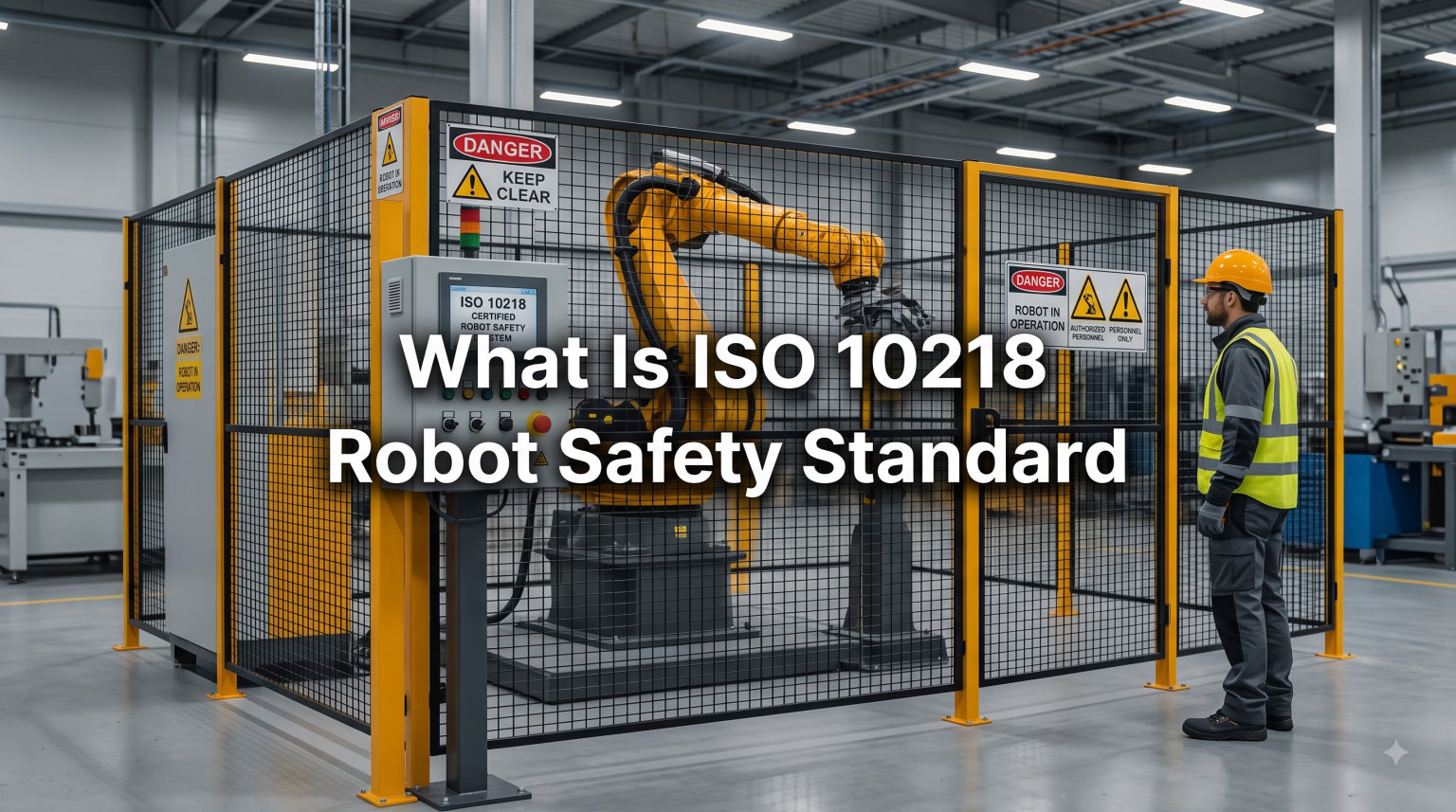
ISO 10218 is the international safety standard for industrial robots, split into two parts. Part 1 covers robot manufacturers, and Part 2 covers system integrators who install robots in real workplaces. Together, the standard defines how robots must be designed, integrated, and used so that people working near them stay safe.
As our team dug into the 2026 edition of this standard and the recent 2025 revision, we saw how often the same questions come up. What does the standard actually require? Who has to follow it? How does it connect to ISO/TS 15066 and to the US ANSI/RIA 15.06? This guide answers all of that in plain language.
If you design robots, integrate cells, or manage a factory floor, this article will give you a working understanding of ISO 10218 without the $200 standard document in your hand.
Table of Contents
What Is the ISO 10218 Robot Safety Standard
The ISO 10218 robot safety standard is the global benchmark for keeping people safe around industrial robots. Developed by ISO Technical Committee 299 (ISO/TC 299), it lays out the safety requirements for the design, construction, and integration of industrial robot systems.
ISO officially describes the standard as covering robots treated as “partly completed machinery.” That means an industrial robot on its own is not a finished product. It becomes a usable machine only when integrated into a complete cell, with guards, controls, and end-of-arm tooling. ISO 10218 captures that full picture across two parts.
- ISO 10218-1: Safety requirements for the robot itself, written for robot manufacturers.
- ISO 10218-2: Safety requirements for robot systems and integration, written for system integrators.
In short, ISO 10218 is the rulebook for every stage of an industrial robot’s life before it reaches the operator. It covers hazard identification, risk assessment, protective measures, and the information a manufacturer must hand off to the next person in the chain.
For a deeper look at one of the safety-critical components inside an industrial robot, see our guide on how planetary gearboxes work in robot joints.
History and Background of the ISO 10218 Standard
The story of ISO 10218 starts in Europe in 1992 with EN 775, the first coordinated European standard for manipulating industrial robots. EN 775 introduced many of the concepts we still see in ISO 10218 today, including the idea that a robot is “partly completed machinery” until integrated.
ISO adopted the first edition of ISO 10218 in 2006, followed by the more familiar 2011 revision. The 2011 version stayed in force for over a decade and shaped how the industry thought about robot safety, especially the four collaborative operation methods later spelled out in ISO/TS 15066.
The 2025 revision, which is the current edition as of 2026, updates the standard to reflect modern safety technology and integration practices. It also reorganizes the relationship between Part 1 and Part 2 and adds more detail on validation, functional safety, and the so-called black channel approach for communication between safety devices.
Key milestones in the standard’s history:
- 1992: EN 775 published in Europe as the first dedicated robot safety standard.
- 2006: First ISO edition of 10218-1 and 10218-2 issued.
- 2011: Major revision that became the reference version for over 13 years.
- 2016: ISO/TS 15066 published as a technical specification focused on collaborative robot operation.
- 2026: 2025 revision published, replacing the 2011 edition.
Throughout this evolution, ISO/TC 299 has remained the responsible committee, with input from robotics manufacturers, integrators, safety specialists, and national standards bodies worldwide.
ISO 10218 Part 1 vs Part 2: Key Differences
The most common point of confusion around the ISO 10218 robot safety standard is the split between Part 1 and Part 2. Both are mandatory to read together, but they target different roles in the supply chain.
Part 1 applies to the company that designs and builds the industrial robot. Part 2 applies to the company that takes that robot, adds tooling, fencing, sensors, and software, and delivers a working cell to the end customer. The handoff between the two is the most safety-critical moment in any robot project.
Comparison Table: ISO 10218-1 vs ISO 10218-2
| Aspect | ISO 10218-1 (Part 1) | ISO 10218-2 (Part 2) |
|---|---|---|
| Primary audience | Robot manufacturers | System integrators |
| Scope | Requirements for the robot as a partly completed machine | Requirements for the integrated robot system and cell |
| Key focus | Inherent safe design, hazards at the robot unit level, manufacturer’s information for use | Risk assessment, safeguarding, installation, commissioning, and validation |
| Typical tasks | Designing limits, forces, energy isolation, and emergency stop interfaces | Designing the cell layout, safety zones, interlocks, and operator interfaces |
| Latest edition | ISO 10218-1:2025 | ISO 10218-2:2025 |
| Mandatory reading for | OEM engineering, R&D, and compliance teams | Integration engineers, safety designers, and project managers |
Think of Part 1 as the robot’s own DNA. It defines what the manufacturer must build into the machine so the integrator has a safe starting point. Part 2 is everything added around the robot to make it usable in a real factory, including fencing, light curtains, scanners, control logic, and the information the integrator hands to the end user.
A common mistake we see in practice is treating the two parts as alternatives. They are not. A robot that satisfies Part 1 can still produce an unsafe cell if Part 2 is ignored. For related guidance on sizing and specifying robots, our payload capacity guide walks through calculations that often feed into risk assessment work.
What Changed in the ISO 10218 2025 Revision
The 2025 revision of ISO 10218 is the most significant change to the standard since 2011. The core structure stays the same, but several technical and editorial updates are worth knowing, especially if you have built compliance programs around the 2011 text.
Key Updates in the 2025 Edition
- Stronger validation requirements: Both Part 1 and Part 2 now place more weight on proving that safety functions actually perform as designed, not just that they are designed correctly.
- Black channel approach clarified: The standard spells out how safety-rated data can travel across non-safety-rated communication lines, which matters for modern IIoT and fieldbus architectures.
- Updated functional safety references: Cross-references to IEC 61508 and related standards are refined to match current editions.
- Sharper manufacturer-to-integrator handoff: Information for use is now expected to include more detail about assumed use, residual risk, and integration constraints.
- Better alignment with ISO/TS 15066: Collaborative operation is woven through the 2025 text more cleanly, with less ambiguity about which collaborative methods are allowed under which conditions.
From a practical standpoint, the 2025 revision is not a complete reset. If you already comply with 2011, most of your safety concepts still hold. What changes is the documentation depth, validation evidence, and how you treat communication paths inside the safety control system.
For operations teams, the bigger near-term impact is in the supply chain. Integrators should expect 2025-compliant robots to deliver more structured safety documentation, and manufacturers should expect more detailed questions from integrators during the design review phase.
Relationship Between ISO 10218 and ISO/TS 15066
ISO 10218 and ISO/TS 15066 are often mentioned together because they are the two documents that govern human-robot collaboration (HRC) in industry. The relationship is simple once you see the structure.
ISO 10218 is the parent standard. It defines the four collaborative operation methods that allow a robot to work near or with a person without traditional guarding. ISO/TS 15066 sits underneath ISO 10218 as a technical specification that gives detailed guidance on how to implement those four methods safely, especially the limits on robot speed, force, and pressure during contact.
The four collaborative operation methods defined in ISO 10218 and expanded in ISO/TS 15066 are:
- Safety-rated monitored stop: The robot stops when a person enters the collaborative workspace.
- Hand guiding: The operator moves the robot by hand using a device near the end-effector.
- Speed and separation monitoring: The robot slows down or stops as the distance to the operator shrinks.
- Power and force limiting: The robot is designed to limit forces and pressures on contact, allowing contact under controlled thresholds.
ISO/TS 15066 is not a full standard, which is why the abbreviation includes TS (Technical Specification). It is meant to support ISO 10218 and can be revised more quickly as collaborative robot technology evolves. For collaborative applications, integrators are expected to use ISO 10218 for the legal framework and ISO/TS 15066 for the specific biomechanical limits and measurement methods.
If you are evaluating a collaborative robot cell, the conversation with your supplier should always include both documents. Asking only about ISO 10218 leaves the actual collaborative limits undefined, and asking only about ISO/TS 15066 ignores the mandatory requirements the parent standard still enforces.
Who Needs to Comply with ISO 10218
ISO 10218 is not optional if you are part of the industrial robot value chain. Compliance falls on three main groups, each with different responsibilities under the standard.
Robot Manufacturers
Any company that designs, builds, remanufactures, or rebuilds an industrial robot must follow ISO 10218-1. This includes the major robot OEMs as well as smaller firms producing specialty or custom robots for industrial use. The standard requires manufacturers to apply inherent safe design, perform hazard identification and risk assessment, and provide information for use that supports downstream safety work.
System Integrators
Companies that take a robot and turn it into a working cell are bound by ISO 10218-2. The integrator owns the risk assessment for the complete system, the selection of safeguards, the layout of the cell, the wiring of safety devices, and the validation evidence that the cell is safe to operate. Even if the robot itself is fully compliant with Part 1, an integrator cannot deliver a safe cell without following Part 2.
End Users and Employers
Factories and facilities that deploy robots are not the direct addressees of ISO 10218 in a strict legal sense, but they carry the workplace safety obligation. In the United States, OSHA uses national adoptions of ISO 10218 to cite employers under the general duty clause. In the European Union, the Machinery Regulation and the related harmonized standards apply the same expectations at the user level. The end user is responsible for ensuring that suppliers and integrators are working to ISO 10218, for training operators, and for maintaining the cell in a safe state for its life.
For organizations managing robot fleets across multiple sites, the compliance scope quickly compounds. Our warehouse robot fleet safety scaling webinar walks through how teams handle these obligations at scale.
Risk Assessment Guidance Under ISO 10218
Risk assessment is the backbone of the ISO 10218 robot safety standard. Both Part 1 and Part 2 require it, and it is the document most often requested during audits and incident investigations. The 2025 revision keeps the same general framework as the 2011 edition but raises expectations for evidence and traceability.
Step-by-Step Risk Assessment Process
- Define the scope of the robot system. Document the robot, the end-effector, the workpiece, the cell layout, and the operating modes the system will support.
- Identify hazards. List mechanical, electrical, thermal, ergonomic, and environmental hazards across the full life cycle, including setup, production, maintenance, and decommissioning.
- Estimate the risk for each hazard. Use a recognized method such as a risk graph, hazard rating matrix, or the approach in ISO 12100. Consider severity of injury, frequency of exposure, and possibility of avoidance.
- Evaluate the risk. Decide whether the estimated risk is acceptable or whether risk reduction measures are required. Document the reasoning, not just the conclusion.
- Apply the three-step hierarchy of controls. First, try to eliminate the hazard or reduce risk through inherent safe design. Then apply safeguarding and complementary protective measures. Finally, provide information for use, such as warnings and training.
- Validate the implemented measures. Confirm that each protective measure actually reduces risk as intended. In the 2025 edition, validation evidence is treated as a deliverable, not an afterthought.
- Maintain the assessment over time. Update the risk assessment whenever the cell changes, the robot is reprogrammed, or a near-miss or incident occurs.
Practical Tips from the Field
From our own work reviewing integrator risk assessments, the most common gap is the validation step. Designers often stop at listing safeguards without showing that the safeguards perform as expected under fault conditions. The 2025 revision makes this gap more visible to auditors, so building validation evidence into your project plan saves time later.
Another common gap is ignoring non-production states. Set-up, teaching, cleaning, and tool changeover are typically the highest-risk moments because operators are close to the robot and many safeguards are bypassed. Make sure these tasks are in your scope, not just normal production operation.
For readers who work with mechanical components, our guide on backlash in robot gearing is a good reminder that mechanical tolerance issues are themselves hazards and belong in the risk assessment register.
ISO 10218 vs ANSI/RIA 15.06: US Adoption Comparison
For readers in the United States, ISO 10218 does not stand alone. The US national adoption of the standard is ANSI/RIA R15.06, published through the Robotic Industries Association (now part of the Association for Advancing Automation, or A3). ANSI/RIA R15.06 has historically been the standard OSHA references in robot-related inspections.
ANSI/RIA R15.06-2012 was the US adoption of ISO 10218:2011. With the publication of the 2026 ISO 10218 revision, the US adoption process is underway. For most of the transition window, companies operating in the US will see both designations referenced in contracts and safety documents.
Key Differences and Harmonization
- Document structure: ANSI/RIA R15.06 combined ISO 10218-1 and ISO 10218-2 into a single US document, while ISO 10218 keeps them as two parts. Functionally, the requirements are aligned.
- National deviations: The US adoption includes national deviations that adapt the international text to US regulatory language, terminology, and references.
- Collaborative operation: Both ISO 10218 and ANSI/RIA R15.06 rely on ISO/TS 15066 for detailed collaborative robot guidance, and the technical limits are the same.
- OSHA enforcement: US inspectors typically cite the ANSI/RIA adoption when discussing robot safety, even though the underlying technical content is the same as ISO 10218.
For practical purposes, if you comply with ISO 10218, you are well positioned for the ANSI/RIA adoption, and vice versa. The main thing to watch is the version date. Make sure the documents you reference are the current editions, not a withdrawn version.
Frequently Asked Questions
What are the requirements for manufacturing robots according to ISO 10218-1?
ISO 10218-1 requires manufacturers to apply inherent safe design, identify hazards, perform a risk assessment on the robot as a partly completed machine, implement protective measures, and provide information for use to the integrator. The standard also sets requirements for emergency stop, energy isolation, mechanical limits, and the safety-related parts of control systems. The 2025 edition adds more detail on validation evidence and the handoff from manufacturer to integrator.
What are the ISO standards for robots?
The core ISO standards for industrial robot safety are ISO 10218-1 (robot manufacturers), ISO 10218-2 (system integrators), and ISO/TS 15066 (collaborative robot operation). ISO 12100 provides the general principles for risk assessment that the 10218 series builds on, and ISO 13849 covers safety-related parts of control systems. ISO/TC 299 is the technical committee responsible for maintaining these documents.
What are the main safety standards for robots?
The main safety standards for industrial robots are ISO 10218-1 and ISO 10218-2, supported by ISO/TS 15066 for collaborative applications. In the United States, the national adoption is ANSI/RIA R15.06, and the European Union references ISO 10218 through the Machinery Regulation. ISO 12100 and ISO 13849 are also commonly cited as supporting standards for risk assessment and control system safety.
Is ISO 10218 mandatory?
ISO 10218 is mandatory in regions where the standard is referenced by law or regulation, including the European Union, and it is the basis for OSHA enforcement in the United States. Even where it is not strictly mandatory, compliance is effectively required for any industrial robot cell sold into major markets. Robot manufacturers and integrators who skip ISO 10218 typically cannot get their products approved by end customers or regulators.
Conclusion
The ISO 10218 robot safety standard is the foundation for safe industrial robot design and integration. Part 1 gives manufacturers the rules for building safe robots, and Part 2 gives integrators the rules for turning those robots into safe cells. The 2026 revision sharpens validation requirements, clarifies the black channel approach, and aligns more closely with ISO/TS 15066 for collaborative applications.
If you are working with industrial robots today, the right next step is to confirm which edition your current documentation references, update your risk assessments to match the 2025 expectations, and make sure your team is fluent in both Part 1 and Part 2. For a deeper look at the physical components that often drive safety decisions, our robot chassis guide is a good place to keep building that foundation.