
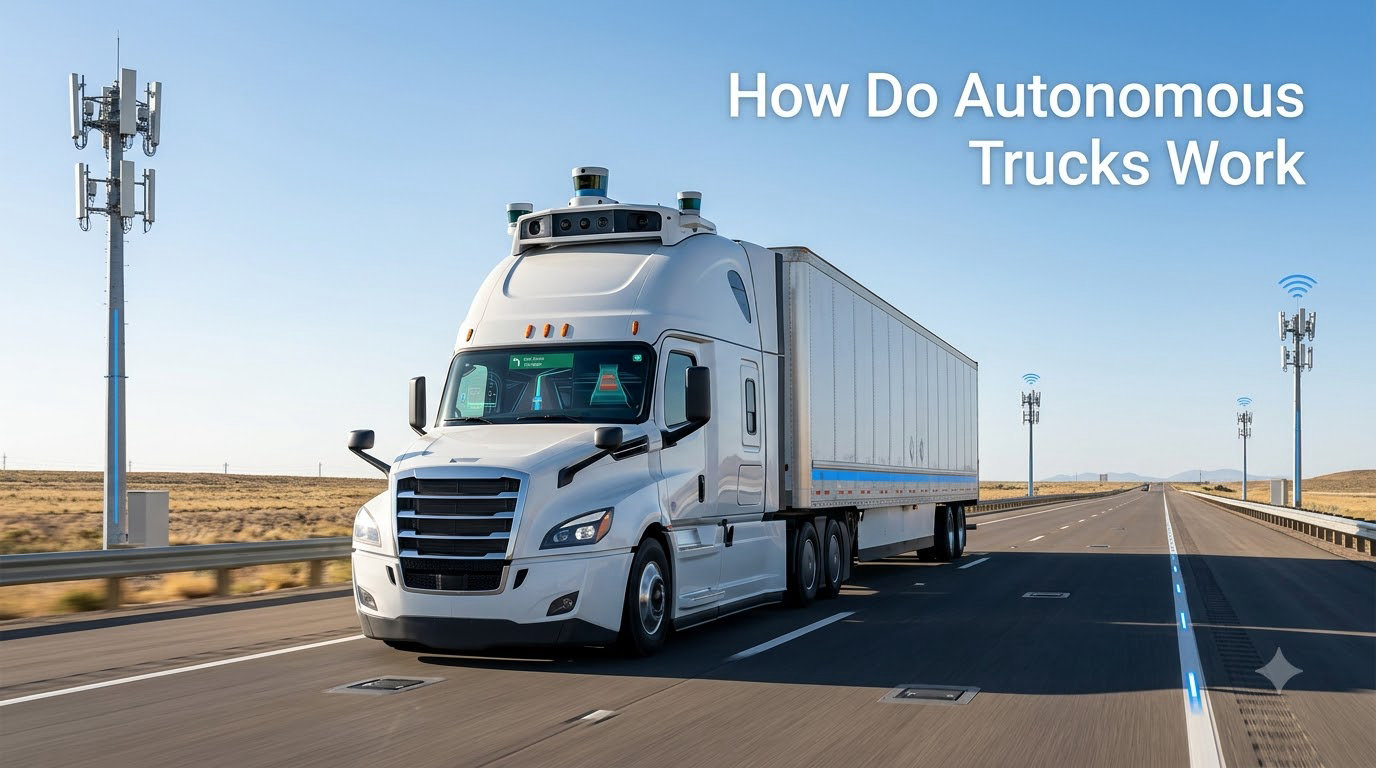
If you have ever asked yourself “how do autonomous trucks work,” you are not alone. I have spent the last few months following this space closely, riding along on test routes and talking to engineers at Aurora, Torc, and a few smaller players. The short answer is that self-driving trucks use a layered stack of sensors, AI software, and high-definition maps to perceive the road, plan a path, and control the vehicle without a human at the wheel. The longer answer, which I will get into below, is far more interesting.
Our team at Smashing Robotics put together this guide after covering autonomous freight for over a decade. I want to give you a real picture of what is rolling down the highway in 2026, what is still in the lab, and what the trucking industry actually thinks about all of it.
Table of Contents
What Are Autonomous Trucks
Autonomous trucks are commercial vehicles that drive themselves using a combination of sensors, software, and connectivity, with little or no human input. Most of the trucks you see on test routes today are classified as SAE Level 4, meaning they can drive themselves within a defined operating domain (usually a highway corridor in clear weather) without a human driver actively supervising. The driver is only needed to take over outside that domain, or as a backup during commercial pilots.
You will also see the term “self-driving trucks,” “driverless trucks,” or “autonomous semis” used interchangeably in the press. They all refer to the same thing. The key distinction is between the technology level and the deployment model. A Level 4 truck driving on a closed mining road is very different from a Level 4 truck navigating I-45 between Dallas and Houston.
For context, SAE International defines six levels of driving automation, from 0 (no automation) to 5 (full automation anywhere a human could drive). Most autonomous freight programs sit at Level 4. Full Level 5 autonomy, where the truck handles any road in any condition without a steering wheel at all, is not a real product yet and likely will not be in 2026.
How Do Autonomous Trucks Work: The 4 Core Stages
When people ask how self-driving trucks actually drive, I usually break it down into four core stages that the software runs continuously, often 10 to 30 times per second:
- Perception – the truck identifies objects around it using LiDAR, radar, and cameras.
- Localization – the truck figures out exactly where it is on the road, down to the lane.
- Planning – the AI decides what to do next, including lane changes, speed adjustments, and braking.
- Control – the software sends commands to steering, throttle, and brakes to execute the plan.
Each stage feeds the next one in a tight loop. If perception detects a slow-moving car ahead, the planner adjusts the trajectory, and the controller applies the brakes or changes lanes. This is the same basic flow every autonomous vehicle uses, whether it is a robotaxi in San Francisco or a Class 8 truck on I-10.
The difference for trucks is scale. A loaded semi can weigh 80,000 pounds, takes much longer to stop, and has very different handling physics than a passenger car. So the perception, planning, and control software has to be tuned for that. That is why you see specialized trucking companies rather than passenger-car robotaxi firms building most of the freight-focused systems.
Stage 1: Perception
Perception is the sensor fusion layer. The truck combines data from LiDAR, radar, and cameras to build a 3D model of the world around it. Each sensor type has strengths and weaknesses, which is why modern autonomous trucks use all of them together rather than picking one.
LiDAR gives precise 3D distance measurements. Radar sees through rain and dust. Cameras read signs, signal lights, and lane markings. The fusion software merges these into a single, real-time picture the rest of the system can trust.
Stage 2: Localization
Localization is how the truck knows where it is. GPS alone is not accurate enough for highway driving, so the system compares live sensor readings against a pre-built high-definition map. This pins the truck’s position down to a few centimeters, lane-accurate, so it can stay centered and navigate exits correctly.
Stage 3: Planning
Planning is where machine learning really earns its keep. The planner predicts what other vehicles and pedestrians are about to do, then picks a trajectory that is safe, efficient, and follows traffic rules. This includes things like deciding when to overtake, how to merge, and when to slow down for a construction zone.
Stage 4: Control
Control is the final stage, and it is the one most people underestimate. Turning software decisions into smooth, physical motion across an 80,000-pound vehicle is hard. The control system modulates steering, throttle, and brakes in real time to keep the truck stable, especially on curves, in crosswinds, or when the load shifts.
The Sensor Stack: LiDAR, Radar, and Cameras
Sensor fusion is what makes autonomous trucks work in the real world. Each sensor covers a gap the others cannot. Here is the breakdown I use when I explain it to people new to the industry.
LiDAR
LiDAR (Light Detection and Ranging) fires laser pulses millions of times per second and measures how long they take to bounce back. The result is a precise 3D point cloud of everything around the truck, accurate to within a few centimeters. Modern automotive LiDAR units, like those from Luminar, Innoviz, and Hesai, can see 250 meters or more down the road. They are essential for spotting vehicles, debris, and lane geometry at highway speed.
The main downside is cost and weather performance. Heavy rain, snow, or fog can scatter the laser light, so LiDAR alone is not enough. That is where radar comes in.
Radar
Radar uses radio waves to detect the range, speed, and angle of objects. It is much cheaper than LiDAR and works in almost any weather. Long-range automotive radar (typically 77 GHz) is the workhorse of adaptive cruise control and automatic emergency braking. It tracks vehicles ahead even through heavy rain, which LiDAR cannot always do.
Cameras
Cameras are the only sensors that can read text and color, so they handle traffic lights, speed limit signs, lane markings, and turn signals. Modern autonomous trucks use multiple high-resolution cameras with overlapping fields of view. They feed computer vision models that detect and classify objects, from cars and trucks to pedestrians and construction barriers.
Ultrasonic and Thermal Sensors
For low-speed maneuvers, parking, and detecting humans or animals in low visibility, trucks also carry ultrasonic sensors and sometimes thermal (infrared) cameras. These fill in the close-range and low-light gaps the main sensors miss.
AI and Machine Learning in Self-Driving Trucks
Behind all those sensors is a stack of machine learning models. Object detection, lane segmentation, behavior prediction, path planning, even how the truck decides whether to change lanes behind a slow car, all of it runs on neural networks trained on millions of miles of real driving data.
The two most important ML tasks are perception and prediction. Perception models classify every object in the scene, telling the planner “that is a passenger car braking ahead” or “that is a pedestrian stepping off the shoulder.” Prediction models forecast what each tracked object will do in the next few seconds. Together they let the planner act early instead of reacting late.
Most companies now use end-to-end learning for parts of the stack, with large transformer-style models handling driving policy and planning. Aurora’s “Foundation” model and Waymo’s driving models are good examples. These systems learn from the entire fleet, so every new mile one truck drives helps all the others.
That fleet learning is a huge advantage of autonomous trucking specifically. Trucks run the same highway corridors over and over, so the system sees a small number of routes millions of times. That is a much easier ML problem than full urban robotaxi driving, which is why I think commercial freight is going to scale first.
High-Definition Maps and Localization
HD maps are the unsung hero of autonomous trucking. Before a truck ever drives a route, the operator’s mapping vans drive it first and build a centimeter-accurate 3D map of every lane, sign, guardrail, and overpass. The truck then compares what its sensors see in real time to that pre-built map, which gives it rock-solid lane positioning even when lane markings are faded or covered by snow.
This is why most current autonomous freight routes are hub-to-hub on interstate corridors. The mapping investment only pays off when the same highway gets driven thousands of times. Long stretches of I-10, I-35, and I-45 in the Sun Belt are popular because they are mostly straight, mostly flat, and have good weather most of the year.
HD maps also include speed limits, exit geometry, and the location of known construction zones. When a truck enters a mapped corridor, the system already knows what is coming and can plan accordingly.
Safety Systems and Redundancy
Safety is the whole reason autonomous trucks exist, and redundancy is built into every layer. If a sensor fails, a backup is already running. If the main computer freezes, a secondary computer takes over. If the planning software gets confused, the truck is designed to pull over safely rather than make a risky decision.
Here is the kind of redundancy I look for when I evaluate an autonomous truck program:
- Sensor redundancy – at least two of LiDAR, radar, and cameras covering every direction.
- Compute redundancy – dual or triple-redundant onboard computers running independently.
- Power redundancy – backup batteries for steering, braking, and the compute stack.
- Communication redundancy – multiple cellular and satellite links to remote operations.
- Minimum risk maneuver fallback – if everything else fails, the truck safely exits traffic and stops.
This is one of the big differences between self-driving trucks and the driver assist features in your car. Adaptive cruise control and lane keep assist are Level 1 or 2. They are designed to hand control back to a human. A Level 4 autonomous truck has no expectation of a human taking over, so the safety systems have to be much more robust.
Current Deployment Status in 2026
So how close are we to autonomous trucks being a normal sight on the highway in 2026? Closer than most people think, but still earlier than the press releases suggest. Here is what I have seen as of mid-2026.
Aurora Innovation has been running commercial freight on the Dallas-to-Houston corridor with driverless trucks since September 2026, moving loads for partners like Hirschbach and Uber Freight. Their trucks run at highway speed with no driver on board, though a remote operator monitors each trip from a control center. By mid-2026 Aurora had logged tens of thousands of driverless miles on that route.
Torc Robotics, owned by Daimler Truck, is running its own autonomous freight pilot in the Sun Belt with a focus on hub-to-hub logistics. Waymo Via (now part of a broader Waymo commercial program) has been testing in Texas and Arizona with both Class 8 trucks and last-mile vehicles. Kodiak Robotics, Plus, and Waabi are also running real freight, mostly with safety drivers still in the cab.
For mining and other controlled environments, fully autonomous trucks have been running commercially for years. Caterpillar, Komatsu, and a few Australian miners run huge autonomous haul fleets 24/7, with no safety driver at all. That is the cleanest real-world proof that the technology works, even if it is in a much easier setting than public highways.
Regulatory Landscape and State Approvals
Regulation is currently the biggest variable in autonomous trucking, and it is mostly decided at the state level. The federal framework from NHTSA covers vehicle safety standards, but state laws decide who is behind the wheel, whether a driver is even required, and which roads are open to driverless operation.
Texas is the current leader. Governor Abbott signed a law that explicitly allows autonomous trucks to operate without a driver on board, and the state has become the de facto testbed for commercial deployment. Aurora’s Dallas-Houston run, Kodiak’s Texas routes, and most of Waymo’s truck testing happen in Texas.
Arizona is the other big hub. The state has welcomed autonomous vehicle testing since the early robotaxi days, and that openness extends to trucks. California is more restrictive. The state’s DMV requires a permit for fully driverless testing of heavy trucks, and several companies have paused plans there while working through the rules.
At the federal level, NHTSA’s AV STEP program and the FMCSA’s work on autonomous trucking rules are moving slowly. There is no nationwide law that says “autonomous trucks are legal.” Each state decides, which is why most deployments cluster in the Sun Belt.
Remote Operation and Human-in-the-Loop
One thing the marketing material often hides is that even “driverless” trucks usually have a human in the loop, just not inside the cab. A remote operator watches the truck’s video feed and sensor output from a control center, and can take over driving through a low-latency cellular link if something unusual happens.
This is not the same as a driver. The remote operator is not steering the truck every second. They are monitoring dozens of trucks at once, ready to intervene when the on-board AI flags an edge case it cannot handle. Think of it more like an air traffic controller than a remote driver.
Companies like Starsky Robotics (now defunct) and currently Aurora, Phantom Auto, and Design Therapeutics have built these teleoperation stacks. The human-in-the-loop approach is what makes the current generation of autonomous trucks practical. The AI handles 99% of the driving, and a human handles the 1% that the AI cannot yet figure out.
Fuel and Energy Solutions for Autonomous Trucks
A surprisingly common question I get is how driverless trucks get fuel. The answer is simpler than people expect: at a truck stop, the same way human-driven trucks do. Either the remote operator schedules a fuel stop into the route, or the truck’s planner detects low fuel and exits to a designated station.
In practice, current pilots use a few common approaches. Some have a human driver handle the first and last miles (the “yard” portion) while the autonomous system drives the highway middle. That driver can also handle fueling. Others are partnering with truck stop chains like Pilot Flying J and TA to allow autonomous trucks to pull in and refuel under remote supervision.
For electric autonomous trucks, charging happens at dedicated depots or hub locations. Volvo Autonomous Solutions and Einride have shown hub-to-hub electric autonomous routes where the truck charges at the origin or destination hub. Battery swap is also being tested, though it is still early.
Challenges and Limitations
I do not want to paint an unrealistically rosy picture. Autonomous trucks still have real, unsolved problems. Here is what I see as the biggest challenges in 2026.
Weather: Heavy rain, snow, and fog still degrade sensors. LiDAR scatters in heavy precipitation, cameras struggle with glare and low contrast, and even radar has limits. Most current operations are limited to fair-weather corridors in the Sun Belt for that reason.
Edge cases and false positives: Forum discussions among professional drivers are full of stories about test trucks panic-braking for shadows, overpasses, or debris that turned out to be nothing. These phantom braking events are a real safety issue. They are getting less common, but they have not been eliminated.
Physical tasks: Autonomous trucks cannot yet do the things drivers do outside the cab. Sliding tandems to adjust axle weight, putting on tire chains, opening trailer doors, inspecting loads, climbing out to check a clearance problem. Every long-haul driver I have talked to mentions at least one of these. Until robots can do all of it, drivers will still be needed for those tasks.
Complex urban and yard environments: Highway driving is the easy part. Pulling into a busy distribution center, navigating a crowded yard, or backing into a dock are much harder. That is why most current pilots are hub-to-hub on the highway, with humans handling the ends.
Public trust and regulation: Every time there is a high-profile incident, public trust drops and the regulatory environment gets harder. The industry is operating on a tightrope between showing enough progress to keep investment flowing and avoiding the kind of accidents that lead to a regulatory crackdown.
None of these are deal-breakers. They are real engineering and policy problems that the industry is working on. But if you have seen marketing that says “fully autonomous trucks are here and drivers are obsolete,” that is hype, not reality.
Frequently Asked Questions
What are the problems with autonomous trucks?
The biggest problems are weather (heavy rain, snow, and fog degrade sensors), edge cases that cause false-positive panic braking, physical tasks the truck cannot do (like sliding tandems or putting on chains), and complex urban and yard driving. Regulation and public trust after high-profile incidents are also major hurdles.
How do driverless trucks get fuel?
Driverless trucks refuel at truck stops the same way human-driven trucks do. The route planner schedules fuel stops in advance, or the system detects low fuel and exits to a designated station. Some pilots have a human driver handle the first and last miles and refuel during that handoff. Electric autonomous trucks charge at hub depots.
Can police pull over a driverless truck?
Yes. Police can pull over an autonomous truck the same way they pull over any commercial vehicle. The remote operator is typically notified, and the truck is designed to safely pull over to the shoulder. State laws vary on exactly how the interaction is handled, and the industry is working with law enforcement on standard procedures.
How close are we to autonomous trucks?
We are close on highway hub-to-hub routes in fair-weather states. Aurora has been running fully driverless commercial freight between Dallas and Houston since September 2026. Broader deployment, including bad weather, urban driving, and nationwide rollout, is likely 5 to 10 years away. Full Level 5 autonomy on any road in any condition is much further out.
Are there really driverless trucks on the road now?
Yes, but in limited numbers and on specific routes. Aurora is running commercial driverless trucks on the Dallas-to-Houston corridor. Waymo Via, Torc, Kodiak, and Plus are running pilots, mostly with safety drivers. In mining, fully autonomous haul trucks have been operating commercially for years with no driver on board.
Will autonomous trucks replace drivers by 2027?
No. Autonomous trucks will not replace all drivers by 2027. They will replace some long-haul highway routes first, especially in good-weather Sun Belt corridors. But physical tasks (chains, load inspection, opening trailers), local delivery, hazmat, and yard work will still need human drivers for many years. Expect a long transition, not a sudden replacement.
How much does a fully autonomous truck cost?
The sensor and compute stack on a current autonomous Class 8 truck adds significant cost over a standard truck, often six figures on top of the base vehicle. Costs are dropping fast as LiDAR and compute scale up, but the business case relies on 24/7 operation and lower labor costs over the truck’s life, not just the upfront price.
The Road Ahead: Autonomous Trucking in 2026
So, how do autonomous trucks work, and what should you take away? They work by stacking LiDAR, radar, and cameras into a fused 3D picture of the world, comparing that picture to high-definition maps, and using machine learning to plan a safe path that the control system then drives. It is a real technology that is already moving real freight on real highways in 2026, even if the marketing is ahead of reality.
If you are a fleet operator, watch the Texas and Arizona corridors. The economics are working there first, and lessons will spread from there. If you are a driver, the honest answer is that long-haul highway work will be the first to feel the pressure, but the physical and local work will be with us for a long time. If you are just curious, keep an eye on the companies I mentioned and watch for the next batch of state-level approvals.
Our team will keep tracking the milestones, the setbacks, and the actual on-road data. Autonomous trucking is one of the most important robotics stories of the decade, and 2026 is the year it stops being a demo and starts being a business.