
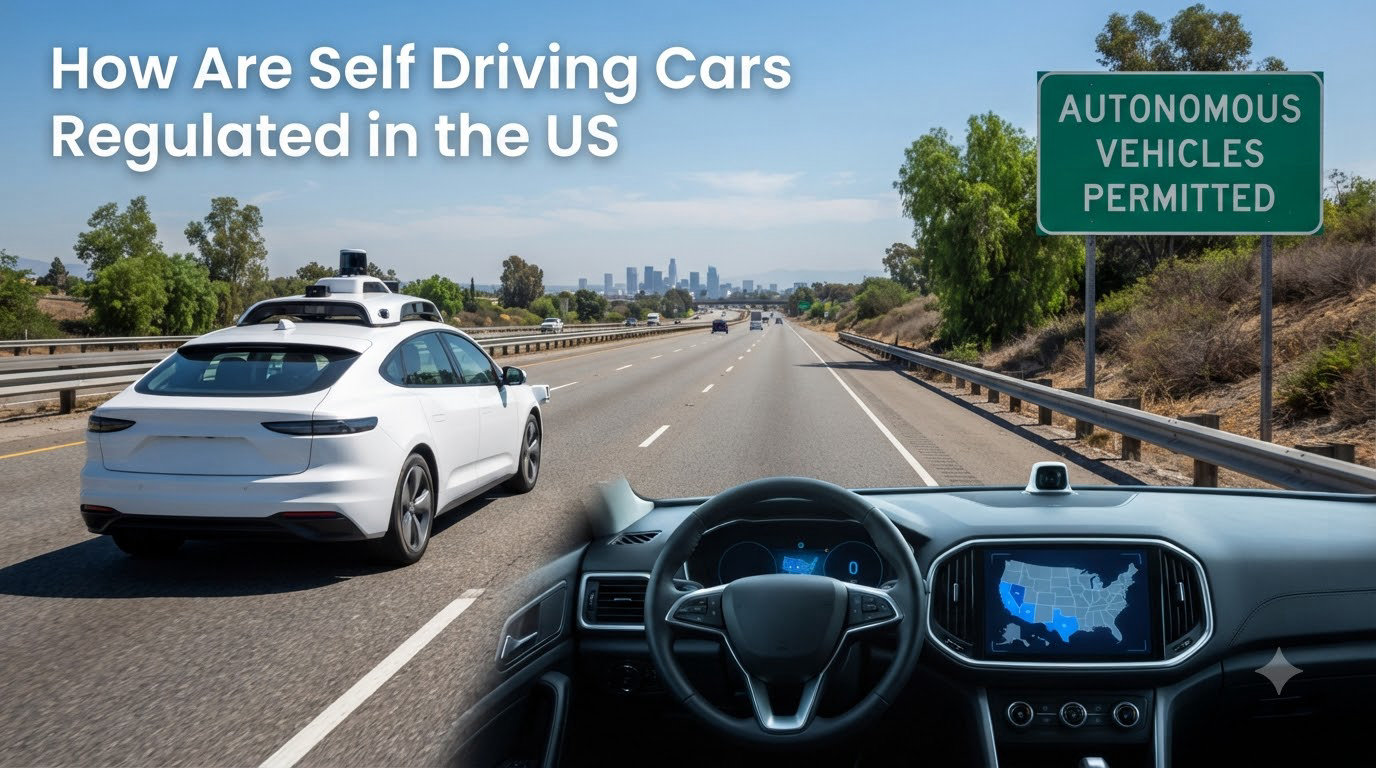
If you have ever wondered how are self driving cars regulated in the US, you are not alone. I dug into the federal statutes, state laws, agency rulebooks, and recent congressional bills to put together a clear picture. The short answer is that no single regulator controls autonomous vehicles in America. Instead, a patchwork of federal agencies and state governments shares authority, and that structure is changing fast in 2026.
In this guide, I will walk you through the SAE automation levels that regulators use to define what counts as “self-driving.” I will also cover the National Highway Traffic Safety Administration’s federal authority, the SELF DRIVE Act of 2026, the liability rules that apply when something goes wrong, and where robotaxis are actually allowed to operate today. By the end, you will understand exactly how the system works and where the gaps still sit.
Table of Contents
What Are Self-Driving Cars? SAE Levels Explained
Self-driving cars in the US are defined using the SAE J3016 standard, a six-level taxonomy that regulators, manufacturers, and insurers all rely on. The levels run from 0 (no automation) to 5 (full automation in every condition), and the legal framework treats each one differently. Understanding these levels is the foundation for understanding every regulation that follows.
Here is how the SAE levels break down, and where each one sits in current US law:
Level 0 (No Automation): The human driver controls everything. Cruise control and basic warnings do not change the level. No AV-specific regulation applies because no automation is doing the dynamic driving task.
Level 1 (Driver Assistance): The car can handle one function, such as steering OR acceleration, but not both. Adaptive cruise control and lane-keeping are common examples. NHTSA regulates these features through the Federal Motor Vehicle Safety Standards (FMVSS), but no special AV laws apply.
Level 2 (Partial Automation): The car can steer and accelerate at the same time, but a human must monitor the road at all times. Tesla Autopilot and GM Super Cruise fall here. The driver remains legally responsible, which matters for liability and traffic enforcement.
Level 3 (Conditional Automation): The car handles the entire driving task within a specific Operational Design Domain (ODD), and the human can look away. If the car asks, the human must take over. Mercedes Drive Pilot and Honda’s Legend were the first Level 3 systems approved for US roads under specific conditions.
Level 4 (High Automation): The car performs the entire driving task within its ODD, with no expectation of a human taking over. Waymo robotaxis are the best-known example. In a Level 4 vehicle, passengers can legally sleep, text, or sit in the back seat, but only inside the approved ODD.
Level 5 (Full Automation): The car drives itself anywhere a human can, in any condition. No Level 5 vehicle exists for public roads in the US, and most experts now believe Level 5 is still many years away.
The crucial legal point: most US regulations treat Levels 3 and 4 as the threshold where “self-driving” actually begins. A Tesla on Autopilot (Level 2) is not legally a self-driving car, even though many drivers treat it like one.
Federal Regulation: NHTSA Role and Authority
The National Highway Traffic Safety Administration (NHTSA) is the federal agency at the center of autonomous vehicle regulation. NHTSA sits inside the Department of Transportation and has authority over vehicle safety standards, defect investigations, and recalls. It does not, however, license drivers or control where vehicles can operate on public roads. That authority belongs to the states.
NHTSA’s main regulatory tools include the Federal Motor Vehicle Safety Standards (FMVSS), which set design and performance rules for every vehicle sold in the US. Most FMVSS rules were written with human drivers in mind, and a fully autonomous car can struggle to comply with standards that assume a steering wheel and a human in the driver’s seat.
To solve this, NHTSA runs an exemption program that lets manufacturers sell or test a limited number of vehicles that do not fully comply with FMVSS. Since 2020, NHTSA has granted exemptions to companies like Nuro, Waymo, and others for specific AV deployments.
NHTSA also published Automated Driving System (ADS) policy guidance and the Standing General Order on crash reporting. The crash reporting rule, updated in 2026, requires manufacturers and operators to report any incident where an engaged ADS was involved in a crash. This is how the agency tracks real-world safety performance and decides whether to open defect investigations.
Finally, NHTSA maintains the Automated Vehicle Transparency and Safety Engagement (AV TEST) initiative, a public database where companies can voluntarily disclose testing activity, miles driven, and safety metrics. Participation is voluntary, but the public disclosure has become an important accountability tool.
State-by-State Regulatory Landscape
State governments control the actual roads. They decide which vehicles can be registered, which operators can be licensed, where AVs can drive, and how traffic laws apply to driverless cars. This is why the answer to “how are self driving cars regulated in the US” always comes back to the state level for anything operational.
As of mid-2026, about half of US states have passed some form of autonomous vehicle legislation. The approaches vary widely, and I have grouped them into three rough tiers based on how permissive the rules are.
Tier 1: Active Deployment States
California, Arizona, Texas, and Florida are the most permissive. California requires a permit from the Department of Motor Vehicles and a separate permit from the Public Utilities Commission for paid robotaxi service. Arizona allows fully driverless testing and commercial deployment without a human operator. Texas (especially Austin) has welcomed Waymo, and Florida has been a friendly home for AV testing since the 2010s. Robotaxis from Waymo operate in Phoenix, San Francisco, Los Angeles, Austin, and parts of Miami in 2026.
Tier 2: Testing-Only States
Many states, including Michigan, Pennsylvania, New York, Nevada, and Washington, allow AV testing with various restrictions. New York City, for example, only allows testing on a very limited set of mapped streets and requires a police escort at the start. Pennsylvania has been a popular testing ground for Pittsburgh-based work by companies like Aurora.
Tier 3: No Enacted Framework
Some states have no autonomous vehicle law at all, which leaves the regulatory status uncertain. In these states, an AV can still operate if it meets federal safety standards and complies with general traffic laws, but there is no formal permit or testing program. This creates legal gray areas that the SELF DRIVE Act of 2026 is partly designed to address.
The patchwork is the single biggest source of confusion for consumers. A Waymo can pick you up in San Francisco, but the same hardware and software would not be legal to operate without a permit in most other states. This is also why robotaxi companies focus their commercial rollouts in just a handful of cities.
Key Legislation: SELF DRIVE Act 2026 and AV START Act
Two congressional bills have shaped the federal side of AV regulation more than any others. The AV START Act was introduced in 2017 and made significant progress before stalling over safety concerns. The SELF DRIVE Act, originally passed by the House in 2017, was reintroduced in 2026 as the SELF DRIVE Act of 2026 (H.R. 7390).
The SELF DRIVE Act of 2026 is the most important federal AV bill now in Congress. Its core purpose is to ensure continued US leadership in autonomous driving while establishing a clearer national framework. The bill would direct NHTSA to update FMVSS so AVs without steering wheels or pedals can be certified for sale, expand the AV exemption cap to allow mass deployment, and create federal preemption of state laws that “unnecessarily restrict” AV operation.
The preemption piece is the most controversial. State regulators and some safety advocates argue that preemption would override state-level consumer protections and traffic enforcement authority. AV manufacturers argue that without federal preemption, the state patchwork will stall the entire industry.
As of August 2026, the SELF DRIVE Act of 2026 has cleared the House Energy and Commerce Committee and is awaiting a floor vote. Companion legislation has been introduced in the Senate, though no vote has been scheduled. If it becomes law, it would represent the most significant change to AV regulation since NHTSA was created in 1970.
The earlier AV START Act, by contrast, focused on a regulatory framework for testing and pre-deployment. It would have required manufacturers to share safety data with NHTSA and would have created a “Highly Automated Vehicle Safety Score” published online. AV START has been reintroduced in various forms but has not advanced to a vote since 2018.
Safety Standards and Compliance Requirements
Before any autonomous vehicle can be deployed on US public roads, it has to clear several safety gates. The exact requirements depend on the SAE level and the state, but the federal baseline is built around FMVSS compliance, NHTSA exemption, and crash reporting.
FMVSS Compliance or Exemption: Most FMVSS rules assume a human driver. A Level 4 vehicle with no steering wheel cannot comply with rules about steering column position or driver controls. NHTSA’s exemption process lets manufacturers apply for a limited waiver, and NHTSA has used this authority to allow Nuro’s low-speed delivery vehicles and Waymo’s robotaxis to operate without a human driver.
Crash Reporting (Standing General Order): In 2026, NHTSA requires AV operators to report any crash in which the Automated Driving System was engaged within a short window. The reports go into a public database and trigger defect investigations if patterns emerge. This is how the October 2023 Cruise pedestrian incident in San Francisco led to a sweeping federal probe.
State Safety Assessments: States like California require their own safety assessment before issuing a deployment permit. The assessments cover vehicle behavior, cybersecurity, operator training, and the company’s response plan for incidents. California’s DMV can suspend or revoke permits, which it did with Cruise in late 2023.
Cybersecurity and Data Sharing: Voluntary NHTSA guidance recommends a cybersecurity plan and data-sharing practices. The SELF DRIVE Act of 2026 would make some of these voluntary standards mandatory.
For consumers, the practical takeaway is this: any AV operating in public in the US has gone through at least a state-level safety review, and most commercial robotaxi operators have also been cleared by NHTSA through the exemption process.
Liability Framework for Autonomous Vehicles
Liability is the question I get asked most often, and it is also the area where US law is least developed. When a driverless car crashes, who pays? The short answer is that liability currently depends on the SAE level, the state, and the specific facts of the incident.
For Levels 0 through 2, the human driver is generally liable because the law still treats them as the operator. If a Tesla on Autopilot crashes, the driver is almost always legally responsible, and Tesla’s marketing language has been the subject of multiple lawsuits precisely because it can blur that line.
For Levels 3 and 4, the picture gets more complicated. The SAE standard says the Automated Driving System is the “driver” when engaged, which shifts liability to the manufacturer or operator. In practice, this gets worked out through insurance, product liability law, and the specific contract between the AV operator and the vehicle owner.
Several real cases from 2023 and 2026 have shaped how courts and regulators think about this:
Waymo vehicle stop incidents in Phoenix: Multiple Waymo cars got stuck in traffic or blocked intersections in 2024. Waymo’s parent company, Alphabet, assumed liability and worked directly with affected drivers to settle claims without litigation.
Cruise pedestrian incident (October 2023): A pedestrian struck by a human driver in San Francisco was then dragged by a Cruise robotaxi that had pulled over. California DMV suspended Cruise’s permit, and Cruise (owned by GM) faced federal investigations and multiple lawsuits. The case is still being litigated, but it set a clear precedent: AV operators cannot hide behind vehicle automation when post-crash behavior is unreasonable.
Tesla Autopilot litigation: A series of trials in 2025 and 2026 found Tesla partially liable in fatal Autopilot crashes. The verdicts hinged on Tesla’s marketing of “Full Self-Driving” features that legally required driver supervision.
Most states have not passed dedicated AV liability laws, which means traditional negligence and product liability rules apply. Insurers are still developing AV-specific policies, and premiums for robotaxi fleets remain substantially higher than for human-driven vehicles.
Law Enforcement Encounters with Robotaxis
Can a cop pull over a Waymo car? Yes. In every state, autonomous vehicles must obey traffic laws, and law enforcement officers can stop any vehicle on the road, including a robotaxi with no one in the driver’s seat. This is settled law in all 50 states.
The practical question is what happens after the stop. Most AV operators, including Waymo and Zoox, have remote support teams that can communicate with passengers through in-car screens and with officers through dedicated phone lines or a “first responder” guide. Some cities, including San Francisco and Phoenix, have run training programs for officers on how to interact with driverless vehicles.
Waymo publishes a first-responder guide that tells officers how to disable the vehicle, where to find the manual override, and how to contact Waymo’s support team. Similar guides exist for Cruise and Zoox.
There have been real incidents. In 2023, a San Francisco police officer pulled over a Cruise vehicle for driving without headlights, and a 2024 Phoenix traffic stop of a Waymo went viral because the empty car appeared to “run away” from the officer. These incidents have prompted updates to AV operator training and clearer protocols for police interactions.
If you are a passenger in a robotaxi that gets pulled over, you typically stay seated and use the in-car support screen to talk to the operator. The AV’s support team will guide you through any needed steps and will handle communication with the officer.
Major Players and Their Regulatory Status
A handful of companies dominate the US autonomous vehicle landscape, and each has a different regulatory relationship. Here is where the major players stand in 2026.
Waymo (Alphabet): Waymo is the clear leader in commercial robotaxi deployment. As of 2026, Waymo operates paid driverless service in Phoenix, San Francisco, Los Angeles, Austin, and parts of Miami. The company holds multiple NHTSA exemptions and has California DMV and CPUC permits for both testing and commercial deployment.
Cruise (General Motors): Cruise lost its California permit in late 2023 and has been rebuilding its program. It has scaled back significantly compared to Waymo and is focusing on supervised testing in a smaller number of cities. GM announced in late 2024 that it would refocus Cruise on personal autonomous vehicle development rather than the robotaxi business.
Zoox (Amazon): Zoox operates a small robotaxi service in Las Vegas and Foster City, California, using a purpose-built vehicle with no steering wheel. It has an NHTSA exemption for its unique vehicle design and is in the early stages of scaling commercial service.
Aurora: Aurora focuses on autonomous trucking rather than passenger vehicles. It has a partnership with Volvo and runs commercial freight pilots on highways in Texas. The regulatory framework for autonomous trucking is more permissive than for passenger robotaxis, especially on highways.
Tesla: Tesla’s Full Self-Driving (FSD) system is a Level 2 driver assistance feature, not a Level 4 autonomous system. Tesla does not operate a robotaxi service in the traditional sense, though in 2026 the company launched an “FSD robotaxi” service in Austin using supervised vehicles. Regulators, including NHTSA, are actively scrutinizing Tesla’s marketing of the “Full Self-Driving” name, which is widely viewed as misleading given the system’s Level 2 classification.
Mobileye, Motional, and others: Several smaller players are testing or planning deployment, including Motional in Las Vegas and Boston, Mobileye with consumer AV technology, and various startups focused on specific use cases like delivery or low-speed urban mobility.
2026 Policy Updates and Future Outlook
2026 has been the most active year for AV policy in over a decade. The SELF DRIVE Act of 2026 is moving through Congress, NHTSA has tightened crash reporting and increased enforcement actions, and the commercial robotaxi market has expanded to more US cities than ever before.
Here is what I expect to watch over the next 12 to 24 months:
Federal Legislation: The SELF DRIVE Act of 2026 is the most likely bill to become law. If it passes, NHTSA will have a clear mandate to update FMVSS for AVs without traditional controls, and federal preemption will set a new baseline that the states must follow.
State Coordination: Several states, including California, Texas, and Arizona, have been pushing for a multi-state agreement to harmonize AV rules. This kind of compact could reduce the patchwork even if federal legislation stalls.
Robotaxi Expansion: Waymo has publicly committed to expanding to 10 or more US cities by the end of 2026. Zoox is scaling in Las Vegas, and Tesla’s supervised robotaxi service is rolling out in multiple cities. Expect more headlines about traffic incidents, and expect regulators to keep tightening rules as commercial fleets grow.
Liability and Insurance: Major insurers are beginning to write AV-specific commercial policies. Expect new insurance products in 2026 and beyond, and expect product liability law to keep evolving through the courts.
The honest answer to “how long before self-driving cars become the norm?” is that Level 4 robotaxis are already here in some cities, but full Level 5 vehicles are still a decade or more away. The regulatory framework is racing to catch up with the technology, and the next few years will be decisive.
Frequently Asked Questions
Which states legally allow self-driving cars?
As of 2026, about half of US states have passed some form of autonomous vehicle legislation. States with active commercial robotaxi service include Arizona, California, Texas, and Florida. Other states allow AV testing only, and some have no enacted framework at all. Always check your state DMV for the most current rules before riding in or operating an autonomous vehicle.
Who is liable when a driverless car crashes?
Liability depends on the SAE automation level and the state where the crash occurs. For Level 0 through 2 vehicles, the human driver is generally responsible. For Level 3 and 4 vehicles, the manufacturer or operator typically assumes liability when the Automated Driving System is engaged. Real cases from 2026, including the Cruise pedestrian incident and multiple Tesla Autopilot verdicts, have established that AV operators cannot escape responsibility for post-crash behavior or misleading marketing of driver assistance features.
Can a cop pull over a Waymo car?
Yes. Law enforcement officers can stop any vehicle on a public road, including a fully driverless Waymo robotaxi. Most AV operators, including Waymo, Zoox, and Cruise, publish first-responder guides and have dedicated support lines for police. Passengers in a stopped robotaxi typically stay seated and use the in-car screen to talk to the operator’s support team, who will communicate with the officer on the scene.
Can you legally sleep in a self-driving car?
You can legally sleep in a Level 4 autonomous vehicle when the Automated Driving System is engaged inside its approved Operational Design Domain. You cannot legally sleep in a Level 2 or Level 3 vehicle, because the human driver must remain ready to take over. In practice, this means you can nap in a Waymo robotaxi in Phoenix or San Francisco, but not in a Tesla on Autopilot, regardless of marketing claims about Full Self-Driving capability.
What is the SELF DRIVE Act?
The SELF DRIVE Act is a federal bill designed to create a national framework for autonomous vehicle regulation. The original SELF DRIVE Act passed the House in 2017 but stalled in the Senate. The SELF DRIVE Act of 2026 (H.R. 7390) is the current version and is working its way through Congress in 2026. If enacted, it would update FMVSS for AVs without steering wheels, expand NHTSA’s exemption cap, and create federal preemption of state laws that unnecessarily restrict autonomous vehicle operation.
How long before self-driving cars become the norm?
Level 4 robotaxis are already operating commercially in several US cities in 2026, but full Level 5 autonomy in any condition is still many years away. Most industry experts project mainstream Level 4 adoption in specific geographic areas by the early 2030s, while Level 5 remains a longer-term goal. The regulatory framework, insurance products, and public acceptance are all moving in parallel, and any of these could accelerate or delay the timeline.
Conclusion
To wrap up, the answer to how are self driving cars regulated in the US is layered: NHTSA sets federal safety standards and runs the exemption and crash reporting programs, while state DMVs and public utilities commissions control testing, deployment, and commercial operations on actual roads. The SAE automation levels determine which rules apply, and liability still depends on a mix of state law, product liability, and the specific SAE level of the vehicle involved.
The SELF DRIVE Act of 2026 is the federal legislation to watch, and the patchwork of state rules will keep evolving as robotaxi fleets expand into more cities. If you are considering riding in a driverless car, check your state DMV and your AV operator’s service area first. If you are curious about the technology itself, our coverage of autonomous systems and robotics has more detail on the sensors and AI behind these vehicles.
I will keep updating this guide as the SELF DRIVE Act of 2026 moves through Congress and as new state frameworks take shape. The rules are changing fast, and the best way to stay informed is to watch NHTSA announcements, your state DMV, and the operators themselves.