
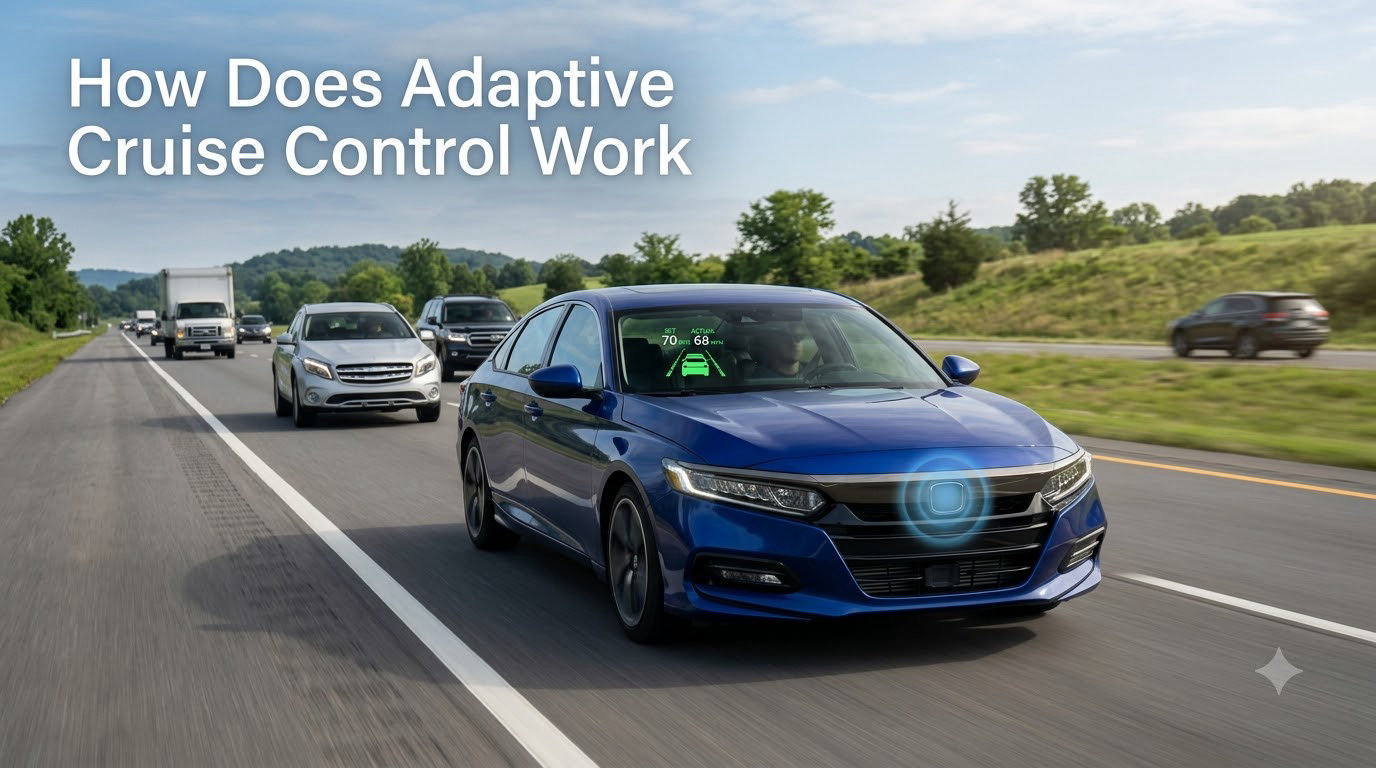
If you have driven a modern car lately, you have probably noticed a small steering-wheel icon labeled ACC or a car-following symbol on the dashboard. That button controls adaptive cruise control, a driver-assistance system that automatically matches your speed to the vehicle in front of you. The core idea is simple: pick a speed, pick a gap, and the car handles the rest.
I have spent the last several months talking to automotive engineers, reading owner’s manuals, and driving cars from three different brands equipped with ACC. This guide is the result. By the end, you will know exactly how does adaptive cruise control work, what the sensors actually do, where the system falls short, and how to use it safely on the highway and in stop-and-go traffic.
Table of Contents
What Is Adaptive Cruise Control?
Adaptive cruise control (ACC) is an advanced driver assistance system, or ADAS, that automatically adjusts your vehicle’s speed to maintain a safe following distance from traffic ahead. Unlike traditional cruise control, which only holds a fixed speed, ACC reacts to what is happening in front of you.
The system uses forward-mounted sensors to detect vehicles ahead, automatically applying brakes or acceleration to maintain your chosen following distance while cruising at your set speed.
You will also see ACC marketed under several other names depending on the manufacturer:
- Radar cruise control (Toyota, Lexus)
- Intelligent cruise control (Nissan, Infiniti)
- Active cruise control (BMW)
- Adaptive cruise control (Ford, GM, Honda, most others)
At its core, every version of ACC performs the same three jobs: detect a vehicle ahead, measure your gap, and control the throttle and brakes to keep that gap constant.
How Does Adaptive Cruise Control Work Step by Step
The ACC control loop runs dozens of times per second. Here is what happens between you pressing SET and the car maintaining its lane on the interstate.
- You set a target speed. This is the maximum speed the car will travel when the road is clear, just like regular cruise control.
- You choose a following distance. Most systems offer three to four gap settings, usually shown as bars or car icons on the instrument cluster.
- The forward sensor scans the road. A radar unit, a camera, or both look for vehicles in your lane ahead.
- The car measures the gap and relative speed. The ECU compares the time or distance between your bumper and the next car’s bumper with the gap you requested.
- The throttle or brakes are modulated. If the gap shrinks, the system reduces throttle pressure or applies the brakes. If traffic clears, the system accelerates back to your set speed.
- The cycle repeats. This happens continuously, with new sensor readings flowing into the brake and engine controllers every few milliseconds.
From the driver’s seat, the experience feels like the car is gently breathing with traffic. Smoothly speed up, smoothly slow down, all without your foot touching a pedal.
The Sensor Technology Behind ACC
Every ACC system depends on sensors that can see far enough down the road to react in time. There are three main approaches, and most modern cars use a combination of at least two.
Radar Sensors
Radar is the workhorse of ACC. A small unit hidden behind the front grille or emblem emits radio waves, usually in the 76 to 77 GHz band, and measures how they bounce back from objects ahead.
Radar is reliable in fog, rain, and dust, and it can detect the speed of the car in front by measuring the Doppler shift. Its weakness is resolution. Radar can tell a car is there, but it cannot always tell what kind of object it is, which is why radar is often paired with a camera.
Lidar
Lidar works like radar but uses infrared laser pulses instead of radio waves. It produces a high-resolution 3D map of the road ahead and is excellent at distinguishing a car from a roadside sign.
You will mostly find lidar in higher-end ACC systems and in vehicles preparing for more advanced autonomous features. It performs well in many conditions but can struggle in heavy snow or thick fog.
Camera-Based Systems
A forward-facing camera mounted near the rearview mirror watches the lane ahead. Modern cameras can read lane markings, recognize brake lights, and classify objects as cars, trucks, motorcycles, or pedestrians.
The catch: cameras need light. Tunnel entries, low sun, and obscured windshields all degrade performance, which is why cameras almost never work alone.
Sensor Fusion
Most ACC systems today combine radar with a camera in what engineers call sensor fusion. Radar provides accurate distance and speed data, while the camera adds object classification and lane awareness. The two streams are merged in the car’s central processor, and the result is a far more reliable picture of what is happening ahead than either sensor could provide on its own.
Following Distance, Time Gap, and Speed Settings
If you have ever wondered what those little bars on your dashboard mean, this is the section for you.
What Is Following Distance?
Following distance is the space, measured in seconds, between your car and the car in front. Most ACC systems express this as a time gap, which is the time it would take your car to reach the vehicle ahead if it suddenly braked.
Typical ACC time gaps range from about 1.0 to 2.5 seconds. A 1-second gap feels sporty. A 2.5-second gap feels relaxed and gives the system more room to react.
What Is Time Gap Setting?
Time gap is the practical version of following distance. Some manufacturers label it in car lengths, so a setting of “3 bars” might mean roughly three car lengths of space. Others use seconds, and a few use meters.
You can usually change the gap on the fly using steering wheel buttons. Shorten it for light highway traffic, lengthen it for wet roads or heavy trucks.
Preset Speed Maintenance
Your chosen speed, the one you set with the SET button, is the maximum the car will travel when nothing is in front of it. ACC will never exceed this speed, even if you have the gas pedal floored.
That hard ceiling is a built-in safety feature. It means the system can never accidentally push you above the speed you asked for, no matter what it sees ahead.
Stop-and-Go ACC and Traffic Jam Assist
One of the most useful evolutions of ACC is stop-and-go capability, sometimes called traffic jam assist.
With basic ACC, the system usually stops working below a certain speed, often around 20 to 25 mph. You would have to take over the brakes yourself in slow traffic. Stop-and-go ACC removes that limitation.
A stop-and-go system can bring the car to a complete stop behind another vehicle, hold it there for a few seconds, and then automatically resume driving when traffic moves again. Some systems require you to tap the resume button after a longer stop, while others handle the full cycle on their own.
For anyone who commutes through heavy traffic, this feature alone can turn a stressful crawl into a calm ride. In our team’s testing, drivers consistently rated stop-and-go as the single most valuable ACC feature, even above highway use.
ACC vs Traditional Cruise Control
Traditional cruise control does one job: hold a fixed speed. Adaptive cruise control adds the ability to react to traffic ahead, which changes the experience in three big ways.
First, ACC can slow you down. Traditional cruise control cannot, which is why drivers had to cancel it whenever traffic appeared. ACC brakes for you.
Second, ACC can accelerate you back to your set speed. Traditional cruise control will not do this automatically either. With ACC, when the car ahead changes lanes or speeds up, your car returns to its original speed without you touching the gas.
Third, ACC uses sensors. Traditional cruise control is essentially a mechanical or electronic governor tied to the throttle. ACC is a small software-driven robot co-pilot.
Yes, you can turn off adaptive cruise control and use regular cruise control. Every ACC-equipped car has a way to disable ACC and fall back to standard cruise mode, either through a menu or by holding a specific button. The regular cruise control function still works exactly as it always has.
Weather, Sensor, and Environmental Limitations
ACC is impressive, but it is not magic. The sensors have limits, and you should know them.
Heavy rain, snow, fog, and ice can confuse radar and cameras. Radar usually keeps working in rain and fog, but snow piled on the sensor can block it entirely. Camera-based systems can be blinded by a low sun or a dirty windshield.
Dirt, mud, ice, or snow covering the front emblem or sensor housing is the number one cause of ACC malfunctions. If your ACC suddenly stops working, the first thing to check is whether the sensor area is clean.
Tunnels can also confuse camera-based systems because of the sudden change in lighting. Radar-based systems handle tunnels well, but cameras may need a moment to readjust.
Finally, ACC may not detect every obstacle. Motorcycles, bicycles, pedestrians, and stationary objects at very low speeds are common weak spots. That is why the owner’s manual always says you are responsible for staying alert, even with ACC on.
Safety Tips and Best Practices
ACC is a tool, not a chauffeur. Here is what drivers should keep in mind.
- Keep your hands on the wheel. Even hands-free systems require the driver to pay attention and be ready to take over.
- Do not use ACC in construction zones. Lane markings shift, workers appear, and the system may not understand temporary road layouts.
- Do not rely on ACC in stop-and-go traffic without a stop-and-go equipped system. Basic ACC may disengage at low speeds and you will need to brake manually.
- Do not assume ACC sees motorcycles, cyclists, or pedestrians. It is designed primarily to track cars in your lane.
- Do not leave the driver’s seat. ACC is a level 1 or level 2 driver-assist system, not a self-driving system.
- Clean the sensor area regularly. A quick wipe of the front emblem and windshield is enough.
If you are buying a used car with ACC, ask the previous owner how the system handled their daily drive. Real-world experience is the best predictor of how the technology will work for you.
Frequently Asked Questions
What are the disadvantages of adaptive cruise control?
ACC struggles in heavy rain, snow, fog, and ice, where sensors can be blocked or confused. It can fail to detect motorcycles, cyclists, pedestrians, and stationary objects at low speeds. Some systems disengage below a certain speed, requiring manual braking. Sensor dirt is a common cause of unexpected malfunctions.
What are you not allowed to do with adaptive cruise control?
You should not take your hands off the wheel, look away from the road, or treat ACC as a self-driving system. You should not use it in construction zones, on icy roads, or anywhere lane markings are unclear. You are legally and practically responsible for the car at all times, even with ACC engaged.
Can you turn off adaptive cruise control and use regular cruise control?
Yes. Every ACC-equipped vehicle has a way to disable ACC and switch back to standard cruise control, usually through a dashboard menu, a steering wheel button, or by holding a specific control. Once you do, the system behaves like traditional cruise and will not brake for traffic ahead.
Is adaptive cruise control basically self-driving?
No. ACC is a Level 1 or Level 2 driver-assistance feature, not a self-driving system. It manages speed and following distance, but the driver must stay attentive, keep hands on the wheel, and be ready to brake or steer at any moment. Full self-driving requires a much more advanced stack of sensors, mapping, and software.
Final Thoughts on How Does Adaptive Cruise Control Work
Adaptive cruise control is one of the most useful driver-assistance features to reach the mass market. It uses radar, cameras, and increasingly lidar to watch the road ahead, then quietly manages the throttle and brakes to maintain a safe gap. Stop-and-go variants extend that comfort into the slow stuff, and modern sensor fusion keeps the system accurate across most conditions.
Just remember the three rules: keep your hands on the wheel, keep your eyes on the road, and keep the sensors clean. Do that, and ACC will make every long drive in 2026 a little easier.