
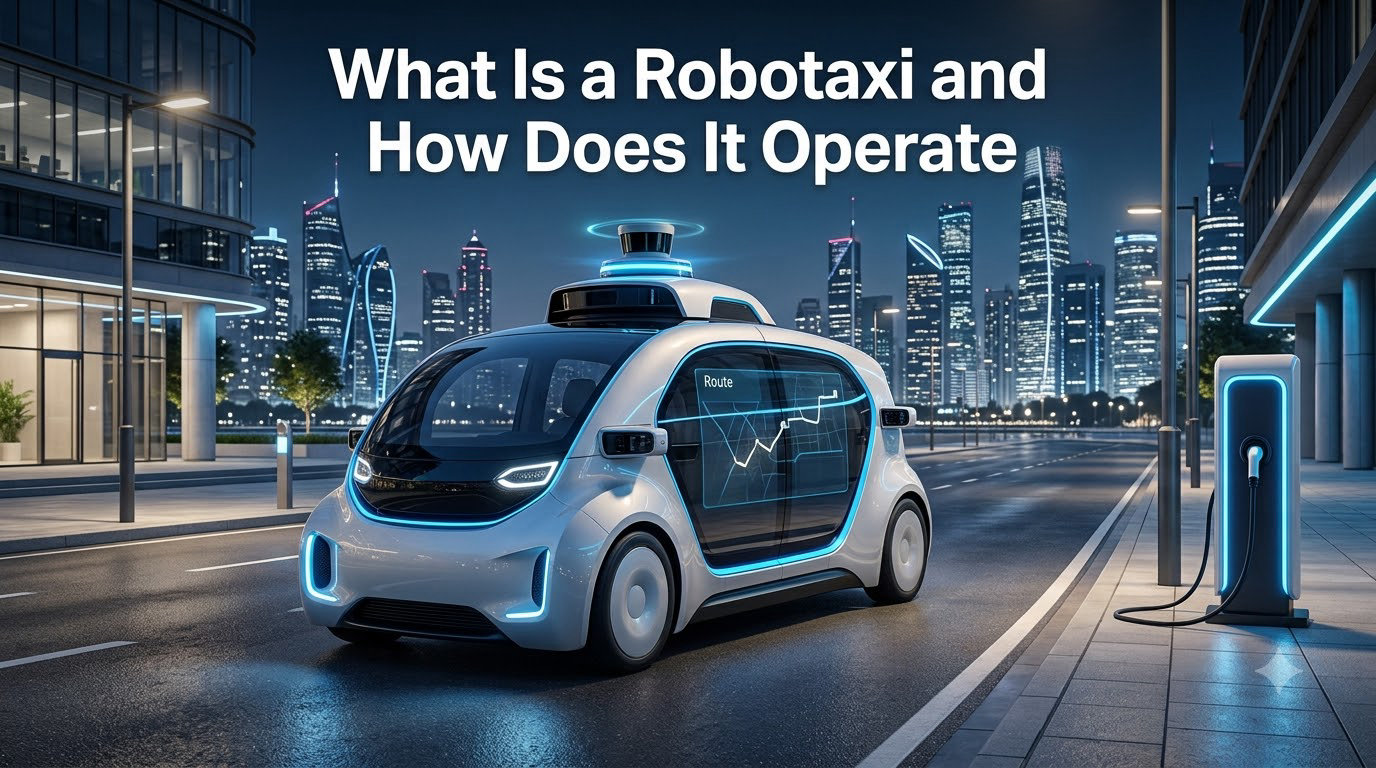
A robotaxi is a fully driverless autonomous vehicle that picks up passengers through a ride-hailing app and transports them to a destination using a combination of LiDAR sensors, cameras, radar, and artificial intelligence, with no human behind the wheel. In plain English, it is a self-driving taxi.
I have spent the last several months following the robotaxi industry, talking to engineers, and reading every credible user report I can find. The question I hear most often is still the same: what exactly is a robotaxi, and how does it actually operate? I will answer both questions, walk you through the technology, and tell you where the service works right now.
This guide pulls from our team at Smashing Robotics and the latest verified data so you get an honest picture of where robotaxis stand in 2026. I will also cover the gaps most articles skip, including accessibility, environmental impact, and the regulatory hurdles still ahead.
Table of Contents
What Is a Robotaxi? A Clear Definition
A robotaxi, also called a robot taxi or self-driving taxi, is a passenger vehicle that operates at SAE Level 4 autonomy within a defined service area, picking up riders and dropping them off without a human driver. The car is summoned through a mobile app, much like Uber or Lyft, and the entire trip is handled by onboard computers and a network of sensors.
SAE Level 4 is the key phrase here. According to the NVIDIA glossary on robotaxis, the vehicle performs all driving tasks and monitors the environment within a specific operational design domain, even if a human does not respond to a request to intervene. That domain is usually a city or a defined zone within a city, which is why robotaxis do not yet work everywhere.
Two related terms often get confused. An autonomous vehicle is the broad category for any self-driving car, including personal vehicles with advanced driver-assistance features. A robotaxi is the specific commercial service that uses those vehicles to transport paying passengers. Think of it as the difference between an electric car and a ride-hailing service that uses electric cars.
Robotaxis fall under the broader umbrella of mobility-as-a-service, where the customer buys a trip instead of buying a vehicle. That model has a few consequences worth noting. It lowers the barrier to using cutting-edge AI transportation, and it shifts liability from the driver to the operator, which we will come back to in the safety section.
How Does a Robotaxi Operate? The Core Technology
Every robotaxi ride follows the same basic pattern, from the moment you tap your phone to the second you step out at your destination. Here is what happens behind the scenes.
Step 1, you request a ride. The rider opens the robotaxi app, drops a pin on the destination, and confirms pickup. The operator’s cloud platform receives the request, checks vehicle availability in the service area, and assigns the closest available car.
Step 2, the car drives itself to you. With no driver, the robotaxi uses its sensor stack to navigate city streets, obey traffic signals, and pull up at the pickup point. Most operators set designated pickup and dropoff locations to simplify the maneuver.
Step 3, the doors unlock. You confirm your identity in the app or on a touchscreen inside the vehicle, and the doors open. You may need to buckle your seatbelt manually, since no one else is there to remind you.
Step 4, the trip runs on AI. The car constantly reads its environment using LiDAR, radar, and cameras, fuses that data into a real-time 3D model of the road, and runs machine learning algorithms to predict what nearby cars, cyclists, and pedestrians will do next. Path planning software then chooses the safest trajectory second by second.
Step 5, you arrive and exit. The robotaxi pulls up to the drop-off point, the doors unlock, and the car drives off to its next assignment or to a charging station. Some operators, like Waymo, also offer in-cabin screens where you can adjust climate, music, and seat position during the ride, similar to what Tesla’s robotaxi support page describes for their service.
Throughout the trip, a remote operations team may be on standby. They cannot drive the car, but they can suggest a safe pullover if the AI gets stuck. The community at r/SelfDrivingCars still debates how much remote help counts as autonomous, and it is a fair point. Most operators, however, describe remote help as a fallback, not a crutch.
The Technology Stack Inside a Robotaxi
The magic of a robotaxi is not one single sensor. It is the combination of several, fused together by AI. Here is the core technology stack you will find in most commercial deployments.
LiDAR: The 3D Laser Eye
LiDAR, which stands for Light Detection and Ranging, shoots out thousands of laser pulses per second and measures how long they take to bounce back. The result is a real-time 3D point cloud of everything around the car, accurate to a few centimeters, day or night, in most weather.
Most robotaxis use multiple LiDAR units mounted on the roof, fenders, and bumpers to create a 360-degree view. Waymo’s fifth-generation system reportedly carries a mix of long-range and short-range LiDARs to balance highway awareness with close-quarters perception.
Cameras and Computer Vision
Cameras read the visual world the way humans do, picking up lane markings, traffic light colors, road signs, and turn signals from other drivers. Modern robotaxis use high-resolution camera arrays, often 8 to 12 per vehicle, feeding into deep learning models trained on millions of labeled images.
Computer vision handles edge cases that LiDAR struggles with, such as reading handwritten signs or distinguishing a police officer directing traffic from a pedestrian waving. The trade-off is that cameras struggle more in low light, fog, or direct sun glare, which is exactly why they are paired with other sensors.
Radar for Speed and Distance
Radar uses radio waves to measure the distance and speed of objects, and it works well in heavy rain, snow, or dust where LiDAR and cameras lose accuracy. Radar is particularly good at tracking the closing speed of a vehicle ahead, which is why adaptive cruise control was one of the first features to use it.
Sensor Fusion and the AI Brain
Sensor fusion is the process of combining all those inputs into one consistent picture of the world. Each sensor has blind spots, but together they cover each other. The AI brain, typically a high-performance compute platform with custom silicon, runs the perception, prediction, and planning models that turn sensor data into driving decisions.
HD maps are another piece of the puzzle. Before a robotaxi enters a new neighborhood, its operator pre-maps every lane, curb, and traffic signal down to a few centimeters. The live sensor data is then matched against that HD map so the AI knows exactly where it is, even when GPS drifts in a tunnel or urban canyon.
If you want to compare how related robotics systems handle signal processing, our explainer on analog-to-digital converters walks through the same input-to-decision pipeline at a smaller scale.
Who Are the Leading Robotaxi Companies in 2026?
Five companies matter most in 2026, and each takes a slightly different approach to the problem. The community at r/SelfDrivingCars generally treats Waymo as the current benchmark for fully driverless commercial service, while watching Tesla’s ambitious scaling claims closely.
Waymo
Waymo, a subsidiary of Alphabet, runs the most established commercial robotaxi service in the United States. It operates fully driverless rides in parts of Phoenix, San Francisco, Los Angeles, and Austin, and is actively expanding. Waymo’s vehicles rely on a dense LiDAR-and-camera sensor stack paired with detailed HD maps, which is why the company focuses on expanding city by city rather than going nationwide overnight.
Tesla Robotaxi
Tesla takes a different path. The company bets on a camera-only system powered by its Full Self-Driving software, arguing that humans drive with two eyes, so cars should drive with cameras. Tesla launched its robotaxi service in Austin in mid-2026 and reports that some vehicles run 6 a.m. to 10 p.m., seven days a week, in defined zones. Community-reported unsupervised miles sit around the tens of thousands per week, a number that is growing but still tiny compared to Waymo’s deployment.
Some Tesla fans and critics agree the app experience is polished, with climate, music, and seat controls available from the touchscreen. The Cybercab concept, however, has only two seats, which has drawn questions about practicality for families and groups.
Cruise
Cruise, owned by General Motors, paused its driverless operations in late 2026 after a high-profile incident in San Francisco. The company is now working with regulators on a measured return to service. Cruise built its robotaxis on the Chevy Bolt platform and leaned heavily on a hybrid sensor stack.
Zoox
Zoox, owned by Amazon, built a purpose-built robotaxi with no steering wheel and a symmetrical, bidirectional design. We covered the production-ready reveal in our Zoox expansion story, and the company is now running tests in Las Vegas, San Francisco, and Foster City, with public rides in some areas.
Baidu Apollo Go
Baidu’s Apollo Go is the most aggressive player in China, operating fully driverless robotaxi service in multiple Chinese cities, including Wuhan and Beijing, and steadily expanding. Apollo Go is the global leader in terms of cumulative autonomous rides given to the public, even if most of those rides are inside China.
Where Can You Ride a Robotaxi Right Now?
Robotaxi availability is still highly local. As of 2026, you can summon a fully driverless robotaxi in parts of the following U.S. cities: Phoenix, San Francisco, Los Angeles, Austin, and Las Vegas, with Waymo and Zoox as the main operators. Tesla’s robotaxi service is currently limited to parts of Austin, with expansion planned.
Internationally, Baidu Apollo Go runs in Wuhan, Beijing, Shenzhen, Chongqing, and several other Chinese cities. Pony.ai operates in parts of Guangzhou and Beijing, and WeRide runs limited services in the Middle East and Asia.
Each operator uses a closed beta or a waitlist, so you may need to sign up and get approved before booking. Once approved, the typical robotaxi app flow looks like this: open the app, enter your destination, see the estimated fare, and confirm the pickup point. Waymo’s app is considered the most user-friendly, while Tesla’s app integrates with the broader Tesla ecosystem for owners.
How Safe Are Robotaxis and What Are the Risks?
Robotaxi safety is the single most debated question in the industry, and rightly so. The promise is huge. The National Highway Traffic Safety Administration estimates that 94% of serious crashes involve human error, so a competent AI driver could in theory save tens of thousands of lives per year.
What we know so far is mixed but mostly positive. Waymo has published safety data showing its vehicles are involved in far fewer airbag-deploying crashes per million miles than human drivers in the same cities. Cruise’s record was also strong until a serious pedestrian incident in 2026 that triggered a major operational pause.
Riders in our community research report that the driving style can feel abrupt. A common complaint is hard braking for objects a human would have ignored, like a plastic bag drifting across the road. The trade-off is that the AI errs on the side of caution, which is generally what regulators want.
One under-discussed safety layer is remote human assistance. When the AI gets confused by a construction zone or a flooded street, a remote operator can suggest a path or ask the car to pull over. Critics argue this is closer to Level 2 autonomy than Level 4. The industry’s response is that remote help is rare, often used in less than 1% of trips, and only as a safety net, not a primary control loop.
Insurance and liability are also evolving. In most current deployments, the operator carries the insurance, not the rider. That is a meaningful shift from the taxi and rideshare model, where a driver’s personal policy is often the first line of defense. As deployments scale, expect regulators to write clearer rules about who pays when something goes wrong.
Robotaxi vs Uber vs Traditional Taxi: Cost Comparison
One of the biggest reasons to care about robotaxis is the cost story. When you remove the driver, which is the largest expense in any ride-hailing service, the per-mile cost drops sharply. Early Waymo data suggests the company is roughly at parity with Uber and Lyft on short trips, with meaningful savings on longer routes as the technology scales.
Traditional taxis are typically the most expensive option in major U.S. cities, because they pay drivers a fixed percentage of the meter, and the meter rates are usually set by city regulators. Uber and Lyft are cheaper, but the driver still takes 60 to 75% of the fare, depending on the market.
Tesla has publicly claimed its robotaxi service could undercut Uber by a significant margin once fleets reach scale and the cars operate nearly 24 hours a day. Real-world prices today are roughly comparable to UberX in the same neighborhoods, with some operators offering promotional pricing during the launch phase.
The honest summary is that robotaxis are not yet dramatically cheaper than Uber in most cities, but the unit economics point that way as fleets grow and utilization improves.
Accessibility and Environmental Impact
Two topics are noticeably missing from most robotaxi articles, and they matter.
First, accessibility. Robotaxis can be a mobility lifeline for people who cannot drive, including many elderly riders and people with disabilities. Waymo has partnered with accessibility advocates to test wheelchair-accessible vehicles, and the app-based flow removes the anxiety of hailing a car on a busy street. Tesla’s two-seat Cybercab raises real questions for group travel, but the broader category is a clear net positive for riders who currently depend on paratransit or family members.
Second, environmental impact. Most robotaxi fleets are electric, which means each mile produces zero tailpipe emissions. Beyond that, a robotaxi can run 18 to 20 hours a day, which is far more utilization than a personal car, and shared rides can lower the per-person carbon footprint further. Cities also benefit indirectly, because fewer personally owned cars means less demand for parking, freeing up urban land for housing, parks, and bike lanes.
The Regulatory Landscape and Future Outlook
Robotaxi regulation is a patchwork. California requires a permit for fully driverless testing and deployment, and the California Public Utilities Commission must also approve commercial passenger service. Arizona, Texas, and Nevada have friendlier rules, which is partly why Phoenix and Austin are the first cities where most operators launch.
At the federal level, the National Highway Traffic Safety Administration has been working on a framework for SAE Level 4 and Level 5 vehicles, and the current administration has signaled support for faster autonomous vehicle deployment. Critics want stronger pre-market safety testing before broader rollouts.
My best guess, based on what I see from regulators and operators, is that we will see fully driverless robotaxi service in 15 to 25 U.S. cities by 2026, with dozens more in China, and the first international expansion into Europe and the Middle East. The remaining bottlenecks are not just technology. They are insurance, public trust, and labor politics, since drivers’ unions are actively pushing back on policies that would let robotaxis replace human drivers.
If you want to see how this all comes together mechanically, our guide on how a robot chassis works gives a useful grounding in the physical layer underneath all that AI.
Frequently Asked Questions
How much does a Tesla Robotaxi ride cost?
Tesla Robotaxi fares vary by city and trip length. In Austin, the service launched with promotional pricing roughly comparable to UberX in the same area. As fleets grow, Tesla has said the long-term target is to undercut Uber meaningfully, especially on longer routes.
Can anyone use a Tesla robotaxi?
Not yet. Tesla’s robotaxi service in Austin is open to approved riders through the Tesla app, with expansion to additional cities planned. Most operators run a waitlist during early deployment to manage demand.
How much cheaper will robotaxi be than Uber?
In the long run, robotaxis should undercut Uber because the largest cost in a rideshare trip, the driver’s share of the fare, is removed. Today, prices are roughly at parity in many U.S. cities, with savings likely once fleets reach scale and utilization improves.
Who is the leading robotaxi company?
Waymo is widely treated as the leading robotaxi operator for fully driverless commercial service in the United States, based on safety data, public ride volume, and multi-city deployment. Baidu Apollo Go leads in total rides in China, and Tesla is the operator to watch as its service scales.
Are robotaxis safe?
Robotaxis have logged millions of miles of fully driverless trips. Waymo’s published data shows fewer serious crashes per million miles than the human-driver average in the same cities. The vehicles are not perfect, and abrupt braking and rare remote-assist events still draw complaints, but overall safety performance is competitive with cautious human drivers.
How does a robotaxi work without a driver?
A robotaxi uses LiDAR, cameras, radar, and ultrasonic sensors to perceive the road, fuses that data with HD maps, and runs AI models to plan and execute driving in real time. A remote operations team can intervene as a safety fallback, but the car drives itself for the entire trip.
When will robotaxis be available everywhere?
Robotaxis will not be available everywhere soon. Expect meaningful coverage in 15 to 25 U.S. cities by 2026 and broader availability in China, but nationwide, year-round, all-weather robotaxi service is still a long way off, mostly because of regulation and edge cases like heavy snow and unmapped rural roads.
Final Thoughts: What a Robotaxi Means for the Future of Travel
A robotaxi is no longer a science project. It is a working, revenue-generating service in multiple cities, and it will reshape urban transportation over the next decade. The key thing to understand is that a robotaxi is a specific commercial application of autonomous vehicle technology, restricted to a defined service area where the AI can be trusted to drive without a human behind the wheel.
How does a robotaxi operate? Through a tightly integrated sensor stack, real-time AI planning, HD maps, and a remote operations safety net. The result is a ride that is increasingly competitive with Uber on price, better than the average human driver on safety, and open to riders who cannot easily drive themselves.
If you want to follow the space, my suggestion is simple. Sign up for the waitlist in your city if Waymo, Tesla, or Zoox operates nearby, and try a ride. The experience is the best way to understand what is real and what is still hype. As the industry matures, I will keep updating this guide with new deployments, pricing data, and safety findings so you have one place to track what a robotaxi actually is and how the service works in 2026.